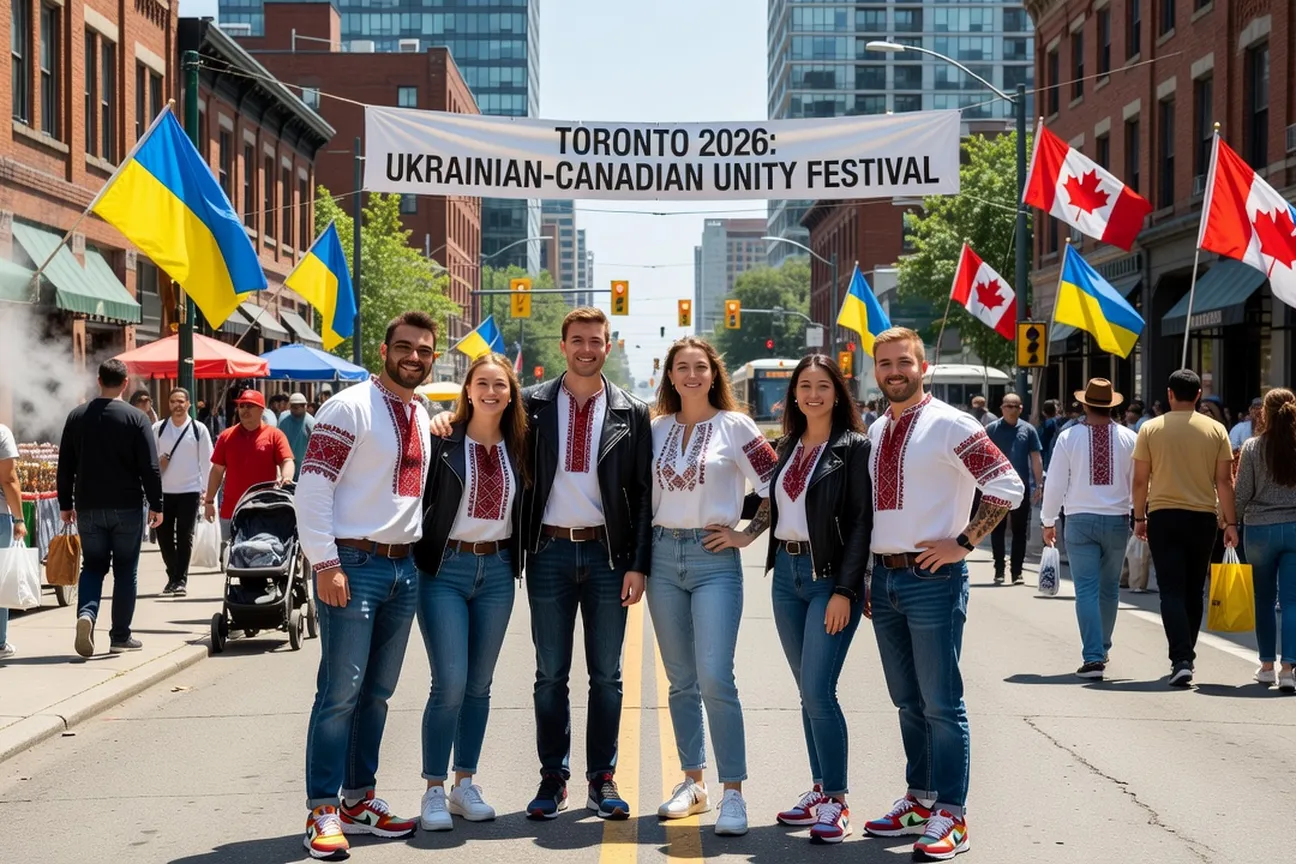
Young Ukrainian-Canadians in traditional vyshyvanka and modern clothing, Toronto 2026.
Table of Contents
- What Does It Mean to Be Ukrainian-Canadian in 2026?
- Four Generations of Ukrainian Canadians: Different Identities
- The Language Question: Ukrainian Retention Across Generations
- Ukrainian-Canadian Churches as Cultural Anchors
- Ukrainian Schools and Saturday Programmes in Canada
- Canada's Multiculturalism Policy and Its Ukrainian Legacy
- How Post-2022 Newcomers Are Changing the Ukrainian-Canadian Community
- Ukrainian-Canadian Culture in Media and Public Life
- Future Directions: Will Ukrainian-Canadian Identity Survive to 2040?
- Frequently Asked Questions
What Does It Mean to Be Ukrainian-Canadian in 2026?
The question of Ukrainian-Canadian identity is rarely simple and never static. In 2026, it encompasses a 130-year arc of immigration, cultural negotiation, political activism, and deliberate heritage preservation. Ukrainian-Canadian identity today is defined not by a single shared experience but by the intersection of immigration wave, linguistic fluency, religious affiliation, regional origin in Ukraine, and individual biography. A fourth-generation Ukrainian Canadian from Vegreville, Alberta, whose great-grandparents homesteaded in 1901, shares ethnic heritage with a 2023 CUAET arrival from Kharkiv — but their lived experiences of being "Ukrainian" are separated by a century and profoundly different cultural reference points.
What they share is a sense of connection to Ukraine as a homeland, whether felt as a living emotional tie or experienced primarily through cultural symbols: the vyshyvanka embroidered shirt, the tryzub trident, the melodic cadences of the Ukrainian language, and the memory of the Holodomor. That connection also runs through public figures whose achievements predate Ukraine's own independent institutions, from Olympic athletes to hockey legends, documented in our guide to Ukrainian-Canadian athletes and Olympic history. In 2026, Russia's ongoing war against Ukraine has transformed this identity from an internal community matter into a globally visible political and humanitarian fact. Ukrainian-Canadian organisations have never been more active, more visible on national media, or more directly engaged with contemporary events in Europe. This convergence of historical memory, cultural maintenance, and present-day geopolitics makes the study of Ukrainian-Canadian identity in 2026 uniquely urgent.
The 2021 Canadian census identified 1.36 million Canadians of Ukrainian origin, making Ukrainians the third-largest ethnic group in Canada after English and French. Alberta (365,000), Ontario (360,000), Manitoba (167,000), British Columbia (140,000), and Saskatchewan (137,000) host the largest concentrations. The Ukrainian community in Canada is geographically dispersed but institutionally dense, with thousands of churches, cultural centres, credit unions, Saturday schools, and advocacy organisations woven into the fabric of every major Canadian city.
Four Generations of Ukrainian Canadians: Different Identities
Scholars of Ukrainian-Canadian history typically distinguish four immigration waves, each producing a distinct generational identity:
First wave (1891–1914): The prairie settlers who came from Galicia and Bukovyna under the Clifford Sifton immigration policy. These were overwhelmingly Greek Catholic and Greek Orthodox peasant farmers who built bloc communities in Alberta, Manitoba, and Saskatchewan. Their descendants — now third and fourth generation — often bear Ukrainian surnames but may speak little or no Ukrainian. Their connection to heritage is typically maintained through church membership, community events, and family memory. Identity tends to be diffuse but emotionally significant.
Second wave (1920s–1930s): A smaller cohort of inter-war arrivals, including labour migrants and political exiles fleeing Soviet collectivisation. This wave included more urban, educated, and politically engaged individuals who strengthened the network of Ukrainian-Canadian organisations. Their descendants often describe a more consciously political dimension to their Ukrainian-Canadian identity, shaped by family narratives of Soviet persecution.
Women’s organizations were central to receiving and settling this cohort — see the women who built Ukrainian Canada.
Third wave (1947–1955): Displaced persons (DPs) who fled Soviet occupation of western Ukraine at the end of the Second World War. This group was disproportionately educated, included many professionals, artists, clergy, and academics, and was intensely nationalist. Their arrival revitalised Ukrainian cultural institutions in Canada, established Ukrainian studies programmes at universities, and produced a wave of cultural production in literature, music, and visual arts. Third-wave families often maintained the strongest Ukrainian-language fluency into the 1980s.
Fourth wave (1991–present): Post-Soviet arrivals beginning after Ukrainian independence in 1991, accelerating with the Euromaidan revolution of 2014, and reaching a peak with the CUAET arrivals post-2022. This wave has fundamentally altered the composition of the Ukrainian-Canadian community, introducing a large cohort of contemporary Ukrainian speakers who relate to Ukraine as a living present rather than a nostalgic past.
The Language Question: Ukrainian Retention Across Generations
Language is perhaps the most emotionally charged dimension of Ukrainian-Canadian identity. The 2021 Canadian census recorded 359,000 persons listing Ukrainian as a mother tongue, but only 108,000 speaking Ukrainian most often at home — a gap that reflects the well-documented pattern of language shift across immigrant generations. By the third generation, most heritage language speakers have transitioned to English as their primary language, using Ukrainian only in religious contexts or at community events. This process, familiar to linguists as "language attrition," is not unique to Ukrainian Canadians but is acutely felt by community activists who have invested decades in heritage language preservation.
Efforts to counter language loss have centred on three institutional mechanisms: Ukrainian Saturday schools (known as "ridna shkola" or "native schools"), bilingual public school programmes, and university-level Ukrainian studies. Saturday schools have operated continuously in Canada since the early 1900s and today serve an estimated 5,000–8,000 students annually across the country. Bilingual Ukrainian–English public school programmes, established in Alberta and Manitoba in the 1970s, enrol approximately 4,500 students in Alberta alone and represent one of the longest-running heritage-language bilingual school systems in North America. These programmes teach core subjects in both languages and have shown measurable effects on language retention into young adulthood. Ukrainian community organisations in Canada continue to lobby for expanded bilingual programming as a cost-effective language preservation strategy.
The post-2022 demographic shift has dramatically increased the number of active Ukrainian speakers in Canada. CUAET arrivals skew young (many are families with school-age children) and predominantly speak Ukrainian as a first language. Their presence has created new demand for Ukrainian-medium childcare, weekend cultural programming, and language support services in public schools. Community organisations in Toronto, Edmonton, and Winnipeg report a doubling or tripling of enrolment in Ukrainian cultural programmes since 2022, driven largely by newcomer demand rather than heritage-community interest. This creates both an opportunity and a tension: heritage organisations designed to serve Canadian-born Ukrainians must now adapt to serve a population whose relationship to Ukrainian identity is rooted in contemporary lived experience rather than diaspora memory.
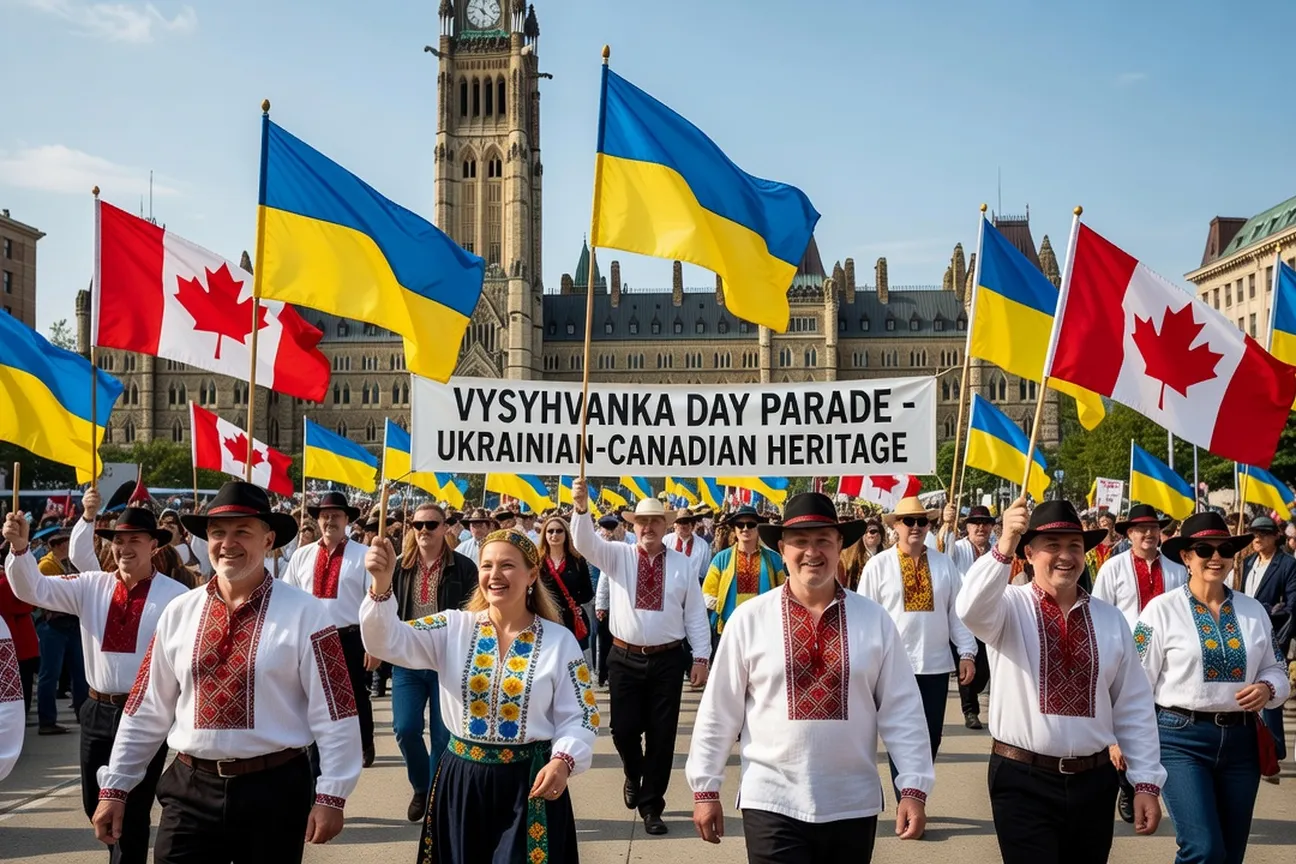
Ukrainian-Canadian community celebrating Vyshyvanka Day on Parliament Hill Ottawa.
Vyshyvanka Day on Parliament Hill, Ottawa — an annual celebration of Ukrainian-Canadian cultural heritage.
Ukrainian-Canadian Churches as Cultural Anchors
No institution has done more to preserve Ukrainian-Canadian identity than the church. Two major denominations serve the community: the Ukrainian Catholic Church and the Ukrainian Orthodox Church of Canada. Both maintain extensive networks of parishes, schools, summer camps, and cultural organisations. The Ukrainian Catholic Church is in full communion with Rome but maintains Byzantine Rite liturgy in Church Slavonic and Ukrainian; the Ukrainian Orthodox Church is autocephalous and aligned with the Ecumenical Patriarchate of Constantinople. Together, these two churches operate over 400 parishes across Canada, many with attached halls that serve as community centres, cultural venues, and gathering places for everything from Easter celebrations to political fundraisers.
Parish life has historically been the social glue of Ukrainian-Canadian communities. Women's organisations such as the Ukrainian Women's Association of Canada (UWAC) and the Ukrainian Catholic Women's League (UCWL) have operated for over a century, providing social support, cultural programming, and charitable work. Men's organisations, choral societies, folk dance troupes, and youth groups are typically organised through or in partnership with parishes. For many Ukrainian Canadians who no longer speak the language fluently, attending Easter liturgy at a Ukrainian church is their primary annual connection to their heritage — a sensory experience of incense, choral music, and ceremonial language that no secular institution can replicate.
The churches have also been crucial in preserving the memory of politically sensitive historical events. The Ukrainian Catholic Church was central in commemorating the Holodomor, the Soviet engineered famine of 1932–33 that killed an estimated 5–7 million Ukrainians. Canadian recognition of the Holodomor as a genocide — passed by Parliament in 2008 — was achieved in part through decades of sustained lobbying by church-affiliated organisations, alongside civil society groups like the Ukrainian Canadian Congress (UCC). The ongoing war has also deepened the churches' political engagement: many Ukrainian Catholic and Orthodox parishes in Canada serve as informal hubs for fundraising, humanitarian aid coordination, and refugee support.
Ukrainian Schools and Saturday Programmes in Canada
The "ridna shkola" (native school) system is one of the most distinctive features of the Ukrainian-Canadian diaspora. These Saturday schools, operating outside the regular public school week, teach Ukrainian language, history, literature, geography, and cultural customs to children who attend English-language public schools during the week. The system traces its roots to the early prairie settlements, where immigrant parents recognised that their children would learn English in the public system but Ukrainian only if deliberately taught. Over a century later, the same logic applies: without intentional instruction in a structured setting, the heritage language disappears within two to three generations.
By 2026, approximately 60–70 Ukrainian Saturday schools operate across Canada, concentrated in cities with large Ukrainian communities: Edmonton, Winnipeg, Toronto, Calgary, Vancouver, and Saskatoon. Schools affiliated with the Ukrainian Catholic church, the Ukrainian Orthodox church, and secular organisations like the Ukrainian Self-Reliance League (USRL) offer programmes ranging from pre-school through Grade 12. Enrolment has surged since 2022: the Ukrainian School of Toronto reported a 40% increase in applications between 2022 and 2024, driven almost entirely by families of recent arrivals who sought a way to maintain their children's Ukrainian-language skills while in Canada.
Beyond language, Saturday schools transmit cultural knowledge. Students learn pysanka egg-decorating, Ukrainian embroidery, traditional dances (including the hopak), Ukrainian folk songs, and basic historical knowledge about Ukraine. School concerts and cultural festivals are important community events that bring together older established families and newer arrivals in a shared cultural performance. These intergenerational encounters help bridge the gap between diaspora memory and contemporary Ukrainian experience, creating a shared cultural space where identity can be negotiated and transmitted across generational lines. The Ukrainian cultural identity in Western diaspora communities follows similar institutional patterns in France, Belgium, and Germany, demonstrating the transnational character of Ukrainian heritage maintenance.
Canada's Multiculturalism Policy and Its Ukrainian Legacy
Canada's official Multiculturalism Policy, first announced by Prime Minister Pierre Trudeau in 1971 and entrenched in the Canadian Multiculturalism Act of 1988, owes a significant intellectual and political debt to the Ukrainian-Canadian community. The Royal Commission on Bilingualism and Biculturalism (1963–1969), which laid the groundwork for the policy, heard extensive testimony from Ukrainian-Canadian organisations challenging the "two founding nations" framework that recognised only English and French as Canada's cultural pillars. Ukrainian Canadians, already a well-organised political force by the 1960s, argued forcefully that Canada's identity was inherently multicultural and that non-British, non-French communities deserved recognition and support. Their advocacy directly influenced Prime Minister Trudeau's decision to add a multicultural dimension to the bilingualism policy.
The practical impact of multiculturalism policy on Ukrainian Canadians has been substantial. Federal and provincial grants have funded Ukrainian cultural organisations, heritage language programmes, and Ukrainian studies academic chairs. The University of Alberta, home to the Canadian Institute of Ukrainian Studies (CIUS), established in 1976, has become North America's leading centre for academic Ukrainian studies. Similar programmes exist at the University of Manitoba, University of Toronto, and York University. These institutions have produced several generations of scholars who document, analyse, and transmit knowledge about Ukraine and the Ukrainian diaspora, providing intellectual infrastructure that most diaspora communities of comparable size lack. The parallel experiences of the French Ukrainian diaspora and the memory of Ukraine's history illuminate how different national contexts shape diaspora identity outcomes.
The multicultural framework has also shaped how Ukrainian Canadians narrate their history in public. The designation of the Ukrainian Canadian internment of 1914–1920 as a violation of civil rights — and the 2005 Canadian government apology and redress — was framed within the multicultural language of historical justice and minority rights. Similarly, campaigns to recognise the Holodomor as genocide and to establish Holodomor Remembrance Day in Canada (the fourth Saturday of November) drew on the multicultural framework of minority communities' right to have their historical tragedies acknowledged by the state.
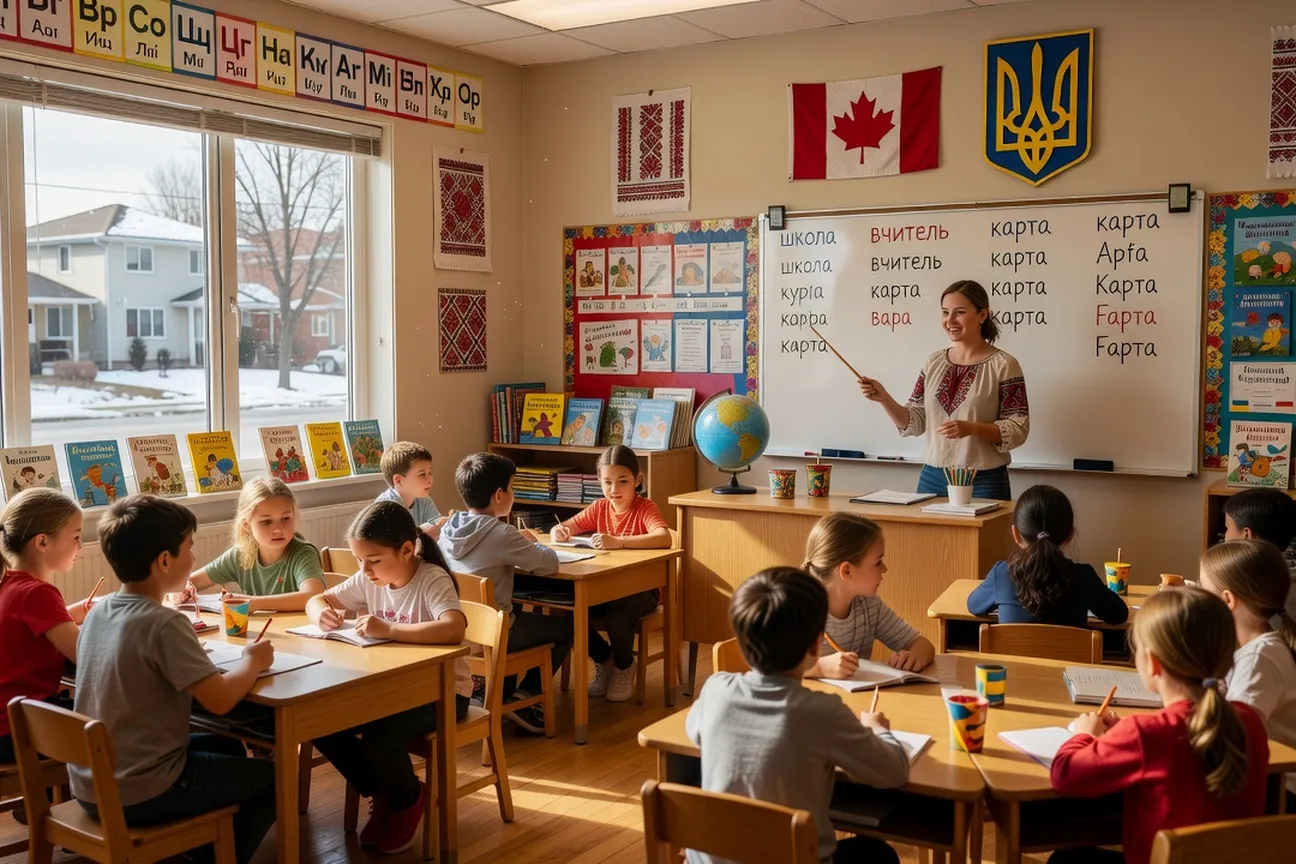
Ukrainian-Canadian bilingual school classroom in Edmonton.
A Ukrainian–English bilingual classroom in Edmonton — one of the oldest heritage-language bilingual programmes in North America.
How Post-2022 Newcomers Are Changing the Ukrainian-Canadian Community
The scale and speed of post-2022 Ukrainian arrivals in Canada has no peacetime parallel. The CUAET programme, launched in March 2022 following Russia's full-scale invasion of Ukraine, offered Ukrainian nationals and their immediate family members temporary residency in Canada without the usual processing requirements. By early 2026, over 200,000 Ukrainians had arrived in Canada under this programme, adding more than 15% to the pre-war Ukrainian-origin population in a single four-year period. This influx has created both extraordinary opportunities and significant challenges for established Ukrainian-Canadian community institutions.
On the opportunity side, post-2022 arrivals have energised organisations that were experiencing demographic decline. Saturday schools, church congregations, folk dance troupes, and cultural clubs that were serving primarily older heritage-community members have received an infusion of younger participants, many of them highly motivated to maintain their Ukrainian identity during what they perceive as a temporary displacement. The Ukrainian Canadian Social Services (UCSS) in Toronto, traditionally a modest social services agency, expanded its operations threefold between 2022 and 2024 to accommodate the demand for settlement assistance, employment counselling, and Ukrainian-language support. Similar expansions occurred at Ukrainian Canadian institutions in every major city.
The challenges are equally significant. Post-2022 arrivals and long-established Ukrainian Canadians do not always share the same cultural reference points. Contemporary Ukrainians from Kyiv, Kharkiv, Odessa, or Lviv have grown up in a post-Soviet, European-oriented Ukraine with a distinct popular culture, political framework, and relationship to history. They sometimes find the Canada-centred diaspora orientation — focused on prairie pioneer heritage, inter-war nationalist politics, and Cold War anti-communism — remote from their own experience. Community organisations have had to develop new programming that speaks to both audiences: long-established Canadians who relate to Ukraine primarily through heritage memory, and new arrivals who relate to it through the lived experience of war, displacement, and European integration. The result is a Ukrainian-Canadian community in creative tension and transformation — more diverse, more bilingual, and more politically engaged than at any point in its 130-year history. Ukrainians in Canada now represent one of the most complex diaspora communities in the country, combining deep historical roots with fresh contemporary relevance.
Ukrainian-Canadian Culture in Media and Public Life
Ukrainian-Canadian contributions to Canadian public life have been disproportionate to the community's size. Three Ukrainian Canadians have served as provincial premiers: William Hawrelak (Edmonton mayor, 1951–75), Peter Lougheed (Alberta Premier, 1971–85), and Roy Romanow (Saskatchewan Premier, 1991–2001). At the federal level, Ukrainian Canadians have been elected to Parliament in every decade since the 1920s. Canada's first female governor general, Adrienne Clarkson (though not Ukrainian), was appointed during a period of intense Ukrainian-Canadian political engagement in Ottawa that produced several landmark policy recognitions.
In the arts, Ukrainian-Canadian writers, musicians, and visual artists have made significant contributions. Myrna Kostash, author of All of Baba's Children (1977), provided the first major English-language literary exploration of Prairie Ukrainian-Canadian identity. The novelist Janice Kulyk Keefer and playwright George F. Walker both drew on Ukrainian-Canadian material. In music, the choral tradition has produced internationally recognised ensembles including the Shevchenko Musical Ensemble of Toronto. The Ukrainian Museum of Canada, with branches in Saskatoon and Toronto, maintains one of the largest collections of Ukrainian folk art outside Ukraine.
Digital media has become an increasingly important arena for Ukrainian-Canadian cultural expression. Social media accounts, YouTube channels, podcasts, and online communities now supplement — and sometimes replace — traditional institutional spaces. Post-2022 newcomers have been particularly active in digital content creation, producing Ukrainian-language content for Canadian audiences and English-language content explaining Ukraine's history and current situation to non-Ukrainian Canadians. This digital activism has introduced Ukrainian culture to audiences far beyond the traditional Ukrainian-Canadian community, creating unexpected bridges between the diaspora heritage and contemporary global interest in Ukraine.
Future Directions: Will Ukrainian-Canadian Identity Survive to 2040?
Predicting the trajectory of ethnic identity across generations is notoriously difficult, but several structural factors point toward a complex but viable future for Ukrainian-Canadian identity beyond 2040. The most important of these is the sheer scale of post-2022 arrivals. Unlike most heritage communities in Canada, which experience constant generational dilution without fresh immigration to replenish active speakers and practitioners, the Ukrainian-Canadian community has received a massive transfusion of active language speakers, cultural practitioners, and politically engaged individuals in a very short period. The effect on institutions, particularly Saturday schools and church congregations, has been immediately visible and is likely to sustain these organisations for at least another generation.
A second factor is the global visibility of Ukraine since 2022. The war has made Ukrainian culture, history, and identity familiar to millions of Canadians who previously had little knowledge of the country. Pysanka workshops, hopak dance performances, Ukrainian Christmas concerts, and traditional food festivals are now attended by diverse audiences, not just Ukrainian-background participants. This broader public interest creates social capital for the community and makes Ukrainian heritage relevant to a wide range of Canadians who may themselves be connecting to it through personal encounters with Ukrainian newcomers. See the complete statistics on Ukrainian Canadians to understand the demographic weight that underpins this community's future.
A third factor is Canada's immigration policy, which continues to provide pathways for Ukrainian arrivals even as CUAET winds down. Economic immigration streams, family reunification, and refugee resettlement all continue to bring Ukrainians to Canada, maintaining a steady flow of new community members. Whether Ukrainian-Canadian identity in 2040 more closely resembles the heritage-community model of the 1990s or the vibrant bilingual community model that post-2022 arrivals are creating remains to be seen. What is certain is that the community will continue to be one of the most institutionally sophisticated, politically active, and culturally productive diaspora communities in Canada — and one whose fate is inseparable from the fate of Ukraine itself.
Frequently Asked Questions
What does it mean to be Ukrainian-Canadian in 2026?
Being Ukrainian-Canadian in 2026 means navigating a dual heritage shaped by four waves of immigration. For many, it involves maintaining Ukrainian language, attending Ukrainian Orthodox or Catholic churches, sending children to Saturday Ukrainian schools, and participating in community events — while also embracing a fully Canadian civic identity.
How many generations of Ukrainian Canadians are there?
Historians identify four main generations: the first wave (1891–1914) of prairie settlers, the second wave (1920s–1930s) of inter-war arrivals, the third wave (1947–1955) of post-WWII displaced persons, and the fourth wave (post-1991 and especially post-2022) of post-Soviet and wartime arrivals. Each generation has a distinct relationship to Ukrainian identity and language.
Is Ukrainian language being lost in Canada?
Ukrainian language retention has declined significantly across generations. While the 2021 census showed 108,000 Canadians speaking Ukrainian at home, the mother-tongue figure was 359,000, indicating that most heritage speakers no longer use Ukrainian daily. However, post-2022 arrivals have contributed a significant new wave of active Ukrainian speakers, partly reversing this trend.
What role do Ukrainian churches play in Canadian identity?
Ukrainian Orthodox and Ukrainian Catholic churches remain the most powerful cultural anchors in the diaspora, hosting language classes, folk dance groups, women's organisations, and annual cultural festivals. For many third- and fourth-generation Ukrainian Canadians, the local parish remains the primary connection to their heritage.
How have post-2022 Ukrainian newcomers changed the diaspora?
The arrival of over 200,000 Ukrainians under CUAET since 2022 has introduced a new cohort of Ukrainian speakers maintaining active ties to contemporary Ukraine. This has energised older community institutions, created demand for Ukrainian-language services, and changed the demographic balance toward active-language communities.