









What You Will Find Here
This section of usctoronto.ca collects the practical, policy-focused and human-interest guides that Ukrainians need when they consider moving to Canada, or when Canadian families try to understand what their recently-arrived relatives are living through. We cover the formal immigration framework, the everyday realities of settlement, and the longer arc of more than a century of Ukrainian migration to this country.
The articles published in the Canada category fall into three complementary groups. The first group explains why Canada's immigration system is widely considered one of the most efficient in the world, with a piece on Canada's immigration system that breaks down Express Entry, economic selection and refugee resettlement. The second group follows newcomers step by step, from the first visa application to permanent residence, including the comprehensive guide on how to immigrate to Canada from Ukraine and the updated CUAET 2026 guide. The third group tells the settlement story itself: the Canadian way of life for immigrants and the Ukrainian refugees in Canada 2022-2026 analysis covering provincial distribution, labour outcomes and what comes next after CUAET.
Canadian Immigration Context for Ukrainians
Canada's relationship with Ukrainian immigration is older than the country's modern immigration system. The first recorded Ukrainian settlers, Ivan Pylypiw and Vasyl Eleniak, arrived in 1891 from Galicia and homesteaded in what would become Alberta. They were followed by four successive waves of migration: the pre-1914 agricultural wave that populated the Prairies, the interwar wave of political refugees, the post-Second World War Displaced Persons wave of the late 1940s, and the post-independence wave that began in 1991. A fifth wave is now unfolding, triggered by the full-scale Russian invasion of February 2022.
Today, about 1.4 million Canadians declare Ukrainian ancestry, roughly 3.8 percent of the national population and the largest Ukrainian community outside the former Soviet space. They are concentrated in the Prairie provinces of Manitoba, Saskatchewan and Alberta, with significant urban communities in Toronto, Edmonton, Winnipeg and Vancouver. This demographic base matters because it shapes settlement capacity, political lobbying and the cultural infrastructure that newcomers plug into on arrival.
The formal immigration framework rests on four main pillars. Express Entry manages applications for the Federal Skilled Worker Program, the Federal Skilled Trades Program and the Canadian Experience Class, ranking candidates on a Comprehensive Ranking System. Provincial Nominee Programs allow provinces to select candidates who fit regional labour needs, and Manitoba, Saskatchewan and Alberta all run streams that have historically favoured Ukrainian applicants. Family sponsorship permits Canadian citizens and permanent residents to sponsor spouses, children and parents. Finally, the refugee resettlement stream welcomes vulnerable populations, including Government-Assisted Refugees and Privately Sponsored Refugees.
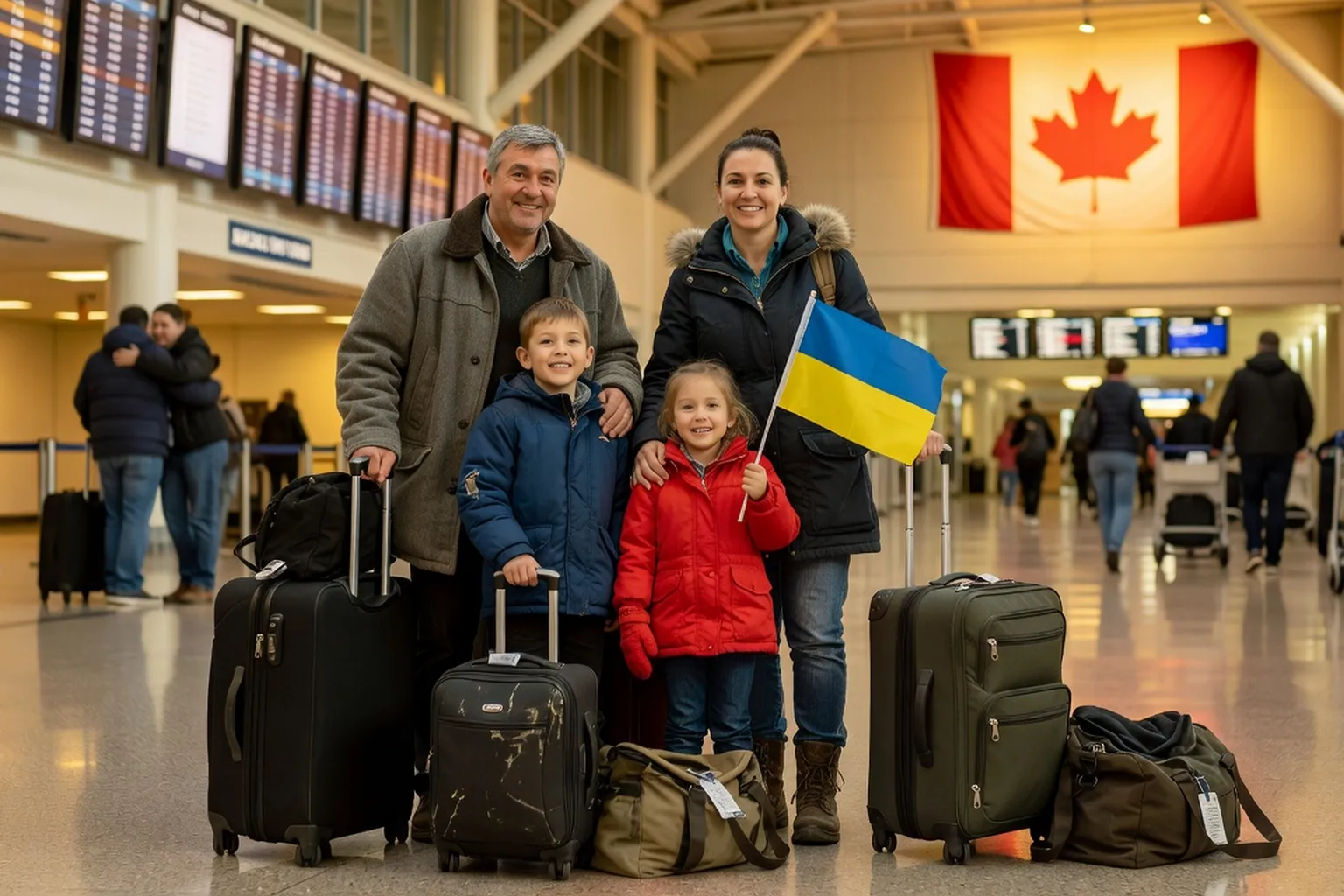
Layered on top of these standard pathways, the Canada-Ukraine Authorization for Emergency Travel, or CUAET, was launched in March 2022 as a temporary measure for Ukrainians fleeing the war. Between 2022 and 2024, Canada approved roughly 960,000 CUAET applications and more than 200,000 people actually arrived. CUAET closed to new overseas applicants in July 2023, but extension provisions run until March 2026. Our CUAET 2026 guide covers what happens next, and the forthcoming Ukrainian Refugees in Canada Stats 2026 piece will deliver the latest provincial numbers and outcomes.
Key Facts in 2026
- 1.4 million Canadians of Ukrainian heritage, representing 3.8 percent of the national population (2021 census baseline, updated estimates).
- 200,000+ Ukrainians admitted to Canada under CUAET between March 2022 and early 2026, out of 960,000 approved applications.
- March 31, 2026 is the final deadline for CUAET status extensions and bridging measures inside Canada.
- The Prairie provinces (Manitoba, Saskatchewan, Alberta) host the highest per-capita Ukrainian populations, with Winnipeg, Edmonton and Saskatoon as historic anchors.
- Express Entry's Comprehensive Ranking System minimum score hovers between 470 and 520 points in 2026, depending on category-based draws.
- Canada's annual immigration target for 2026 stands at roughly 395,000 permanent residents, slightly reduced from the 2024 peak but still among the highest per-capita in the OECD.
Related Topics on usctoronto.ca
Canadian immigration does not happen in isolation. Understanding the diaspora that welcomes newcomers, the cultural life that preserves identity across generations, and the economic sectors where Ukrainians thrive gives a fuller picture than immigration law alone. The following cross-category links connect the Canada section with the rest of the site so readers can move from policy to lived experience and back.
- Community of Ukrainians in Canada - five waves of migration that built today's diaspora.
- Specifics of the Ukrainian diaspora living in Canada - identity, cultural institutions and generational differences.
- Ukrainians in Toronto - the largest urban Ukrainian community east of the Prairies.
- Ukrainian IT in Canada - tech workers, remote employment and the Silicon Valley North corridor.
- Ukraine - the country newcomers leave behind, and why that shapes their Canadian choices.
- Ukrainians and Jews in Canada - a complex shared history in the Canadian context.
Frequently Asked Questions
Is CUAET still open to new applicants in 2026?
The Canada-Ukraine Authorization for Emergency Travel stopped accepting new overseas applications on July 15, 2023, but Ukrainians already in Canada under CUAET can still apply for extensions of their temporary resident status until March 31, 2026. After that date, most pathways for Ukrainians shift to standard economic, family and humanitarian programs such as Express Entry, Provincial Nominee Programs and the refugee stream.
Which Canadian province is the easiest for Ukrainians to settle in?
Manitoba, Saskatchewan and Alberta historically offer the fastest settlement for Ukrainians because of long-established Ukrainian-Canadian communities, active Provincial Nominee Programs and affordable housing. Ontario and British Columbia receive the largest absolute numbers but have tougher housing markets. Manitoba's PNP stream, with its Ukrainian cultural infrastructure, remains one of the most accessible routes to permanent residence for Ukrainian applicants.
How many Ukrainians came to Canada after the 2022 invasion?
More than 200,000 Ukrainians arrived in Canada under CUAET between March 2022 and 2024, out of roughly 960,000 approved applications. Canada welcomed the largest per-capita intake of Ukrainians among G7 countries. These arrivals are in addition to the 1.4 million Canadians who already claim Ukrainian heritage, making Canada home to the third-largest Ukrainian population in the world.
Do Ukrainians need a job offer to immigrate to Canada?
A job offer is not strictly required for all pathways. Express Entry's Federal Skilled Worker stream accepts candidates based on a Comprehensive Ranking System score that weighs age, education, language and work experience. A valid Canadian job offer adds 50 or 200 CRS points and boosts chances significantly. Provincial Nominee Programs often do require a job offer, and family sponsorship bypasses the job requirement entirely.
Latest Insights
The editorial team monitors Immigration, Refugees and Citizenship Canada announcements, Statistics Canada releases and settlement agency reports to keep this section current. Policy changes move quickly, and what was true about CUAET in 2023 is no longer accurate in 2026. Readers who want the most recent, operationally useful guidance should start with the pieces below, which are refreshed whenever federal policy or provincial nomination criteria shift.
- CUAET Program and Immigrating to Canada from Ukraine in 2026 - the transition from emergency travel to permanent residence.
- Ukrainian Refugees in Canada 2022-2026 - provincial data, settlement outcomes and what is next.
- How to Immigrate to Canada from Ukraine: Complete Guide - pathways, timelines and documents.