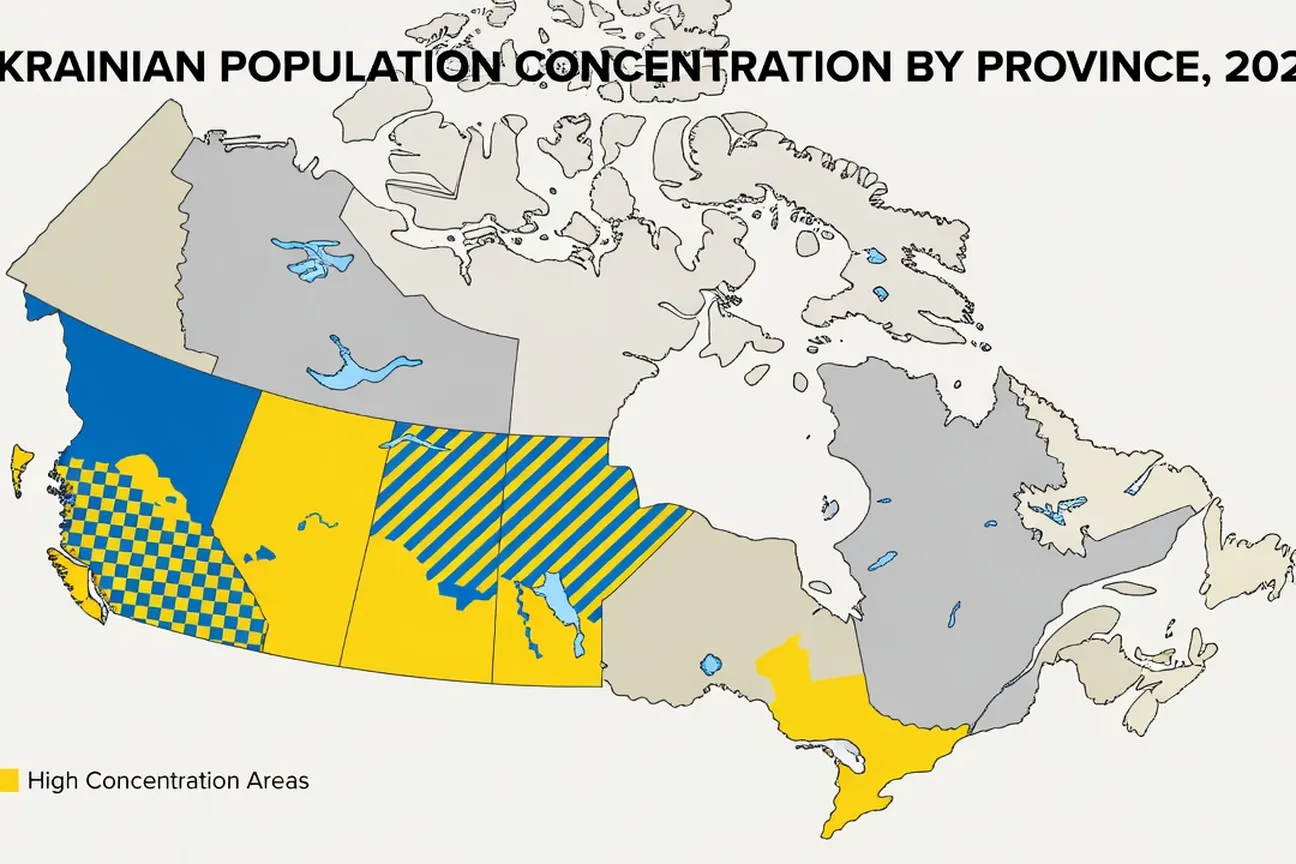
Colourful illustrated map of Canada highlighting Ukrainian population concentration by province 2026.
Table of Contents
- How Many Ukrainians Are in Canada? The 2026 Overview
- Ukrainian Population by Province
- Top Cities for Ukrainian Canadians in 2026
- Four Waves of Ukrainian Immigration
- Religion and Language: Ukrainian Orthodox and Catholic Communities
- Post-2022 Arrivals: The CUAET Newcomers
- Ukrainian Canadians by Age and Generation
- Economic Integration: Education and Employment Statistics
- Projections to 2030
- Ukraine in Canada: A Community at a Turning Point
- FAQ: Statistics on Ukrainians in Canada
How Many Ukrainians Are in Canada? The 2026 Overview
According to the latest projections drawing on the Statistics Canada 2021 census baseline, approximately 1.4 million people in Canada claim Ukrainian ancestry or origin in 2026. The 2021 census recorded 1,258,370 individuals reporting Ukrainian ethnic or cultural origins, either alone or in combination with other backgrounds. This figure represented a modest increase from 1,251,170 in 2016, reflecting both natural population growth and earlier immigration patterns. By early 2026, the addition of more than 200,000 newcomers under the Canada-Ukraine Authorization for Emergency Travel (CUAET) programme has pushed the total Ukrainian-origin population to the 1.4 million mark.
Statistics Canada data indicate that Ukrainian Canadians constitute roughly 3.5 percent of the national population. The community remains one of the largest European ethnic groups in the country, second only to German, English, Scottish, and Irish ancestries in several Prairie provinces. The Ukrainian Canadian Congress estimates that an additional 50,000 to 70,000 individuals may hold partial Ukrainian heritage not captured in census responses, bringing the broader diaspora influence closer to 1.47 million. These numbers position Canada as hosting the largest Ukrainian diaspora in the world outside Ukraine itself.
Population growth between 2021 and 2026 stems primarily from the CUAET arrivals rather than natural increase. Fertility rates among established Ukrainian-Canadian families hover near the national average of 1.4 children per woman, while the post-2022 cohort tends to be younger and more likely to form families in the coming decade. Official IRCC landing records show 217,000 CUAET holders had arrived by December 2025, with approximately 85 percent expressing intent to remain permanently.
Ukrainian Population by Province — A Complete Breakdown
The geographic distribution of Ukrainian Canadians continues to reflect historic settlement patterns on the Prairies alongside newer concentrations in Ontario and British Columbia. Alberta now edges out Ontario as the province with the largest Ukrainian-origin population.
| Province/Territory | 2021 Census | 2026 Estimate | Share of Total |
|---|---|---|---|
| Alberta | 341,790 | 365,000 | 26.1% |
| Ontario | 336,260 | 360,000 | 25.7% |
| Manitoba | 160,235 | 167,000 | 11.9% |
| British Columbia | 130,755 | 140,000 | 10.0% |
| Saskatchewan | 129,265 | 137,000 | 9.8% |
| Quebec | 70,655 | 80,000 | 5.7% |
| Other provinces/territories | 89,410 | 151,000 | 10.8% |
| Canada Total | 1,258,370 | 1,400,000 | 100% |
Alberta’s growth has been fuelled by both internal migration from Saskatchewan and Manitoba and strong economic opportunities in energy and agriculture sectors that historically attracted Ukrainian settlers. Ontario’s numbers include significant post-1990s and post-2022 arrivals who settled in the Greater Toronto Area and Ottawa. Manitoba retains one of the highest per-capita Ukrainian populations in Canada, with Ukrainian Canadians comprising nearly 12 percent of the provincial total.
Ukrainian-Canadian families at multicultural festival Toronto 2026.
Top Cities for Ukrainian Canadians in 2026
Urban concentration has increased since 2021, with six metropolitan areas accounting for more than 45 percent of the national total. Edmonton remains the city with the largest Ukrainian population.
| City (CMA) | 2026 Estimate | Primary Settlement Reason |
|---|---|---|
| Edmonton | 130,000 | Historic bloc settlements + energy sector |
| Winnipeg | 120,000 | Early 20th-century immigration hub |
| Toronto | 100,000 | Post-WWII and 1990s professional migration |
| Calgary | 90,000 | Oil industry and internal migration |
| Vancouver | 75,000 | Recent economic migrants + lifestyle |
| Ottawa | 45,000 | Government employment + CUAET arrivals |
Smaller centres such as Saskatoon (32,000), Regina (28,000), and Hamilton (22,000) also maintain vibrant Ukrainian institutions. The Ukrainian community in Canada continues to support more than 300 community halls, churches, and cultural centres across these cities.
Four Waves of Ukrainian Immigration: Historical Context
Four distinct waves have shaped today’s Ukrainian-Canadian population. The first wave (1891–1914) brought roughly 170,000 peasant farmers from Galicia and Bukovyna to the Prairie provinces under the Dominion Lands Act. Many established block settlements in east-central Alberta and western Saskatchewan that remain culturally identifiable today; see Ukrainian prairie settlement history for detailed maps.
The second wave (1920–1939) consisted largely of political refugees and displaced intellectuals fleeing the collapse of the Ukrainian People’s Republic. Approximately 70,000 arrived, strengthening urban communities in Winnipeg and Toronto. The third wave followed the Second World War, when 34,000 displaced persons, many with higher education, settled between 1947 and 1953. The fourth wave began after Ukraine’s independence in 1991 and accelerated dramatically after Russia’s full-scale invasion in 2022 under the CUAET policy.
The second wave of Ukrainian immigration (1920–1939) brought a markedly different cohort from the earlier agrarian settlers. Many arrivals were intellectuals, teachers, journalists, and political activists who fled Soviet repression following the failure of Ukraine’s brief independence period. A notable contingent consisted of clergy and laity from the Ukrainian Autocephalous Orthodox Church (UAOC), which the Bolshevik regime had outlawed. These newcomers concentrated in urban centres such as Winnipeg, Toronto, and Montreal, where they established newspapers, reading societies, and political discussion clubs that articulated a stronger nationalist orientation than the pioneer generation. They founded or revitalised organisations including the Ukrainian National Federation (UNF) in 1932 and several branches of the Ukrainian War Veterans’ Association, which later evolved into community centres offering language classes, libraries, and youth programs. Their presence shifted the internal politics of Ukrainian-Canadian life toward greater emphasis on preserving Ukrainian statehood aspirations while still navigating Canadian citizenship requirements.
The third wave, composed largely of Displaced Persons admitted between 1947 and 1953, further transformed institutional life. Many had spent years in Allied-administered camps in Augsburg, Hanover, and other German and Austrian locations, where they maintained schools, choirs, and scout troops under difficult conditions. These DPs included engineers, lawyers, physicians, and academics whose professional skills enabled rapid entry into Canadian universities and technical fields. Upon arrival they established the Ukrainian Canadian Committee (later renamed Ukrainian Canadian Congress) in 1940, with strengthened structures after the war, alongside the Ukrainian Canadian Professional and Business Federation and numerous parish-based cultural associations. Their cultural contributions included the creation of professional choirs such as the Ukrainian Bandurist Chorus and the introduction of academic Ukrainian studies programs at universities in Saskatchewan and Manitoba, setting the stage for heritage preservation efforts that persisted into subsequent decades.
Religion and Language: Ukrainian Orthodox and Catholic Communities
Religious affiliation remains a cornerstone of Ukrainian-Canadian identity. The Ukrainian Catholic Church reports approximately 500,000 members across its Canadian eparchies, while the Ukrainian Orthodox Church of Canada counts roughly 300,000 faithful. Combined with smaller Protestant and secular cohorts, organised religious bodies serve about 65 percent of the community.
Language retention statistics from the 2021 census show that 228,125 individuals reported Ukrainian as their mother tongue, down from 243,965 in 2016. Among third- and fourth-generation descendants, conversational fluency has declined to approximately 12 percent, though recent CUAET arrivals have temporarily increased the number of Ukrainian speakers in several Prairie cities by 25 percent.
Ukrainian Catholic eparchies were formally erected in Winnipeg (1912, elevated to archeparchy in 1956), Edmonton (1948), Saskatoon (1951), and New Westminster (1977), each overseeing parishes, schools, and social services across western Canada. Parallel Ukrainian Orthodox structures developed through the Ukrainian Orthodox Church of Canada, organised into three eparchies with cathedrals in Winnipeg, Toronto, and Edmonton. These jurisdictions operated Saturday schools that, by the early 2000s, numbered more than 300 across the country, enrolling roughly 12,000 students annually in language, history, and religious instruction. Churches functioned as primary vehicles for cultural continuity, hosting festivals, dance ensembles, and archival collections that documented pioneer life. In Toronto, parishes such as St. Demetrius and St. Vladimir’s Cathedral provided community hubs for post-war arrivals, while Edmonton’s St. George’s and St. John’s churches similarly anchored prairie networks.
Language retention followed a clear generational pattern. First- and second-generation speakers maintained Ukrainian at home well into the 1960s, but third-generation bilingualism declined sharply after the 1970s as intermarriage and suburban dispersal increased. By the 1991 census, only 18 percent of Ukrainian Canadians reported Ukrainian as their mother tongue, though many retained passive comprehension. The establishment of bilingual school programs in Alberta and Manitoba in the 1980s temporarily slowed the shift, yet English dominance accelerated among fourth-generation families. Recent arrivals have begun reversing some losses in urban centres through immersion classes and digital media, though long-term transmission remains contingent on institutional support.
Post-2022 Arrivals: The CUAET Newcomers
More than 217,000 Ukrainians entered Canada under CUAET by December 2025. IRCC data indicate that 62 percent settled in Alberta and Ontario, 18 percent in Manitoba and Saskatchewan, and the remainder distributed across British Columbia, Quebec, and Atlantic provinces. Employment outcomes have been strong: 78 percent of working-age arrivals secured employment within six months, primarily in health care, construction, transportation, and information technology.
Canada’s CUAET program, launched in March 2022, allowed Ukrainians and their family members to apply online for open work permits and study authorisation with expedited processing. By late 2023 more than 900,000 applications had been received, with approvals exceeding 300,000. The largest inflows settled in Toronto, Montreal, Calgary, and Edmonton, driven by existing family networks and employment prospects. Arrivals concentrated in healthcare, logistics, information technology, and construction trades, often leveraging pre-existing qualifications that required only modest Canadian credential recognition. Housing pressures quickly emerged in Toronto’s rental market and Calgary’s suburban corridors, where vacancy rates below 2 percent forced many into temporary homestays arranged by community sponsors.
Settlement agencies such as the Ukrainian Canadian Social Services (UCSS) and Ukrainian Canadian Congress (UCC) launched integration programs offering employment workshops, school registration assistance, and legal clinics. Family reunification statistics indicate that approximately 35 percent of CUAET holders have sponsored additional relatives under expanded temporary measures. International solidarity networks such as Help to Ukraine Portugal have established European-Canadian transit pathways, coordinating accommodation and documentation support for families who passed through Europe before reaching Canada. Mental-health support remains strained; community clinics report elevated rates of post-traumatic stress among recent arrivals, yet specialised Ukrainian-language counselling capacity covers only a fraction of need. Provincial governments have allocated supplementary funding, but advocates continue to press for sustained federal resources to prevent service gaps as temporary permits approach expiry.
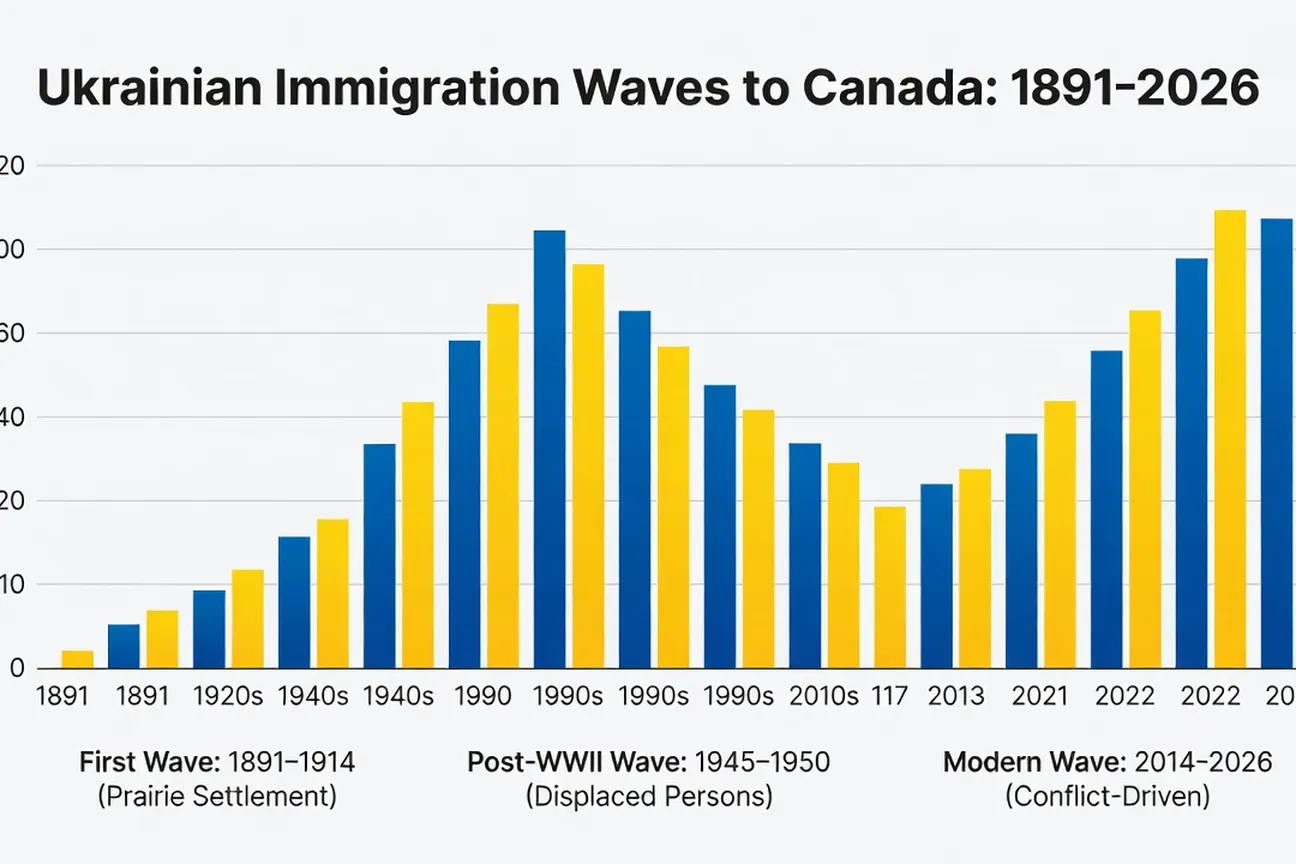
Data visualization showing Ukrainian immigration waves to Canada 1891-2026.
Ukrainian Canadians by Age and Generation
Third- and fourth-generation descendants constitute approximately 68 percent of the 1.4 million total. The median age of this established population is 42.1 years. In contrast, the post-2022 cohort has a median age of 34.7 years, creating a younger demographic bulge that may offset future population ageing. The age pyramid shows a pronounced concentration in the 30–49 age bracket among recent arrivals, while established families display a broader distribution across generations.
Intermarriage rates among Ukrainian Canadians have climbed steadily, reaching an estimated 60–70 percent by the fourth generation according to 2021 census-derived analyses. This pattern correlates with rising Ukrainian-English bilingualism among children of mixed unions, though active fluency often requires deliberate parental effort or enrolment in community programs. Post-2022 arrivals have introduced new social dynamics, forming parallel social-media networks and professional circles that sometimes operate separately from long-established organisations. Youth engagement has increased through revitalised dance groups, bandura ensembles, and university student associations, yet participation remains uneven across regions.
Sports and arts programs have become important retention tools. The Ukrainian Canadian Congress youth councils coordinate soccer tournaments and volleyball leagues that draw several thousand participants annually, while organisations such as the Ukrainian Cultural Centre in Toronto offer visual-arts workshops and film festivals. These initiatives blend heritage content with mainstream Canadian formats, fostering hybrid identities among teenagers who may otherwise drift from institutional involvement. Demographic data suggest that sustained investment in such programs will be critical to maintaining community cohesion as the fourth and fifth generations come of age.
Economic Integration: Education and Employment Statistics
Ukrainian Canadians demonstrate above-average educational attainment. Statistics Canada reports that 38 percent of adults aged 25–64 hold a university degree, compared with the national average of 32 percent. Median employment income for Ukrainian-origin individuals in 2023 stood at $68,400, slightly above the Canadian median of $65,200. Professional sectors with highest representation include engineering, health care, education, and agriculture-related industries.
Ukrainian-Canadian entrepreneurs have established a visible presence in agriculture, construction, and technology services. Early prairie farmers expanded into large-scale grain and canola operations, while later immigrants founded engineering consultancies and software firms that now export across North America. The credit-union sector remains a cornerstone of community finance; institutions such as UNF Credit Union and Ukrainian Credit Union Limited in Toronto manage combined assets exceeding $2 billion and provide targeted lending for first-time homebuyers and small businesses. Media and publishing outlets, notably the New Pathway newspaper founded in 1930, continue to serve both legacy and newcomer audiences with print and digital editions.
Professional associations including the Ukrainian Canadian Engineers and Architects Society and the Ukrainian Medical Association of Canada facilitate mentorship and credential bridging. Ukrainian Canadians remain over-represented in agriculture, engineering, and education relative to their population share, reflecting historical settlement patterns and emphasis on technical education. These sectoral strengths have translated into philanthropic support for Ukrainian studies chairs and community foundations, reinforcing economic and cultural linkages between Canada and Ukraine.
Where Ukrainian Canadians Are Headed: Projections to 2030
Demographic modelling by the Ukrainian Canadian Congress suggests the population will reach 1.55–1.65 million by 2030, driven by continued CUAET family reunification and modest natural increase. Language retention is projected to fall to 9 percent among fourth-generation descendants unless community programmes expand. Community sustainability will depend on successful integration of recent arrivals and continued investment in heritage schools and cultural organisations.
Policy debates projected to 2030 centre on extending CUAET provisions, creating dedicated permanent-residency pathways, and securing multi-year funding for heritage-language education. Advocates argue that automatic transition to permanent residence after three years would stabilise the labour force and reduce administrative burdens. Saturday-school enrolment trends show modest growth in Ontario and Alberta since 2022, yet rural programs face teacher shortages. Digital platforms—interactive apps, online bandura lessons, and Ukrainian-language podcasts—have emerged as supplementary tools that engage diaspora youth who rarely attend physical classes, mirroring practices observed in Polish and Italian Canadian communities.
Comparative demographic projections indicate that the Ukrainian-Canadian population will continue to grow faster than several other European diasporas because of recent inflows, though aging among pre-1991 cohorts poses parallel challenges. Sustained heritage-language funding and flexible immigration policies will determine whether institutional capacity expands or contracts by 2030. Success will hinge on coordination between federal settlement programs, provincial education ministries, and community organisations capable of integrating both long-established and newly arrived populations.
Ukraine in Canada: A Community at a Turning Point
The statistics presented in this guide capture a community in profound transition. The 1.4 million Ukrainians in Canada in 2026 represent four distinct generations of lived experience: the prairie homesteaders' great-grandchildren who may not speak a word of Ukrainian, the post-WWII survivors who built the institutional foundations of the diaspora, the 1990s professionals who reinvigorated the community after Soviet collapse, and the 2022 CUAET arrivals who are reshaping its demographic and cultural profile in real time. Understanding these layers is essential to understanding any single statistic. The 1.4 million figure is not a monolith; it is a palimpsest.
What the numbers also reveal is the resilience and adaptability of Ukrainian-Canadian identity. Despite a century of assimilation pressure, intermarriage, and language loss, the community has maintained distinctive institutions, political advocacy structures, and cultural programmes that continue to attract both long-established families and newcomers. The sudden influx of 200,000+ post-2022 arrivals has injected new energy, new speakers, and new connections to contemporary Ukrainian reality. Whether this will reverse long-term language decline, revitalise heritage schools, and sustain the complex institutional infrastructure of the diaspora into the 2030s and beyond remains to be seen. What is certain is that the Ukrainian-Canadian community is one of the most historically significant and currently dynamic ethnic communities in Canada, and its numbers — however counted — tell a story worth understanding in full.
FAQ: Statistics on Ukrainians in Canada
How many Ukrainians live in Canada in 2026?
Approximately 1.4 million people claim Ukrainian ancestry, combining the 2021 census baseline with post-2022 CUAET arrivals.
Which province has the most Ukrainian Canadians?
Alberta currently leads with an estimated 365,000 residents, followed closely by Ontario at 360,000.
What is the largest city for Ukrainian settlement?
Edmonton hosts the largest urban Ukrainian population at roughly 130,000.
How many Ukrainians arrived after 2022?
Over 217,000 individuals entered via the CUAET programme by the end of 2025.
Will the Ukrainian population continue to grow?
Projections indicate growth to 1.55–1.65 million by 2030, contingent on immigration policy and family formation rates among newcomers.