In brief: Ukraine's age has three credible answers. The modern sovereign Ukrainian state is 35 years old, having declared independence on August 24, 1991. The named Ukrainian political entity dates to the Cossack Hetmanate established by Bohdan Khmelnytsky in 1648, making it nearly 380 years old. The deeper civilizational thread, traced through Kyivan Rus and its Christianization in 988, reaches back over 1,100 years. All three layers belong to the same continuous story.
The Question of Ukraine's Age — A Layered Answer
Few simple questions in European history are as politically loaded as "how old is Ukraine?" The answer is genuinely layered, and serious historians refuse to collapse it into a single date. Modern Ukraine, as a sovereign nation-state with internationally recognized borders, a constitution and a seat at the United Nations, was born on August 24, 1991. By that strict legal measure, Ukraine is 35 years old in 2026. Yet treating 1991 as the "founding" of Ukraine erases more than a millennium of political, cultural and religious history rooted in the same lands and the same people.
A more honest framework distinguishes three layers. The first is the layer of continuous international sovereignty, which begins in 1991. The second is the layer of named Ukrainian polities, which begins with the Cossack Hetmanate in 1648 and includes the brief Ukrainian People's Republic of 1917 to 1921. The third is the layer of civilizational continuity, the deep cultural, linguistic and religious thread running from Kyivan Rus through every subsequent regime to the present day.
This layered approach is the consensus among professional Ukrainian historians, most prominently Mykhailo Hrushevsky, whose ten-volume History of Ukraine-Rus (1898 to 1937) established the modern academic case for Ukrainian historical continuity, and Serhii Plokhy, the Harvard historian whose 2015 book The Gates of Europe remains the standard English-language synthesis. Both reject the imperial Russian framing that treats Ukrainian history as a regional chapter of Russian history, and both reject the simplistic counter-claim that Ukraine "began" in 1991. The truth is older, richer and more complicated.
The territory's deep history starts with the Cucuteni-Trypillia neolithic civilization (5500-2750 BC), whose vast settlements on Ukrainian soil predate the oldest cities of Mesopotamia by centuries.
Kyivan Rus 9th–13th Century — The First East Slavic State
The deepest historical root of Ukrainian statehood is Kyivan Rus, the East Slavic federation that emerged in the late 9th century along the Dnipro river. Traditional historiography places its founding in 882 CE, when the Varangian prince Oleg of Novgorod seized Kyiv from the local rulers Askold and Dir and declared the city the "mother of Rus cities." Oleg's consolidation united the trade route from the Baltic to the Black Sea, the so-called "route from the Varangians to the Greeks," under a single dynastic authority.
Over the following century, Kyivan Rus became one of the largest and most powerful states in medieval Europe. Under Volodymyr the Great, who ruled from 980 to 1015, the realm adopted Byzantine Christianity in 988, an event that anchored the cultural identity of all three modern East Slavic nations. Volodymyr's son Yaroslav the Wise (1019 to 1054) codified the first Slavic legal text, the Ruska Pravda, sponsored the construction of Saint Sophia Cathedral in Kyiv, and married his daughters to the kings of France, Norway and Hungary. At its zenith, Kyivan Rus stretched from the Black Sea to the Arctic and rivalled the Byzantine and Holy Roman Empires in cultural influence.
Kyivan Rus is therefore not "Russia" in any modern sense. It was a multi-ethnic East Slavic confederation in which Kyiv, the predecessor city of modern Ukraine's capital, was the unambiguous political and religious centre. The city of Moscow was not even founded until 1147, more than 250 years after Oleg took Kyiv, and Moscow remained a peripheral frontier post for another two centuries. The Russian historiographical claim that Kyivan Rus is the cradle of "Russian" history requires retroactively assigning a 19th-century imperial identity to a medieval state that knew nothing of it.
The Mongol invasion of 1240, in which Batu Khan's forces sacked Kyiv after a brief siege, ended Kyivan Rus as a unified polity. The destruction was catastrophic: contemporary Italian envoy Giovanni da Pian del Carpine, passing through in 1246, reported that the once-great city had been reduced to barely 200 standing houses. Political authority over the former Rus lands fragmented among successor principalities, and the Ukrainian story enters a long phase of foreign rule that would not end until the 20th century.
Galicia-Volhynia and the Lithuanian-Polish Era 13th–17th Century
The most direct medieval successor to Kyivan Rus on Ukrainian soil was the Kingdom of Galicia-Volhynia, ruled by the Romanovich dynasty from 1199 to 1349. Under King Danylo Romanovich, crowned by a papal envoy in 1253, Galicia-Volhynia maintained Rus political and religious traditions while adopting Western European diplomatic and administrative practices. The kingdom held off the Mongols, traded with Hungary and Poland, and at its peak controlled most of what is now western and central Ukraine.
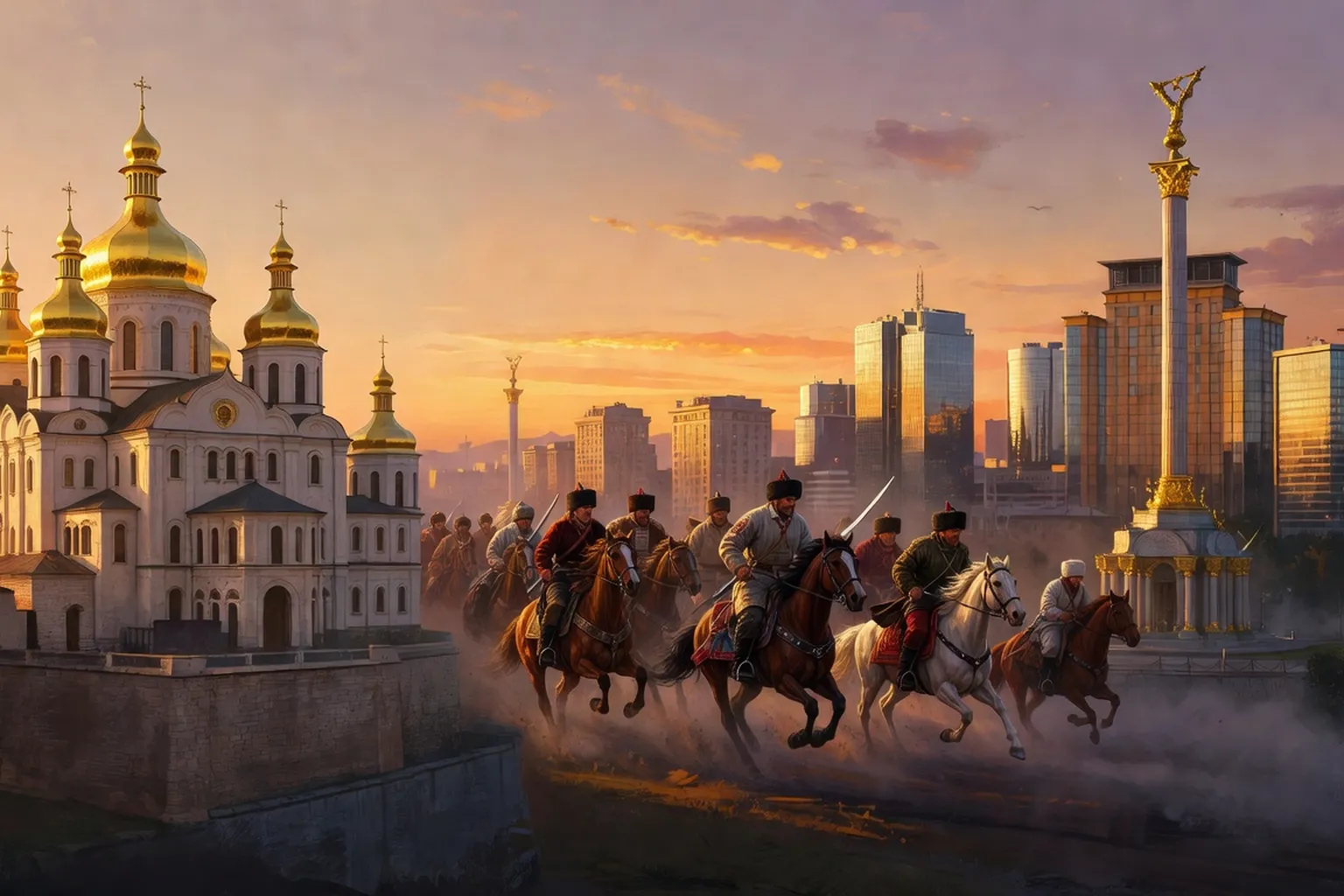
Historic timeline of Ukraine showing Kyivan Rus, Cossack Hetmanate and modern Ukrainian flag.
After the extinction of the Romanovich line in the mid-14th century, the Ukrainian lands were absorbed by two expanding neighbours. The Grand Duchy of Lithuania, under Algirdas and his successors, absorbed Kyiv and most of central Ukraine between 1362 and the late 14th century, while the Kingdom of Poland annexed Galicia in 1349. The 1569 Union of Lublin merged Poland and Lithuania into a single Commonwealth and transferred most Ukrainian territories to Polish administration. For roughly three centuries, Ukrainians lived as a peasant majority within a Polish-Lithuanian state run by a Catholic noble class.
This long Polish-Lithuanian period was paradoxical. On one hand, Ukrainian Orthodox identity came under heavy pressure: the 1596 Union of Brest created the Greek Catholic (Uniate) Church and split Ukrainian religious life, while Polish nobles imposed serfdom on the Orthodox peasantry. On the other hand, Ukrainian elites engaged with Renaissance and Reformation Europe, founded printing presses in Lviv, Ostroh and Kyiv, and produced the Peresopnytsia Gospel of 1556 to 1561, the first major translation of the Bible into a recognizably proto-Ukrainian vernacular.
The Cossack Hetmanate 16th–18th Century — A Free Ukrainian Polity
By the 16th century, the steppe frontier south of the Polish-Lithuanian Commonwealth was being settled by the Cossacks, free fighting communities of escaped serfs, runaway nobles and Tatar converts. The Cossack stronghold of the Zaporozhian Sich, established around 1556 below the Dnipro rapids, became the first self-governing institution in centuries that could plausibly be called Ukrainian. The Cossacks held elections, ran their own courts and built a sophisticated military culture that inspired generations of Ukrainian and Polish poetry alike.
The decisive moment came in 1648, when the Cossack uprising led by Hetman Bohdan Khmelnytsky against Polish rule produced an autonomous Ukrainian state, the Cossack Hetmanate. At its height in the 1650s, the Hetmanate covered most of central Ukraine, fielded an army of more than 100,000, conducted its own foreign policy, signed treaties with Sweden, Moldavia, the Crimean Khanate and Muscovy, and exchanged ambassadors with European powers. For Ukrainian historians, this is the first unambiguous example of a named Ukrainian polity since Kyivan Rus.
The Hetmanate's tragedy was its strategic vulnerability. The 1654 Treaty of Pereyaslav, in which Khmelnytsky accepted the protection of Tsar Alexis of Muscovy, was understood by Cossack elites as a temporary military alliance among equals. Moscow read it as a transfer of sovereignty. Decades of war followed, culminating in the 1709 Battle of Poltava, in which Tsar Peter I crushed the army of Hetman Ivan Mazepa, who had switched sides to ally with Sweden's Charles XII. Mazepa's defeat broke Cossack autonomy as a credible counterweight to Russian power.
The Hetmanate continued in attenuated form until 1764, when Catherine the Great formally abolished the office of Hetman, and 1775, when she razed the Zaporozhian Sich. By the late 18th century, the Cossack experiment had been folded into the Russian imperial administrative system. Yet for 116 years between 1648 and 1764, a Ukrainian polity with its own institutions, laws, language of administration and diplomatic representation had functioned in central Ukraine. Its memory would prove decisive when the question of Ukrainian statehood resurfaced in the modern era.
Russian and Austrian Partitions 1772–1917
The three Partitions of Poland, in 1772, 1793 and 1795, dismembered the Polish-Lithuanian Commonwealth and divided the Ukrainian lands between two empires. Russia absorbed central, eastern and southern Ukraine, including Kyiv, Poltava and the newly conquered Black Sea coast. Austria took Galicia and parts of Volhynia, including Lviv, which became the capital of the Habsburg crown land of Galicia and Lodomeria. The two Ukraines, sometimes called Russian Ukraine and Austrian Ukraine, would develop along sharply different lines for the next 145 years.
In Russian Ukraine, imperial policy was assimilationist. The Ukrainian language was suppressed under the Valuev Circular of 1863 and the Ems Decree of 1876, both of which banned the publication of Ukrainian-language books. Schools, churches and administration operated in Russian. Yet Ukrainian intellectual life persisted underground: the poet Taras Shevchenko (1814 to 1861), born a serf, became the foundational figure of modern Ukrainian literature, and his 1840 collection Kobzar remains the cornerstone of the Ukrainian literary tradition. Ukrainian historians, ethnographers and political activists used Galicia as a refuge to publish what was forbidden in the Russian Empire.
In Austrian Galicia, by contrast, the Ukrainian language enjoyed legal protection from 1867 onward under the Habsburg constitutional system. Lviv University began offering Ukrainian-language instruction in the 1860s, the cooperative movement built rural prosperity, and a Ukrainian political party, the Ukrainian National Democratic Party, won seats in the Vienna Reichsrat. By 1914, Galicia hosted around 4 million Ukrainian speakers, a flourishing press, paramilitary youth organizations and the academic foundations for Hrushevsky's monumental history project. When the First World War broke out, Austrian Ukraine was the political laboratory in which modern Ukrainian nationalism took shape.
The First Ukrainian People's Republic 1917–1921
The collapse of the Russian Empire in February 1917 opened the first realistic window for Ukrainian statehood since the Hetmanate. Within weeks of the tsar's abdication, a Ukrainian Central Council, the Tsentralna Rada, formed in Kyiv under the chairmanship of Mykhailo Hrushevsky himself. On November 20, 1917, the Rada proclaimed the Ukrainian People's Republic as an autonomous part of a future Russian federation. After the Bolshevik coup in Petrograd, the Rada moved further: on January 22, 1918, it issued the Fourth Universal proclaiming full independence.
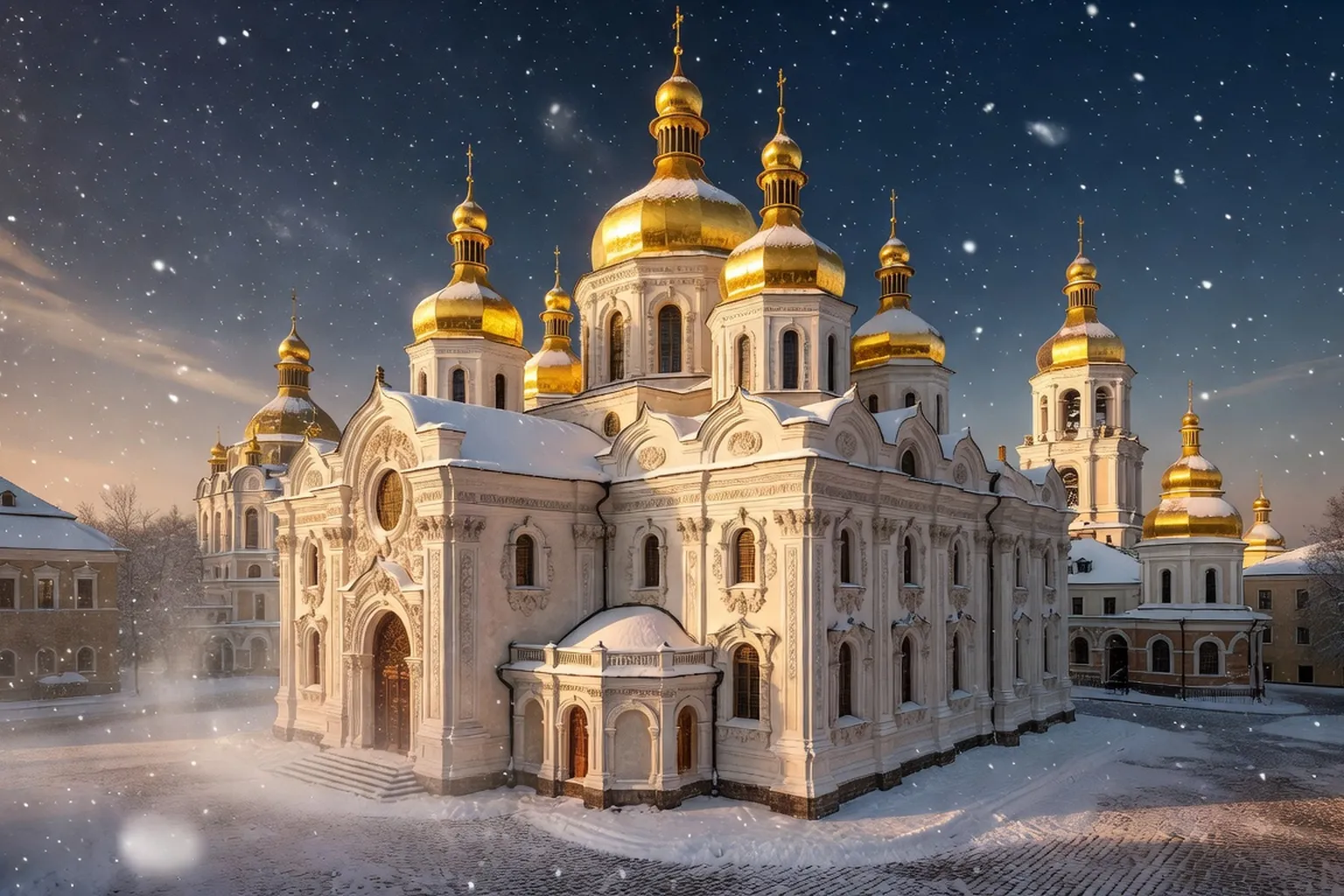
Cossack Hetmanate fortress and Ukrainian Cossack horsemen on the steppe.
The young republic faced impossible odds. Bolshevik forces invaded almost immediately, occupying Kyiv in February 1918. The Brest-Litovsk treaty in March 1918 brought German troops to Ukrainian soil; they installed Hetman Pavlo Skoropadsky in a brief conservative restoration. Skoropadsky fell in December 1918, replaced by the Directory under Symon Petliura, which fought a multi-front war against the Bolsheviks, the Whites under Denikin, anarchist forces under Makhno, and Polish armies. On January 22, 1919, the Ukrainian People's Republic and the Western Ukrainian People's Republic, established in Lviv after the Habsburg collapse, formally united in the Act of Zluky, an event still commemorated annually as Ukraine's Day of Unity.
By 1921, military exhaustion and diplomatic isolation had defeated the experiment. The Treaty of Riga in March 1921 partitioned Ukraine between Soviet Russia and Poland, with Galicia going to Warsaw and the centre and east to the Bolshevik-controlled Ukrainian SSR. Petliura was assassinated in Paris in 1926. Yet the four years of the Ukrainian People's Republic established the constitutional template, the blue-and-yellow flag, the trident emblem and the institutional memory that would make 1991 possible. For Ukrainian national mythology, 1917 to 1921 is the bridge between Cossack memory and modern statehood.
Soviet Ukraine 1922–1991 — Repression and the Holodomor
From 1922 to 1991, central and eastern Ukraine existed as the Ukrainian Soviet Socialist Republic within the USSR. The first decade brought a paradoxical "Ukrainization" policy: under Stalin's early national policy, Ukrainian was promoted in schools, government and the arts, and a brilliant generation of writers and filmmakers, the so-called Executed Renaissance, briefly flourished. By the late 1920s, however, the policy reversed sharply. Almost the entire Ukrainization-era cultural elite was arrested, imprisoned in the Solovki camps or shot during the Great Terror of 1937 to 1938.
The defining catastrophe of Soviet Ukraine was the Holodomor, the man-made famine of 1932 to 1933 produced by Stalin's forced collectivization and grain requisition policies. Estimates of mortality range from 3.5 million to 7 million Ukrainian peasants dead in approximately eighteen months, with the most cited scholarly figure around 3.9 to 4 million. Internal Soviet documents, declassified after 1991 and analyzed by historians including Andrea Graziosi and Anne Applebaum, document the deliberate targeting of Ukrainian villages, the closing of Ukraine's borders to prevent peasants from seeking food elsewhere, and the simultaneous export of grain abroad. Ukraine, Canada, the United States, the European Parliament and more than 30 other states have officially recognized the Holodomor as a genocide. For an in-depth treatment of these events, see our complete history of Ukraine.
The Second World War devastated Ukraine on a scale matched only by Belarus. Approximately 7 million Ukrainians died between 1939 and 1945, including roughly 1.5 million Jewish Ukrainians murdered in the Holocaust at sites such as Babyn Yar in Kyiv, where 33,771 Jews were killed in two days in September 1941. After 1945, Stalin extended the Soviet Ukrainian SSR to include western Galicia and Volhynia, creating for the first time since the medieval period a single political unit covering nearly all ethnographically Ukrainian territory.
The postwar decades brought rebuilding, urbanization, heavy industrialization in the Donbas and Kharkiv regions, and a slow Russification of urban life. Ukrainian dissidents such as Vasyl Stus, Levko Lukyanenko and the human rights movement of the 1960s and 1970s kept national memory alive, often at the cost of long camp sentences. The 1986 Chornobyl disaster, in which Reactor 4 exploded on April 26, exposed the brittleness and dishonesty of the Soviet system and accelerated Ukrainian disillusionment. By the late 1980s, the Rukh movement had millions of supporters, and Soviet Ukraine was already drifting toward independence in everything but legal form.
Independent Ukraine Since 1991 — A Modern State Reborn
The legal birth of modern Ukraine occurred between August and December 1991. Following the failed Soviet coup attempt of August 19 to 21, 1991, the Verkhovna Rada in Kyiv adopted the Act of Declaration of Independence on August 24, 1991, by a vote of 321 to 2 with 6 abstentions. On December 1, 1991, a national referendum confirmed independence with 92.3 percent in favour on a turnout of 84 percent. Even majority-Russian-speaking regions, including Donbas at 83.9 percent and Crimea at 54 percent, voted yes. International recognition followed within weeks, and the Soviet Union formally dissolved on December 25, 1991. By any standard measure of international law, Ukraine has been a continuously sovereign state for 35 years as of 2026.
The post-1991 decades have been turbulent but real. The 1996 constitution established a semi-presidential republic, the hryvnia replaced the karbovanets as national currency that same year, and the country joined the Council of Europe in 1995. The 2004 Orange Revolution overturned a fraudulent election and signalled Ukraine's democratic trajectory; the 2013 to 2014 Revolution of Dignity, in which more than 100 protesters were killed on the Maidan in Kyiv, deepened that orientation toward Europe. Russia's annexation of Crimea in March 2014 and its instigation of separatist warfare in Donbas marked the start of an undeclared war that lasted eight years before becoming open invasion.
The full-scale Russian invasion of February 24, 2022 was the largest land war in Europe since 1945. Despite expectations of rapid collapse, Ukrainian forces held Kyiv, retook large parts of Kharkiv and Kherson regions, and entered 2026 with most of the country under continued Ukrainian control. The war has cost an estimated 130,000 to 200,000 Ukrainian military and civilian lives by mid-2026, displaced more than 8 million people, and reshaped European security thinking. Through it all, Ukrainian state institutions, elections postponed only by the constitutional martial-law clause, the hryvnia, and the international diplomatic apparatus have continued to function. The diaspora, including the Canadian Ukrainian diaspora, has played a major role in financial and political support.
Modern Ukraine in 2026 is therefore not just 35 years old. It is a state that has survived a regime change, a colour revolution, a constitutional revolution and an existential war, and emerged with its territorial integrity contested but its institutional integrity intact. Readers interested in the economic dimension of this resilience can consult our overview of the modern Ukrainian economy, while the human story of emigration to North America is treated in our Ukrainian immigration history to Canada. For broader cultural and historical context outside of our coverage, see Ukraine cultural and historical resources.
So How Old Is Ukraine, Really? Three Honest Answers for 2026
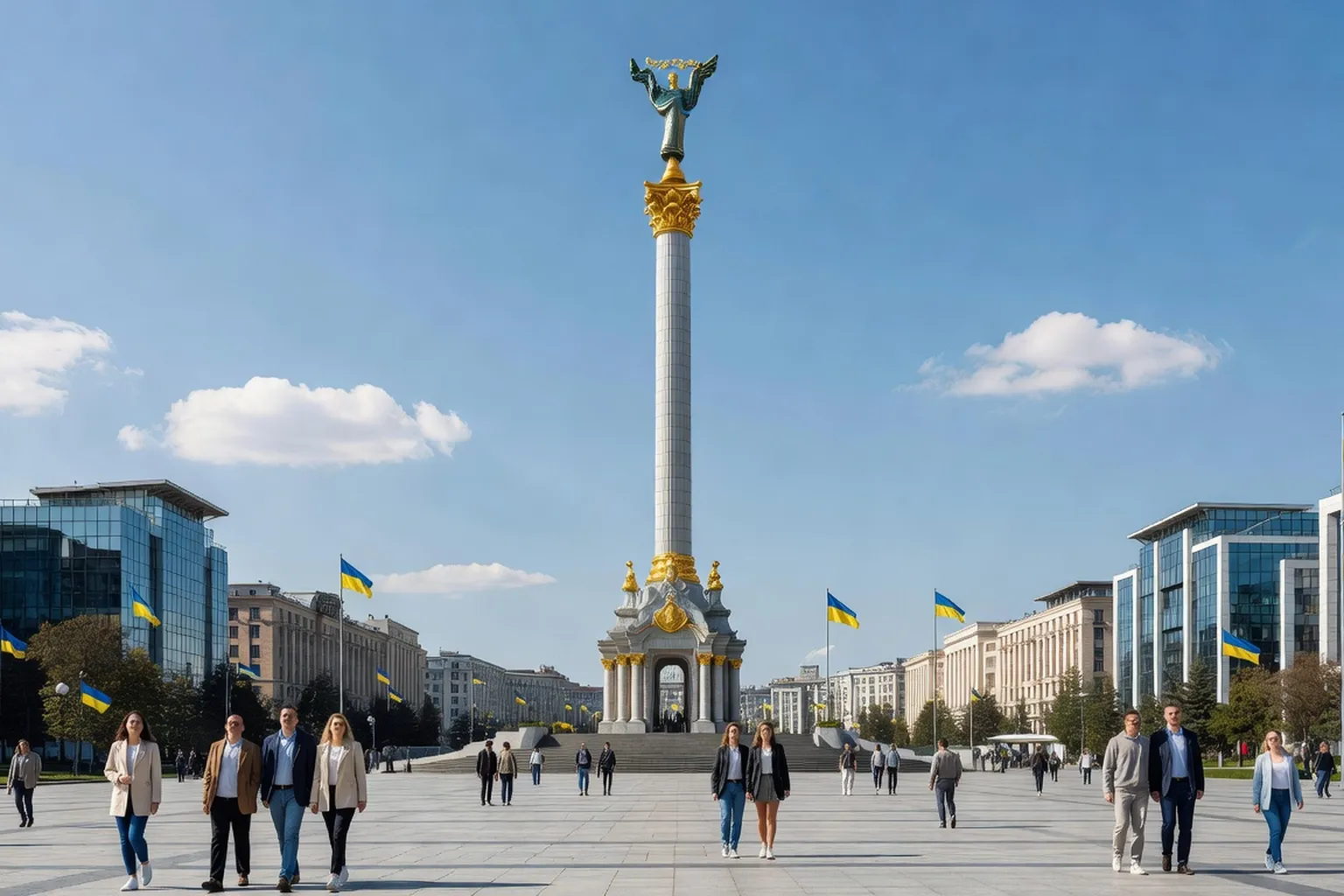
Ukrainian flag raised over Kyiv during the 1991 independence declarations.
Strict legal answer: Ukraine is 35 years old in 2026, dating from the August 24, 1991 declaration of independence and confirmed by the December 1, 1991 referendum. This is the answer used in international law, in the United Nations and in any official document that requires a single founding date.
Political-historical answer: Ukraine as a named, self-governing polity is roughly 378 years old, dating from the establishment of the Cossack Hetmanate by Bohdan Khmelnytsky in 1648. This includes the Hetmanate's autonomous existence until 1764, the Ukrainian People's Republic of 1917 to 1921, and the modern republic since 1991. By this measure, Ukrainian statehood has been interrupted multiple times but never erased from political memory.
Civilizational answer: the Ukrainian historical and cultural space, anchored in Kyiv and rooted in the East Slavic state of Kyivan Rus, is more than 1,140 years old as of 2026, dating from Oleg's consolidation of Kyiv around 882 CE and the Christianization of 988. This is not the same thing as continuous Ukrainian statehood, but it is the civilizational substrate from which all subsequent Ukrainian polities drew their language, religion, capital city and self-understanding. It is also the layer most directly contested by modern Russian historiography, including Vladimir Putin's July 2021 essay "On the Historical Unity of Russians and Ukrainians," which argued that Ukrainians and Russians are "one people" and that Ukrainian statehood is an artificial Soviet creation. Mainstream Western and Ukrainian scholarship rejects this on factual grounds: Kyivan Rus was a Kyiv-centred polity that predates Moscow's founding by 250 years, and the divergence of Ukrainian, Russian and Belarusian identities is documented in linguistic, religious and political sources from the 14th century onward.
The three answers are not in competition. They describe different layers of the same reality, and any honest account of Ukrainian history needs all three. In 2026, on the eve of Ukraine's 35th independence anniversary and its 1,144th year of recorded statehood in some form, the question "how old is Ukraine?" has its richest possible answer: as old as the continuous European civilization that has persisted on these lands since the 9th century, and as new as a modern democracy still being built under fire.