In brief: Ukraine's economy in 2026 is in its third consecutive year of growth after the 2022 shock. The IMF projects real GDP expansion of 3.5 to 4.5 percent, inflation in the 7 to 9 percent range, and a hryvnia that trades around 42 per US dollar under a managed float. Reconstruction needs are estimated by the World Bank at $486 billion over ten years, financed by the EU Ukraine Facility, the IMF Extended Fund Facility, G7 partners and a slowly returning private sector. Foreign direct investment remains below pre-war levels but is rising, and the Ukrainian-Canadian diaspora is becoming an increasingly visible source of trade, capital and expertise.
Ukraine's Economic Position in Early 2026
Four years into the full-scale war, Ukraine's economy in early 2026 looks fundamentally different from the one that existed before February 2022. Real GDP per capita has stabilized at roughly 4,200 US dollars, down from the pre-war benchmark of about 4,800 dollars in 2021 but well above the trough seen in mid-2022. Ukraine's nominal GDP, measured in current dollars, is once again approaching the 200 billion dollar mark, supported by a more competitive exchange rate and a recovering tradable sector.
The macroeconomic story has three pillars. The first is fiscal: the Ukrainian state budget is sustained by a combination of domestic tax revenue, war bonds purchased by Ukrainian banks and households, and external financing from the European Union, the IMF, the World Bank and G7 partners. External support is no longer episodic. It is structural and predictable, anchored in the Ukraine Facility (50 billion euros over 2024 to 2027) and the IMF Extended Fund Facility (15.6 billion US dollars over 2023 to 2027).
The second pillar is monetary. The National Bank of Ukraine, often referred to by its acronym NBU, has restored its inflation-targeting framework after the wartime fixed exchange rate. Since October 2023 the hryvnia has traded under a managed float, and inflation has descended from the post-invasion peak of 26.6 percent toward a projected 7 to 9 percent range in 2026. The NBU has begun a gradual easing cycle, lowering its policy rate while remaining cautious about premature loosening.
The third pillar is reconstruction. Even while the war continues, large-scale reconstruction projects are underway in liberated and rear regions, financed by multilateral lenders, bilateral grants and a growing pool of private capital. The combination of these three pillars (predictable external financing, restored monetary framework, active reconstruction pipeline) is what distinguishes 2026 Ukraine from the country in survival mode of 2022 and 2023.
From Wartime Contraction to Recovery: GDP Trajectory 2022–2026
The single most striking line in Ukraine's macroeconomic record of the last four years is the GDP trajectory. In 2022, real GDP collapsed by 29.1 percent, one of the largest peacetime-equivalent contractions ever recorded for a country of Ukraine's size. The shock combined occupation of major industrial regions, destruction of infrastructure, displacement of roughly a third of the population, and the closure of Black Sea ports.
The 2023 rebound surprised most analysts. Real GDP grew 5.3 percent as the front line stabilized, the Black Sea grain corridor partially reopened, and the population adapted to wartime conditions. The 2024 figure was lower, around 3.5 percent, reflecting the cumulative effect of Russian missile and drone strikes on the energy grid, which forced rolling blackouts across most of the country during the cold months.
The 2025 estimate, still being finalized by the State Statistics Service, sits in a range of 3.2 to 4.0 percent. For 2026, the IMF projects 3.5 to 4.5 percent growth, broadly consistent with the trajectories published by the National Bank of Ukraine, the European Bank for Reconstruction and Development (EBRD), and the Ministry of Economy. These figures all depend on three baseline assumptions: continued Western financing, no significant expansion of the front line, and incremental restoration of energy generation capacity.
It is important to read the growth numbers in context. A 3.5 percent expansion from a base that is still 20 percent below the pre-war trend is not the same as 3.5 percent in a normal economy. Ukraine in 2026 is recovering ground rather than reaching new heights. By the most optimistic scenarios, real GDP will not return to its 2021 level before 2027 or 2028, and even then, the structure of that GDP will be very different from the pre-war composition. For a deeper baseline view, our overview of Ukraine's economy fundamentals covers the longer-term structural picture.
The 400+ Billion Dollar Reconstruction Plan
The most cited number in any conversation about Ukraine's recovery is the World Bank reconstruction estimate. Published jointly with the Government of Ukraine, the European Commission and the United Nations, the third Rapid Damage and Needs Assessment (RDNA3) of March 2024 priced Ukraine's reconstruction needs at 486 billion US dollars over ten years. By the end of 2025, updated tracking suggests the figure has crossed the 500 billion dollar mark, although the official RDNA4 has not yet been released.
The reconstruction needs are unevenly distributed across sectors. Roughly 38 percent of the total covers housing, including the rebuilding or replacement of millions of damaged dwellings. 16 percent is allocated to transport infrastructure (roads, railways, bridges and ports), and 12 percent to the energy sector, where Russian strikes have systematically targeted thermal and hydroelectric capacity. Social sectors (health, education, social protection) account for another large share, and the remainder covers agriculture, environment, demining, and digital infrastructure.
Financing this reconstruction is the central macroeconomic project of the next decade. No single donor can cover even a quarter of the bill. The current strategy combines four streams: multilateral financing from the EU, IMF, World Bank, EBRD and EIB; bilateral grants and loans from G7 countries (notably the United States, Canada, the United Kingdom, Germany and Japan); private investment supported by international guarantees; and the politically charged option of using frozen Russian sovereign assets, which the G7 has begun to mobilize through the Extraordinary Revenue Acceleration loan agreed in 2024.
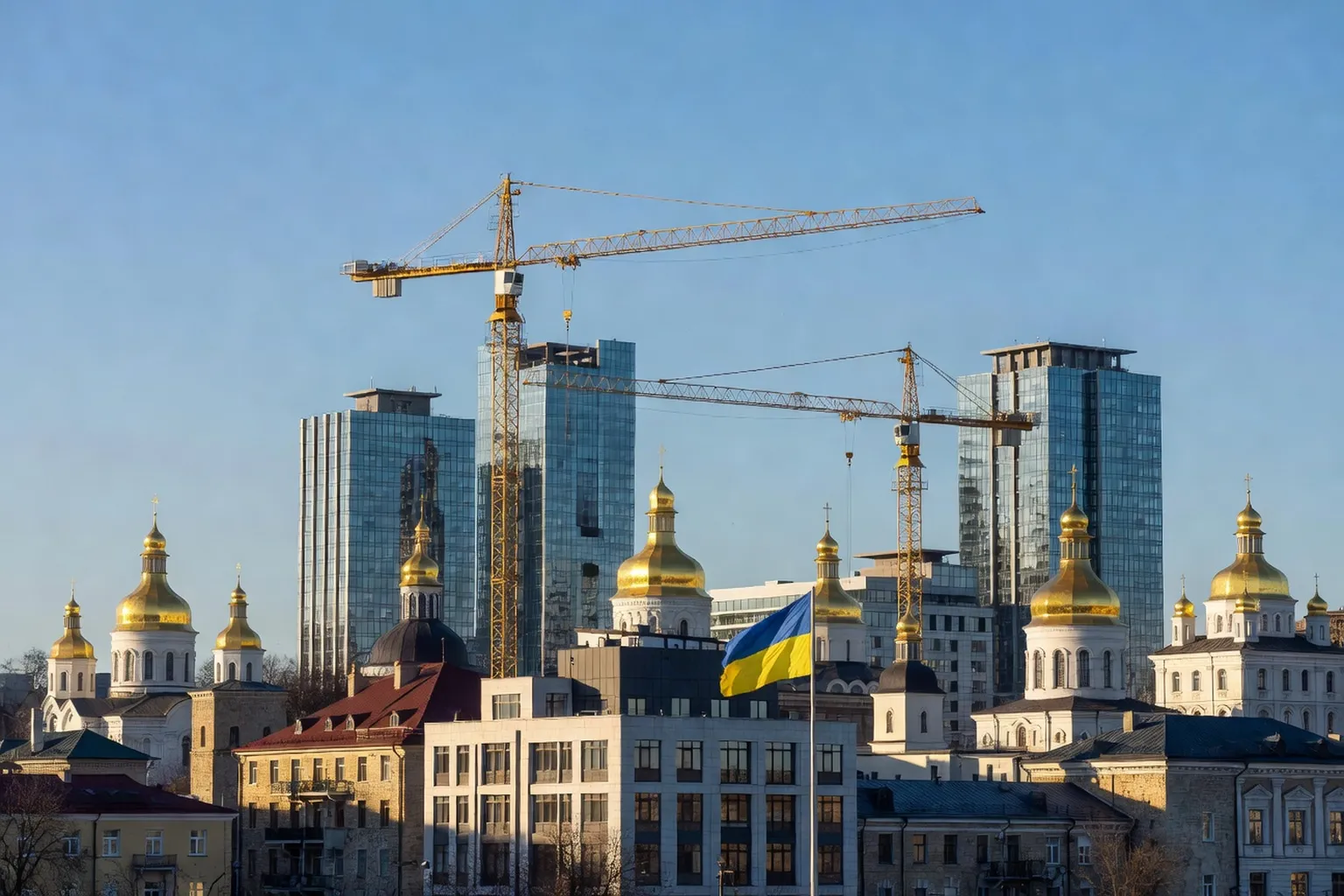
Ukrainian skyline with cranes and reconstruction sites under a calm sky in 2026.
Canada has been a consistent contributor. Through Export Development Canada, the federal government has committed loan guarantees and reconstruction lending. Canada also issued sovereign Ukraine bonds and channelled budget support through the IMF administered account. While Canada is not the largest donor in absolute terms, the share of GDP committed places Canada among the more generous G7 partners on a per-capita basis.
Foreign Direct Investment and the Ukraine Investment Framework
Foreign direct investment (FDI) into Ukraine collapsed in 2022 and has been recovering slowly. According to the National Bank of Ukraine, net FDI inflows in 2024 reached approximately 4.2 billion US dollars, well above the 2022 trough but still below the 6 billion dollar pre-war annual average. The 2025 estimate is in the 5 to 6 billion dollar range, and 2026 projections from EBRD point to roughly 7 to 8 billion dollars if conditions hold.
The investment landscape has been reshaped by the Ukraine Investment Framework, a coordinated initiative by the EBRD, IFC, EIB, MIGA and the European Commission to channel risk-mitigated private capital into Ukrainian projects. The framework offers political risk insurance through MIGA and similar mechanisms, blended finance with concessional layers absorbing initial risk, and direct equity from EBRD and IFC into selected sectors.
The strongest investment flows have gone into agribusiness (silos, processing, logistics), renewable energy (solar and wind in western and central Ukraine), IT services and outsourcing, and selected manufacturing tied to defence and reconstruction. Ukrainian unicorn Grammarly, the agritech leader Kernel, and several reconstruction-focused real estate developers have all attracted significant 2025 and 2026 investment rounds.
Major Western corporations have signalled long-term commitment. Bayer expanded its Ukrainian seed treatment facility. Fluor, Bechtel and Strabag are involved in reconstruction tendering. Several Canadian firms in mining services, agribusiness and IT consulting have opened or expanded Ukrainian operations through 2025 and into 2026, often with diaspora hiring as a competitive advantage.
Inflation, the Hryvnia and Monetary Policy
The monetary side of Ukraine's recovery is one of the under-appreciated success stories of the post-2022 period. When the war began, the National Bank of Ukraine froze the exchange rate at 29.25 hryvnia per dollar, sharply raised the policy rate, and imposed extensive capital controls. Inflation peaked at 26.6 percent year-on-year in late 2022 as imports surged in price and the budget deficit ballooned.
In October 2023, after stabilizing reserves at over 35 billion US dollars thanks to Western financing, the NBU replaced the fixed peg with a managed float. The hryvnia gradually depreciated to a new equilibrium and now trades, in 2026, at approximately 42 hryvnia per US dollar. The depreciation has been orderly: daily volatility is low, and the NBU intervenes at the margin to smooth the trajectory.
Inflation has fallen sharply. After 26.6 percent in late 2022, year-on-year CPI dropped to single digits through 2024 before rebounding modestly in 2025 due to energy disruptions. The 2026 projection is in the 7 to 9 percent range, with the NBU targeting a return to its medium-term 5 percent objective by 2027 to 2028. This trajectory has allowed the central bank to begin lowering its policy rate, supporting credit flow to the private sector while remaining vigilant on second-round effects.
The international reserves position is the foundation of this monetary stability. Gross international reserves stood at roughly 40 billion US dollars at the start of 2026, equivalent to nearly five months of imports, the highest level in the country's modern history. This buffer is what allows the NBU to operate a managed float without triggering speculative pressures.
Sectors Driving the Recovery: Agriculture, IT, Energy, Defence
The macroeconomic numbers obscure a profound sectoral reshaping of the Ukrainian economy. Some sectors have rebounded faster than the average; others remain deeply impaired. The table below summarizes the picture for 2026.
| Sector | 2024 Output | 2026 Forecast | Key Driver |
|---|---|---|---|
| Agriculture | $24B exports | $28B | Black Sea corridor reopened |
| IT services | $7.4B exports | $9B | Diaspora demand, EU contracts |
| Energy | -42% capacity | +25% recovery | Renewables, EU grid integration |
| Defence / MIC | $20B+ | $30B | Domestic + Western contracts |
| Construction | -55% (vs 2021) | +18% recovery | Reconstruction projects |
| Tourism | -90% | -70% | Western Ukraine holding |

Construction workers and EU flag at a Ukrainian reconstruction project in 2026.
Agriculture remains Ukraine's most resilient export engine. Despite the loss of cropland in occupied territories and the destruction of port infrastructure, agricultural exports reached approximately 24 billion US dollars in 2024, supported by the de facto Ukrainian Black Sea corridor that displaced the original Russian-mediated grain initiative. By 2026, exports are projected at around 28 billion dollars, with grain, oilseeds, vegetable oil and poultry leading the mix.
The IT services sector is the surprise outperformer. Despite the war, Ukrainian IT exports reached 7.4 billion US dollars in 2024 and are projected to clear 9 billion in 2026. The sector employs over 300,000 specialists, many working remotely from Ukraine for European, North American and even Asian clients. The diaspora factor is strong: Ukrainian IT engineers in Canada, Poland and Germany serve as both a market and a connector for Ukrainian-based firms. Our coverage of Ukrainian IT professionals in Canada details this transnational network.
Energy is the most damaged sector and the most strategically critical. By the end of 2024, Russian strikes had eliminated approximately 42 percent of pre-war thermal and hydro generation capacity. Recovery is underway through three channels: rapid restoration of damaged thermal units, accelerated deployment of distributed solar and wind, and full integration with the European ENTSO-E grid since March 2022. By 2026, the IEA and EBRD project a 25 percent recovery from the 2024 trough, with renewables overtaking thermal in new capacity additions.
The defence and military-industrial complex has become a major growth driver. Ukrainian defence production reached an estimated 20 billion US dollars in 2024 and is projected to exceed 30 billion in 2026, driven by domestic procurement, Western co-production agreements, and growing exports of drones, electronic warfare systems and demining equipment to NATO members. This sector is reshaping employment patterns in the central and western oblasts.
Construction, after collapsing 55 percent from 2021 to the 2022-2023 trough, is now in measured recovery, projected to expand 18 percent in 2026 thanks to reconstruction projects. Tourism, by contrast, remains structurally impaired; international arrivals are still about 70 percent below 2021 levels, although western Ukrainian cities such as Lviv and Ivano-Frankivsk maintain a meaningful domestic and Polish-cross-border tourism flow.
Key Risks and Headwinds for 2026–2027
The 2026 outlook is contingent on several risks, any of which could materially alter the trajectory. The most consequential is the war itself. A significant escalation, particularly intensified strikes on energy and port infrastructure, would directly suppress GDP and increase humanitarian and reconstruction costs. The IMF baseline scenario assumes a stable front line; alternative scenarios drag growth back toward 1 to 2 percent.
The second risk is external financing. The Ukraine Facility runs through 2027 and the IMF EFF through the same horizon, but disbursements are conditional on policy reforms and political alignment among donors. Any disruption in the multilateral envelope, particularly through US political shifts, would force difficult adjustments to the budget and, potentially, to the exchange rate regime.
The third risk is demographic. Ukraine's population, estimated at over 41 million in 2021, has fallen to around 31 to 33 million in 2026 due to occupation, war fatalities, displacement abroad and a collapsed birth rate. The labour force shortage is now visible across construction, agriculture, healthcare and IT, and the productivity loss is structural. The return of refugees, particularly working-age women and skilled professionals, is one of the most important variables for the 2027 to 2030 horizon.
The fourth risk is fiscal and debt-related. Ukraine's debt-to-GDP ratio crossed 90 percent in 2024 and is projected to peak around 100 percent in 2026 before stabilizing. The country's sovereign debt was successfully restructured in 2024, but the medium-term debt service profile depends critically on growth, exchange rate and concessional financing assumptions.
The fifth and increasingly visible risk is governance and reform fatigue. Donors require ongoing progress on judicial reform, anti-corruption institutions, public procurement transparency and customs modernization. Recovery momentum has so far supported reform; a slowdown could create donor frustration and threaten the unconditional flow of external finance.
What Ukraine's Recovery Means for Ukrainian-Canadians
For the 1.4 million strong Ukrainian-Canadian community, the recovery story is not abstract. It shapes everyday questions: whether to invest savings in Ukrainian bonds, whether to start a Ukraine-Canada business, whether to consider eventual return, and how to support family members still in Ukraine or among those displaced. Our overview of Canada's Ukrainian community provides the demographic backdrop.

Ukrainian IT engineers working in a Lviv office with Ukrainian and EU flags.
On the investment side, several Canadian-led vehicles now channel diaspora capital into Ukrainian projects. The Canada-Ukraine Trade and Investment Support program, the Ukrainian Canadian Congress investment task force, and several private diaspora venture funds have positioned Canadian Ukrainians as one of the most engaged investor diasporas globally. Ukrainian government bonds, available through select Canadian brokerages and through direct subscription, have attracted growing diaspora demand since 2024.
On the trade side, the modernized Canada-Ukraine Free Trade Agreement (CUFTA), updated in 2023 and broadened with services and investment chapters, has created a strong legal framework for diaspora-led commerce. Canadian agricultural equipment, IT services contracts, mining know-how and education services flow into Ukraine, while Ukrainian agricultural products, IT services and selected manufactured goods flow into Canada.
On the labour and demographic side, the question of refugee return hangs over both economies. Many CUAET arrivals in Canada hold professional credentials, accumulated savings and Canadian work experience that would be valuable to Ukraine's recovery. At the same time, those families have established lives, schools and employment in Canada. Most surveys conducted in 2025 suggest a mixed pattern: a share of CUAET arrivals will eventually return, particularly when children complete schooling, while a substantial majority will remain in Canada and integrate permanently. For the policy framework that brought them, see our coverage of CUAET program and Canada-Ukraine ties.
The diaspora's financial weight should not be overstated, but it is meaningful. Total annual Canadian-origin financial flows to Ukraine, including remittances, donations, FDI and bond purchases, are estimated in the 1 to 2 billion Canadian dollar range in 2026. That is small relative to multilateral support but disproportionately significant in targeted areas such as IT venture capital, agritech and humanitarian reconstruction projects in specific Ukrainian regions.
Beyond capital, the diaspora plays a softer but equally important role: serving as a conduit for talent, market intelligence, language services and reputational support. Ukrainian-Canadian executives in Bay Street firms, Calgary energy companies, Toronto IT corridors and Vancouver venture funds have collectively normalized Ukraine as an investment destination in Canadian boardrooms in ways that pure economic metrics do not capture. For broader cultural and country context, readers can also consult the broader Ukraine context and culture.
The bottom line for 2026 is that Ukraine is no longer a country in collapse. It is a country in difficult, financed and strategically important reconstruction, with measurable growth, a stable monetary regime, an enormous unmet investment need and an engaged diaspora. The next five years will determine whether the recovery accelerates into structural transformation or stalls under the weight of the war and reform fatigue. For Ukrainian-Canadians, the answer to that question is more than economic; it is generational. Browse all our analysis in the Ukraine category.