In brief: Toronto's Ukrainian community is anchored in Bloor West Village but stretches across Roncesvalles, Etobicoke, High Park, St. Clair West, North York and the outer GTA. Each pocket has its own character, shaped by postwar arrivals, 1990s economic migrants, and the CUAET wave since 2022. The map below is the insider's version locals actually use.
Toronto's Ukrainian Heart: Where the Community Lives
More than 100,000 Ukrainian-Canadians now call the Greater Toronto Area home, according to census figures reinforced by the CUAET arrivals since 2022. That makes Toronto the second-largest concentration of Ukrainians in Canada after the Prairie provinces, and by far the largest urban Ukrainian community in the country.
The historical settlement pattern is easy to read on a map. The first generations of Ukrainian immigrants to Toronto gathered in the West End, close to the factories and rail yards that gave them their earliest jobs. Bloor Street West, from Lansdowne to Jane, became the spine of that community in the late 1940s and 1950s, when displaced persons from Galicia and Volhynia established parishes, cooperative stores and cultural halls within walking distance of one another.
By the 1970s, the community had begun to spread outward. Etobicoke absorbed a generation of skilled tradespeople buying bungalows along Royal York and Kipling. North York filled with professionals drawn to the apartment corridors along Bathurst and Yonge. Since 2022, Mississauga, Brampton and the Bathurst-Steeles area have quietly become the new demographic centre of gravity for recent arrivals, even as the cultural centre of gravity remains firmly in Bloor West Village. For background on the broader community, see our overview of Ukrainians in Toronto.
The current distribution reflects a layered history. Old Ukrainian Toronto still gathers on Bloor West for Sunday liturgy, christenings and funerals, then disperses afterwards to homes scattered across Mississauga, Oakville, Vaughan and Markham. Newer Ukrainian Toronto, arriving since 2022, tends to rent first in North York or Etobicoke and only later move closer to the Bloor West parishes as finances stabilize. The result is a community with two overlapping maps: one for institutions, one for where people actually sleep, and the two are increasingly far apart.
Bloor West Village: The Historic Ukrainian Core
Walk along Bloor Street West from Runnymede Road to Jane Street on a Saturday morning and you will hear Ukrainian spoken at bus stops, see vyshyvanky in boutique windows, and smell fresh bread from the bakeries. This is Bloor West Village, the neighbourhood that generations of Torontonians simply call "the Ukrainian strip." Its association with the community goes back to the postwar era, when a wave of displaced persons settled just south and north of Bloor, within walking distance of the Jane, Runnymede and High Park subway stations on TTC Line 2.
The most visible landmark is St. Demetrius the Great Martyr Ukrainian Orthodox Church, whose parish anchors a cluster of Ukrainian institutions along Bloor West. A few blocks away, the Ukrainian Canadian Art Foundation operates a gallery and archive dedicated to Ukrainian visual art in Canada, with rotating exhibitions that draw visitors from across the GTA. Dance schools, credit union branches, bookstores and travel agencies with Ukrainian signage complete the cultural ecosystem along a stretch of maybe eight city blocks.
Every September, the Toronto Ukrainian Festival takes over Bloor Street West between Jane and Runnymede for a weekend. The event typically closes the street to traffic, fills it with food stalls, outdoor dance stages and artisan markets, and draws tens of thousands of visitors. For many in the Ukrainian diaspora across Ontario, the festival functions as an annual homecoming, a reason to bring grandchildren back to the neighbourhood where their grandparents first landed.
Gentrification has reshaped Bloor West Village over the past fifteen years. Property values have climbed sharply, pushing younger Ukrainian-Canadian families toward Etobicoke, Mississauga and points further west. Yet the strip's Ukrainian character has proved surprisingly durable. Parish boards, credit union members and festival volunteers continue to commute in from the suburbs to keep the institutions running, and the commercial core along Bloor keeps its Ukrainian flavour even as condo towers rise around the edges.
Roncesvalles: Polish-Ukrainian Bridge
South of Bloor West Village, running from Dundas Street West down to the Queensway, Roncesvalles Avenue has always been Toronto's primary Polish commercial strip. Less well known is how thoroughly Polish and Ukrainian community life overlap here. The same delis that sell Polish kielbasa and pierogi also carry Ukrainian kovbasa and varenyky, often made by staff who switch between both languages depending on the customer in front of them.
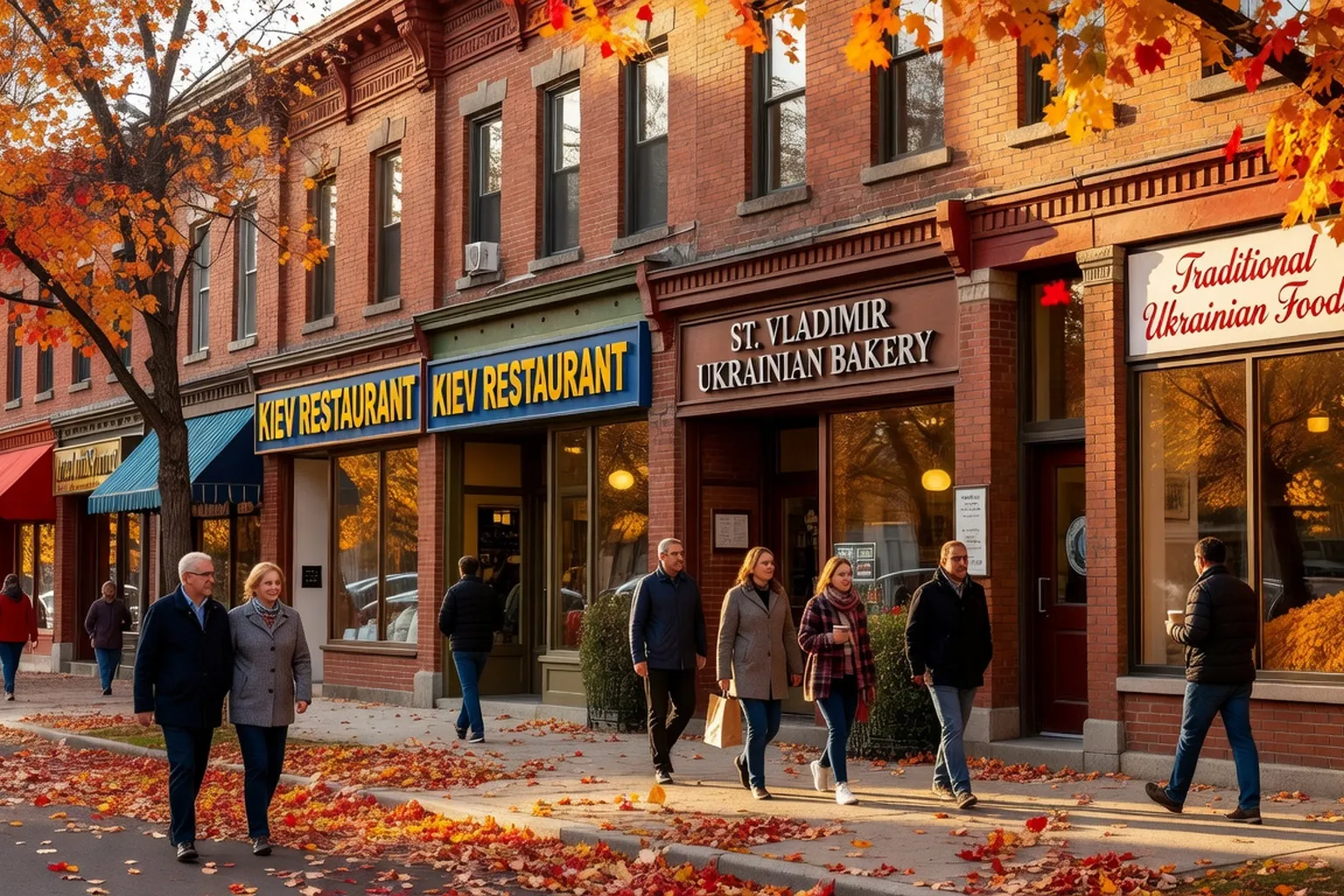
Bloor West Village Toronto street scene with Ukrainian shops.
The 504 King and 506 Carlton streetcars thread through Roncesvalles, making the strip easy to reach from anywhere in the west end. Along the avenue, you will find half a dozen European delis stocking smoked meats, pickled vegetables, rye breads and Eastern European candies. Sit-down restaurants serve what many locals simply call "Slavic comfort food," with borscht, cabbage rolls, potato pancakes and stuffed dumplings appearing on the same menu without apology or fuss.
The residential streets east of Roncesvalles, including Geoffrey, Galley and Constance, have housed Ukrainian families since the postwar decades. Many remain in the hands of second- and third-generation descendants who grew up attending St. Casimir's Polish parish a few doors down from their own Ukrainian Orthodox or Catholic church. The Polish-Ukrainian blending here is not just culinary. It is woven into how the neighbourhood works day to day.
For newer arrivals, Roncesvalles offers a gentler introduction to Toronto than the downtown core. Cafes and bookstores cluster alongside the delis, the Revue Cinema anchors an arts-oriented crowd, and High Park lies only a short walk away. Ukrainian families who want the amenity mix of a walkable neighbourhood without paying Bloor West prices often land on side streets here, commuting north to Bloor West parishes on Sundays and doing daily shopping on Roncesvalles itself.
Etobicoke and Islington: Suburban Ukrainian Hubs
West of the Humber River, Etobicoke offers the suburban counterpoint to Bloor West Village. Postwar Ukrainian tradespeople moved here in the 1950s and 1960s, buying modest bungalows along Royal York Road, Islington Avenue and Kipling Avenue. They built churches, community halls and schools in the surrounding side streets, and their grandchildren still fill those same pews and dance floors today.
Ukrainian Canadian Social Services, one of the most important settlement agencies for the community, operates offices in Etobicoke and provides counselling, employment support and help with government paperwork in Ukrainian. Several community halls host weekend dance practices, Saturday schools and adult language classes, and the area's churches run their own parallel ecosystem of clubs and youth groups.
The suburban character of Etobicoke has also made it attractive to newer waves of Ukrainian immigration. Families arriving through CUAET after 2022 often gravitate toward the high-rise apartment corridors near Kipling and Islington subway stations, where rents remain more accessible than in the downtown core and where existing Ukrainian-language services make settlement easier. For a deeper look at the broader Ukrainian community in Toronto, our dedicated overview maps the full network of organizations.
High Park and West End: Where Families Settle
Between Bloor West Village and Roncesvalles sits High Park itself, Toronto's largest west-end green space, and the residential streets that surround it. This is where Ukrainian families with children tend to settle once they can afford to leave the rental market behind. The draw is obvious: the park offers 400 acres of forest, ponds, tennis courts and a zoo, all free and a short walk from home.
Several Ukrainian Catholic elementary schools operate in the west end, teaching the full Ontario curriculum alongside Ukrainian language, religion and cultural studies. Parents who send their children there often do so for three generations running, building tight friendship networks across the Ukrainian-Canadian professional class that dominates the surrounding streets. After school, those same children funnel into Plast Ukrainian Youth Association meetings, folk dance rehearsals with local ensembles, or choir practice at parish halls.
The residential housing stock here is older and more expensive than in Etobicoke, with single-family Victorian and Edwardian homes commanding prices well above the Toronto average. That means the High Park cluster skews toward established professionals, often with grandparents who bought in decades ago and passed property down through the family.
Weekends here revolve around the park. Soccer leagues run by Ukrainian community organizations use the fields in summer, outdoor skating at the nearby Grenadier Pond rink fills winter Saturdays, and the park's annual Shakespeare in High Park productions draw multigenerational Ukrainian families who treat the outings as a chance for grandparents and grandchildren to share the same cultural experience. The park, in effect, has become the community's shared backyard.
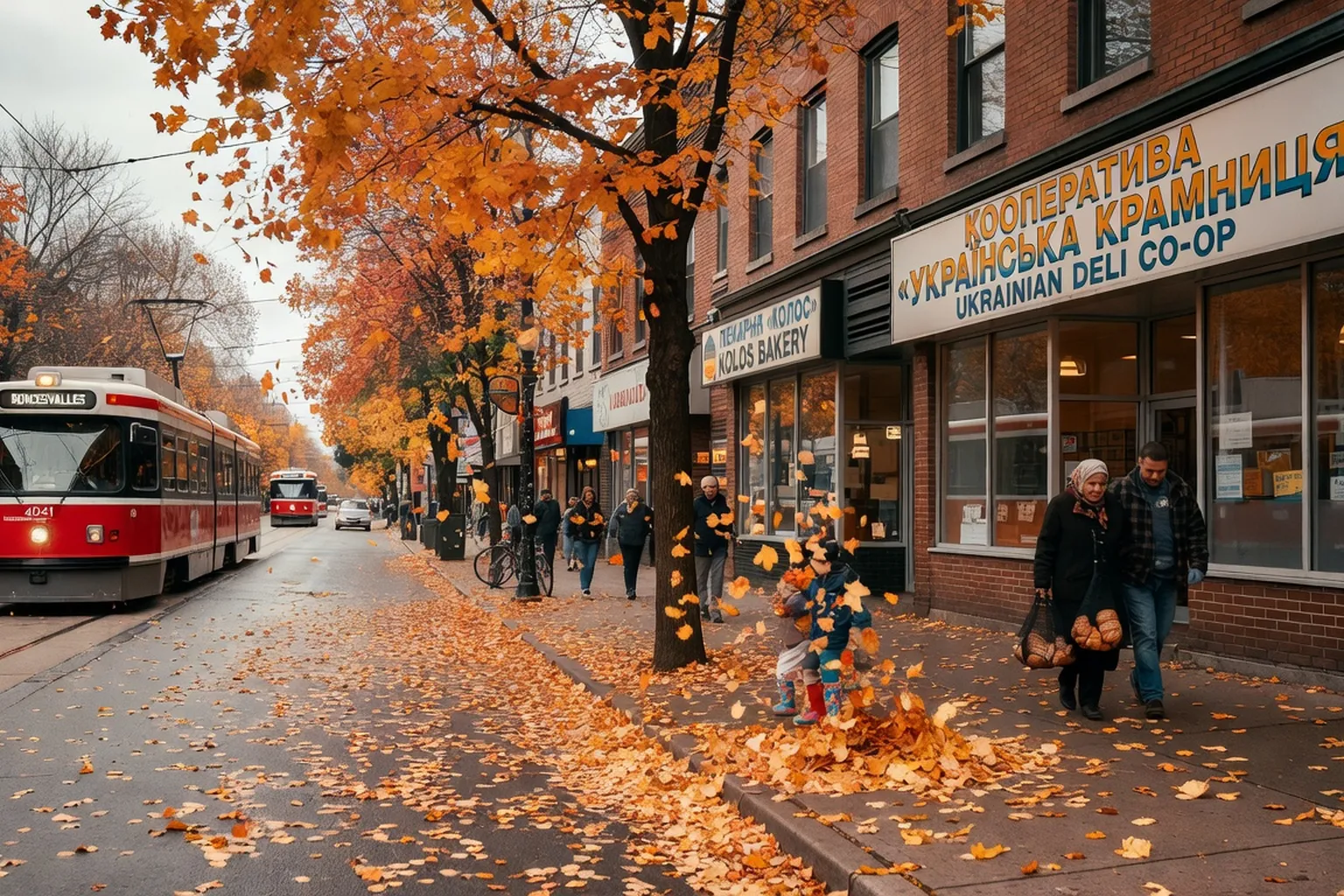
Roncesvalles Avenue Toronto streetcar and Ukrainian storefronts.
St. Clair West and North York: Growing Communities
North of Bloor, the Ukrainian presence along St. Clair West has been steady for decades, with the stretch near Bathurst Street serving as a secondary cultural hub. St. Andrew's Ukrainian Orthodox Cathedral stands on Bathurst just south of St. Clair, and several community organizations cluster in nearby halls and office buildings. This corridor tends to draw professionals who want to stay close to the subway without paying Bloor West prices.
Further north, the Bathurst-Finch-Steeles corridor in North York has become the epicentre of the post-2022 Ukrainian arrivals. Apartment towers along Bathurst between Sheppard and Steeles have filled with CUAET families, drawn by relatively affordable rents by Toronto standards, good TTC connections via the Yonge-University line and multiple bus routes, and the presence of other Ukrainian families navigating the same settlement process.
The informal infrastructure here is remarkable. Ukrainian-language playgroups meet in community centre rooms, WhatsApp and Telegram groups with thousands of members coordinate everything from furniture giveaways to ride-shares, and small Ukrainian-owned businesses, including accounting practices, dental clinics and immigration consultants, have opened along Bathurst and Wilson to serve the growing population. Weekend Ukrainian schools operate out of rented church halls, teaching hundreds of children whose parents arrived in the past three years.
The contrast with Bloor West Village is striking. Where the historic core is anchored by visible institutions built across seventy years, the Bathurst corridor is held together by a dense web of informal networks that barely existed five years ago. Neither map is complete without the other, and many community organizers now spend their weeks shuttling between the two, running English-language programs at established cultural centres on Tuesdays and Ukrainian-language settlement workshops in North York rec rooms on Thursdays.
Churches and Cultural Centres
The spiritual backbone of Ukrainian Toronto is the network of Orthodox and Greek Catholic parishes that spans the GTA. Each one serves as a cultural institution as much as a place of worship, hosting language classes, youth groups, bazaars and charitable drives. For a full tour of these institutions across the country, our article on Ukrainian churches in Canada provides the national context.
The most prominent parishes in Toronto include:
- St. Demetrius the Great Martyr Ukrainian Orthodox Church, the cornerstone of Bloor West Village Orthodox life
- St. Andrew's Ukrainian Orthodox Cathedral on Bathurst Street, the seat of the local Orthodox hierarchy
- St. Josaphat Ukrainian Catholic Cathedral on Franklin Avenue in Etobicoke, the flagship Greek Catholic parish
- St. Nicholas Ukrainian Catholic Church, serving families across the west end
- St. Volodymyr Ukrainian Orthodox Cathedral, whose golden domes are a west-end landmark
Alongside the churches, secular cultural centres carry much of the community's educational and artistic work. The Ukrainian Canadian Congress (UCC), Toronto Branch coordinates advocacy and programming across dozens of affiliated organizations. The St. Volodymyr Institute on Pears Avenue hosts lectures, film screenings and a residence for Ukrainian students. The Ukrainian National Federation hall on College Street runs a library and event programming that stretches back generations. And the Ukrainian Canadian Art Foundation in Bloor West Village maintains the community's most important visual art collection in Canada.
Food and Restaurants: Where to Find Ukrainian Cuisine
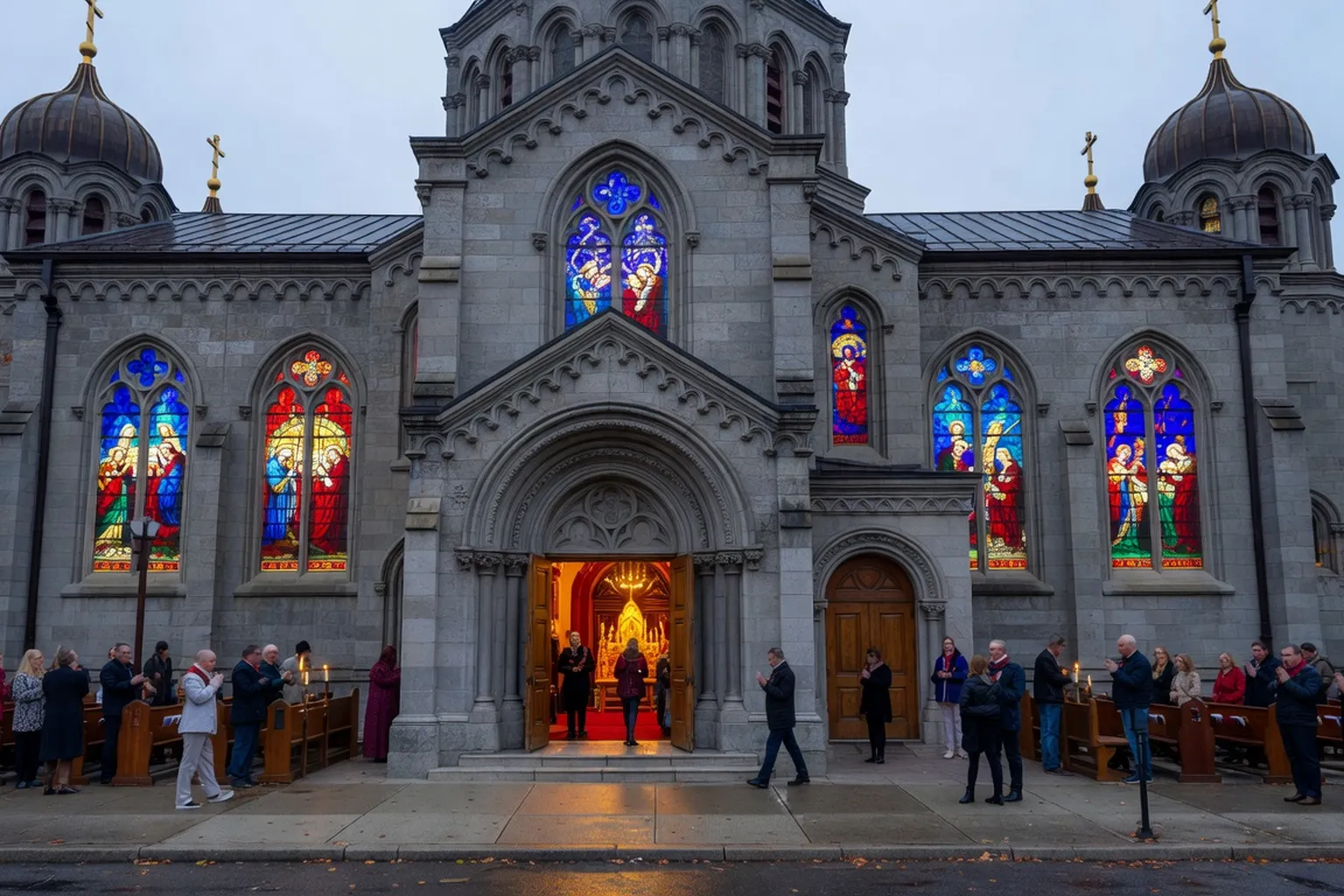
Ukrainian Catholic cathedral in Toronto with stained glass.
Ukrainian food in Toronto splits roughly along three axes: sit-down restaurants with traditional menus, European delis selling ingredients and prepared foods, and bakeries specializing in breads and pastries. All three genres concentrate heavily around Bloor West Village and Roncesvalles, with scattered outposts along Bathurst Street and in Mississauga.
On the restaurant side, Future Bakery on Bloor West has been a fixture for decades, serving varenyky, cabbage rolls and borscht alongside its enormous pastry counter. Ukrainian Caravan Restaurant, also on Bloor West, offers a more formal sit-down experience with a traditional menu that has barely changed in forty years. Several other spots, including smaller family-run operations in the side streets, round out the options for visitors looking for a plate of classic Ukrainian comfort food. For the national picture, see our guide to Ukrainian food in Canada.
The delis are where daily life happens. Along Roncesvalles, half a dozen European grocery stores stock imported kovbasa, smoked hams, pickled vegetables, dairy products and Ukrainian candies. Customers come in with shopping lists passed down from their grandmothers and leave with bags heavy enough to need help carrying. The bakeries add the third leg of the stool, turning out paska at Easter, kutia for Christmas Eve and everyday breads year round. For Toronto services, real estate and business connections across the Canadian-Ukrainian network, the Toronto services and Canadian-Ukrainian business directory offers a useful starting point.
For a broader look at the category landing page, the Ukrainian section of this site maps every related article, from immigration history to church directories and food guides. Together, the neighbourhoods, churches, cultural centres and restaurants described above form an ecosystem that has sustained Ukrainian identity in Toronto for more than a hundred years, and shows every sign of continuing to thrive through the next century.