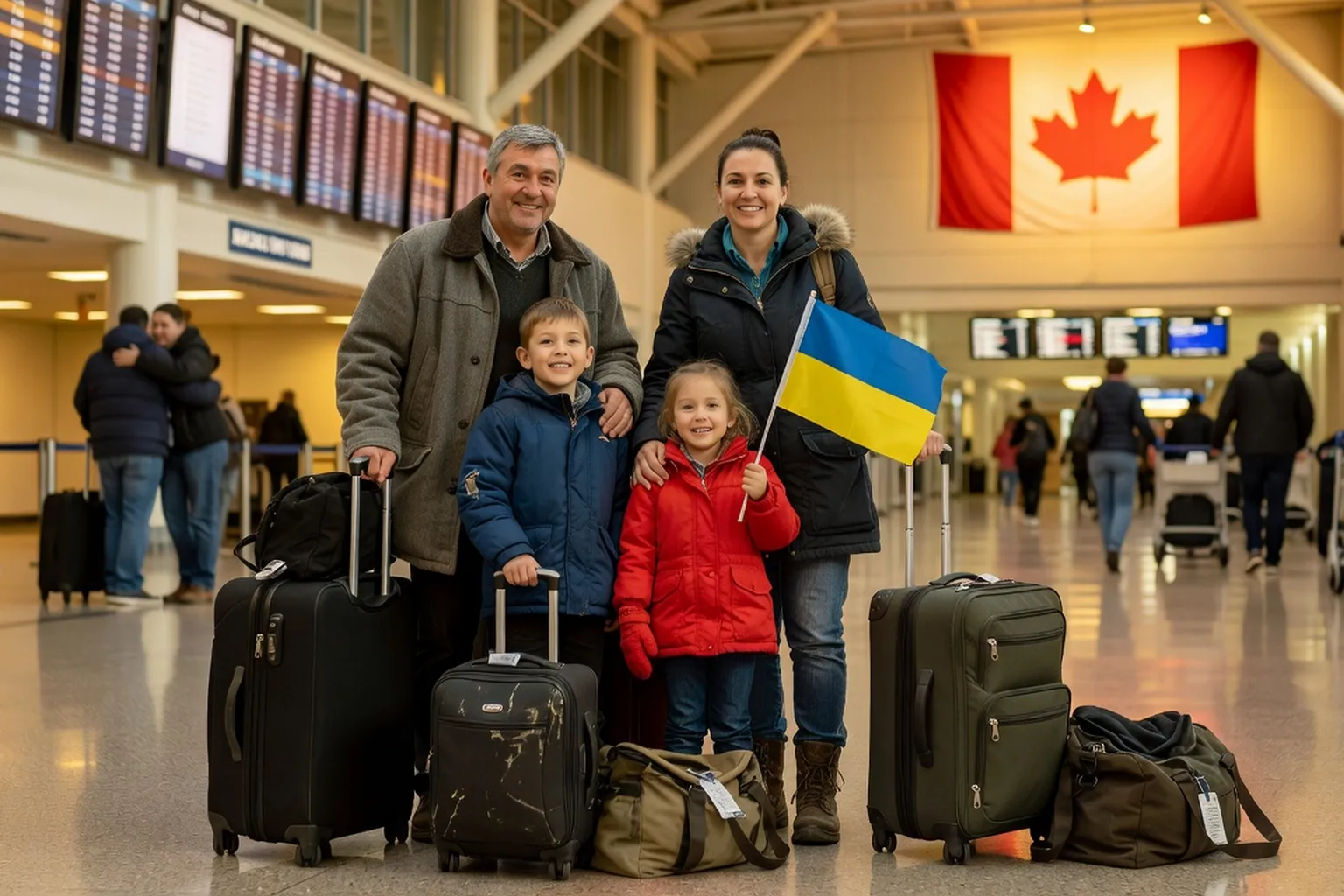
Ukrainian family arriving at Toronto Pearson airport.
In brief: By April 2026, more than 298,000 Ukrainians had arrived in Canada under the CUAET program, out of 1.19 million applications processed since March 2022. Ontario, Alberta and British Columbia absorbed roughly 70 percent of arrivals. Employment rates among working-age arrivals reached approximately 60 percent within the first year, and tens of thousands of children are now enrolled in Canadian schools. With CUAET closed to new applications since March 2024, attention has shifted to permanent residence pathways.
The CUAET Program: A Unique Humanitarian Response
The Canada-Ukraine Authorization for Emergency Travel, commonly known as CUAET, was announced on 3 March 2022, nine days after the beginning of the full-scale Russian invasion of Ukraine. Designed by Immigration, Refugees and Citizenship Canada (IRCC) as a temporary, visa-based emergency measure, it allowed Ukrainians and their family members to come to Canada outside of the conventional refugee resettlement framework. Unlike the Private Sponsorship of Refugees program or the Government-Assisted Refugees stream, CUAET did not require United Nations Convention refugee status, medical inadmissibility waivers for common conditions, or traditional sponsorship undertakings.
Applicants received a Canadian temporary resident visa valid for up to three years, along with an open work permit for adults and a study permit for children. The policy was extraordinary for three reasons. First, it bypassed the biometric processing queue, with most applications decided within fourteen days during the first year. Second, it allowed recipients to travel to any province or territory and choose their own housing. Third, it was explicitly temporary: arrivals were not granted permanent residence or a guaranteed path to it, a design choice that continues to shape debates about integration in 2026.
CUAET closed to new applications on 31 March 2024. Ukrainians already in Canada under the program have continued to benefit from permit extensions, with open work permit renewals and study permit extensions available through 31 March 2026. A separate, narrower CUAET permanent residence pathway launched in October 2023 specifically for those with close Canadian family members. A broader overview of the program's four-year arc is available in our article Ukrainian refugees in Canada from 2022 to 2026. For the full breakdown of CUAET eligibility, current status and 2026 alternatives, see our complete 2026 CUAET guide explaining eligibility and pathways for Ukrainians in Canada. Among CUAET arrivals with professional training, physicians and nurses face a particular obstacle documented in our piece on Ukrainian-Canadian healthcare workers and the credential-recognition challenge.
Arrivals Timeline 2022-2026
The trajectory of CUAET arrivals tracked closely with the military situation in Ukraine and Canada's administrative capacity. The first arrivals landed in Toronto and Montreal in late March 2022. By the end of June 2022, approximately 40,000 Ukrainians had already reached Canada. Volumes peaked between August 2022 and March 2023, when between 15,000 and 25,000 arrivals were recorded each month. A second, smaller wave followed in the summer of 2023, driven by renewed fighting in eastern Ukraine and the expansion of the program's eligibility for family members.
After the closure of new applications in March 2024, arrival numbers tapered sharply but did not stop: applicants approved before the deadline retained the right to travel to Canada throughout 2024 and 2025. The table below summarizes the year-by-year flow, drawing on figures published by IRCC and cross-referenced against provincial settlement agency reports.
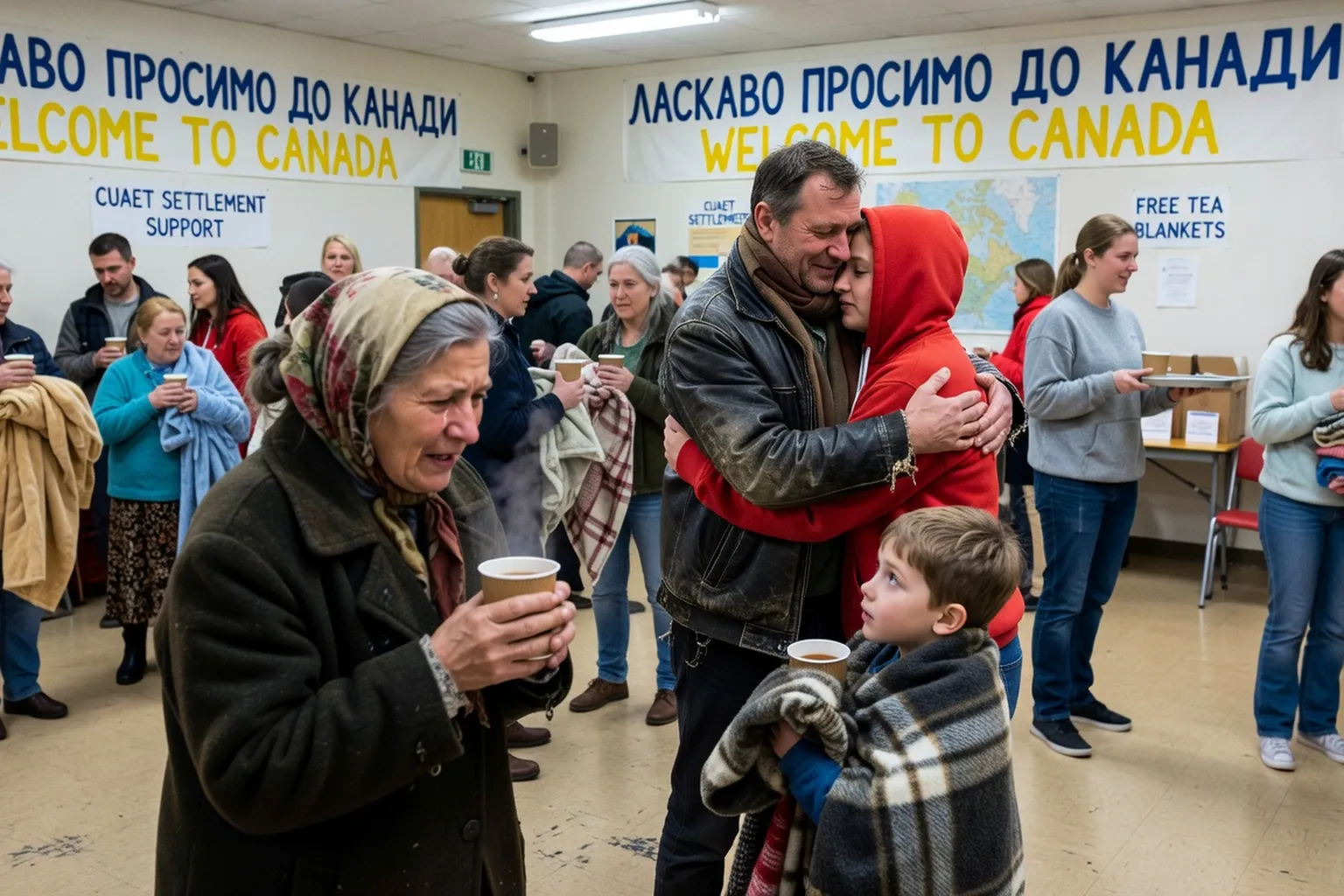
Ukrainian CUAET refugees welcomed by Canadian volunteers.
| Year | Applications Received | Arrivals in Canada | Permit Extensions Granted |
|---|---|---|---|
| 2022 (Mar-Dec) | ~724,000 | ~133,000 | Not applicable |
| 2023 | ~298,000 | ~89,000 | ~12,000 |
| 2024 | ~145,000 (closed 31 Mar) | ~52,000 | ~48,000 |
| 2025 | 0 new applications | ~18,000 | ~74,000 |
| 2026 (Jan-Apr) | 0 new applications | ~6,000 | ~31,000 |
| Total | ~1,190,000 | ~298,000 | ~165,000 |
The large gap between applications received and arrivals recorded reflects several factors. Many applicants secured the option of coming to Canada as an insurance policy but ultimately remained in Ukraine or moved to other European countries, particularly Poland, Germany and the Czech Republic where initial displacement routes were shorter and more immediate. Others had their applications refused or withdrew them after family situations changed. IRCC processed most files within the two-week target during the first year, though wait times lengthened to four to six weeks by the middle of 2023 as the volume of applications continued to grow.
Monthly breakdowns show that March to August 2022 accounted for roughly 48 percent of all arrivals across the full four-year period. This initial surge placed extraordinary pressure on federal and provincial intake infrastructure. Toronto Pearson International Airport and Montreal-Trudeau International Airport handled the majority of arrivals, with dedicated reception areas staffed by Service Canada agents, Red Cross volunteers and Ukrainian Canadian Congress representatives. Temporary hotel accommodations were activated in Toronto, Vancouver, Calgary and Winnipeg through federal cost-sharing agreements with provincial governments. The federal one-time transitional financial assistance payment of 3,000 Canadian dollars per adult and 1,500 per child helped stabilize households in their first weeks, though it expired for new applicants at the end of March 2024.
Province-by-Province Breakdown
Settlement patterns across Canada followed a combination of existing diaspora geography, labour market conditions and, for a minority of arrivals, the presence of sponsoring family members. The Prairie provinces, historically home to the largest concentration of Ukrainian Canadians, received a disproportionate share of arrivals relative to their total population. Quebec, by contrast, received fewer arrivals than its demographic weight would suggest, partly because the program did not require French language skills and partly because existing Ukrainian community infrastructure in the province is thinner than elsewhere.
| Province / Territory | Approximate Arrivals | Share of Total |
|---|---|---|
| Ontario | ~104,000 | 35% |
| Alberta | ~60,000 | 20% |
| British Columbia | ~45,000 | 15% |
| Quebec | ~30,000 | 10% |
| Manitoba | ~21,000 | 7% |
| Saskatchewan | ~15,000 | 5% |
| Nova Scotia | ~10,000 | 3% |
| New Brunswick | ~6,000 | 2% |
| Newfoundland, PEI, Territories | ~7,000 | 3% |
| Total | ~298,000 | 100% |
Within Ontario, the Greater Toronto Area absorbed the largest share, with significant secondary concentrations in Ottawa, Hamilton and Windsor. Alberta's arrivals clustered in Edmonton and Calgary, with notable settlement in smaller agricultural communities such as Vegreville and Mundare, where Ukrainian heritage has deep historical roots. British Columbia's cohort is concentrated in the Lower Mainland, especially Surrey, Richmond and Burnaby, as well as on Vancouver Island. Manitoba's arrivals are overwhelmingly located in Winnipeg, the traditional heart of Ukrainian Canadian institutional life.
Saskatchewan's Ukrainian CUAET arrivals settled primarily in Saskatoon and Regina, alongside smaller rural communities such as Yorkton and Canora that retain strong historical Ukrainian identities. Nova Scotia welcomed a larger than expected cohort relative to its population, thanks in part to Halifax's proactive municipal welcome strategy and the province's deliberate effort to funnel newcomers toward healthcare and hospitality sectors facing acute labour shortages. New Brunswick, Prince Edward Island and Newfoundland each received smaller but demographically significant groups, with community sponsorship networks playing a disproportionately large role in these provinces compared to the larger urban jurisdictions.
Quebec's smaller share of 10 percent reflects several structural factors. CUAET did not require Quebec-specific immigration selection, but provincial settlement services operate largely in French, and federally funded language training for adult newcomers in Quebec is delivered primarily through the francization program. For Ukrainian arrivals with prior English study but no French, the province posed practical barriers to rapid labour market entry. Nevertheless, Montreal, Quebec City and Gatineau each host active Ukrainian community organizations, and a growing subset of arrivals have pursued francization pathways toward Quebec permanent residence through the Programme de l'experience quebecoise and the Programme regulier des travailleurs qualifies.
Integration Outcomes: Housing, Work, Schooling
Four years into the program, integration outcomes present a mixed but generally positive picture. What securing that housing actually involves is set out in our [2026 rental market guide for Ukrainian newcomers](/canada/ukrainian-newcomers-housing-rental-market-canada-2026/). Provincial settlement agencies report that most CUAET arrivals secured stable housing within six months, though the transition was often from temporary hotel placements and host family arrangements to long-term rentals. In Ontario and British Columbia, housing affordability remains the single largest stressor identified in community surveys, with families reporting that rent consumes 40 to 55 percent of household income in urban centres.
On the employment front, approximately 60 percent of working-age CUAET holders found paid work within their first twelve months in Canada, a rate that compares favourably with other recent newcomer cohorts. Sectors of concentration include logistics and warehousing, food service, construction, information technology, healthcare support roles and, increasingly, entrepreneurial ventures. Women's labour force participation has been lower than men's in the first year but has caught up significantly by year two, once childcare arrangements stabilized and language training took effect.

Ukrainian newcomer starting first day at Canadian workplace.
Schooling has been one of the clearer success stories. Provincial ministries of education estimate that more than 50,000 Ukrainian children are currently enrolled in Canadian public schools, with the highest concentrations in Toronto District School Board, Edmonton Public Schools, and the Calgary Board of Education. Many school boards created dedicated settlement workers and provided Ukrainian-speaking liaison staff. Reading outcomes for Ukrainian students tracked somewhat below provincial averages in the first two years but have been closing the gap in 2025 and 2026.
Federally funded language training programs enrolled approximately 120,000 adult CUAET holders in English or French as a Second Language classes between 2022 and 2025. Completion rates for Canadian Language Benchmark Level 4 and above stand at roughly 68 percent, with regional variation tied to the availability of in-person classes versus online-only options. For a broader perspective on immigrant adaptation patterns in Canada, see our guide on how to immigrate to Canada from Ukraine.
Current Status in 2026: Permanent Residence Pathways
As the final CUAET work and study permits approach their March 2026 expiry dates, the central policy question has shifted from arrival to long-term status. IRCC has made several pathways available to CUAET holders who wish to remain in Canada permanently. The most specialized is the CUAET PR Pathway for Family Reunification, launched in October 2023 and continuing in 2026, which allows eligible CUAET holders with Canadian spouses, parents, grandparents, children, siblings or grandchildren to apply for permanent residence under a streamlined process.
Beyond the dedicated pathway, the Express Entry system remains open to CUAET holders who meet the criteria for the Federal Skilled Worker Program, the Canadian Experience Class or the Federal Skilled Trades Program. Given that most CUAET arrivals accumulated at least a year of Canadian work experience before their permits began to expire, the Canadian Experience Class has been a particularly accessible route. Provincial Nominee Programs in Manitoba, Saskatchewan, Alberta, Ontario, British Columbia and Atlantic Canada have also introduced Ukrainian-specific streams or allocated priority processing to CUAET holders meeting regional labour needs.
By April 2026, IRCC statistics suggest that roughly 75,000 CUAET holders have transitioned to permanent residence through one of these channels, a further 90,000 have active applications in progress, and an estimated 50,000 are still weighing their options or extending their temporary status. The remaining arrivals have either returned to Ukraine, moved to third countries, or in smaller numbers pursued refugee protection claims inside Canada.
Challenges and Support Resources
Despite generally positive integration outcomes, Ukrainian arrivals face persistent challenges. Credential recognition remains the single most frequently cited barrier for skilled professionals. Doctors, engineers, nurses, teachers and accountants trained in Ukraine encounter provincial licensing regimes that can require years of bridging education, supervised practice and standardized testing. Provincial governments in Ontario, British Columbia and Alberta introduced accelerated credential assessment programs in 2023 and 2024, but waiting times and costs continue to frustrate many highly qualified arrivals.
Language proficiency, particularly at the advanced level required for regulated professions and managerial roles, remains an ongoing investment. While conversational English comes quickly for many younger arrivals, the gap between functional English and Canadian workplace fluency takes on average three to five years of sustained exposure and formal study to close. Mental health and trauma-related concerns have also been significant, with community organizations reporting elevated rates of anxiety, grief and post-traumatic stress, particularly among those with family members still in active conflict zones.
Community support networks have been indispensable. The Ukrainian Canadian Congress, with its national office in Winnipeg and provincial branches across Canada, coordinated volunteer efforts, humanitarian shipments and advocacy to the federal government throughout the CUAET period. Regional settlement agencies such as COSTI Immigrant Services in Ontario, MOSAIC in British Columbia and the Edmonton Mennonite Centre for Newcomers in Alberta expanded Ukrainian-specific programming, hiring Ukrainian-speaking staff and launching targeted employment workshops. For ongoing community resources oriented toward the Ukrainian diaspora, the Ukrainian Canadian community resource for Prince Edward Island provides genealogy and settlement support. A fuller portrait of the national community is available in our article on the community of Ukrainians in Canada.
What Comes Next: 2027 and Beyond
The post-CUAET policy landscape is still taking shape. As of April 2026, the federal government has not announced a comprehensive successor program, but several partial measures are under active consideration. These include a possible time-limited extension of open work permits for Ukrainians who arrived near the end of the CUAET window and who need more time to qualify for permanent residence, as well as targeted provincial pilots aimed at retaining Ukrainian healthcare workers and skilled tradespeople in smaller communities facing labour shortages.
For the majority of CUAET holders who will transition to permanent residence over the next twelve to twenty-four months, the expected trajectory is familiar from the experience of previous waves of newcomers: sustained labour market integration, citizenship applications beginning to peak around 2027 and 2028 (on the standard three-year residency requirement after PR grant), and the gradual entrenchment of a new generation of Ukrainian Canadians in the country's civic, economic and cultural life. A minority, estimated at between 10 and 20 percent based on current indicators, will return to Ukraine if and when security conditions permit, contributing to the post-war reconstruction effort with skills and capital accumulated in Canada.
What is already clear is that the 2022-2026 wave has permanently reshaped the Ukrainian Canadian community. It has added nearly 300,000 people to a diaspora that previously numbered roughly 1.4 million, it has renewed the vitality of Ukrainian-language institutions in cities where they had been aging, and it has embedded Canada more deeply than ever before into the network of Western countries that will shape Ukraine's long-term future.