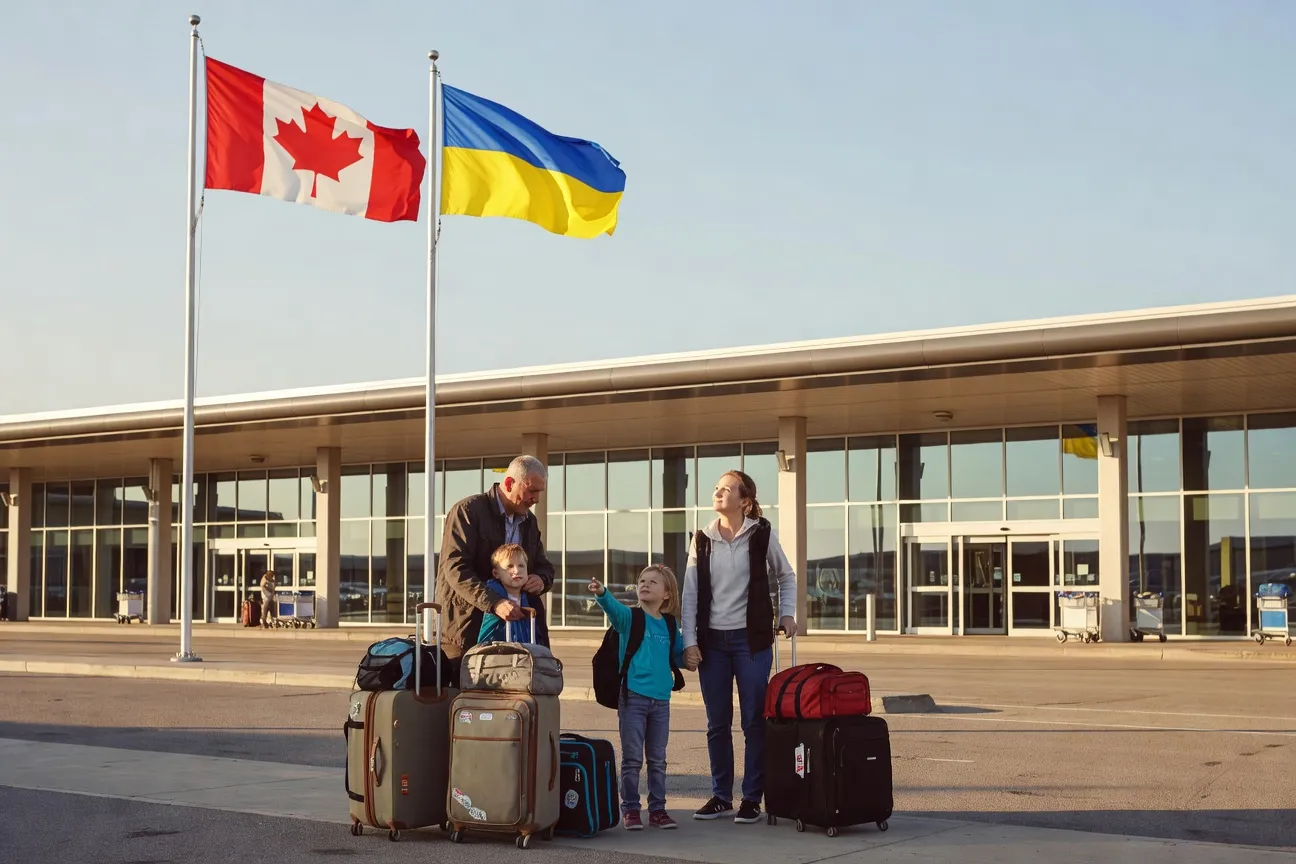
Ukrainian family arriving at a Canadian airport under CUAET.
What Is CUAET? The Emergency Authorization Explained
The Canada-Ukraine Authorization for Emergency Travel—universally known by its acronym CUAET—was a special federal immigration measure introduced by Immigration, Refugees and Citizenship Canada (IRCC) on March 17, 2022, just three weeks after Russia’s full-scale invasion began on February 24, 2022. It was, by any measure, an unprecedented response: a free, fast-tracked pathway that gave Ukrainian nationals and their immediate family members the right to live, work, and study in Canada for up to three years.
Unlike Canada’s conventional immigration streams, CUAET was not subject to caps, quotas, or the lengthy processing timelines that typically characterize temporary resident applications. The government waived application fees entirely and committed to processing most applications within a matter of weeks. Applicants did not need a job offer, a language test, or an educational credential assessment. The only hard requirements were Ukrainian nationality (or qualifying family ties to a Ukrainian national) and a valid travel document.
Upon arrival, CUAET holders were automatically authorized to work without a separate work permit, and their children could enrol in Canadian schools immediately. The program also included access to federally funded settlement services—language training, employment assistance, and community integration support—that are normally reserved for government-assisted refugees. In practical terms, CUAET gave its beneficiaries a status nearly identical to that of a refugee, but without the refugee determination process and with considerably greater speed. For CUAET arrivals with medical training, that speed of entry has not translated into an equally fast route into practice; see our analysis of the credential-recognition challenge facing Ukrainian-Canadian healthcare workers.
The policy rationale was both humanitarian and strategic. Canada has the largest Ukrainian diaspora outside of Europe, with an estimated 1.4 million Canadians of Ukrainian descent. That deep-rooted community, spread across the Prairies, Ontario, and British Columbia, meant Canada had both the social infrastructure and the political will to absorb large numbers of Ukrainians rapidly. The Ukrainian community in Canada mobilized to provide housing, employment connections, and cultural support on a scale that few other countries could replicate.
Finding somewhere to live has proved one of the hardest parts of that arrival, as our [guide to the rental market for Ukrainian newcomers](/canada/ukrainian-newcomers-housing-rental-market-canada-2026/) sets out. The program was also deliberately designed to be temporary—a humanitarian bridge, not a permanent settlement scheme. The word “emergency” in its name was intentional. Canadian officials expected that many Ukrainians would return home once conditions allowed. That expectation has proven only partially correct, with a significant proportion of CUAET arrivals indicating they wish to remain in Canada permanently.
Is CUAET Still Active in 2026? Current Status
The short answer is no—not for new applicants. CUAET officially closed to new applications on July 15, 2023. The federal government made a deliberate decision not to extend the intake period, citing the program’s extraordinary scope and the need to transition toward longer-term policy frameworks for Ukrainian arrivals.
However, “closed” does not mean irrelevant in 2026. Three important realities shape the current picture:
Existing CUAET status holders are still in Canada. Depending on when they arrived and whether they received one-, two-, or three-year authorizations, many CUAET holders still have valid status in 2026. Some received authorizations extending to 2025 or even 2026. These individuals are legally present, employed, and in many cases deeply integrated into Canadian communities.
Status expiry is creating urgency. A significant wave of CUAET statuses began expiring in 2024 and continues through 2025 and 2026. Holders whose status has lapsed or is about to lapse face a critical decision window: apply for an extension, transition to another immigration category, or depart Canada. Federal policy guidance has evolved repeatedly, and applicants are strongly encouraged to consult an authorized immigration representative for their specific situation.
Federal policy remains in flux. The Canadian government has signalled ongoing concern for Ukrainian nationals in Canada and has introduced transitional measures, including facilitated access to Temporary Resident Permits (TRPs) for those whose CUAET status has expired. The political commitment to supporting Ukrainians has not wavered, even as the formal CUAET mechanism is closed. Reviewing the Canadian immigration pros and cons in today’s context illustrates just how uniquely generous Canada’s response to the Ukrainian crisis has been compared to other receiving countries.
For anyone monitoring the situation in 2026, the key watchword is transition. CUAET as an intake vehicle is finished; the challenge now is converting a temporary emergency measure into durable legal status for those who have built lives in Canada.
Eligibility: Who Can Apply for CUAET
Although CUAET is closed to new applicants, understanding the eligibility criteria remains important for several reasons: it determines whether someone’s existing status is valid, and it informs which transitional programs a person may access in 2026.
CUAET was available to the following categories of people:
Ukrainian nationals. Any person holding Ukrainian citizenship was eligible, regardless of where they were physically located when applying. Ukrainians who had been living abroad before the invasion—in Poland, Germany, the United States, or elsewhere—could apply, provided they could demonstrate their Ukrainian nationality through a valid passport or other official documentation.
Stateless persons habitually resident in Ukraine. Individuals who were stateless but had been residing in Ukraine prior to the invasion were also eligible, reflecting the complex reality of post-Soviet statelessness in the region.
Immediate family members of eligible Ukrainians. This category was broadly defined and included spouses and common-law partners (regardless of nationality), dependent children, parents, grandparents, and siblings. A Canadian citizen or permanent resident with an immediate Ukrainian family member could also sponsor that person through the CUAET mechanism.
Extended family members under discretionary authority. IRCC retained some discretionary authority to approve extended family members on humanitarian and compassionate grounds, though this pathway was less clearly defined and less commonly used.
Crucially, CUAET had no income requirements, no language test, no educational threshold, and no job offer requirement. Biometric information was required (fingerprints and photographs), and all applicants were subject to security screening and health checks—standard requirements for any Canadian temporary resident.
Step-by-Step Application Process
The CUAET application process was designed for speed and accessibility, acknowledging that applicants were often fleeing an active conflict zone with limited time and resources. While the intake period is now closed, documenting the process helps current CUAET holders understand how their authorization was granted and what documentation they should retain.
Step 1: Determine eligibility. Applicants first confirmed they were Ukrainian nationals, stateless persons habitually residing in Ukraine, or qualifying family members. Documentary evidence of Ukrainian citizenship—typically a Ukrainian passport—was the primary requirement.
Step 2: Gather required documents. Beyond proof of nationality, applicants needed a valid travel document (passport or equivalent), biometric enrolment (either previously collected by IRCC or completed at a Visa Application Centre), and documents supporting any family relationship claims (marriage certificates, birth certificates, etc.).
Step 3: Submit the online application. Applications were submitted via IRCC’s secure online portal. IRCC also established in-person collection points at Canadian border crossings to accommodate people arriving directly from Ukraine via land borders—primarily those crossing through Poland and then into Canada. Paper applications were accepted at ports of entry for those without internet access.
Step 4: Await processing. IRCC committed to processing CUAET applications within weeks rather than the months or years typical of other streams. Many applications received approval within two to four weeks. Processing times varied by volume; at peak periods in mid-2022, some applications took slightly longer.
Step 5: Receive authorization and travel to Canada. Approved applicants received a CUAET letter confirming their status. Upon arrival at a Canadian port of entry, they were issued a Visitor Record confirming their authorization to stay, work, and study for up to three years.
Step 6: Access settlement services. Once in Canada, CUAET holders were connected to federally funded settlement service providers, including language training programs (primarily LINC—Language Instruction for Newcomers to Canada), employment services, and community orientation programs. For travel resources for Ukrainians coming to Canada, a range of practical guides exists to help newcomers navigate their first weeks and months.
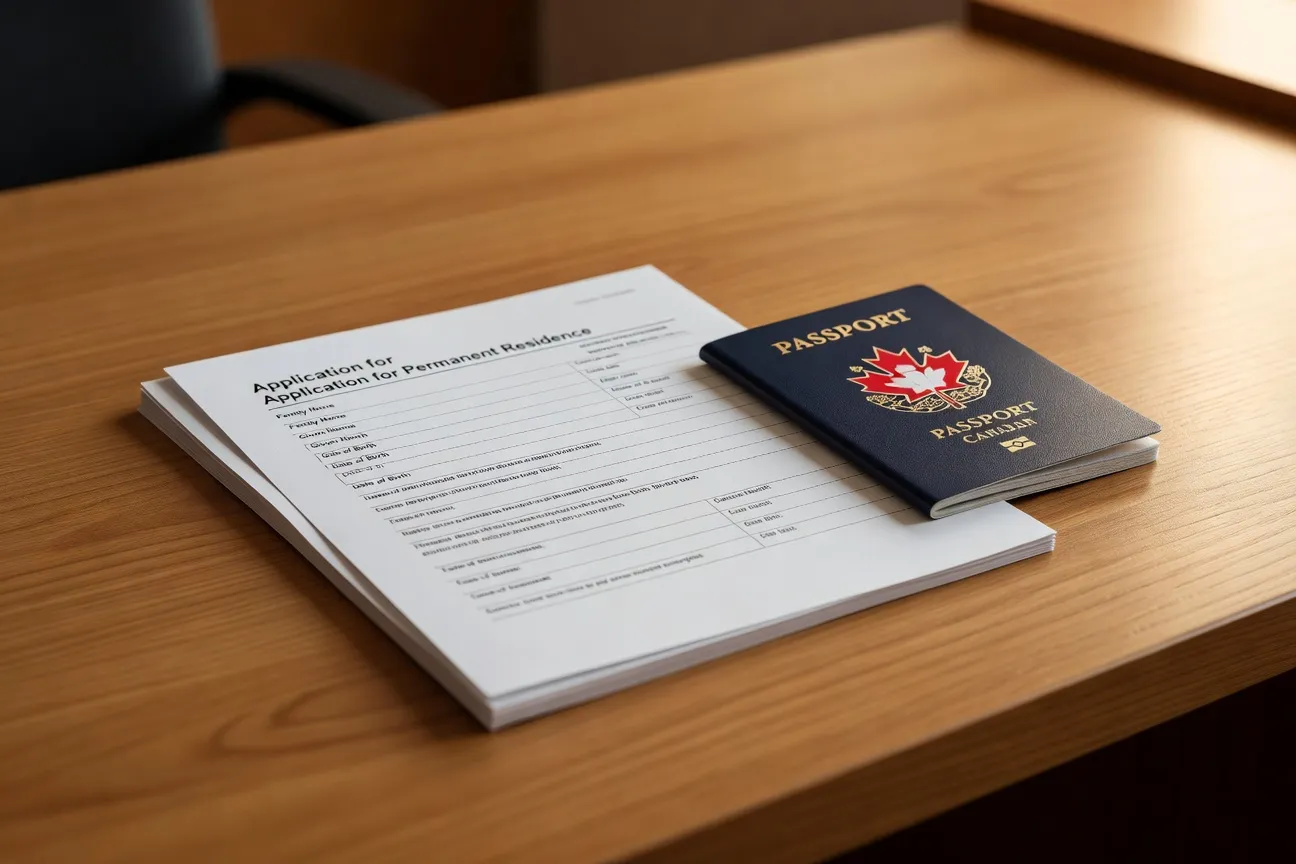
CUAET application form and Canadian immigration documents.
CUAET vs Regular Canadian Immigration Pathways
To understand why CUAET was so significant, it is instructive to compare it against Canada’s regular immigration mechanisms. The contrast reveals both the generosity and the deliberate exceptionalism of the measure.
Canada’s standard temporary resident streams—Visitor Visas, Temporary Foreign Worker permits, and International Mobility Program permits—typically require several weeks to several months of processing, involve application fees ranging from $100 to $1,000 or more, and often require employer sponsorship or demonstrated ties to one’s home country. Work authorization under a visitor visa is categorically prohibited under normal circumstances.
The refugee determination system, administered by the Immigration and Refugee Board (IRB), is another avenue for Ukrainians—but it is far slower and less certain. Refugee claimants in Canada can wait two to three years for their hearing, are subject to the Safe Third Country Agreement (which, depending on travel route, may affect eligibility), and live with considerable uncertainty about the outcome.
CUAET, by contrast, was free, fast, comprehensive, and came with immediate work and study authorization. It was arguably the most favourable temporary status Canada has ever offered to a specific national group. The trade-off is that it was explicitly temporary, and the absence of a direct pathway to permanent residence within the CUAET framework means that holders must navigate the regular immigration system to remain in Canada long-term.
For Ukrainian IT professionals in Canada, this distinction matters enormously. Tech sector workers with Canadian work experience are now well-positioned to access Express Entry and the Canadian Experience Class, potentially turning their CUAET arrival into a pathway to permanent residency—but the process requires proactive planning well before status expiry.
Ukrainian Refugees in Canada: 2026 Statistics
The scale of Ukrainian arrivals in Canada since 2022 is historically remarkable and reshaping the demographic landscape of several provinces.
By the time CUAET closed in July 2023, IRCC had approved more than 900,000 applications. Not all approvals translated into arrivals—some applicants chose to remain in Poland, Germany, or other European countries closer to home—but approximately 300,000 Ukrainians had physically arrived in Canada under the program by late 2023, representing one of the largest and fastest influxes of a single national group in Canadian history.
For detailed current numbers, the dedicated article on Ukrainian refugees in Canada 2026 provides a full statistical breakdown by province, year of arrival, and settlement outcomes. Some highlights relevant to the CUAET story include:
Ontario received the largest share, with Toronto, Ottawa, and Hamilton emerging as the primary destination cities. The Greater Toronto Area alone absorbed an estimated 80,000 to 100,000 CUAET arrivals.
Alberta and British Columbia attracted significant numbers, partly due to the pre-existing Ukrainian diaspora communities in Edmonton and Calgary (Alberta has been home to Ukrainian Canadians for over 130 years) and the economic opportunities in Vancouver.
Retention rates are high. Surveys conducted in 2024 and 2025 consistently show that between 60% and 70% of CUAET arrivals intend to remain in Canada permanently if possible. This represents a substantial departure from the “temporary bridge” assumption underlying the program’s design.
Labour market integration has been mixed. Ukrainian arrivals with post-secondary education and professional backgrounds—particularly in engineering, medicine, and information technology—have integrated relatively quickly. Others, especially older arrivals, women with young children, and those without French or English fluency, have faced greater barriers. Federal employment programs have been expanded multiple times in response.
Housing has been the primary challenge. In cities like Toronto and Vancouver, where housing costs are already extreme, the influx of CUAET arrivals has intensified competition in the rental market. Federal and provincial governments have partnered with Ukrainian diaspora support organizations across Canada to coordinate emergency housing, furniture donations, and host family programmes.

Ukrainian families arriving in Canada under CUAET program.
Life After CUAET: Pathways to Permanent Residence
For the hundreds of thousands of Ukrainians who arrived in Canada under CUAET and wish to remain permanently, 2026 is a pivotal year. CUAET status is expiring in waves, and the pathways to permanent residence require careful navigation. Here is an overview of the most viable options.
Express Entry — Canadian Experience Class (CEC). The CEC is designed precisely for people who have gained Canadian work experience as temporary residents. CUAET holders who have worked in Canada for at least one year in a skilled occupation (National Occupational Classification skill levels 0, A, or B) are eligible to create an Express Entry profile and enter the pool for permanent residence draws. With one year of Canadian work experience, a Canadian work permit, and at least CLB 7 language proficiency, many CUAET holders have competitive Comprehensive Ranking System (CRS) scores. This is currently the most commonly used pathway.
Provincial Nominee Programs (PNPs). Every province and territory except Quebec and Nunavut operates a Provincial Nominee Program that allows provinces to select immigrants who meet local labour market needs. Many PNPs have streams specifically designed for workers already employed in the province, meaning CUAET holders who have been working in a province for six to twelve months may be eligible. PNP nominations add 600 points to an Express Entry CRS score, virtually guaranteeing an Invitation to Apply for permanent residence.
Rural and Northern Immigration Pilot (RNIP). This community-driven program is designed to attract immigrants to smaller communities outside major urban centres. Several RNIP-designated communities have actively recruited Ukrainian newcomers, and CUAET holders with a job offer in a participating community may find this an accessible route to permanent residence.
Spousal and Family Sponsorship. Ukrainians who have married or entered common-law relationships with Canadian citizens or permanent residents since arriving have a relatively straightforward path to permanent residence through spousal sponsorship, though processing times can extend to twelve to eighteen months.
Temporary Resident Permits (TRPs) as a bridge. For those whose CUAET status has already expired and who are not yet eligible for permanent residence streams, a TRP can provide interim legal status while a longer-term application is prepared. TRPs are discretionary—they require demonstrating compelling reasons to remain—and should be applied for before status actually lapses to avoid a break in legal status that can complicate future applications.
Refugee claims. While CUAET and refugee protection are legally distinct categories, some Ukrainians who arrived under CUAET have also filed refugee claims with the IRB. This route offers the possibility of protected person status, which is equivalent to permanent residence in terms of protection from deportation, but the backlog at the IRB means decisions can take two to three years.
Legal guidance is strongly recommended for all of these pathways. An authorized immigration consultant (RCIC) or immigration lawyer can assess an individual’s specific circumstances, work history, language scores, and family situation to identify the most advantageous strategy.
Key Takeaways
- CUAET is closed to new applicants as of July 2023, but hundreds of thousands of Ukrainians holding CUAET status remain in Canada, many with status that is currently valid or recently expired—making transition planning the defining immigration challenge of 2026.
- Existing CUAET holders have real pathways to permanent residence—primarily through Express Entry’s Canadian Experience Class, Provincial Nominee Programs, and family sponsorship—but these require proactive applications and, in most cases, at least one year of skilled Canadian work experience.
- The program was unprecedented in Canadian history: free, fast, comprehensive, and open to over 900,000 applicants, resulting in approximately 300,000 Ukrainians arriving in Canada—a demographic influx with lasting consequences for communities from Halifax to Vancouver.
- Legal advice is essential in 2026. Federal policy toward CUAET holders continues to evolve, and the difference between valid and lapsed status—or between eligible and ineligible for a given permanent residence stream—can determine years of someone’s life. Consult an RCIC or immigration lawyer before status expires.