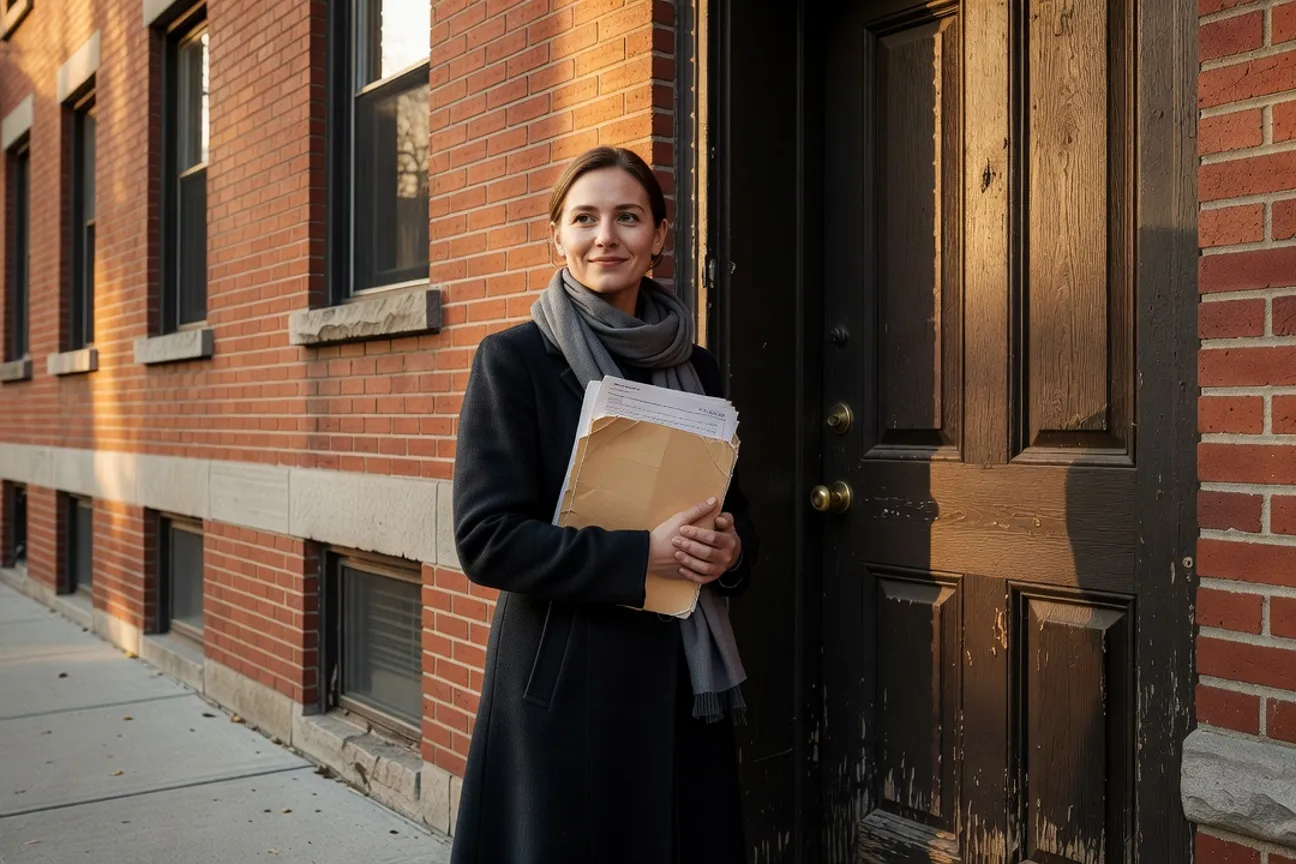
Ukrainian newcomer mother holding lease documents outside a Montreal apartment building.
Table of Contents
- Why This Matters for Ukrainian Newcomers
- The Law: Security Deposits Are Illegal in Quebec
- A Pattern Reported by Newcomer Tenants
- Illegal Deposit vs. What a Landlord Can Actually Ask For
- Same-Day Move-Out Penalties: What Is and Is Not Lawful
- If This Happens to You: Steps to Take
- Filing a Claim with the Tribunal Administratif du Logement
- Why Newcomers Are Especially Targeted
- Where to Get Free Help
- Know the Law Before You Sign
- Frequently Asked Questions
Why This Matters for Ukrainian Newcomers
Since 2022, tens of thousands of Ukrainians have arrived in Canada under the Canada-Ukraine Authorization for Emergency Travel (CUAET) program and related humanitarian streams, many settling in Montreal and other Quebec cities as part of the province's broader wave of Ukrainian refugees and newcomers. Signing a first Quebec lease is often one of the earliest and most consequential financial decisions a newly arrived family makes, frequently completed within days of arrival, in an unfamiliar legal system, and sometimes in a second or third language.
That combination, unfamiliarity with Quebec's specific tenancy rules, urgency, and a language gap, creates exactly the conditions in which a small number of landlords attempt practices that would not survive a moment's scrutiny from a tenant who already knew their rights. Housing rights committees and settlement workers in Montreal have reported a recurring pattern among newcomer tenants, including Ukrainian arrivals: being asked for a cash deposit at signing that Quebec law does not allow a landlord to request in the first place.
The Law: Security Deposits Are Illegal in Quebec
Unlike most other Canadian provinces, Quebec does not permit residential landlords to collect a security deposit, damage deposit, or key deposit from a tenant. Article 1904 of the Civil Code of Quebec states plainly that a landlord may not require any sum of money from a tenant other than the rent stipulated in the lease. This is not an obscure technicality; it is common enough as a source of confusion that the mandatory standard lease form used across the province includes it as a worked example of a prohibited practice, with wording to the effect that a landlord cannot demand any sum of money from the tenant, for instance, a deposit for the keys.
| Payment Type | Allowed in Quebec? |
|---|---|
| Monthly rent as stated in the lease | Yes |
| Security or damage deposit | No |
| Key deposit | No |
| Last month's rent paid in advance as a deposit | No |
| Post-dated cheques for future months, at the tenant's own choice | Generally permitted as a payment method, not a deposit |
Because this rule surprises many newcomers accustomed to deposit practices elsewhere, including in other Canadian provinces and in many other countries, it is worth stating clearly: if a Quebec landlord asks for an extra sum described as a deposit, guarantee, or key fee at signing, that request does not have a legal basis, regardless of how it is phrased on an informal receipt or side agreement outside the lease itself.

Tenant reviewing a residential lease document with a pen at a kitchen table.
A Pattern Reported by Newcomer Tenants
Housing rights advocates working with newcomer communities in Montreal describe a recurring sequence that goes beyond a single isolated case; the wider rental picture facing Ukrainian newcomers across Canadian cities helps explain why families accept terms they should refuse. A tenant, often a newly arrived family without an established local support network, is asked at lease signing to pay a cash sum on top of the rent, described informally as a deposit. The amount is not written into the signed lease itself and does not appear on the lease's payment schedule, appearing only as a separate cash or e-transfer exchange between landlord and tenant.
The pattern can continue at the other end of the tenancy. At move-out, some tenants have reported being told that the return of this deposit, money the landlord was never legally entitled to collect in the first place, would be conditional on paying an additional, unrelated sum, sometimes framed as a penalty for a move-out timeline the tenant was given only hours of notice to meet. Advocates note that this combination, an illegal deposit used as leverage to extract a second illegal payment, is particularly difficult for a newcomer tenant to push back on in the moment, especially when communicated in a language the tenant does not fully understand and under real time pressure involving young children or elderly family members.
The Core Pattern to Recognize
1. An illegal deposit collected at signing. Requested informally, often not written into the lease, despite article 1904 prohibiting it outright.
2. Pressure applied through urgency. Same-day or next-day move-out demands, sometimes communicated informally and in a language the tenant does not fully understand.
3. The illegal deposit used as leverage. Its return made conditional on an additional payment that also has no basis in the signed lease.
Illegal Deposit vs. What a Landlord Can Actually Ask For
It helps to be precise about what a Quebec landlord can and cannot legitimately request, since confusing the two is exactly what allows this kind of practice to persist.
- A landlord can require the monthly rent amount written into the signed lease, paid on the schedule specified in that lease.
- A landlord can request post-dated cheques as a payment method for future rent, if the tenant agrees, but this is a payment mechanism, not an additional deposit sum.
- A landlord cannot require any additional lump sum described as a security deposit, damage deposit, or key deposit, under any label.
- A landlord cannot condition the return of any money already paid on a further, separate payment not specified in the lease.
Same-Day Move-Out Penalties: What Is and Is Not Lawful
A second recurring element in reported cases involves move-out timing. A lease ending on a specific date does not, by itself, give a landlord the right to unilaterally impose and immediately collect a cash penalty if a tenant needs a short additional window to finish moving, particularly a tenant managing the move largely alone, with young children, or with an elderly or unwell family member. Disputes over move-out timing and any associated compensation generally belong in front of the Tribunal administratif du logement (TAL) rather than being resolved through an on-the-spot cash demand collected directly by the landlord or building staff.
| Situation | Lawful Process |
|---|---|
| Landlord believes tenant caused a loss by moving out late | File a claim with the TAL, with evidence of an actual loss |
| Landlord verbally demands a cash penalty on the spot | Not a lawful collection method |
| Landlord withholds a refund pending an extra payment | Not permitted; tenant can demand full return and file a TAL claim |
If This Happens to You: Steps to Take
Newcomer tenants who find themselves asked for a deposit, or told that a refund is conditional on an extra payment, have concrete options rather than having to simply accept the demand.
| Step | What It Involves |
|---|---|
| 1. Do not pay an informal deposit if possible | Point to article 1904 and the standard lease form's own wording if asked |
| 2. Keep every document | Lease, receipts, bank records, and any written or text communication |
| 3. Put the demand in writing | Ask the landlord to confirm any request or condition by text or email, not only verbally |
| 4. Send a formal notice (mise en demeure) | A written demand for the return of any sum improperly collected, ideally with help from a housing rights committee |
| 5. File with the Tribunal administratif du logement | If the landlord does not respond or refuses, a formal claim can be filed, including for punitive damages in serious cases |

Community housing rights advisor consulting with a newcomer family about a lease dispute.
Filing a Claim with the Tribunal Administratif du Logement
The Tribunal administratif du logement is Quebec's specialized housing tribunal, and it handles exactly this category of dispute: illegal deposits, contested move-out penalties, and related landlord-tenant disagreements. A tenant does not need a lawyer to file a claim, and the process is designed to be navigable without one, though a housing rights committee or community legal clinic can help prepare the paperwork and evidence. In cases where a landlord's conduct is found to be an intentional and unlawful interference with a tenant's rights, article 49 of the Quebec Charter of Human Rights and Freedoms allows the TAL to award punitive damages on top of the return of any money owed, a provision that exists precisely to discourage landlords from treating an illegal deposit as a low-risk way to extract extra money from tenants who are unlikely to push back, such as recently arrived newcomers unfamiliar with the system.
Why Newcomers Are Especially Targeted
Advocates working with immigrant and refugee tenant populations in Montreal are candid about why newcomers, including Ukrainian arrivals, are disproportionately represented in these cases. A tenant who has just arrived in the country, is signing a first Quebec lease under time pressure, may not yet read or speak French or English fluently, and has no existing local network to consult before signing, is simply less likely to recognize an illegal request in the moment than a tenant who grew up navigating the Quebec rental system. None of that changes the underlying legal reality: the prohibition on security deposits applies identically to every tenant in Quebec, regardless of immigration status, length of time in the country, or the language the lease negotiation happened in, a protection that extends to CUAET arrivals exactly as it does to any other resident, part of the same body of Canadian and provincial protections newcomers can rely on alongside broader settlement resources described in our overview of Canada's immigration system.
Common Mistakes to Avoid
- Assuming a deposit is normal because it was normal elsewhere. Deposit practices common in other provinces or countries do not apply in Quebec.
- Paying in cash without a receipt. Any payment, even one you believe may not be fully legal, should be documented with a bank record if it has already been made.
- Accepting a verbal condition on a refund. A landlord cannot lawfully withhold money already owed to you pending a separate, unrelated payment.
Where to Get Free Help
Tenants do not need to navigate this alone. Comités logement (housing rights committees) operate across Montreal neighbourhoods and generally offer free guidance in plain language, often including support in multiple languages or referral to interpretation help. Settlement organizations working with the Ukrainian community in Canada can frequently point newcomer tenants toward the nearest housing rights committee, and the Tribunal administratif du logement itself publishes tenant information directly on its website. Community legal clinics in Montreal also assist with drafting a formal mise en demeure or preparing a TAL filing at no cost for tenants who qualify.
Know the Law Before You Sign
The single most useful thing a newcomer tenant can know before signing a first Quebec lease is simple: no landlord can lawfully ask for a security deposit, under any name, and no landlord can lawfully make the return of money already paid conditional on a further, separate payment. Knowing this in advance turns an intimidating, high-pressure moment into a straightforward one, where the tenant can point to article 1904 and the standard lease form's own wording and decline to pay.
For newcomer families still settling in and building a support network, the broader lesson extends beyond any single lease. Quebec's tenant protections exist regardless of immigration status, and Ukrainian newcomers, like any other tenant in the province, are entitled to the full protection of those rules from the day they sign their first lease, whether or not they yet know how the system works in detail.
Frequently Asked Questions
Are security deposits legal for apartment rentals in Quebec?
No. Under article 1904 of the Civil Code of Quebec, a landlord cannot demand any sum of money from a tenant other than the rent set out in the lease. This includes deposits described as a damage deposit, key deposit, or last month's rent deposit. The prohibition is explicit and is even printed as an example on the mandatory standard lease form itself.
What should I do if a landlord already asked me for a deposit?
You are entitled to refuse the request. If you have already paid an illegal deposit, you have the right to demand its full return, in writing, and you can pursue the claim before the Tribunal administratif du logement (TAL) if the landlord does not return it voluntarily.
Can a landlord charge a daily penalty if I do not move out on the exact lease end date?
Not automatically or informally. Any penalty for late move-out generally needs to follow a legal process through the Tribunal administratif du logement rather than being unilaterally imposed and collected by the landlord on the spot, and a lease-end date does not by itself authorize a same-day cash penalty demanded outside that process.
What if a landlord tries to withhold my deposit refund unless I pay an extra fee?
Conditioning the return of money owed to a tenant on an additional, unrelated payment is not a lawful practice under Quebec residential tenancy rules. A tenant in this situation can send a formal notice (mise en demeure) demanding the return of all sums paid and can file a claim with the Tribunal administratif du logement, including for punitive damages in cases involving intentional and unlawful interference with a person's rights under the Quebec Charter of Human Rights and Freedoms.
Where can newcomers get help understanding their rights as tenants in Quebec?
Housing rights committees (comités logement), community legal clinics, and settlement organizations serving newcomers can generally provide free or low-cost guidance in plain language, and the Tribunal administratif du logement publishes information for tenants directly on its own website.
Does this protection apply to CUAET arrivals and other temporary residents?
Yes. Quebec's residential tenancy protections, including the prohibition on security deposits, apply to any tenant renting a dwelling in the province, regardless of immigration status, including newcomers who arrived under the Canada-Ukraine Authorization for Emergency Travel (CUAET) program or other temporary resident categories.