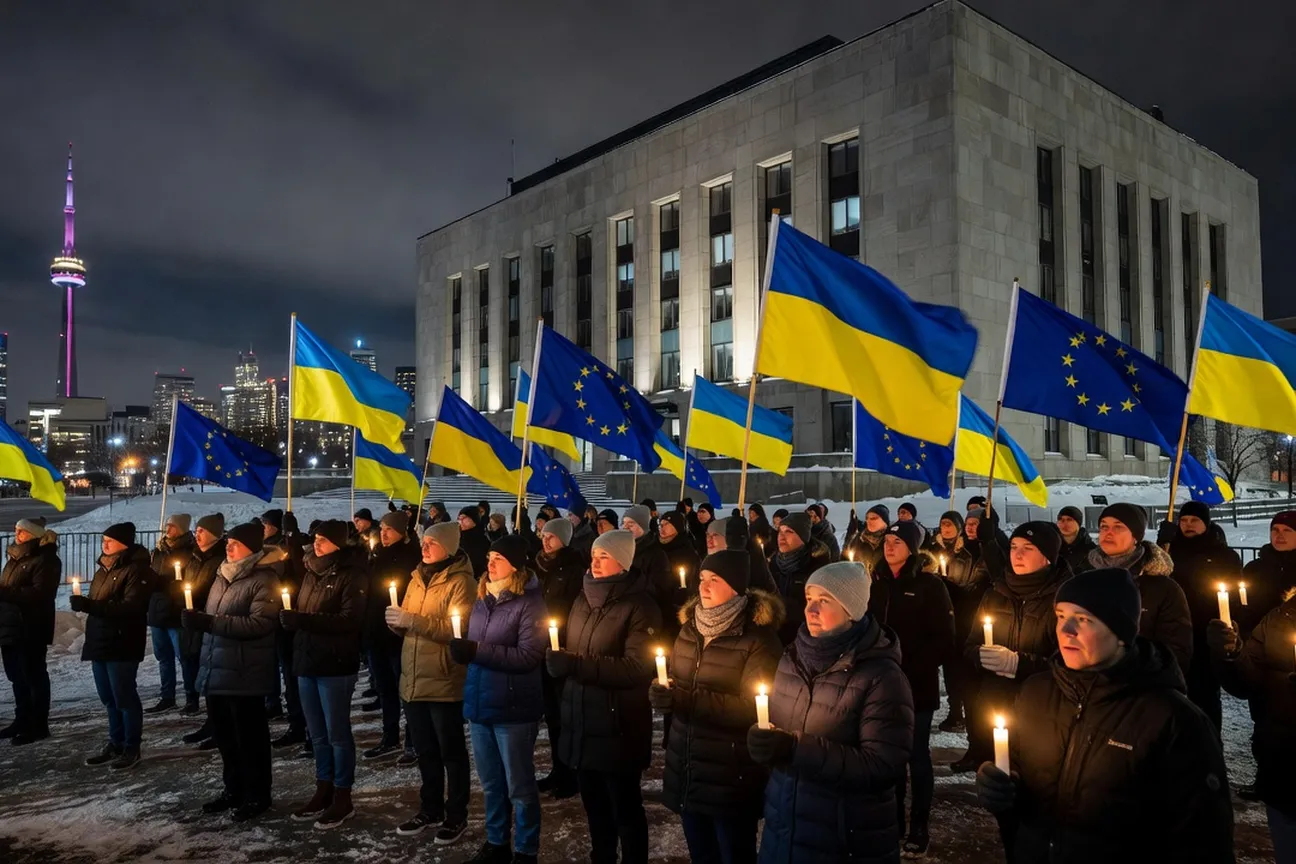
Ukrainian Canadian diaspora rally supporting Euromaidan protests outside Toronto Ukrainian consulate winter 2013.
Table of Contents
- The Spark: 21-28 November 2013
- Toronto Responds: Consulate Rallies and Nathan Phillips Square
- Edmonton, Winnipeg and the National Mobilisation
- The Ukrainian Canadian Congress Takes Command
- Fundraising for the Maidan: The Medical Relief Fund
- The Harper Government's Response
- February 2014: The Heavenly Hundred
- Aftershock: Crimea's Annexation and the Donbas Escalation
- CANDU and the May 2014 Election Observation Mission
- A Lasting Political Identity: From Maidan to 2022
- Conclusion: The Diaspora That Never Looked Away
- Frequently Asked Questions
The Spark: 21-28 November 2013
On 21 November 2013, the government of President Viktor Yanukovych announced it was suspending preparations to sign the Association Agreement with the European Union, an accord years in the making that would have deepened Ukraine's trade and political integration with Brussels. The decision, taken under sustained pressure from Moscow and the promise of a $15 billion loan from Russia, detonated almost instantly on Kyiv's Independence Square. Within hours, several hundred students and civic activists gathered on the Maidan Nezalezhnosti, the first spontaneous demonstration of what would become known as Euromaidan, a portmanteau of "Europe" and "Maidan" (square). By 24 November, the crowd had swelled past 100,000 according to independent estimates, one of the largest protests Ukraine had seen since the 2004 Orange Revolution.
The turning point came on the night of 29-30 November, when Ukraine's riot police unit, the Berkut, violently dispersed a much smaller overnight encampment of students, beating dozens with batons in scenes captured on mobile phone video and broadcast globally within hours. The brutality of that crackdown transformed a protest about a trade agreement into a protest about state violence and government legitimacy. By 1 December, the crowd on the Maidan had grown to an estimated 500,000, and demonstrators occupied Kyiv City Hall and set up barricades along Khreshchatyk Street. News of the beatings reached Canada's Ukrainian community almost in real time, circulated through diaspora Facebook groups, WhatsApp chains among recent immigrants, and the Ukrainian-language press, most notably New Pathway–Ukrainian News, based in Toronto.
For readers seeking the deeper historical throughline that connects these events to earlier chapters of Ukrainian statehood, the full history of Ukraine situates Euromaidan within a much longer struggle for sovereignty stretching back centuries.
Toronto Responds: Consulate Rallies and Nathan Phillips Square
Toronto, home to the largest concentration of Ukrainian Canadians in the country, produced the earliest and most sustained domestic mobilisation. Within 48 hours of the Berkut crackdown, several hundred protesters assembled outside the Consulate General of Ukraine on Bloor Street West, waving Ukrainian and EU flags side by side, a juxtaposition that captured the dual character of the movement: a demand for European integration paired with an assertion of Ukrainian sovereignty against Russian pressure. Organisers, many drawn from the Ukrainian Canadian Students' Union and the League of Ukrainian Canadians, distributed placards reading "Yanukovych: Sign the Agreement" and "Berkut: Hands Off Our Students."
As the crisis deepened through December 2013, the demonstrations relocated to Nathan Phillips Square in front of Toronto City Hall, a larger public venue capable of accommodating crowds that regularly exceeded a thousand people on weekends. Speakers included representatives of the Ukrainian Canadian Congress Toronto Branch, clergy from both the Ukrainian Catholic and Ukrainian Orthodox churches, and, on several occasions, sitting members of the Ontario legislature who arrived to express solidarity. Candlelight vigils became a recurring feature, particularly after reports of injuries among Maidan protesters filtered back through diaspora networks and international news wires. The Toronto rallies also served a coordinating function: organisers used the gatherings to solicit volunteers for the fundraising apparatus that the Ukrainian Canadian Congress was assembling nationally, discussed further below.
Community institutions along Bloor West Village, the historic heart of Toronto's Ukrainian settlement, displayed blue-and-yellow ribbons in shop windows throughout the winter of 2013-2014, and several churches, including St. Vladimir Institute, hosted information sessions explaining the EU Association Agreement's provisions to a diaspora audience many of whom had left Ukraine before the agreement's negotiation began.
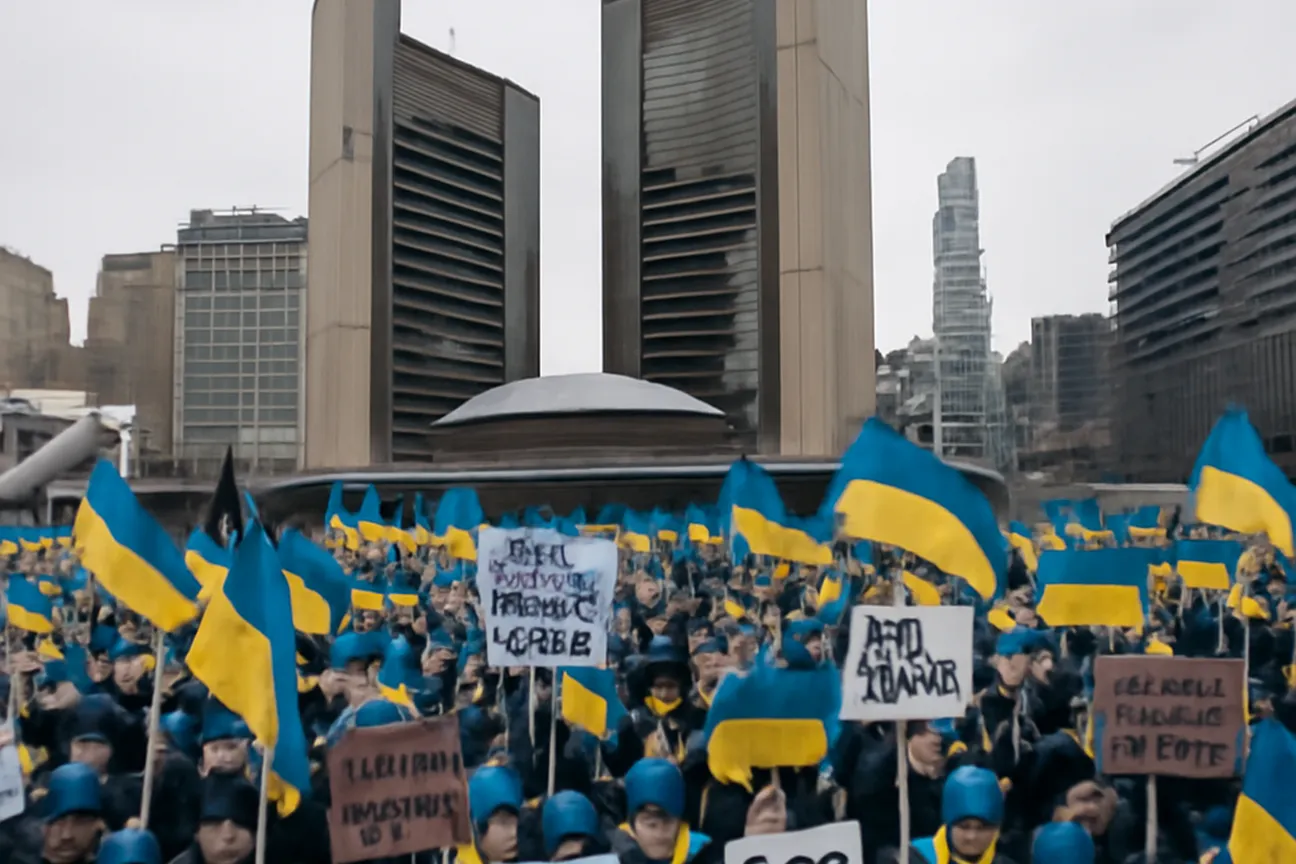
Candlelight vigil held by Ukrainian Canadians at Nathan Phillips Square Toronto during Euromaidan winter 2013-2014.
Edmonton, Winnipeg and the National Mobilisation
The response was never confined to Toronto. Edmonton, anchored by one of the oldest and most institutionally dense Ukrainian communities on the Prairies, staged its own consulate-adjacent rallies at the Alberta Legislature Grounds, drawing on decades of organisational experience built through the Ukrainian Canadian Congress Alberta Provincial Council and the Ukrainian Youth Association (CYM). Winnipeg's demonstrations, organised through the Ukrainian Canadian Congress Manitoba Provincial Council, took place at the Manitoba Legislative Building and frequently coincided with services at Winnipeg's Ukrainian Orthodox and Catholic cathedrals, reflecting the deep integration of church and civic organisation typical of Prairie Ukrainian communities. Ottawa demonstrations targeted the Russian Embassy directly by December 2013, as diaspora organisers increasingly framed the crisis not merely as an internal Ukrainian political dispute but as a proxy contest with Moscow.
Calgary and Vancouver, home to smaller but organised Ukrainian communities, held solidarity events timed to coincide with the larger Toronto and Edmonton rallies, creating a coast-to-coast pattern of simultaneous demonstration that diaspora leaders explicitly modelled on earlier mobilisations during the 2004 Orange Revolution. This national coordination, spanning six major cities within the first three weeks of the crisis, represented one of the most rapid civic mobilisations in the history of the Ukrainian Canadian community, exceeding even the response to the 2004 Orange Revolution in geographic breadth. Readers interested in the scale and distribution of these communities today can consult the leading Ukrainian Canadian organisations shaping the diaspora in 2026, many of which trace their modern advocacy capacity directly to lessons learned during this period.
The Ukrainian Canadian Congress Takes Command
The Ukrainian Canadian Congress (UCC), the umbrella organisation representing the community's more than thirty member organisations nationally, moved quickly to establish itself as the central coordinating body for the Canadian response. Within the first week of December 2013, the UCC's national executive issued formal statements calling on the Canadian government to condemn the use of force against protesters and to press the European Union to keep the Association Agreement offer open. The UCC's structure, with provincial councils in every province with a significant Ukrainian population, allowed messaging, fundraising appeals, and rally logistics to be disseminated uniformly across the country within days rather than weeks.
UCC national president Paul Grod became a visible spokesperson throughout the crisis, giving interviews to Canadian broadcasters including CBC and CTV, and meeting with federal officials in Ottawa to press for a stronger Canadian diplomatic posture. The UCC also activated its relationship with the Ukrainian World Congress, coordinating messaging with diaspora organisations in the United States, the United Kingdom, and Australia so that the international response appeared unified rather than fragmented by country. This coordinating function proved to be one of the most consequential legacies of the Euromaidan period: it established a template for rapid national mobilisation that the UCC would deploy again, at vastly greater scale, following Russia's full-scale invasion in 2022.
Fundraising for the Maidan: The Medical Relief Fund
As violence against protesters escalated through January 2014, the UCC and affiliated organisations, including the Ukrainian Canadian Foundation for Children's Aid and the Ukrainian Canadian Social Services, established what became widely known within the community as the Maidan medical relief fund, a dedicated channel for donations earmarked specifically for treating injured protesters and supporting the families of those killed or hospitalised. Collection points appeared at churches, community centres, and Ukrainian credit unions in Toronto, Edmonton, Winnipeg, and Montreal, while online donation portals allowed diaspora members outside major urban centres to contribute directly.
Funds raised were channelled through partner medical organisations operating field clinics on and around the Maidan itself, including volunteer medical brigades that had formed spontaneously among Kyiv's own civil society to treat protesters injured by rubber bullets, batons, and, after February 2014, live ammunition. Canadian diaspora fundraising in this period is frequently cited by community historians as a direct precursor to the far larger humanitarian fundraising apparatus that Canadian Ukrainian organisations would stand up in 2022, when donation infrastructure built during Euromaidan and the subsequent Donbas war was simply reactivated and scaled dramatically. Individual parishes, notably in Toronto's Bloor West Village and Edmonton's core Ukrainian neighbourhoods, ran weekly collection drives that continued well into the spring of 2014, long after the initial crisis had shifted into the Crimean annexation and eastern Ukraine conflict.
The Harper Government's Response
The government of Prime Minister Stephen Harper adopted an unusually vocal early position relative to other Western governments, a stance widely attributed to Canada's large and politically engaged Ukrainian Canadian electorate, concentrated in swing ridings across the Prairies and in parts of the Greater Toronto Area. Foreign Affairs Minister John Baird issued a statement within days of the 30 November crackdown condemning the use of force against peaceful demonstrators and calling on Ukrainian authorities to respect the right to assembly. Harper personally raised the issue at multilateral forums, and Canadian officials engaged directly with European counterparts to explore how the Association Agreement negotiation might be salvaged even as Yanukovych's government stalled.
As the crisis intensified into January and February 2014, following the passage of restrictive anti-protest laws by the Ukrainian parliament on 16 January (quickly dubbed the "dictatorship laws" by opposition and diaspora commentators alike), the Harper government moved toward more concrete measures, including public discussion of targeted sanctions against Ukrainian officials responsible for ordering violence against protesters. Canada ultimately imposed sanctions on a list of Yanukovych-era officials in early March 2014, coordinated closely with the United States and European Union, once the president had fled Kyiv and Russia's occupation of Crimea was already underway. Baird also travelled to Kyiv in December 2013 and again in February 2014, among the first Western foreign ministers to visit the Maidan in person, a gesture diaspora leaders in Toronto and Edmonton frequently credited with demonstrating that Canadian solidarity extended beyond rhetoric.
February 2014: The Heavenly Hundred
The crisis reached its most violent and consequential phase between 18 and 20 February 2014, when government snipers and security forces opened fire on protesters occupying the Maidan and surrounding streets. Over the course of those three days, approximately one hundred people were killed, the great majority shot by snipers positioned on rooftops overlooking Instytutska Street, one of the main approaches to the square. The dead became known collectively in Ukraine, and swiftly across the diaspora, as the Nebesna Sotnia, the Heavenly Hundred, a designation that fused religious and military connotations to honour those who died as, in effect, the first casualties of what many now regard as the opening phase of Russia's broader war against Ukrainian sovereignty.
News of the sniper killings reached Canada within hours through livestreamed footage and social media, and the emotional impact on diaspora communities was immediate and profound. Emergency vigils were organised overnight in Toronto, Edmonton, and Winnipeg; church bells were rung in mourning at several Ukrainian Catholic and Orthodox parishes; and community leaders described the days of 18-20 February 2014 as a turning point after which the diaspora's engagement with events in Ukraine shifted from solidarity activism to something closer to grief for a wartime loss. Yanukovych fled Kyiv for Kharkiv and ultimately Russia on 21-22 February, and the Ukrainian parliament voted to remove him from office, formally ending the immediate crisis even as it opened the far more dangerous chapter that followed within days. Canadian diaspora communities have held annual commemorations of the Heavenly Hundred every February since 2014, typically coordinated by the UCC's provincial councils and hosted at the same civic spaces, including Nathan Phillips Square, that had served as rally points during the original protests.
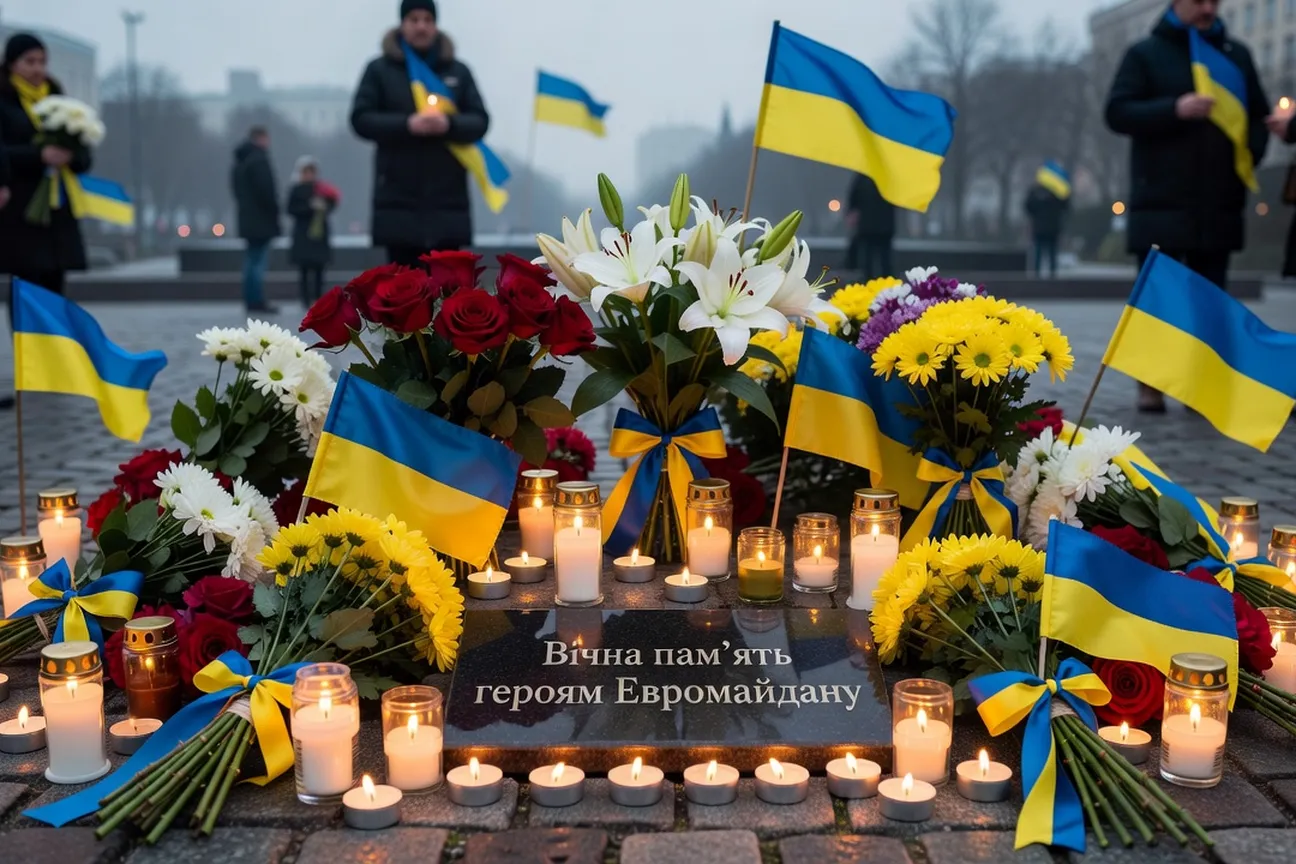
Ukrainian Canadian community commemoration ceremony honouring the Heavenly Hundred Euromaidan victims February 2014.
Aftershock: Crimea's Annexation and the Donbas Escalation
Within days of Yanukovych's flight, unmarked Russian troops, quickly nicknamed "little green men" by Ukrainian and international media, began seizing key installations across Crimea. By 27 February 2014, armed men had occupied the Crimean parliament building in Simferopol, and a hastily organised referendum on 16 March 2014, widely condemned as illegitimate by Canada, the United States, and the European Union, provided the pretext for Russia's formal annexation of the peninsula on 18 March 2014. The speed of the annexation, following so closely on the heels of the Maidan's apparent victory, produced a profound sense of whiplash within the Canadian diaspora: the celebration of Yanukovych's departure gave way almost immediately to alarm over Russian territorial aggression.
The Canadian government responded to the Crimean annexation with a further round of sanctions and the suspension of bilateral military cooperation with Russia, while diaspora organisations shifted fundraising priorities from Maidan medical relief toward humanitarian support for displaced Crimean Tatars and, within months, for the growing number of internally displaced persons fleeing the conflict that erupted in the Donetsk and Luhansk regions of the Donbas in April 2014. Pro-Russian separatist movements, backed by Russian military and intelligence support, seized government buildings across eastern Ukraine that spring, initiating a war that would grind on for eight years before escalating into the full-scale invasion of February 2022. Canadian Ukrainian communities, having just mobilised extensively around Euromaidan, found themselves pivoting within weeks to a sustained wartime advocacy and humanitarian footing that would not meaningfully relent for the following decade. For a broader assessment of how Ukraine's economy and institutions have evolved in the years since, Ukraine's economic recovery and 2026 outlook traces the long arc from this period of acute instability toward the reconstruction challenges of today.
CANDU and the May 2014 Election Observation Mission
One of the most concrete institutional legacies of the Euromaidan period was the scaling up of Canadian election observation capacity through CANDU, the Canada-Ukraine Parliamentary Program, and the broader Canadian election observation apparatus coordinated with Ukraine's Central Election Commission and the Organization for Security and Co-operation in Europe. In the wake of Yanukovych's removal, Ukraine scheduled a presidential election for 25 May 2014, widely viewed as a critical test of the country's ability to complete a peaceful and credible democratic transition amid the ongoing Crimean crisis and the outbreak of fighting in the Donbas.
Canada dispatched one of its largest election observation missions in the country's history to Ukraine for the May 2014 vote, drawing heavily on volunteers recruited through Ukrainian Canadian community networks, many of them fluent Ukrainian speakers with family ties to specific regions who could serve effectively as observers in polling stations across the country, including in contested areas of the east. The Ukrainian Canadian Congress played a direct recruitment and logistical role, working alongside Elections Canada and the federal government to identify, vet, and deploy observers. The election, ultimately won decisively by Petro Poroshenko in the first round, was judged largely free and fair outside the Russian-occupied Crimea and the parts of Donetsk and Luhansk already beyond government control, a result diaspora organisations in Canada regarded as vindication of the sacrifices made on the Maidan months earlier.
This election observation infrastructure did not disappear once the immediate crisis passed. CANDU and successor programmes continued deploying Canadian observers, many drawn from the same diaspora networks, to every subsequent major Ukrainian election through 2019, building a body of institutional expertise in election monitoring that Canadian Ukrainian organisations would draw upon again when advocating for Ukraine's democratic legitimacy during the far larger crisis that began in 2022.
A Lasting Political Identity: From Maidan to 2022
Euromaidan's most durable effect on Canada's Ukrainian community was not measured in dollars raised or rallies held, significant as both were, but in a fundamental reshaping of the diaspora's political identity and organisational capacity. Prior to 2013, Ukrainian Canadian advocacy, while well established through institutions dating to the early twentieth century, had operated largely as a heritage and cultural preservation movement, focused on language schools, church life, and commemoration of events such as the Holodomor. Euromaidan, followed almost immediately by the annexation of Crimea and the outbreak of war in the Donbas, transformed the UCC and its affiliated bodies into a sustained foreign-policy lobbying operation, one capable of shaping Canadian parliamentary debate, securing sanctions legislation, and coordinating humanitarian responses on short notice.
This transformation proved foundational when Russia launched its full-scale invasion of Ukraine on 24 February 2022. The organisational muscle memory built during Euromaidan, from rapid multi-city rally coordination to dedicated fundraising infrastructure to relationships with federal officials cultivated over sanctions advocacy, allowed the Canadian diaspora to mobilise within hours of the 2022 invasion rather than the days or weeks that characterised the initial Euromaidan response in 2013. Community leaders who came of age organising Toronto's consulate rallies and Nathan Phillips Square vigils in the winter of 2013-2014 went on to hold senior positions within the UCC and allied organisations during the far larger humanitarian and advocacy effort of 2022 and beyond, a direct generational through-line from one crisis to the next. Additional context on the diaspora's commemorative practices that emerged from this era of activism is available in Holodomor memorials across Toronto, Edmonton and Winnipeg, which documents how Euromaidan-era organisational patterns were subsequently applied to historical memory work as well.
External resources tracking Ukraine's broader trajectory during and after this period, including regional reporting from travel and cultural coverage of Ukraine's regions, provide additional texture for readers seeking to understand how the country diaspora members were advocating for continued to change in the years following 2014.
Conclusion: The Diaspora That Never Looked Away
The winter of 2013-2014 tested Canada's Ukrainian community in ways that few crises before it had. Within days of the first crackdown on Kyiv's Maidan, diaspora members in Toronto, Edmonton, Winnipeg, and cities across the country had organised rallies, opened fundraising channels, and pressed their own government toward a clearer stance. When the crisis culminated in the deaths of the Heavenly Hundred that February, the response deepened into something closer to collective mourning, followed almost immediately by the shock of Crimea's annexation and the outbreak of war in the Donbas. What emerged from those few months was not merely a series of protests and vigils but a durable political capacity, an organisational memory that the Ukrainian Canadian Congress and its member bodies would draw upon again, at a scale few could have anticipated in 2014, when Russia's invasion returned in full force in February 2022. Euromaidan did not end when Yanukovych fled Kyiv. For Canada's Ukrainian community, it marked the beginning of a decade, and counting, of sustained engagement with a homeland under siege.
Frequently Asked Questions
What triggered the Euromaidan protests in November 2013?
President Viktor Yanukovych's government suspended preparations for signing the EU Association Agreement on 21 November 2013, prompting the first student-led demonstrations on Kyiv's Independence Square (Maidan Nezalezhnosti) on 21-28 November.
How did the Ukrainian Canadian Congress coordinate the diaspora response?
The UCC activated its national council structure within days, organising simultaneous rallies in Toronto, Edmonton, Winnipeg, Ottawa, Calgary and Vancouver, while channelling donations through a dedicated Euromaidan relief fund for injured protesters and their families.
Who were the Heavenly Hundred and why do they matter to the diaspora?
The Nebesna Sotnia, or Heavenly Hundred, refers to the roughly one hundred protesters killed by government snipers and security forces between 18 and 20 February 2014; Canadian diaspora communities hold annual candlelight vigils commemorating their deaths every February.
What was Stephen Harper's government's position on Euromaidan?
Prime Minister Stephen Harper's government issued early statements of support for the protesters, condemned the use of force by Ukrainian riot police (Berkut), and moved toward targeted sanctions against Yanukovych-era officials once the crisis escalated in February 2014.
Did Euromaidan lead to lasting change in Canadian-Ukrainian diaspora relations?
Yes. Euromaidan reinvigorated diaspora lobbying capacity, produced sustained election-observation missions through CANDU, and built organisational infrastructure that was mobilised again, at far greater scale, after Russia's full-scale invasion in February 2022.