What Was the Holodomor? A 100-Word Primer
The Holodomor, a Ukrainian word combining holod (hunger) and moryty (to inflict death), refers to the Soviet-engineered famine of 1932-33 that killed between 3.5 and 7 million Ukrainians. Stalin's regime imposed impossible grain-procurement quotas on the Ukrainian Soviet Socialist Republic, sealed villages where peasants refused to surrender food, and prevented starving Ukrainians from leaving for work in neighbouring Russian regions. The famine was concentrated in ethnic Ukrainian territory; deaths fell disproportionately on rural populations in the central and eastern Ukrainian provinces. Contemporary scholarship and international legal opinion have, after decades of Soviet suppression, increasingly recognised the famine as an act of genocide.
Canada was the first country outside Ukraine to formally recognise the Holodomor as genocide, through Bill C-459 in 2008. The recognition was the culmination of decades of advocacy by the Ukrainian-Canadian community, which carried the memory of the famine to Canada through the third wave of postwar displaced persons in the late 1940s. Today, twelve memorial sites across Canada commemorate the famine, along with educational institutions, archives, and annual events. To understand how Canada arrived at this position and what the memorial landscape looks like in 2026, we spoke with Dr. Yuriy Borysenko at the Ukrainian Canadian Congress office in Edmonton.
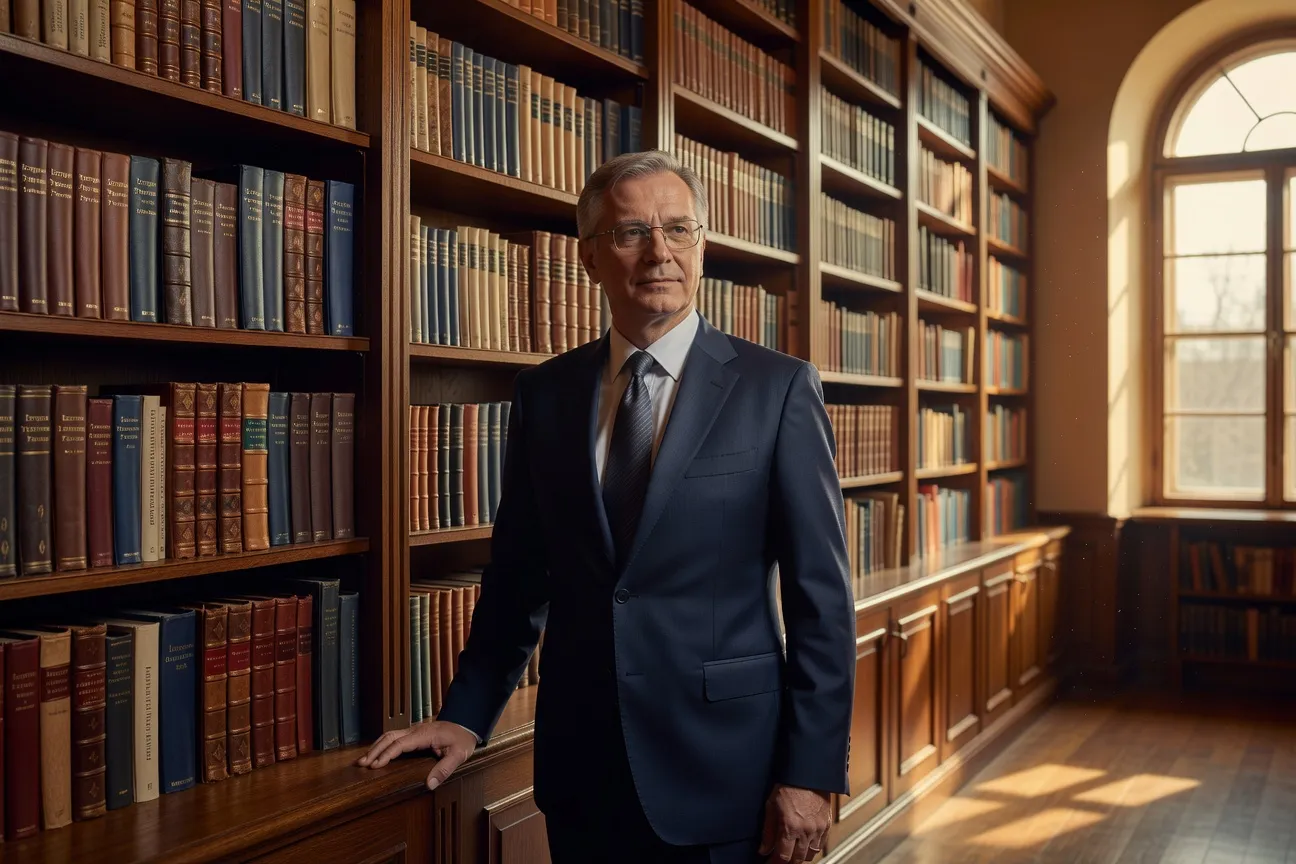
Dr. Yuriy Borysenko, Historian and Commemoration Coordinator of the Ukrainian Canadian Congress in Edmonton.
Dr. Yuriy Borysenko
Historian and Commemoration Coordinator, Ukrainian Canadian Congress (Edmonton). PhD in Soviet History from the University of Alberta. Twenty-two years working on Holodomor memory, genocide recognition policy, and diaspora commemorative practice. Author of two scholarly works on Ukrainian-Canadian historical consciousness.
Q1: When did Canada officially recognize the Holodomor as genocide?
Mark SmolyakYuriy, let me start at the beginning. When did Canada actually recognise the Holodomor as genocide, and how did that happen?
Dr. Yuriy BorysenkoLet me be precise here. The federal Holodomor recognition came in two stages, and people often conflate them. The first stage was the Senate's unanimous resolution in 2003 acknowledging the Holodomor as a deliberate act of genocide against the Ukrainian people. That was a political statement but not law. The second stage was Bill C-459, introduced by James Bezan, a Manitoba Conservative MP, in 2008. The bill formally recognised the Holodomor as genocide and designated the fourth Saturday of November as the Ukrainian Famine and Genocide (Holodomor) Memorial Day in Canada. It received Royal Assent in May 2008.
The record shows that Canada was the first national government outside Ukraine to issue this recognition through legislation. Australia and the United States followed with non-binding congressional and parliamentary statements. The European Parliament's 2008 resolution called the Holodomor a crime against humanity but stopped short of the genocide designation. The Holy See made a formal statement in 2008 mourning the victims. It was Canadian Parliament, however, that took the legislative step first.
What's often missed is how long the prior advocacy lasted. The Ukrainian Canadian Congress had been pushing for federal recognition since at least 1983, the fiftieth anniversary of the famine. Twenty-five years passed between the start of organised advocacy and the law. The legislative process required building broad cross-party support, which took successive Ukrainian-Canadian community campaigns through multiple Parliaments. It is not an accident that recognition occurred under a Conservative government with a substantial Ukrainian-Canadian constituency, but it is worth recording that the Liberal opposition supported the bill without dissent.
Q2: Where is the National Holodomor Memorial in Canada?
Mark SmolyakIf someone wants to visit the principal national Holodomor memorial, where do they go?
Dr. Yuriy BorysenkoThe national memorial is in Ottawa, on the eastern grounds of Parliament Hill, between Wellington Street and the Rideau Canal. It was unveiled on November 24, 2018, after a decade of community fundraising. The sculptor was Petro Drozdowsky, a Ukrainian-Canadian artist from Mississauga who emigrated as a child after World War Two. The bronze sculpture depicts a young Ukrainian girl, perhaps ten years old, with a downcast head, holding a small bundle of wheat to her chest. The figure stands on a base of black granite that bears the inscription in Ukrainian, French, and English.
The choice of a single child rather than a group of figures was deliberate. The Holodomor disproportionately killed children — demographic studies indicate that children under five had the highest mortality rate of any age cohort. The bundle of wheat the girl holds represents not bread (which the regime confiscated) but the unmet promise of nourishment. The sculptor wanted a memorial that could be encountered emotionally, without political slogans or ideological framing. To be clear, the memorial took ten years to fundraise and approve, partly because of debates within the community about whether the figure should be more politically explicit. The final decision to focus on the individual child has, in my judgment, been validated by the popular response.
The Ottawa memorial is the centre of national commemoration each November. The Governor General and federal officials attend the annual ceremony. It is the obvious destination for a single national memorial visit. But the federal memorial alone is not the whole story; the twelve other Canadian sites carry significant community weight, and several of them predate the Ottawa monument by years.
Q3: What memorials exist in Toronto, Edmonton, Winnipeg and Calgary?
Mark SmolyakWalk me through the major city memorials, because most people in Canada are not going to make a special trip to Ottawa.
Dr. Yuriy BorysenkoRight. Let me give you the major cities one by one.
Toronto has two principal memorials. The first is the bronze sculpture at Wynyard Park on Annette Street West, in the Bloor West Village neighbourhood, which is the historic heart of Ukrainian Toronto. The sculpture, also depicting a young girl, was installed in 1985 and was one of the first significant Holodomor memorials anywhere in North America. The annual Toronto commemoration ceremony is held at Wynyard Park each November. The second Toronto memorial is the plaque and small reflective garden at the Ukrainian Canadian Congress Toronto branch building on Bathurst Street. Smaller plaques exist at several Ukrainian Catholic and Orthodox parishes across the GTA.
Edmonton, where I am based, has two principal sites. The first is the Holodomor Memorial Plaque at the entrance to City Hall Plaza, near Sir Winston Churchill Square, unveiled in 2007. The second is the larger sculpture and interpretive panels at the Ukrainian Cultural Heritage Village, the open-air museum east of Edmonton. The Heritage Village memorial is more substantial educationally; the City Hall plaque is more accessible for daily public encounter. Both are visited by school groups throughout the year.
Winnipeg's principal memorial is at the Manitoba Legislature grounds, unveiled in 2014 after the provincial Holodomor recognition. The sculpture is by Roman Korol and depicts a Ukrainian peasant woman in mourning. It stands on the southern edge of the Legislature lawn and is visible from Memorial Boulevard. A second memorial at Holy Family Ukrainian Catholic Church in central Winnipeg serves as the principal parish commemoration site.
Calgary has the Holodomor memorial sculpture installed at the Calgary Tower base plaza in 2008. The annual Calgary ceremony is held there. Smaller memorials exist at the Ukrainian National Federation hall and the St. Vladimir's Ukrainian Orthodox Cathedral. Calgary's growing Ukrainian community has expanded the local commemorative network in the post-2022 period.
Vancouver, Saskatoon, Regina, Ottawa (in addition to Parliament Hill), Sudbury, and Hamilton each have their own Holodomor memorials of varying scale. The full list is at the end of this article. Briefly: the geographic distribution closely tracks the historical Ukrainian-Canadian settlement pattern across the Prairies and major eastern cities. There is a memorial in every province with a significant Ukrainian community.
Q4: When is Holodomor Memorial Day in Canada?
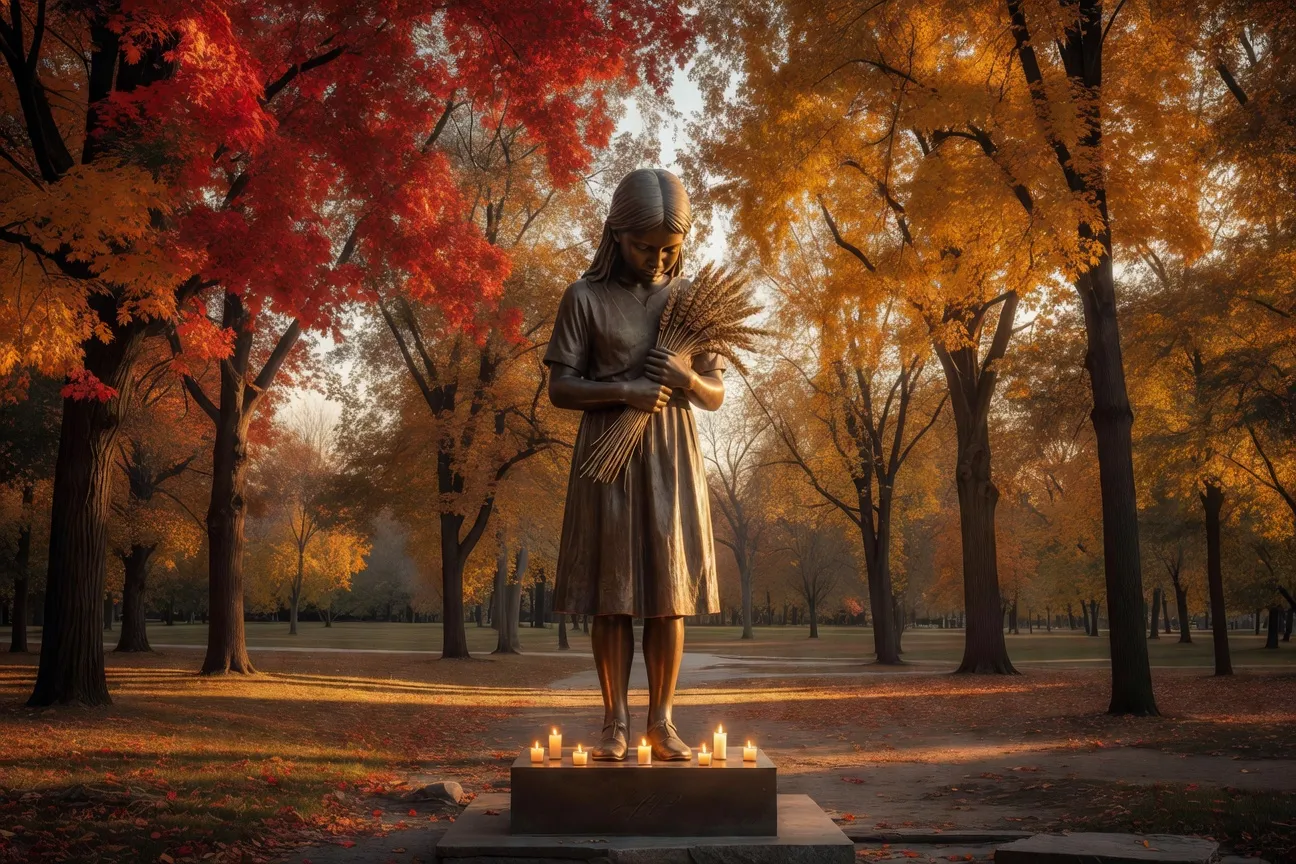
Holodomor memorial sculpture at Wynyard Park Toronto, bronze figure of a young girl holding wheat, golden autumn light, candles at the base.
Mark SmolyakFor someone who wants to participate this year, when and how is the day observed?
Dr. Yuriy BorysenkoThe federal designation under Bill C-459 sets the fourth Saturday of November as the National Ukrainian Famine and Genocide (Holodomor) Memorial Day. In 2026 this falls on November 28.
The principal national ceremony is at the Parliament Hill memorial in Ottawa, usually starting at 4 p.m. when the sun sets and candles are most effective visually. Provincial ceremonies take place earlier in the day at the major city memorials. Most ceremonies include four core elements: a candle-lighting (often the lighting of one candle for each million estimated deaths, so typically four to seven candles); the playing of Ukrainian sacred and folk music, including the choral lament “Vichnaya Pamyat” (Eternal Memory); the reading of survivor testimonies (now mostly from recorded archives as first-generation survivors have passed away); and a moment of silence followed by the singing of the Ukrainian national anthem.
Many Ukrainian-Canadian families fast during the day in remembrance, taking no food until the evening meal, when a single piece of bread is eaten in the symbolic act of breaking the fast. The bread is often the dark Ukrainian rye loaf khlib, which carries strong cultural weight in Ukrainian peasant tradition. Families who do not fast often light a candle in their kitchen for the duration of the day. The practice varies by household but the symbolic vocabulary is consistent.
Q5: How is the Holodomor taught in Canadian schools?
Mark SmolyakI went through Toronto public schools in the 1990s and we did not learn about the Holodomor. Has that changed?
Dr. Yuriy BorysenkoYes, considerably, but the implementation is uneven across provinces.
Ontario's curriculum has included Holodomor content at the Grade Ten history level since the curriculum review of 2013. Alberta and Manitoba have included the Holodomor at the secondary level for longer, since the early 2000s. Saskatchewan added Holodomor content in 2018. British Columbia includes it in some optional units but not as a standard requirement. The Atlantic provinces and Quebec have less formal coverage; teachers in those provinces who include the Holodomor typically do so at their own initiative.
What's interesting is the quality of the curricular materials. The Holodomor Research and Education Consortium at the University of Toronto, established in 2013, has produced grade-level lesson plans, primary-source documents, and teacher training materials that are now available free to schools across the country. The Consortium also funds visits to schools by historians and survivors' descendants. Several thousand Canadian secondary school students each year receive direct instruction on the Holodomor through these programs.
Where the system still struggles is in non-history subject areas. English Language Arts curricula occasionally include Holodomor-themed novels (Vasily Grossman's Forever Flowing, more recently the YA novel Enough by Marsha Skrypuch); social studies sometimes touches on famine in the context of Stalinism. But the deep integration of Holodomor history into broader narratives of twentieth-century genocide remains uneven. Compared to Holocaust education, which is now systematically integrated into Canadian school curricula nationwide, Holodomor education is still in a formative stage. Cultural traditions among Ukrainians in Canada include the carriage of this historical memory across generations, and the schools are increasingly catching up to what has long been transmitted within the community.
Q6: Has Russia's invasion in 2022 changed Holodomor commemoration?
Mark SmolyakThis is the question that everyone wants to ask. How has 2022 changed Holodomor commemoration?
Dr. Yuriy BorysenkoProfoundly. Attendance at the November 2022 commemoration ceremonies, the first after the full-scale invasion, was at least double what it had been in 2019 and 2020. The Edmonton City Hall ceremony in 2022 had approximately 1,400 attendees; the 2019 ceremony had about 600. The Toronto Wynyard Park ceremony, which usually draws 200 to 300, drew over 900 in 2022.
What's been more significant than the numbers is the shift in discourse. Before 2022, Holodomor commemoration was primarily about historical remembrance — honouring a past atrocity that we hoped would never be repeated. After 2022, the discourse explicitly links the Soviet famine to the contemporary Russian war. The genocide framing is now used not just to interpret 1932-33 but to interpret 2022 and after. The phrase “same enemy, different generation” appears repeatedly in commemorative speeches. Whether this rhetorical move is historically defensible is debated within the academic community, but it is now the framework most Canadian Ukrainians use.
Several Canadian municipalities formally recognised the Holodomor as genocide for the first time in 2022-2024 — cities that had been content to defer to provincial and federal recognition before then. Universities have established new Holodomor-related courses, fellowships, and conferences. The Ukrainian Canadian Research and Documentation Centre in Toronto has reported a 400 percent increase in survivor-testimony archive requests since 2022.
The arrival of Ukrainian refugees in Canada through the CUAET program after 2022 has changed the audience for Holodomor commemoration. Many CUAET arrivals knew the Holodomor as Ukrainian history but had not previously participated in commemorative practice; they had often grown up with the famine treated as a private family memory rather than a public ritual. Encountering the institutional Holodomor commemoration of the Canadian diaspora has been a powerful experience for many of them. The Canadian diaspora has, in turn, found in the CUAET arrivals a more immediate and personal link to ongoing Russian aggression than the heritage community could otherwise maintain.
Q7: What about second and third-generation Canadian Ukrainians — do they still know?
Mark SmolyakOne thing that worries me as a journalist is whether the cultural memory of the Holodomor is being transmitted intergenerationally as effectively as we might hope. What's your read?
Dr. Yuriy BorysenkoI would say generational transmission varies significantly by community and by family. Let me give you a frank picture.
In tight diaspora communities — the rural Ukrainian belt of Manitoba and Alberta, the Bloor West neighbourhood of Toronto, the Selkirk area in Manitoba — awareness of the Holodomor remains strong across third and fourth generations. These communities have annual rituals, dense church and community-institution networks, and continuous family memory transmission. A fourth-generation Ukrainian-Canadian raised in Mundare, Alberta is very likely to know the Holodomor as central to their family's history.
In more dispersed urban diaspora families — second-generation Ukrainian Canadians who moved away from heritage communities, mixed Ukrainian-other-ethnic marriages, families who lost connection to the Greek Catholic or Orthodox parish — the transmission is weaker. I have spoken with third-generation Ukrainian Canadians in their fifties who had only general awareness of the Holodomor before 2022. After 2022, that changed: many of them deliberately reconnected with their heritage through Holodomor commemoration and through other Ukrainian community activities.
The 2022 effect has been to reverse, at least temporarily, the long-term trend of generational fade. Whether this revival sustains over decades depends on what happens in Ukraine and on whether Ukrainian-Canadian institutional life maintains the infrastructure of commemoration. The schools, the parishes, the cultural centres, the annual rituals — these are the load-bearing structures of generational memory. They have been getting more, not less, support since 2022.
For families wanting to trace their own connection to the Holodomor, Ukrainian genealogy and family history resources can help establish family origins in specific Ukrainian regions and sometimes reveal Holodomor losses among ancestors. The Canadian Ukrainian community context provided through contemporary Ukrainian society and historical resources can further connect Canadian diaspora families to the parallel narratives of those who stayed.
Quick Questions
YES True or false: Canada was the first country outside Ukraine to recognise the Holodomor as genocide. — True. 2008 federal recognition through Bill C-459.
NUANCE Is the Holodomor death toll widely agreed upon? — The general magnitude is, but exact estimates vary between 3.5 and 7 million depending on methodology. Most scholarly estimates cluster around 4-5 million.
NO Does Russia recognise the Holodomor as genocide? — No. The Russian government rejects the genocide designation. This is one of the points of dispute that the 2022 invasion has sharpened.
YES Can non-Ukrainians attend Holodomor commemorations? — Absolutely. All ceremonies are open to the public and increasingly attract Canadians from outside the Ukrainian community.
NUANCE Are Holodomor memorials maintained by the government or the community? — Mixed. The federal Parliament Hill memorial is government-maintained. Most provincial and municipal memorials are jointly maintained by community organisations and local government. The community organisations carry most of the operational burden.
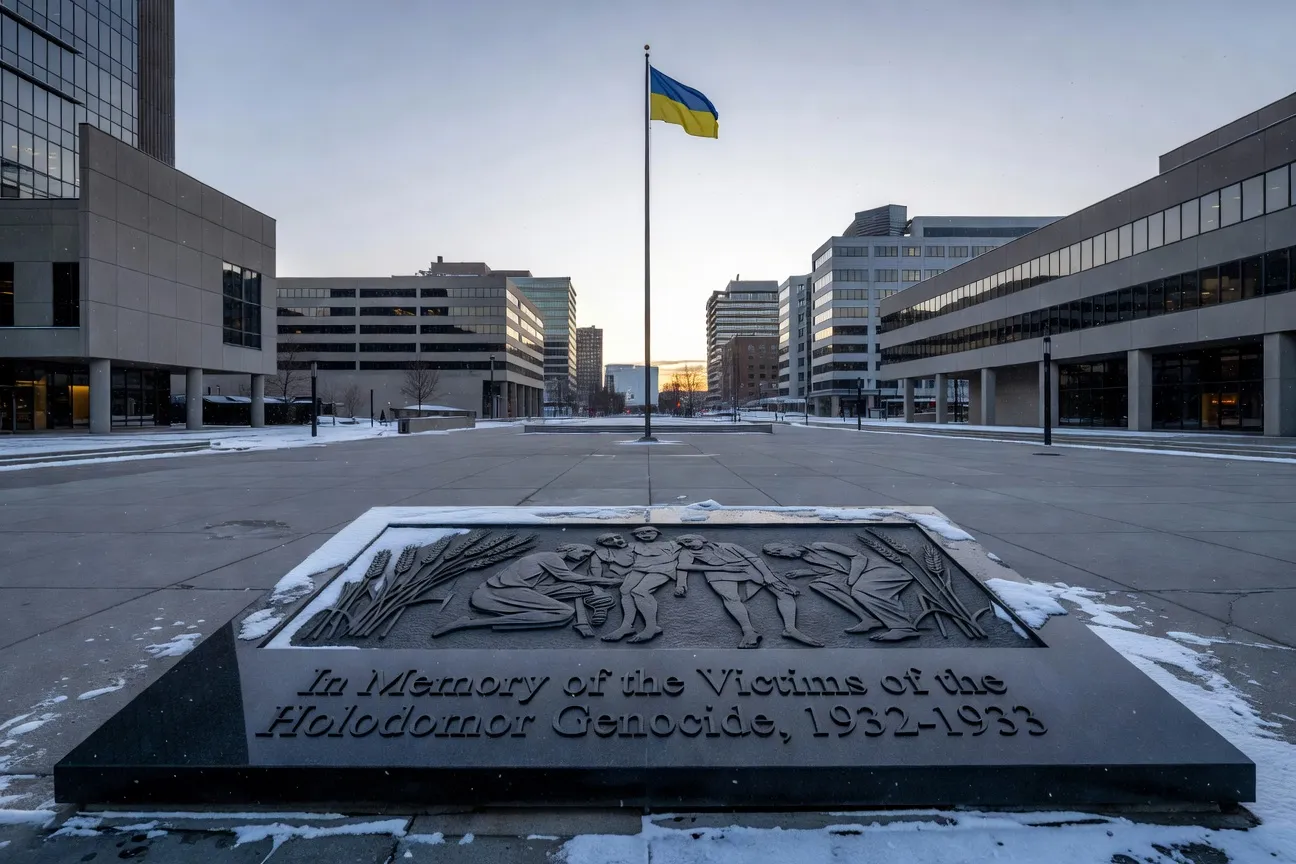
Holodomor genocide memorial in Edmonton city hall plaza, dawn winter light, snow on the ground, Ukrainian flag visible in distance.
Full List: 12 Holodomor Memorials Across Canada
For readers who want the complete inventory of dedicated Holodomor memorial sites in Canada as of 2026:
- Ottawa — Parliament Hill National Holodomor Memorial (2018, federal monument)
- Toronto — Wynyard Park, Annette Street (1985, oldest Canadian Holodomor monument)
- Toronto — Ukrainian Canadian Congress Toronto branch, Bathurst Street
- Edmonton — City Hall Plaza Memorial Plaque (2007)
- Edmonton — Ukrainian Cultural Heritage Village (interpretive sculpture)
- Winnipeg — Manitoba Legislature grounds (2014, sculpture by Roman Korol)
- Winnipeg — Holy Family Ukrainian Catholic Church (parish memorial)
- Calgary — Calgary Tower base plaza (2008)
- Vancouver — Ukrainian Catholic Cathedral New Westminster (memorial garden)
- Saskatoon — Ukrainian Museum of Canada (memorial wall and interpretive exhibit)
- Sudbury — St. Mary Ukrainian Greek Orthodox Church (memorial plaque)
- Hamilton — Ukrainian Catholic Diocese of Hamilton (memorial garden, established 2023)
Additional smaller plaques and memorials exist at over forty Ukrainian Catholic and Orthodox parishes across the country. The Ukrainian Canadian Congress provincial branches maintain the regional inventories. Memorial visits during the late November commemorative period are an accessible way for any Canadian to engage with this part of the country's historical record, regardless of their personal heritage background.
For the broader cultural context of how Canadian Ukrainians carry this memory alongside other foundational stories of Ukrainian immigration history to Canada and the long history of Ukraine itself, the commemorative practice is best understood not as standalone ritual but as one chapter in a continuous historical consciousness.