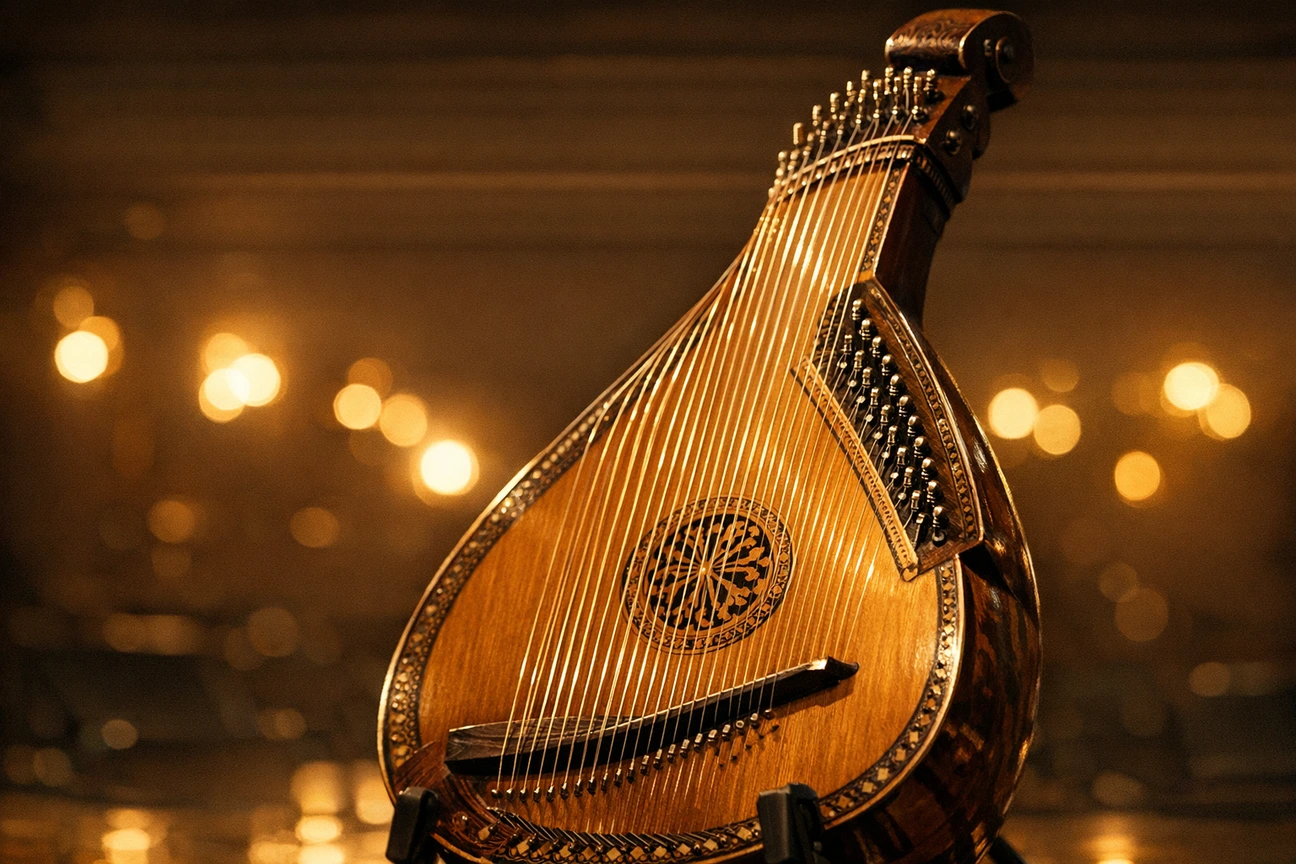
The bandura, Ukraine's national instrument, with its unmistakable fan of treble strings.
Table of Contents
- What the Bandura Is: Anatomy of a National Instrument
- The Kobzars: Blind Bards of the Steppe
- Persecution and the Great Silence of the 1930s
- Revival: From Underground Workshops to UNESCO
- How the Bandura Crossed the Atlantic
- Toronto's Bandura Schools and Ensembles
- The Toronto Bandura Festival
- From Shchedryk to Carol of the Bells
- An Old Instrument at Home in a New Country
- Frequently Asked Questions
What the Bandura Is: Anatomy of a National Instrument
The bandura looks like nothing else in the concert hall: a broad, lute-shaped body held almost upright against the player's chest, fanned with dozens of metal strings that catch the light. According to the Internet Encyclopedia of Ukraine, the instrument carries 32 to 55 strings in its modern form — 8 to 14 bass strings, called bunty, stretched along the neck, and 24 to 43 treble strings, the prystrunky, running along the side of the soundboard. It has no frets, and each string produces exactly one note. The melody is played on the prystrunky while the bunty provide accompaniment, which is what gives the bandura its characteristic shimmering, harp-like texture under a sung line.
The modern instrument is chromatic, usually tuned in G major or E minor, with a range running from AA to G3. Its body, the koriak, is carved from sycamore, cherry, maple or red willow, with a spruce soundboard and steel strings whose lower register is wound with copper, brass or bronze. Two playing traditions coexist. In the more widespread Chernihiv method, the instrument rests in the player's lap at an angle to the body, the right hand taking the melody and the left the accompaniment. In the Kharkiv (Zinkiv) method, the bandura lies parallel to the body and the hand roles are reversed. For larger ensembles, makers have developed banduras of different ranges — the pryma (piccolo), alto, bass and even contrabass — allowing a full bandura orchestra.
The instrument's pedigree is old. The Internet Encyclopedia of Ukraine points to an 11th-century fresco of skomorokhy (court entertainers) in Saint Sophia Cathedral in Kyiv, which shows a lute-like instrument regarded as an ancestor of both the bandura and the kobza. The prystrunky that define the modern bandura were added around the 16th century, and the instrument later spread widely among Ukrainian musicians, gradually displacing its fretted cousin, the kobza. In 1894 the virtuoso Hnat Khotkevych designed an asymmetrical bandura that enlarged its range, and through the 20th century instrument makers turned it into the fully chromatic concert instrument heard today. The bandura remains a fixture of Toronto's Ukrainian choirs and folk bands, where its sound anchors the community's musical identity.
The Kobzars: Blind Bards of the Steppe
You cannot tell the bandura's story without the men who carried it. The kobzars were itinerant bards who performed a repertoire of epic-historical songs — the dumy — along with religious songs and folk ballads, accompanying themselves on the kobza or bandura. The tradition most probably emerged in the 16th century in Left-Bank Ukraine, in the Poltava region around the towns of Myrhorod and Komyshnia. Popular memory ties the kobzars to the Cossack era, and their epics kept the history of those wars alive in song.
Kobzardom was a profession, not a hobby. The kobzars developed a formal apprenticeship system, bound together in brotherhoods, with standards that, as the Internet Encyclopedia of Ukraine notes, reflected values adopted by professional guilds elsewhere in Europe. By the late 18th century, as the Hetman state declined, the occupation had become the near-exclusive province of the blind and crippled, for whom music and alms were often the only livelihood. Their repertoire included:
- Dumy — sung epic poems recounting Cossack campaigns, captivity and liberation;
- Religious songs and psalms — moralistic and parareligious material performed at markets and church feasts;
- Historical songs — narratives of uprisings and national figures;
- Social and satirical songs — commentary on the injustices of village life.
Historical memory made the kobzars politically dangerous. From the 1870s, the tsarist regime persecuted virtuosos such as Ostap Veresai and Hnat Honcharenko as propagators of Ukrainophile sentiment and historical memory. Taras Shevchenko immortalized the kobzar in his poetry and drawings — and titled his landmark 1840 collection Kobzar, fixing the wandering bard as the very symbol of the Ukrainian nation. At the 12th Russian Archaeological Congress in Kharkiv in 1902, kobzars including Terentii Parkhomenko and Ivan Kucherenko-Kuchuhura performed to great acclaim, accompanied by Khotkevych, and the congress passed a resolution on the great value of their art. In 1909 Khotkevych published the first history and manual of bandura playing; from 1908, bandura was taught at the Lysenko Music and Drama School in Kyiv.
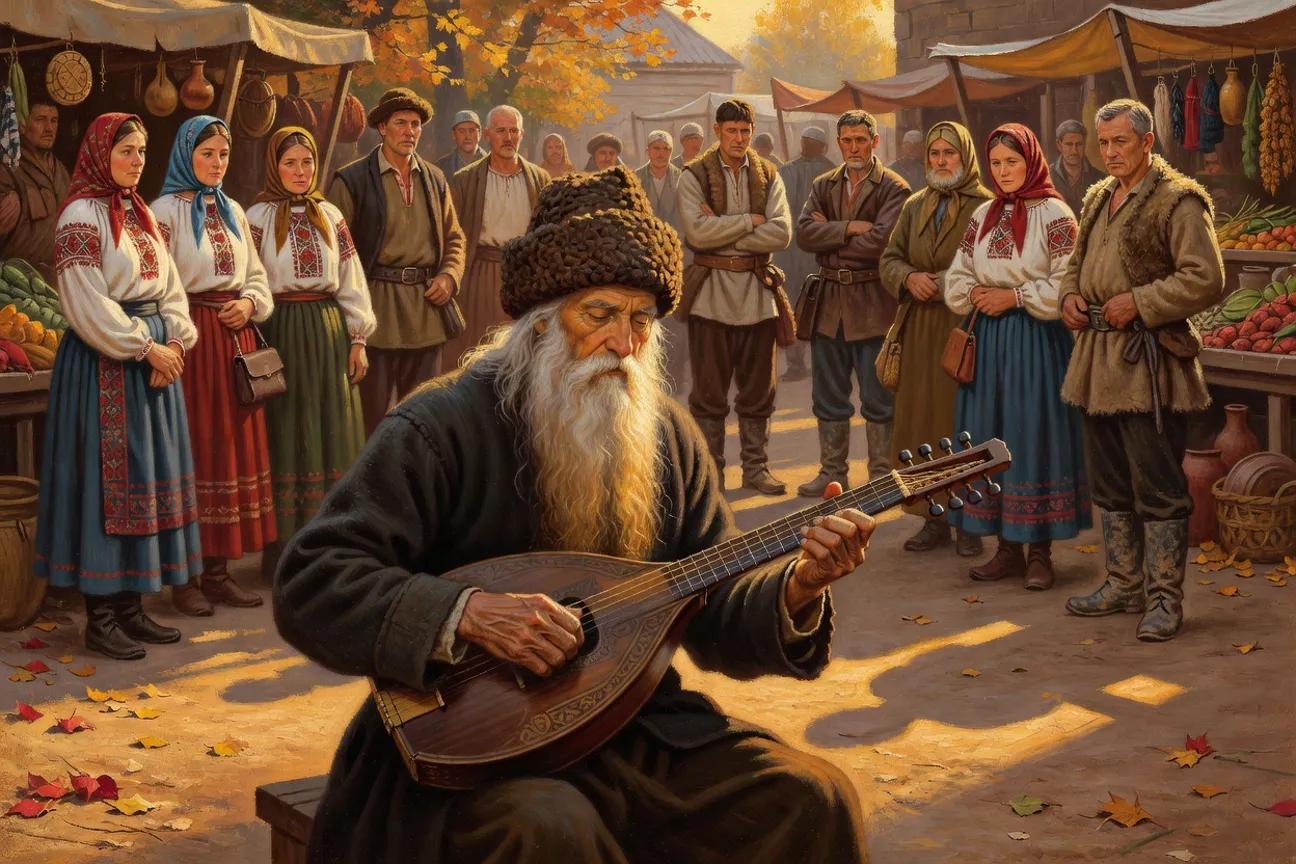
A kobzar at a village market — the itinerant, usually blind bards who carried Ukraine's historical memory in song.
Persecution and the Great Silence of the 1930s
The 1902 congress opened a brief golden age. Bandura schools were founded, kobzar concerts became frequent events in Ukrainian and Russian cities, and during the revolution and Ukrainian-Soviet war of 1917–1921, kobzars composed and performed songs promoting the national cause — many paying for it with their lives. The first Ukrainian banduryst ensemble existed briefly in Kyiv from July 1918 to 1919, and under Soviet rule it was reestablished in 1923 as the State Banduryst Kapelle of Ukraine. Through the 1920s, scholars of the All-Ukrainian Academy of Sciences, including Klyment Kvitka and Kateryna Hrushevska, conducted serious studies of the kobzars.
Then came the catastrophe. In the 1930s, forced collectivization, the Famine-Genocide of 1932–33 and the Stalinist suppression of Ukrainian culture destroyed the social world the kobzars lived in. Performers were registered, their repertoire was censored, and the parareligious material at the heart of their art was banned. Some kobzars were arrested and executed; others simply disappeared. Khotkevych himself — the man who had done more than anyone to modernize the instrument and legitimize its study — died in 1938, a victim of the Great Terror. By the end of the 1930s, the Internet Encyclopedia of Ukraine records, traditional authentic kobzardom had ceased to exist. The First Republican Conference of Kobzars and Lirnyks, held in April 1939, unveiled the approved replacement: "Soviet kobzars" performing newly composed dumy about the Communist Party and Lenin on modernized instruments.
One part of this story requires honesty. The most famous account of the kobzars' destruction holds that hundreds of blind musicians were summoned to a congress in Kharkiv, taken away under a pretext, and executed together — Accounts disagree even on the basics: some place a congress of folk singers at the Kharkiv Opera Theater in December 1930, others date it to 1932 or 1933, and the story rests heavily on later testimony rather than on a surviving execution order. Some researchers report finding no documentary proof of a mass execution; others accept it as oral history. The honest summary is the one the record supports: the Soviet state unquestionably dismantled kobzardom and killed individual kobzars, while the single dramatic massacre remains an important but unproven tradition.
Revival: From Underground Workshops to UNESCO
Kobzardom refused to stay buried. In the 1970s, a non-official movement arose in Soviet Ukraine dedicated to authentic kobzar performance on traditionally built instruments. Originated by Heorhii Tkachenko and later led by Mykola Budnyk and Mykola Tovkailo, it ran instrument workshops and performed the traditional repertoire outside official channels, while Volodymyr Kushpet established a school of traditional performance practice. According to UNESCO, the remaining bearers of the tradition reestablished the tsekh system in the 1980s, with long-term master-apprentice training.
The revival received its highest international recognition in December 2024, when UNESCO's Intergovernmental Committee for the Safeguarding of the Intangible Cultural Heritage, meeting at its 19th session in Asunción, Paraguay, selected Ukraine's "Safeguarding programme of kobza and wheel lyre tradition" (file No. 02136) for its Register of Good Safeguarding Practices. The decision, 19.COM 7.d.2, describes a living programme in which the tsekhs are financed through crowdfunding and donations. Between 1980 and 2022, the programme involved more than 80 masters and performers, produced more than 70 scientific findings and created some 1,500 photographic and video records, with communities such as Kyiv, Kharkiv and Lviv among those involved. For readers who want a deeper dive into the instrument's construction and repertoire, Ukraine Zoom has published a musicologist's interview on the bandura and traditional Ukrainian music (in French) that complements this history well.
How the Bandura Crossed the Atlantic
The bandura came to Canada with the immigrants themselves, but its formal Canadian history begins with the postwar generation. The second wave of Displaced Persons that arrived between 1947 and 1954 carried not only suitcases but training: musicians formed in the bandura kapelles of interwar and wartime Ukraine, for whom the instrument was a portable homeland. The Internet Encyclopedia of Ukraine credits a roster of masters with cultivating kobzar artistry in the West — Vasyl Yemets, Hryhorii Kytasty, Zinovii Shtokalko, Volodymyr Lutsiv, Julian Kytasty and Victor Mishalow among them. Shtokalko's Kobzars'kii pidruchnyk (Kobzar's Handbook), published in Edmonton and Kyiv in 1992, stands as a monument to that diaspora scholarship.
Toronto's own bandura story runs through the Ukrainian youth organizations. The Hnat Khotkevych ODUM Bandurists' Ensemble grew out of the ODUM youth association. According to the staff biography on the Kobzarska Sich bandura camp website, the ensemble was founded by Walentina Rodak, and her daughter, the conductor and bandurist Oksana Rodak, began playing bandura in it at a young age. The ensemble took its name from Hnat Khotkevych (1877–1938), the virtuoso bandurist, composer, writer and researcher who was executed in 1938. Naming a Toronto youth ensemble for a man the Soviet state had killed and banned was itself a statement, and it set the pattern that Toronto's bandura community still follows: youth training, parish roots and a repertoire spanning folk, classical and sacred Ukrainian music.
Toronto's Bandura Schools and Ensembles
Decades after the ODUM ensemble, Toronto has an active bandura community. The scene works like a conveyor belt: parish-based schools train children, youth ensembles carry them through their teens, and adult groups give them a stage for life. The ensembles listed for the 2025 Toronto Bandura Festival include:
| Ensemble or school | Founded | Profile |
|---|---|---|
| St. Demetrius Bandura School and Ensemble | 1983 | School founded in 1983; directed by Ron Demeda, assisted by William Kowalenko; based in Etobicoke |
| Canadian Bandurist Capella | 2001 | Male voices combined with bandura; established as the Toronto Bandurist Capella and renamed in 2004 |
| Zoloti Struny (Vira Zelinska Bandura Capella) | — | Youth ensemble of young musicians dedicated to the bandura |
| Kobzari | — | Toronto group of young boys specializing in the traditional repertoire |
| Women's Bandura Ensemble of North America, Toronto Region | — | Twenty-member bandura and vocal group |
| Paul Yuzyk Academy of Toronto Bandura Ensemble | 2022 | School ensemble founded in 2022 |
The Canadian Bandurist Capella best illustrates the tradition's continuity. Established in 2001 as the Toronto Bandurist Capella and renamed in 2004, it pairs powerful male voices with the sound of the bandura, in the direct line of the kobzar and bandurist tradition. Its members appear at community events, including the city's major street festival covered in our Toronto Ukrainian Festival guide.
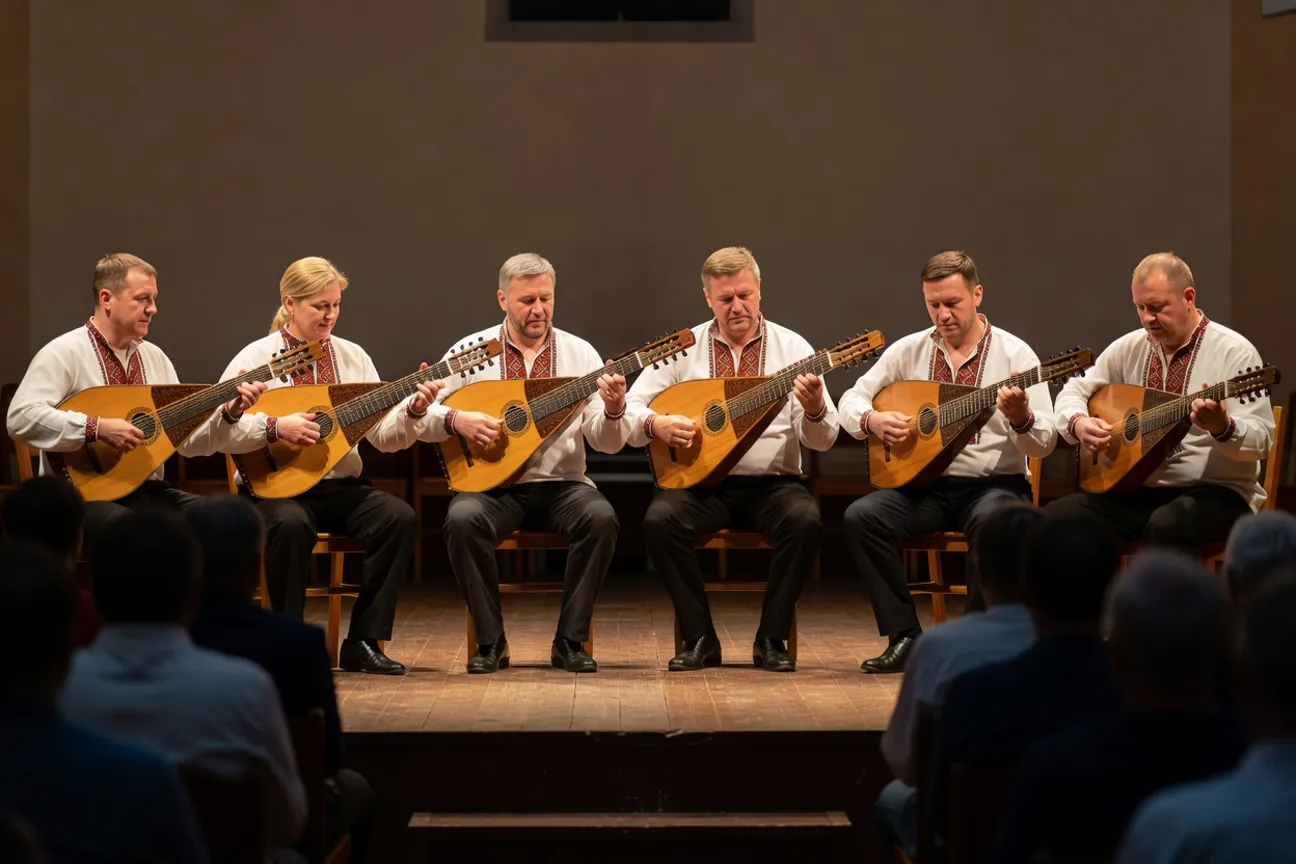
A bandura ensemble in concert — in Toronto, parish schools and community groups keep the instrument in regular performance.
The Toronto Bandura Festival
The clearest sign of the scene's vitality arrived in 2025. On Saturday, 25 October 2025, the first biennial Toronto Bandura Festival brought together the major bandura ensembles of the Greater Toronto Area — the Canadian Bandurist Capella, Kobzari, the Paul Yuzyk Academy Bandura Ensemble, the St. Demetrius Bandura Ensemble, Zoloti Struny and the Women's Bandura Ensemble of North America's Toronto Region — for a single evening concert at Knox Presbyterian Church, 630 Spadina Avenue. In a gesture that linked the diaspora stage back to the homeland, all net proceeds went to the Canada-Ukraine Foundation's AID for Artists Fund, which supports artists working in wartime Ukraine.
The festival matters beyond a single evening. A biennial format gives the schools and ensembles a shared deadline and a shared audience; it puts school ensembles on the same programme as adult capellas; and it presents the bandura to Torontonians who may never set foot in a parish hall. For an instrument whose tradition UNESCO has just listed as a good safeguarding practice, a recurring Toronto stage is safeguarding in practice.
From Shchedryk to Carol of the Bells
As the year turns toward December, the bandura's seasonal repertoire comes into its own — and here the kobzar tradition touches nearly every person on earth, whether they know it or not. The wider Ukrainian ritual song tradition includes the shchedrivky, New Year songs of good wishes sung on Shchedryi Vechir. One of them, a short ostinato melody about a swallow promising prosperity to a household, was arranged for choir by the composer Mykola Leontovych. His Shchedryk was first performed in Kyiv in December 1916, according to the Ukrainian Institute and Ukraїner (sources differ on the exact day).
The song crossed the ocean with Oleksander Koshetz's Ukrainian National Chorus, which performed it at Carnegie Hall on 5 October 1922 a date given in Carnegie Hall's own centenary article on the carol. In 1936 the American composer Peter J. Wilhousky wrote new English lyrics to Leontovych's melody, and "Carol of the Bells" entered the global Christmas canon. The carol's journey — ritual song, art-music arrangement, diaspora performance, worldwide standard — is the bandura tradition's journey in miniature. The song remains part of the broader fabric of Ukrainian Christmas traditions in Canada.
An Old Instrument at Home in a New Country
The bandura's biography is improbable. An instrument depicted in an 11th-century Kyiv cathedral fresco, carried for centuries by blind itinerant bards, banned, registered and nearly silenced in the 1930s, rebuilt by underground workshops and recognized by UNESCO in 2024 — and, in the same century, transplanted to Canada by refugees and taught ever since to children in Toronto church basements. Few cultural traditions have been attacked so deliberately and survived so completely.
In Canada, survival has become ordinary life: a bandura school at St. Demetrius in Etobicoke founded in 1983, a school ensemble at the Paul Yuzyk Academy, the Canadian Bandurist Capella, and a biennial festival on Spadina Avenue. The kobzars believed their songs held a people's memory. In Toronto in 2026, the strings are still being tuned — and the memory is still being played.
Frequently Asked Questions
How many strings does a bandura have?
According to the Internet Encyclopedia of Ukraine, a bandura has 32 to 55 strings: 8 to 14 bass strings (bunty) stretched along the neck and 24 to 43 treble strings (prystrunky) running along the soundboard. The instrument is fretless and each string produces a single note. Modern concert banduras are chromatic and are commonly tuned in G major or E minor.
What is a kobzar?
A kobzar was an itinerant Ukrainian bard, usually blind, who performed epic historical songs (dumy), religious songs and folk ballads while accompanying himself on the kobza or bandura. Kobzars emerged in Left-Bank Ukraine in the 16th century, organized themselves into guild-like brotherhoods with formal apprenticeships, and served as carriers of Ukrainian historical memory for centuries before being suppressed under Soviet rule in the 1930s.
Did the Soviets really massacre the blind kobzars at a congress in Kharkiv?
The popular story that hundreds of blind kobzars were lured to a congress in Kharkiv and executed en masse is not conclusively documented. Accounts disagree on the date (1930, 1932 or 1933), and some researchers report no documentary proof of a mass execution. What is firmly documented is the broader destruction of kobzardom: registration of performers, censorship, arrests, individual executions and disappearances, which ended traditional kobzardom by the late 1930s.
Where can I hear or learn the bandura in Toronto?
Toronto has an active bandura scene. The St. Demetrius Bandura School in Etobicoke was founded in 1983, the Canadian Bandurist Capella was established in 2001, and youth groups such as Zoloti Struny and Kobzari also perform in the city. The first biennial Toronto Bandura Festival, held on October 25, 2025 at Knox Presbyterian Church, brought together the major ensembles of the Greater Toronto Area.
Is Carol of the Bells really a Ukrainian song?
Yes. Carol of the Bells is based on Shchedryk, a choral arrangement of a Ukrainian New Year song by composer Mykola Leontovych, first performed in Kyiv in December 1916. Oleksander Koshetz's Ukrainian National Chorus introduced it to North America at Carnegie Hall on October 5, 1922, and Peter J. Wilhousky wrote the English Christmas lyrics in 1936. The shchedrivka genre it belongs to is part of the same ritual song tradition that kobzars and bandurists carried for centuries.