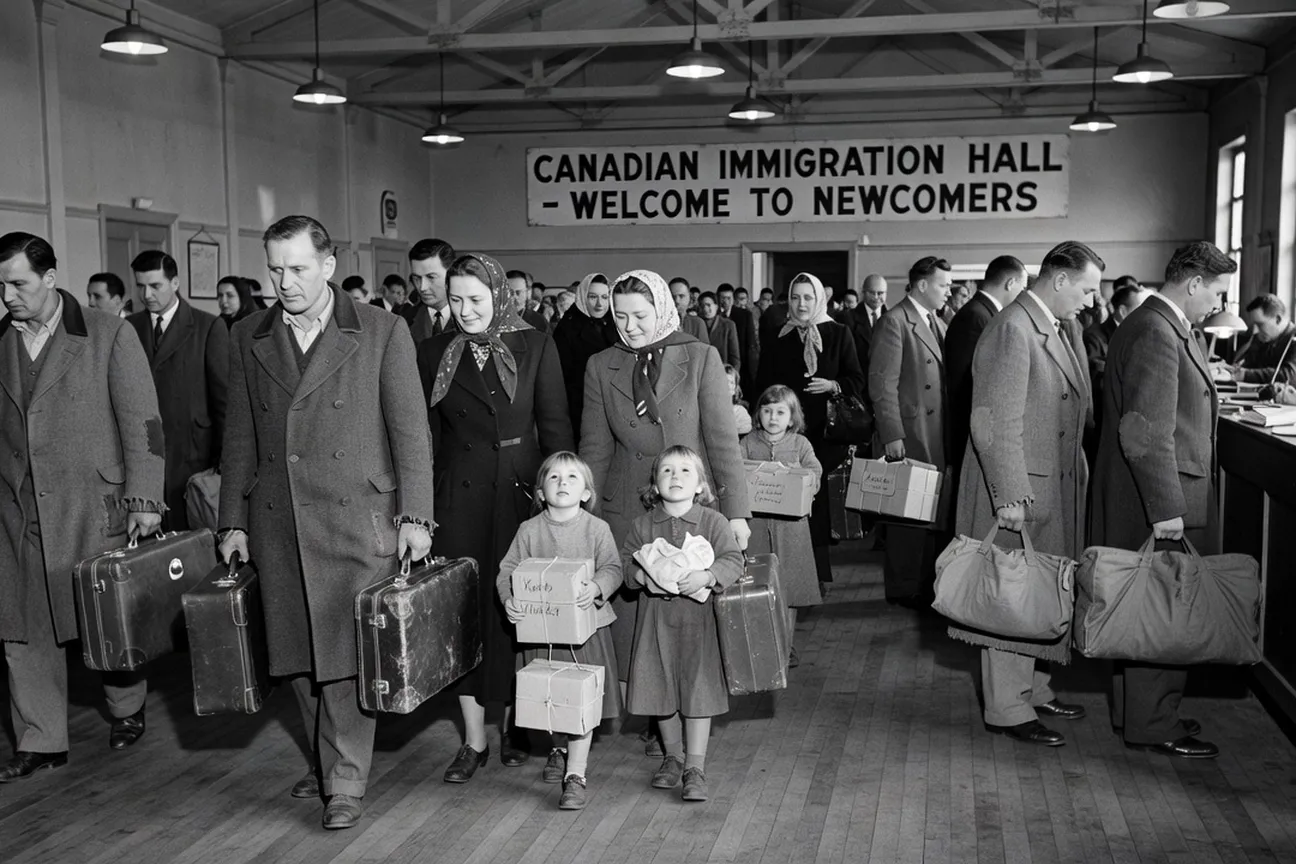
Ukrainian Displaced Persons boarding ship for Canada from postwar European DP camp.
Table of Contents
- From War to the Displaced Persons Camps
- Order-in-Council PC 2856 and Canada's Sponsorship Rules
- Who Were the DP Immigrants? A Different Profile
- The Bush Camps and Labour Contracts
- Building Urban Institutions: Toronto and Montreal
- The Ukrainian Canadian Committee and Youth Organisations
- Tensions with the First Wave
- Numbers and Demographic Impact
- Legacy in 2026
- A Diaspora Transformed
- Frequently Asked Questions
From War to the Displaced Persons Camps
The Second Wave of Ukrainian immigration to Canada emerged directly from the catastrophe of the Second World War and the years of Soviet consolidation that followed it. As the Red Army advanced westward in 1943 and 1944, hundreds of thousands of Ukrainians fled ahead of it, driven by memories of the 1932–1933 Holodomor, the purges of the 1930s, and the certainty that returning Soviet rule meant arrest, deportation, or execution for anyone associated with nationalist organisations, wartime administration, or simply residence in territory the Soviets deemed occupied. Others were forced labourers, the so-called Ostarbeiter, who had been deported to Germany and Austria to work in factories and on farms and who had no wish to be repatriated into Stalin's hands. By the war's end in May 1945, an estimated two million Ukrainians found themselves stranded in the American, British, and French occupation zones of Germany and Austria.
The Allied military authorities, overwhelmed by a refugee population that numbered in the millions across all nationalities, organised displaced persons camps at sites such as Augsburg, Regensburg, Mittenwald, Berchtesgaden, and Somerset House near Hamburg. Ukrainian DPs, administered initially under the United Nations Relief and Rehabilitation Administration and later the International Refugee Organization after 1947, built remarkably dense institutional lives inside these camps. Camp populations organised their own schools, Orthodox and Greek Catholic parishes, theatre troupes, and even university-level courses staffed by professors who had themselves fled Lviv, Kyiv, and other centres of learning. This is a crucial point of contrast with the earlier first wave of Ukrainian immigration between 1891 and 1914, whose members arrived largely illiterate and untouched by higher education; the DP camps, by contrast, incubated an unusually credentialed refugee population.
Soviet repatriation commissions toured the camps through 1945 and into 1946, pressuring and sometimes forcibly seizing individuals for return to the USSR under the terms of the Yalta agreements. Thousands of Ukrainians resisted repatriation through hunger strikes, hiding, and appeals to Western chaplains and camp administrators, a resistance that hardened Western sympathy as Cold War tensions escalated. By 1947, forced repatriation had largely ceased, but the DPs faced a new uncertainty: the occupation zones could not absorb them permanently, and immigration quotas to English-speaking countries remained tightly restricted in the immediate postwar years.
Order-in-Council PC 2856 and Canada's Sponsorship Rules
Canada's response to the DP crisis was cautious and initially framed entirely around labour needs rather than humanitarian obligation. Order-in-Council PC 2856, passed on 27 June 1946, opened a narrow channel by authorising the admission of displaced persons from Allied-occupied zones in Europe, provided each adult signed a contract binding them to a full year of designated labour before they could seek alternative employment. The categories targeted were overwhelmingly manual: bush and lumber work in northern Ontario and British Columbia, general farm labour across the Prairies and southern Ontario, mining in Sudbury and the Kirkland Lake district, and domestic service for young unmarried women recruited under a parallel scheme administered jointly with the Department of Labour.
Selection missions, staffed by Canadian immigration officers and RCMP security screeners, visited the DP camps beginning in 1947 to interview and medically examine candidates. Screening explicitly excluded anyone with documented Communist Party membership, though it proved comparatively permissive toward former members of nationalist formations, including veterans of the Division Galizien, whose wartime record became a matter of considerable later controversy and historical scrutiny. Successful applicants received passage, typically aboard converted troopships such as the Volendam and the General Stewart, disembarking at Halifax's Pier 21 before being dispersed by rail to their contracted employers. Canadian officials favoured young, single, physically fit applicants, a preference that skewed the DP cohort demographically toward men and women in their twenties and thirties, disproportionately without dependents compared to the family-centred chain migration of the earlier Prairie settlement.
The labour-bond system generated persistent friction. Contracted bush workers in isolated camps in northern Ontario and Quebec complained of substandard food, inadequate winter clothing, and wages that barely covered their board deductions. Several bush-camp strikes and formal complaints reached the Department of Labour by 1948, prompting modest reforms to contract terms and inspection frequency, though the fundamental one-year bond remained in force for most arrivals until 1950.
Who Were the DP Immigrants? A Different Profile
The demographic and social profile of the Second Wave diverged sharply from the peasant homesteaders who had settled Alberta and Saskatchewan a half-century earlier, a contrast documented in detail in the account of Ukrainian Prairie settlement in Alberta and Saskatchewan. Where the first wave was rural, largely illiterate, and drawn from the Austrian crownlands of Galicia and Bukovyna, the DP cohort included university graduates, engineers, teachers, army officers, journalists, and clergy from central and eastern Ukrainian regions that had experienced Soviet rule directly, including Kyiv, Kharkiv, and Poltava oblasts, as well as western regions such as Galicia and Volhynia that had passed under Soviet control only after 1939.
This educated, politically conscious character produced a cohort with sharply defined national convictions. Many DPs had lived through the short-lived attempt at Ukrainian statehood during 1917–1921, or had been raised on its memory, and viewed the Soviet occupation of Ukraine as an illegitimate foreign imposition rather than a legitimate government to which loyalty was owed. Political affiliations within the camps ranged across factions of the Organization of Ukrainian Nationalists and various democratic and socialist émigré parties, producing an émigré political culture considerably more factionalised and ideologically explicit than anything found among the largely apolitical Prairie farming communities of the interwar period.
Occupationally, the DPs arriving in Canada under PC 2856 were compelled by the labour-bond system to take positions well below their prior qualifications: physicians laboured in bush camps, engineers worked as farmhands, and former university lecturers found themselves cutting pulpwood in northern Ontario. This mismatch between credentials and assigned work became a defining and often bitter experience of the resettlement period, one frequently recorded in memoirs and oral histories collected decades later by Ukrainian Canadian archival projects.
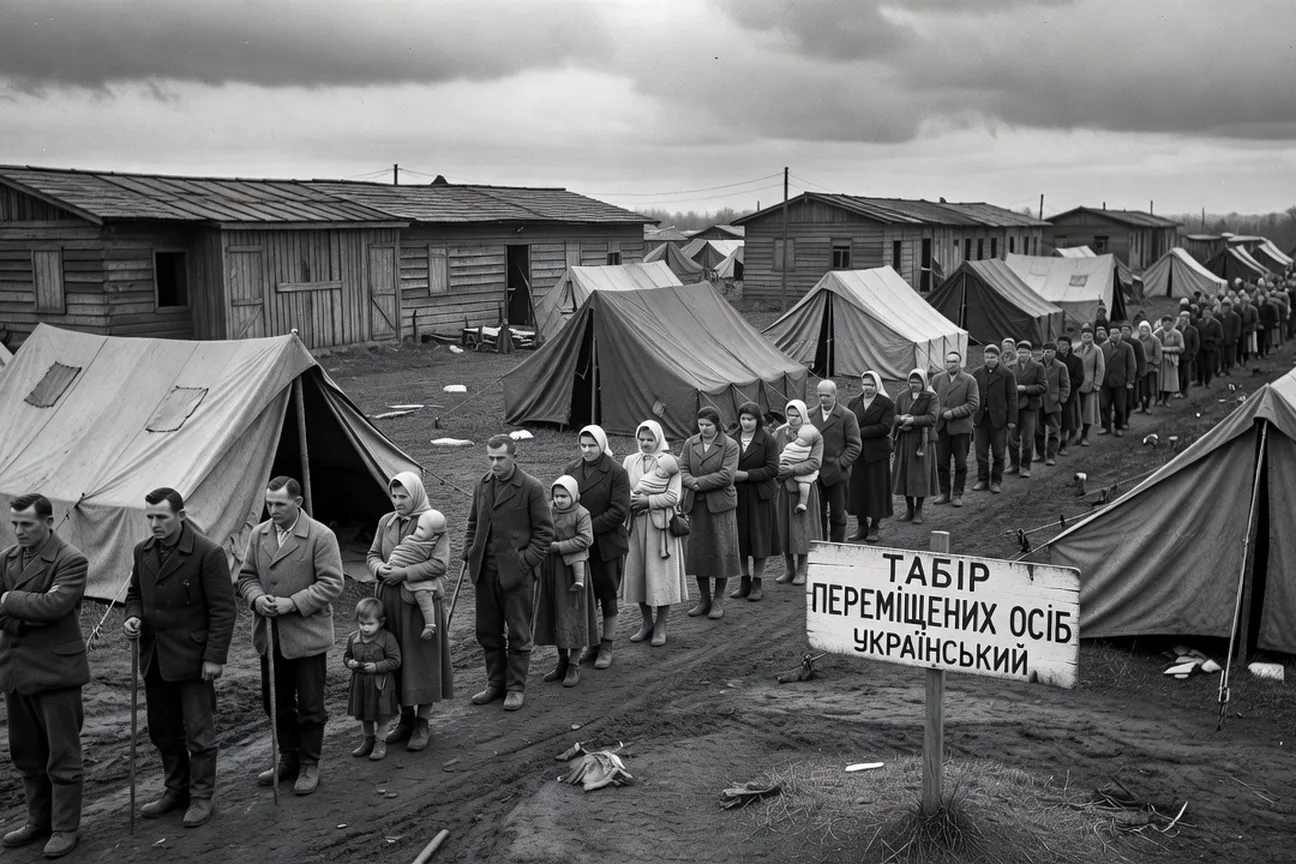
Ukrainian displaced persons labour camp workers in northern Ontario bush camp late 1940s.
The Bush Camps and Labour Contracts
Life under the one-year labour bond varied enormously depending on placement. Bush workers assigned to logging operations in the Nipigon and Cochrane districts of northern Ontario endured isolation, harsh winters, and company-town conditions where wages were reduced by charges for board, tools, and transportation. Farm labourers placed in southern Ontario, the Fraser Valley of British Columbia, or the Manitoba grain belt generally reported somewhat better conditions, particularly where they were billeted with families of Ukrainian descent from the earlier Prairie settlement, creating an early and sometimes uneasy point of contact between the two waves.
Women recruited for domestic service, a category that drew several thousand young unmarried DPs, were typically placed in urban households in Toronto, Hamilton, and Montreal. Employers were required to provide room, board, and a modest wage, but enforcement of contract terms was inconsistent, and complaints of excessive working hours were common in the records of Ukrainian Canadian aid societies that monitored placements. Once the mandatory year expired, most former domestics moved quickly into factory work or clerical positions in the growing postwar urban economy, often settling permanently in the same cities where they had completed their bonded service.
Completion of the labour contract marked a decisive turning point. Freed from bonded obligations, DPs gravitated toward cities with existing Ukrainian institutional infrastructure or industrial employment opportunities, above all Toronto, which absorbed a disproportionate share of the DP cohort and, within a decade, displaced Winnipeg as the demographic centre of Ukrainian Canadian life.
Building Urban Institutions: Toronto and Montreal
The concentration of educated, nationally conscious DPs in Toronto and Montreal produced a wave of institution-building unlike anything the rural Prairie settlements had generated. Within a few years of arrival, DP-led communities had established Ukrainian-language bookstores, credit unions, professional associations for engineers and teachers barred from practising their credentials, and a vigorous émigré press that included newspapers such as Homin Ukrainy, founded in Toronto in 1948, which quickly became one of the most widely read Ukrainian-language publications in North America.
Toronto's Bloor West Village area began to acquire its distinctly Ukrainian commercial character during this period, as DP-owned delicatessens, travel agencies, and professional offices clustered along the strip, a development that would only intensify over subsequent decades. Montreal's DP community, smaller but influential, established parallel institutions serving both Ukrainian Catholic and Orthodox congregations, along with a network of credit unions modelled on cooperative principles familiar from the interwar Prairie experience yet adapted to an urban, wage-earning membership.
Cultural production flourished alongside commercial and religious institution-building. Émigré writers, many of whom had published in interwar Lviv or wartime Kraków, continued their literary careers from Toronto and Montreal presses, while touring theatre and choral ensembles recreated, in diminished but still vital form, the artistic institutions that Soviet rule had suppressed in Ukraine itself. This urban cultural flowering stood in sharp contrast to the rural, church-and-schoolhouse-centred cultural life documented among the earlier Prairie settlers.
The Ukrainian Canadian Committee and Youth Organisations
The Ukrainian Canadian Committee, founded in Winnipeg in 1940 as an umbrella body uniting the fractious constellation of prewar Ukrainian Canadian organisations under the pressures of wartime unity, became the principal institutional vehicle through which established Ukrainian Canadians organised sponsorship, resettlement assistance, and advocacy on behalf of the incoming DPs. Working alongside the Canadian Ukrainian Immigrant Aid Society, the Committee lobbied Ottawa for more generous admission quotas, provided reception services at Pier 21 and other ports of entry, and coordinated the network of local committees that helped new arrivals navigate housing, employment, and the bureaucracy of the labour-bond system.
Youth organisations played an especially important integrative role for the children who arrived with DP families or who were born shortly after resettlement. CYMK, the Ukrainian Catholic Youth organisation, and SUM, the Ukrainian Youth Association founded within the DP camps themselves before being transplanted to Canada, provided structured programming in Ukrainian language, history, and scouting-style activities that helped the second generation maintain linguistic and cultural continuity even as they attended English-language public schools and, increasingly, Canadian universities. These organisations, still active in 2026, trace an unbroken institutional line back to the camp schools of postwar Germany and Austria.
Tensions with the First Wave
The arrival of a politically vocal, urban, and often visibly better-educated DP cohort produced genuine friction with the descendants of the first wave of Prairie settlers. Many Canadian-born Ukrainians, having spent decades demonstrating loyalty and assimilating into Canadian civic life, viewed the DPs' overt nationalism and continued preoccupation with Soviet-occupied Ukraine as a potential liability that might reawaken the wartime-era suspicion that had led to the internment of figures such as Bishop Nykyta Budka a generation earlier. Some Prairie-born community leaders worried that DP political activism, particularly agitation connected to factions of the Organization of Ukrainian Nationalists, risked association with fascism in the eyes of the broader Canadian public.
DPs, for their part, sometimes regarded the existing Prairie-based institutions as parochial, insufficiently focused on the goal of Ukrainian independence, and too accommodated to a rural, agrarian identity that many DPs, coming from urban professional backgrounds, did not share. Language differences compounded the divide: DPs generally spoke standard literary Ukrainian shaped by interwar Galician or Soviet Ukrainian education, while many Prairie-born descendants spoke regional dialects inflected with decades of English borrowing.
These tensions eased gradually through joint work inside organisations such as the Ukrainian Canadian Committee, intermarriage between the two cohorts, and the shared project of building Cold War-era advocacy against Soviet rule in Ukraine, a cause that gave both groups common political purpose. By the 1960s, the distinction between "first wave" and "second wave" families had softened considerably, though it remained a recognisable marker of identity within community memory for decades afterward.
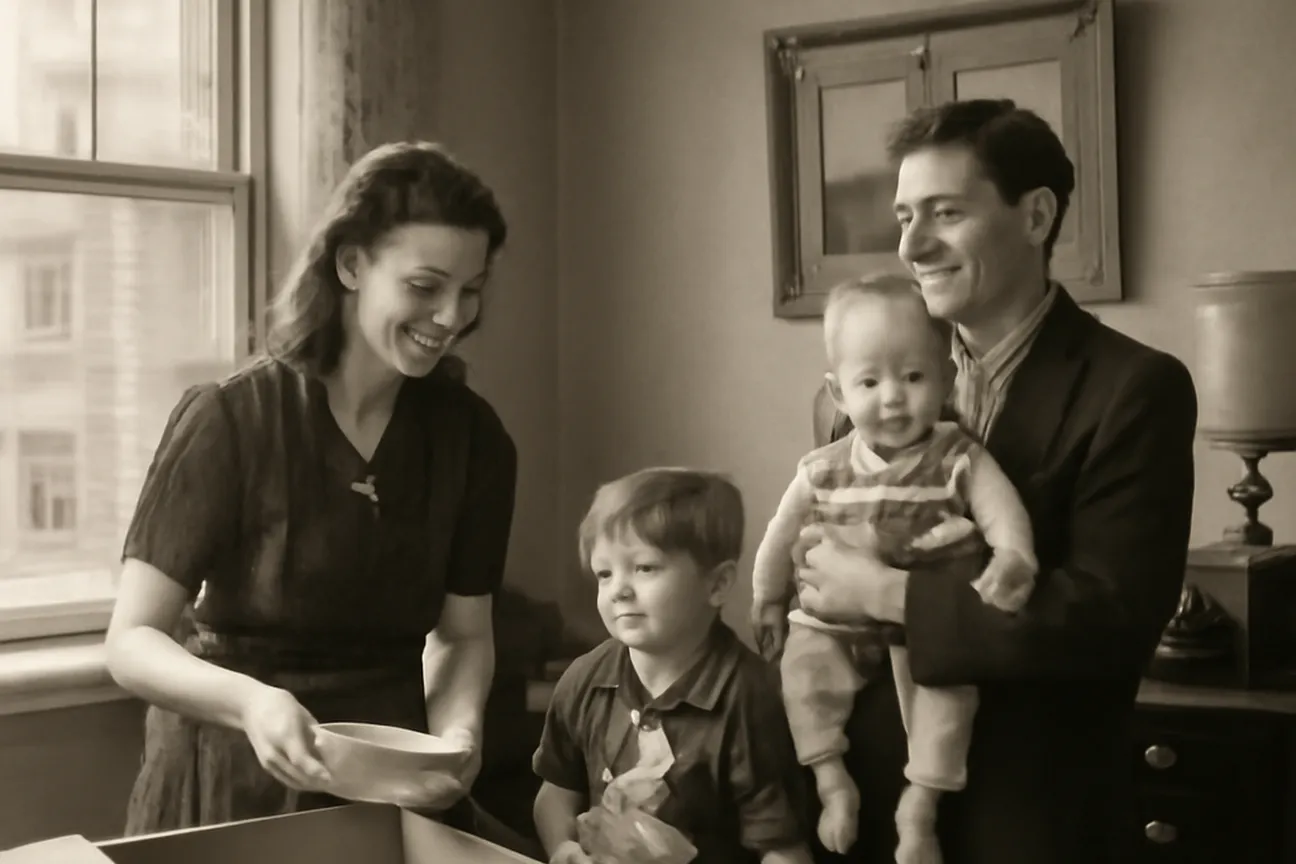
Ukrainian Canadian Committee reception for displaced persons arriving in Toronto 1948.
Numbers and Demographic Impact
Historiographical estimates place Ukrainian DP admissions to Canada between 1947 and 1952 at roughly 30,000 to 34,000 individuals, a figure derived from Statistics Canada immigration records cross-referenced against International Refugee Organization camp registers. This made Canada one of the three principal destinations for Ukrainian DPs, alongside the United States and Britain, out of a total European Ukrainian DP population historians estimate at around 165,000 to 200,000 by the time camp populations were finally resettled or repatriated in the early 1950s.
The demographic effect on Canada's existing Ukrainian population, then concentrated overwhelmingly in the Prairie provinces and numbering roughly 305,000 according to the 1941 census, was to inject a comparatively small but disproportionately influential cohort concentrated in central Canadian cities rather than dispersed across rural bloc settlements. Toronto's Ukrainian population, negligible in relative terms before the war, grew substantially through DP settlement and continued chain migration of family members throughout the 1950s, permanently shifting the demographic and institutional centre of gravity of Ukrainian Canadian life away from Winnipeg and the Prairie bloc settlements described in the account of the Ukrainian community in Canada today.
Legacy in 2026
The institutional and cultural legacy of the Second Wave remains highly visible in 2026. Bloor West Village in Toronto continues to serve as a symbolic and commercial anchor of Ukrainian Canadian identity, its origins traceable directly to DP-era settlement rather than to the earlier Prairie migration. The Ukrainian Canadian Congress, successor body to the wartime Ukrainian Canadian Committee, continues to coordinate national advocacy, a role whose organisational template was set during the DP resettlement period. SUM and CYMK chapters remain active across Ontario and Quebec, and many of their current leaders are third- or fourth-generation descendants of DP families.
Since 2022, the arrival of over 200,000 Ukrainians under the Canada-Ukraine Authorization for Emergency Travel programme has drawn renewed attention to the DP resettlement precedent. Community organisations in Toronto explicitly reference the DP experience, including the labour-bond hardships and the eventual institutional flourishing that followed, when designing settlement services for the newest arrivals, offering a historical framework that situates the current displacement within a longer pattern of forced migration and eventual community-building, as detailed further in current statistics on Ukrainian Canadians in 2026.
Genealogical interest in DP-era arrivals has also grown considerably, with descendants seeking access to International Refugee Organization camp records, Pier 21 arrival manifests, and Canadian immigration files from the PC 2856 programme. Several archival partnerships, including collaborations with organisations such as the Ukrainian genealogy resources documenting postwar resettlement, have begun digitising these scattered records, allowing families to trace relatives through the specific DP camp, ship manifest, and labour-contract placement that shaped their arrival in Canada.
A Diaspora Transformed
The Second Wave of Ukrainian immigration did more than add numbers to an existing diaspora. It fundamentally altered the character of Ukrainian Canadian life, shifting its centre of gravity from rural Prairie bloc settlements to urban centres in central Canada, introducing a politically engaged nationalist consciousness shaped by direct experience of Soviet rule, and building an institutional infrastructure of newspapers, credit unions, youth organisations, and advocacy bodies whose descendants remain active seven decades later. The friction between the pioneering, agrarian first wave and the educated, urban, ideologically driven second wave was real and, for a time, genuinely uncomfortable, yet it ultimately produced a more complex, more resilient, and more politically capable community than either group could have built alone.
For researchers and descendants exploring this history in 2026, the story of the Displaced Persons offers an instructive counterpoint to the homesteading narrative more commonly associated with Ukrainian Canadian settlement. It is a story of war, forced displacement, bureaucratic labour bonds, and the slow, often painful process of rebuilding professional and civic life from nothing — a story with clear resonance for the newest generation of Ukrainian arrivals navigating displacement in the wake of Russia's full-scale invasion since 2022.
Frequently Asked Questions
How many Ukrainian Displaced Persons came to Canada after WWII?
Historians and Statistics Canada estimates place the number at roughly 30,000 to 34,000 Ukrainian DPs admitted between 1947 and 1952, out of a broader wave of some 165,000 Ukrainians who eventually reached Canada, the United States, Britain, and Australia from the European DP camps.
What was Order-in-Council PC 2856?
Issued in June 1946, PC 2856 authorised the admission of displaced persons from Allied-occupied zones under the condition that each adult signed a one-year labour contract, typically in bush work, farming, mining, or domestic service, before being permitted to seek other employment.
How did the Second Wave differ from the first wave of Ukrainian immigrants?
The first wave (1891-1914) consisted overwhelmingly of illiterate or semi-literate peasant homesteaders from Galicia and Bukovyna who settled the rural Prairies, whereas the Second Wave DPs included a disproportionate share of urban professionals, university-educated nationalists, and former soldiers who gravitated toward Toronto, Montreal, and Winnipeg.
What tensions existed between the first and second waves of Ukrainian settlers?
Established Prairie-born Ukrainian Canadians sometimes viewed the politically vocal, anti-Soviet DPs as unwelcome disruptors of a hard-won respectability, while many DPs considered the first wave's community institutions insufficiently nationalist; these frictions eased through joint work in organisations such as the Ukrainian Canadian Committee.
Which organisations helped Ukrainian DPs resettle in Canada?
The Ukrainian Canadian Committee, founded in Winnipeg in 1940, coordinated sponsorship and relief efforts alongside the Canadian Ukrainian Immigrant Aid Society, while youth organisations such as CYMK (Ukrainian Catholic Youth) and SUM (Ukrainian Youth Association) helped integrate the children of DP families into Canadian urban life.