In brief: As of 2026, approximately 1.4 million Canadians report Ukrainian ethnic origin, about 3.5 percent of the national population. Ontario leads in raw numbers, while Alberta, Saskatchewan and Manitoba remain the provinces where Ukrainian heritage is most deeply woven into local identity. The CUAET program added more than 200,000 war-displaced Ukrainians between 2022 and 2024, reshaping the community's geography, age structure and language landscape.
1.4 Million Ukrainians in Canada: The Big Picture
Canada's Ukrainian community is one of the country's oldest and most visible ethnic groups. According to projections built from the 2021 Census, ongoing administrative immigration data and CUAET arrival counts, roughly 1.4 million Canadians identified Ukrainian ethnic origin in 2026, either as a single response or in combination with another heritage. That figure represents about 3.5 percent of Canada's total population of around 40 million.
Globally, this places Canada second only to Russia as the largest host country for the Ukrainian diaspora, ahead of the United States, Poland, Germany and Brazil. The Canadian diaspora is distinctive for its age, institutional density and political influence: no other country outside Ukraine has produced as many elected officials, major cultural organizations and religious structures tied to the Ukrainian identity. For a province-by-province breakdown and generational analysis, see our complete 2026 Ukrainian population statistics for Canada.
Within the 1.4 million figure, it is useful to distinguish three broad cohorts. The first is the multigenerational core, descendants of pre-1991 immigration waves, numbering around one million people, most of whom are Canadian-born and fully integrated linguistically. The second cohort is the post-independence economic migration of roughly 150,000 Ukrainians who arrived between 1991 and 2022. The third and newest cohort is the more than 200,000 war-displaced Ukrainians who came through CUAET between March 2022 and the program's wind-down in 2024. For the broader historical context, see our overview of Ukrainians in Canada.
It is worth noting that the 1.4 million figure counts all forms of Ukrainian ancestry, including mixed-heritage Canadians who report partial Ukrainian origin. The gap between heritage identification and daily use of the language is examined in detail in our study of [Ukrainian language retention across generations](/ukrainian/ukrainian-language-retention-canada-generations/). The number of Canadians who identify primarily as Ukrainian, speak the language at home or were born in Ukraine is considerably smaller, around 450,000 to 500,000. Both measures matter: the larger figure reflects cultural reach and political weight, while the smaller one captures the active, linguistically identifiable community.
Population by Province: Full 2026 Breakdown
Ukrainian-Canadians are unevenly distributed across the country. While the Prairies remain the symbolic homeland of Ukrainian Canada, Ontario has long held the largest absolute population thanks to Toronto's scale. British Columbia has surged into third place on the strength of recent CUAET arrivals, while Quebec and the Atlantic provinces host much smaller but growing communities.
| Province | Ukrainian-Canadian population | % of province | Key city |
|---|---|---|---|
| Ontario | ~400,000 | 2.6% | Toronto |
| Alberta | ~345,000 | 7.2% | Edmonton |
| British Columbia | ~200,000 | 3.7% | Vancouver |
| Manitoba | ~180,000 | 12.4% | Winnipeg |
| Saskatchewan | ~150,000 | 12.8% | Saskatoon / Regina |
| Quebec | ~35,000 | 0.4% | Montreal |
| Atlantic provinces | ~18,000 | 0.7% | Halifax |
| Territories | ~2,500 | 2.1% | Yellowknife |
Ontario's 400,000 Ukrainian-Canadians are concentrated in the Greater Toronto Area, with secondary clusters in Hamilton, Ottawa, Windsor and Thunder Bay. The GTA alone holds roughly 300,000 residents of Ukrainian origin, making it the single largest urban Ukrainian community in the country. Detailed coverage of this hub is available in our guide to Ukrainians in Toronto.
Alberta is the province where Ukrainian heritage is most visible in everyday life: towns such as Vegreville, Mundare and Andrew still host pysanka festivals, and the Ukrainian Cultural Heritage Village east of Edmonton preserves the homesteading era. Saskatchewan and Manitoba together account for more than 330,000 Ukrainian-Canadians, or roughly 12 to 13 percent of each province's population, a remarkable density a century after the first block settlements were surveyed.
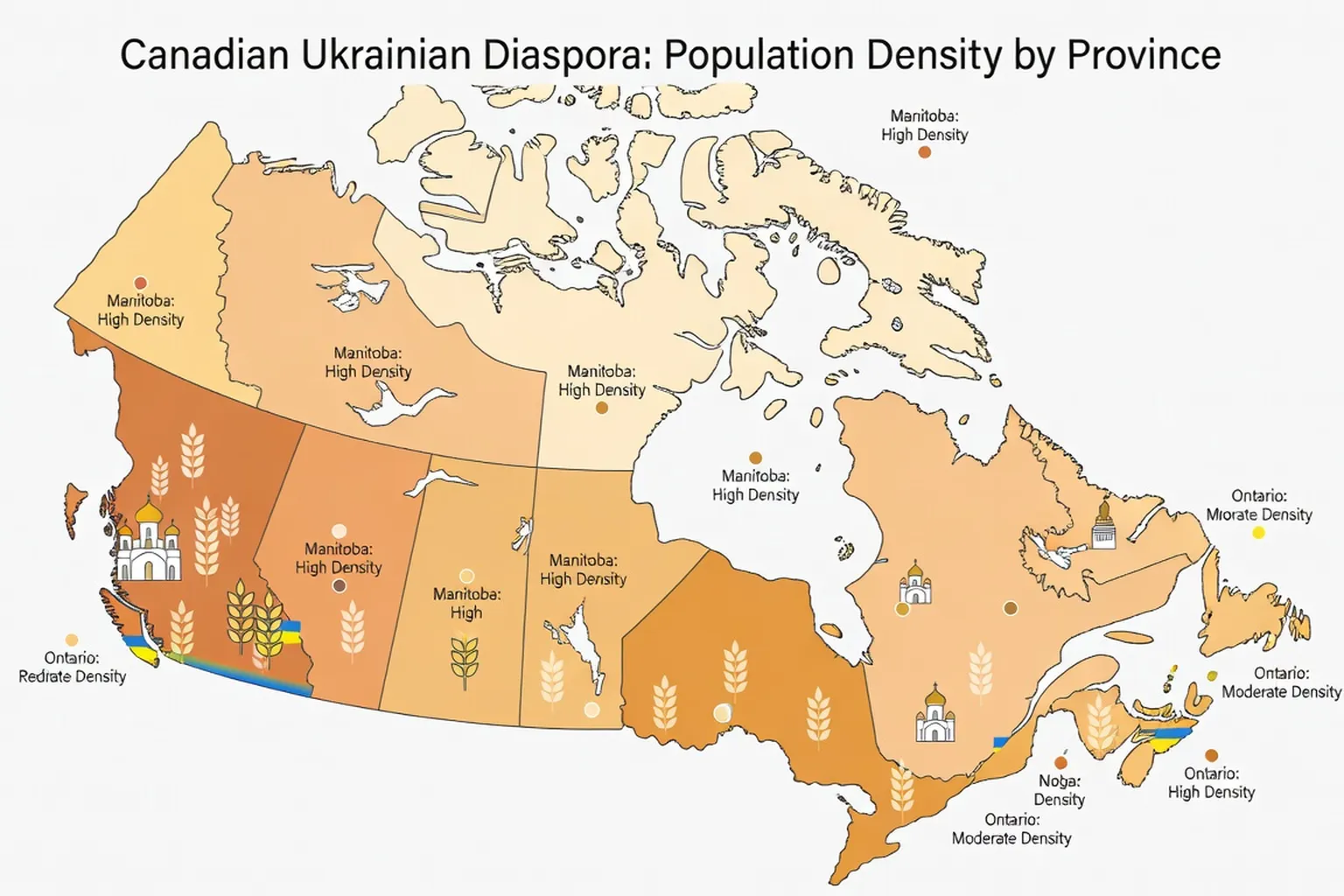
Canadian provinces map showing Ukrainian-Canadian population density by region.
Age Structure and Generations
The Ukrainian-Canadian age pyramid has two distinct peaks. The first is a broad plateau of Canadian-born descendants aged 45 and older, the grandchildren and great-grandchildren of the first three immigration waves. The second, newer peak is concentrated between 25 and 45 years old and consists largely of post-Soviet economic migrants and CUAET arrivals along with their young children. The war-displaced cohort skews heavily toward women and minors because Ukrainian men of military age were largely unable to leave the country after February 2022.
Demographers typically identify five generational layers within the community. First-generation Ukrainian-Canadians were born in Ukraine and emigrated as adults; they number approximately 350,000 today, with more than half having arrived since 2015. Second-generation Canadians, born in Canada to Ukraine-born parents, number roughly 300,000. Third-generation Canadians, with Ukraine-born grandparents, total around 400,000. Fourth- and fifth-generation Canadians, whose Ukrainian ancestry traces back to pre-1930 settlers, account for the remaining 350,000 or so.
Children aged 0 to 14 represent about 18 percent of the community, slightly above the Canadian average, because of the many young families that arrived through CUAET. Seniors aged 65 and over represent about 21 percent, reflecting the aging of second-wave postwar arrivals. Working-age adults make up the remaining 61 percent. This structure is healthier demographically than the Canadian baseline and suggests continued natural growth into the 2030s, particularly if CUAET arrivals transition to permanent residency and begin family formation in Canada.
The generational split also shapes identity. Fourth- and fifth-generation Ukrainian-Canadians often identify with Ukrainian heritage symbolically, through food, dance and religion, rather than language. By contrast, first- and second-generation arrivals maintain active Ukrainian-language households, consume Ukrainian-language media and hold strong emotional ties to the homeland. The coexistence of these two modes of belonging is one of the defining tensions of the community in 2026.
Language Retention: Ukrainian at Home
Language data offers one of the clearest windows into diaspora vitality. According to the 2021 Census, roughly 102,000 Canadians reported Ukrainian as their mother tongue, and about 67,000 reported speaking Ukrainian most often at home. By 2026, after the CUAET influx, the home-use figure has climbed to an estimated 160,000 to 180,000 people, a dramatic reversal of a decades-long decline.
Across the full 1.4 million community, around 15 to 18 percent actively speak Ukrainian at home, either as the primary household language or alongside English or French. Another 10 to 12 percent understand Ukrainian without speaking it fluently, typically members of the second and third generations who grew up hearing the language from grandparents. The remaining roughly 70 percent are monolingual English or French speakers who identify with Ukrainian culture but no longer use the language.
Bilingual households are the norm among CUAET arrivals. Parents typically speak Ukrainian at home while children acquire English or French rapidly through school and daycare. Within five years, these families usually operate in at least two languages, and many adopt a rotating pattern where Ukrainian is used with older relatives and English or French with peers and institutions.
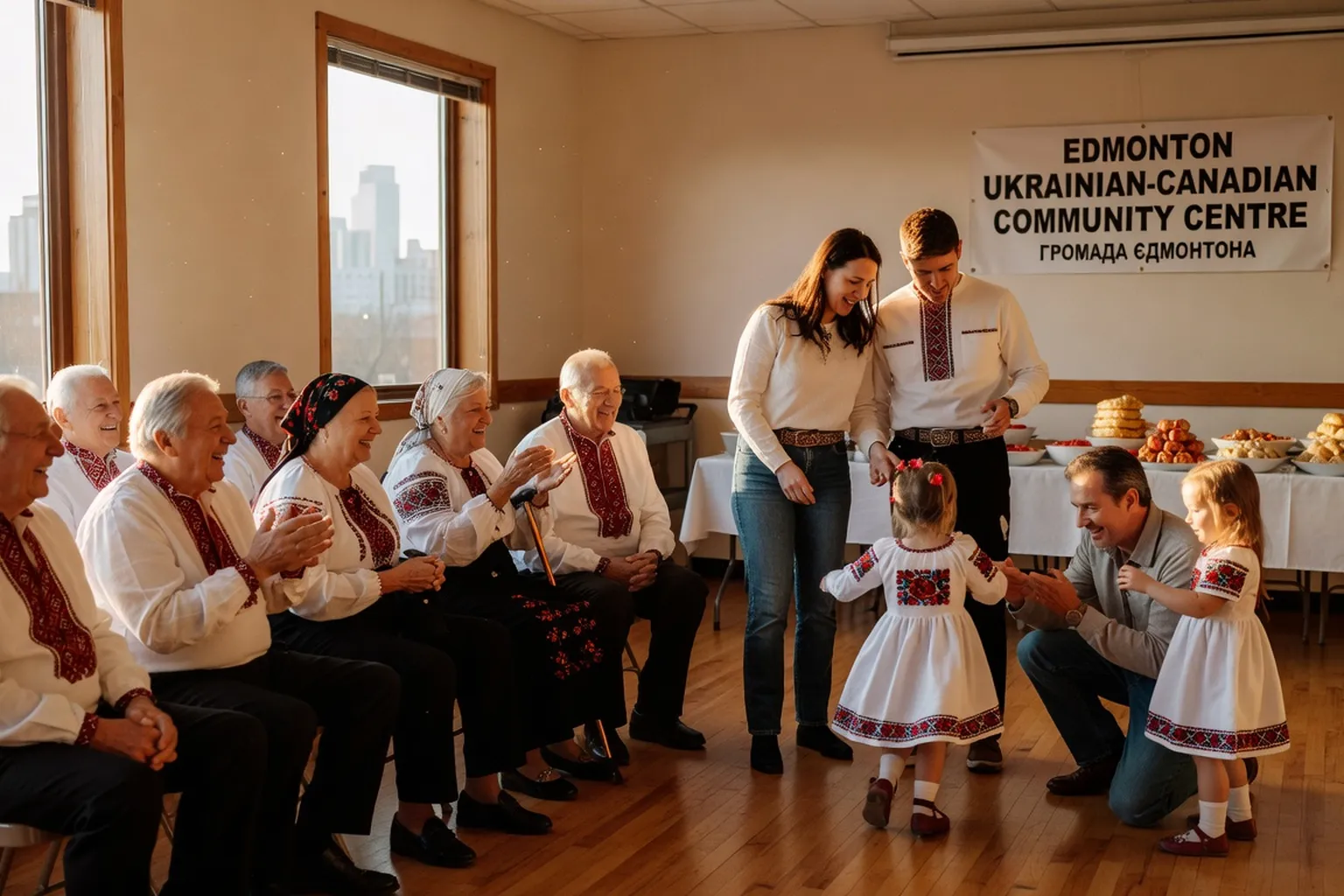
Ukrainian-Canadian family and seniors gathering at a community centre in Alberta.
The revival effect of 2022 cannot be overstated. Before the war, Ukrainian-language Saturday schools in cities like Edmonton, Winnipeg and Toronto were struggling to maintain enrolment, with classes often dominated by heritage students with limited fluency. Since 2022, many of these schools have doubled or tripled in size, and several new programs have opened in cities that previously had none. The presence of native-speaker children has also raised the fluency level of heritage learners, creating a genuine bilingual environment for the first time in decades. For a broader look at diaspora life, see our article on the community of Ukrainians in Canada. Readers interested in Ukrainian cultural heritage can also explore Ukraine cultural resources for context on the language and traditions feeding this revival.
Immigration Waves: From 1891 to 2026
Ukrainian migration to Canada is traditionally divided into five distinct waves, each shaped by the political and economic conditions of its era. The first wave, from 1891 to 1914, brought approximately 170,000 settlers from the Galicia and Bukovyna regions of the Austro-Hungarian Empire. Drawn by the Dominion Lands Act and its offer of 160-acre homesteads for a ten-dollar registration fee, these farming families established the block settlements that still define rural Alberta, Saskatchewan and Manitoba.
The second wave, from 1922 to 1939, consisted of roughly 68,000 interwar migrants fleeing economic hardship and the collapse of the short-lived Ukrainian People's Republic. Many settled in cities and industrial towns, entering the mining, railway and manufacturing workforces. The third wave, from 1947 to 1954, brought approximately 34,000 displaced persons from postwar European camps, including political refugees, former forced labourers and intellectuals. This wave profoundly reshaped urban communities by establishing the cultural, religious and educational institutions that define the diaspora to this day.
The fourth wave, sometimes called the post-independence or economic wave, ran from 1991 through 2021 and brought about 150,000 Ukrainians in search of economic stability, education and family reunification. Unlike earlier waves, it was dispersed across all major urban centres and included many skilled professionals, IT workers and students. The detailed timeline is covered in our guide to Ukrainian immigration history.
The fifth and most recent wave began on March 17, 2022, when the Canadian government launched the Canada-Ukraine Authorization for Emergency Travel (CUAET). Unlike traditional refugee programs, CUAET offered a three-year open work permit and study rights to Ukrainians fleeing the Russian invasion. By the time the program closed to new applications in March 2024, more than 200,000 Ukrainians had arrived in Canada under its provisions, with many more still in the application pipeline. This wave is distinctive for its speed, its concentration of women and children, and its high urban preference.
Where the Growth Is in 2026
The CUAET wave has redrawn the map of Ukrainian settlement in Canada. Unlike the farming pioneers of the 1890s, the newcomers of 2022 to 2024 overwhelmingly chose large cities with strong labour markets and existing Ukrainian infrastructure. The Greater Toronto Area absorbed roughly 80,000 CUAET arrivals, with heavy concentrations in Mississauga, Brampton, North York and Etobicoke. The Edmonton and Calgary metropolitan areas together received approximately 45,000, and Metro Vancouver added about 30,000. Winnipeg, Saskatoon and Montreal each received between 8,000 and 15,000. Readers can also explore the worldwide Ukrainian diaspora ranking.
Smaller cities have also played an outsized role. Communities such as Saskatoon, Regina, London (Ontario), Hamilton, Victoria and Halifax saw their Ukrainian populations increase by 15 to 40 percent between 2022 and 2026, often through organized community sponsorship networks. In several cases, new Ukrainian Saturday schools, churches and social services opened for the first time in decades.
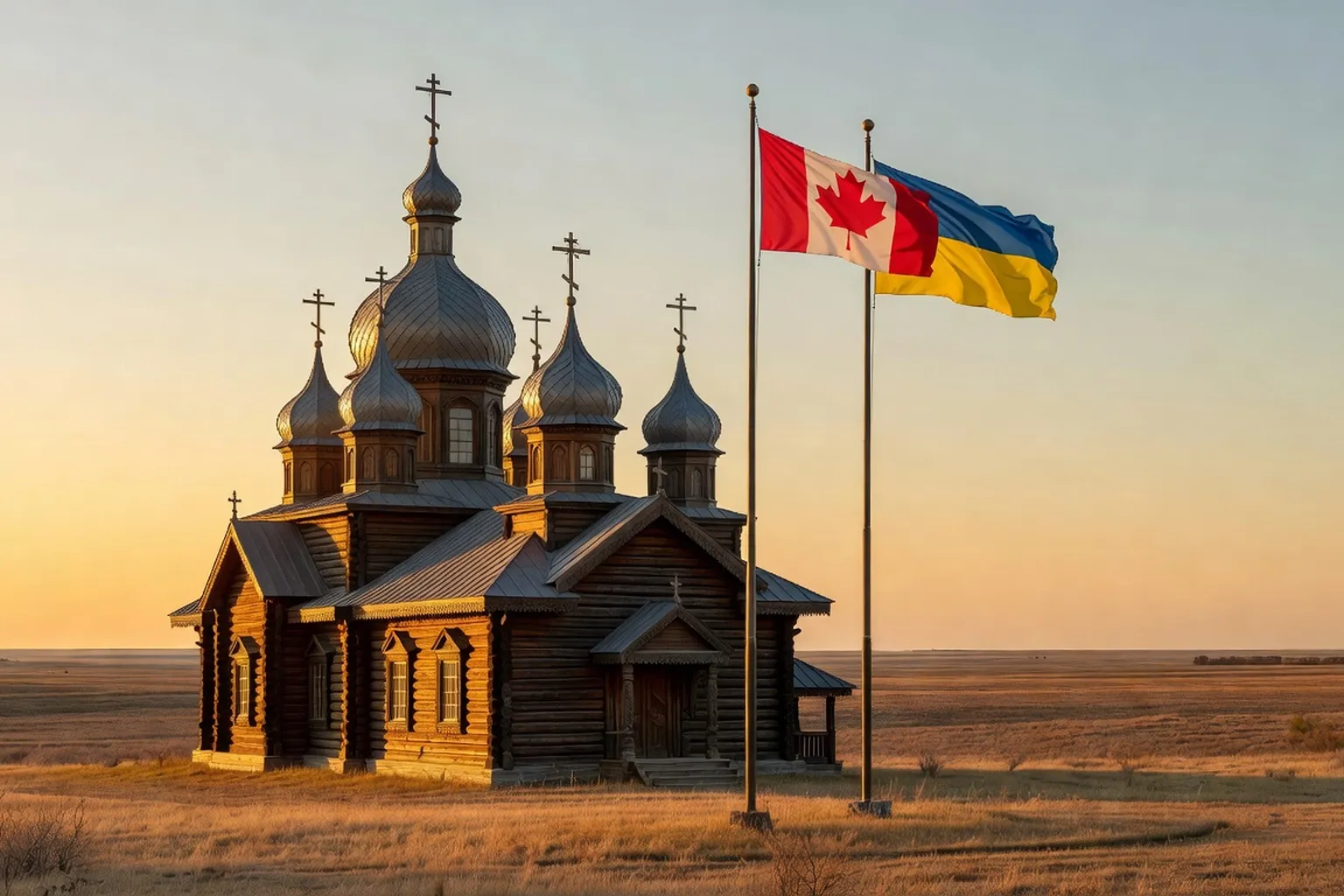
Ukrainian Orthodox prairie church with onion domes against a Manitoba landscape.
Integration metrics suggest a community adapting quickly. Labour market participation among CUAET arrivals of working age reached 72 percent by the end of 2025, close to the Canadian average of 78 percent, with concentrations in healthcare support, logistics, IT, hospitality and education. Homeownership remains low for this cohort, as expected after only a few years, but rental stability is high. English-language proficiency among adults has risen sharply: roughly 65 percent report being able to conduct daily transactions in English by 2026, compared with 35 percent on arrival.
Looking forward, the trajectory depends heavily on permanent residency outcomes. The federal government has introduced several pathways for CUAET arrivals to transition to permanent status, and uptake has been strong. If current trends continue, the Ukrainian-Canadian community could approach 1.6 million by the early 2030s, driven by CUAET families settling permanently, family sponsorship, and continued arrivals from Ukraine even after the war ends. That would position Canada as a permanent anchor of the global Ukrainian diaspora for generations to come. Browse all our coverage in the Ukrainian category.