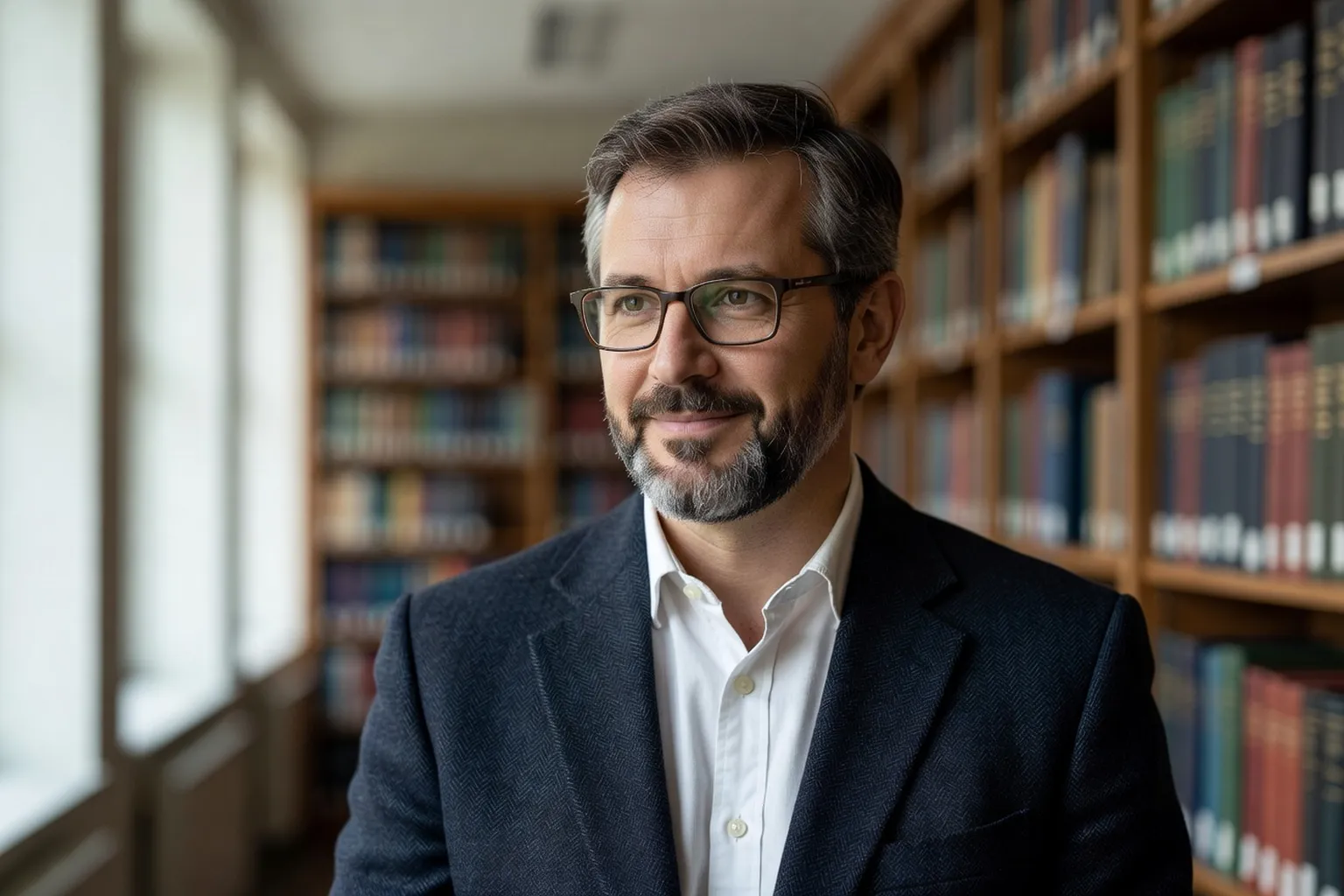
Portrait of Dr. Marko Petrenko, sociologist of Eastern European diasporas.
Dr. Marko Petrenko
Sociologist of Eastern European diasporasBased in Edmonton, Alberta, Dr. Petrenko has spent fifteen years studying Ukrainian communities in Canada, the United States, Brazil and Germany. His comparative research focuses on migration patterns, generational identity formation and the post-2022 displacement flows reshaping the global Ukrainian map. He holds a PhD in sociology and has contributed to academic and public-facing work on diaspora demographics.
Editorial portrait. This interview synthesizes peer-reviewed research and academic commentary on Ukrainian diaspora demographics.
The University of Alberta’s Edmonton campus is an apt setting for this conversation. Outside the window of Dr. Petrenko’s office, the Ukrainian Cultural Heritage Village sits a short drive east, while inside, an outsized map of the Ukrainian-speaking world covers most of one wall. Coloured pins mark Toronto, Edmonton, Winnipeg, Chicago, São Paulo, Berlin, Warsaw and dozens of smaller dots. “Every pin is a methodology argument,” he says with a smile as we sit down.
Ranking debates are not academic curiosities. They shape funding for community institutions, allocations of consular resources, and even the way governments speak about the war and reconstruction. For readers used to seeing Canada described as “the second-largest Ukrainian diaspora in the world,” the post-2022 picture is more complicated. We asked Dr. Petrenko to walk us through that complexity, slowly.
The Global Ranking in 2026
Anna: Let’s start with the question every reader wants answered. What’s the global ranking of the Ukrainian diaspora in 2026, top to bottom?
Marko:There are several plausible rankings, and they disagree. By the broadest measure — people who claim Ukrainian ancestry in some form — the leading host countries in 2026 are Russia at roughly 2.5 to 3 million, Poland at around 2.5 million counting pre-war residents and post-2022 temporary protection, Canada at 1.4 million, Germany at approximately 1.4 to 1.5 million, the United States at about 1 million self-reported, Brazil at 600,000, Argentina at 300,000 and Italy at 250,000.
If you re-rank by Ukraine-born current residents, Poland jumps to first or second, Germany lands third, the United States fourth and Canada fifth. By active Ukrainian-language speakers at home, Poland leads in absolute numbers because the post-2022 cohort is fluent, Germany follows, and Canada drops further because the bulk of our 1.4 million is Canadian-born and English-speaking. Three legitimate questions, three different answers.
How You Actually Count a Diaspora
Anna: But isn’t that just methodology? Why does it produce such different numbers?
Marko:Methodology is everything. Four counting methods are in active use. Ethnicity counts a person as Ukrainian if a state record or census attaches that label, the approach Russia and the former Soviet republics rely on. Citizenship counts holders of a Ukrainian passport. Country of birth counts people physically born inside Ukraine. Ancestry self-identification, which Statistics Canada uses, counts anyone who ticks a heritage box in the census.
Each method captures something different. Ethnicity captures legacy state classifications, often coercive; citizenship captures legal status; birth captures recent migration; ancestry captures cultural belonging across generations. None is wrong, and none alone is sufficient. The Canadian figure of 1.4 million is an ancestry count. Switch to citizenship and Canada drops to perhaps 350,000, because most third- and fourth-generation Ukrainian-Canadians hold no Ukrainian passport. So when a journalist writes “the largest Ukrainian diaspora,” they should always specify which yardstick they used. Otherwise the number is just rhetoric.
Why Russia Has Historically Led
Anna: Russia has long been called the country with the largest Ukrainian diaspora. Why is that, and is the label still accurate?
Marko:Russia’s position at the top is a Soviet inheritance. Throughout the twentieth century, Soviet internal migration moved millions of Ukrainians eastward for industrial work, military service, agricultural projects in Siberia and the Far East, and political reasons including deportations. The 2002 Russian census recorded 2.9 million ethnic Ukrainians; the 2010 census, 1.9 million; subsequent counts have been more contested.
Soviet ethnic registration was rigid: a nationality assigned at birth often persisted even when a person assimilated fully into Russian-speaking life. Intermarriage produced large mixed-heritage populations whose self-identification fluctuates with political circumstances, and the 2022 invasion has made identifying as Ukrainian inside Russia far more dangerous, suppressing self-reporting.
So when I cite 2.5 to 3 million ethnic Ukrainians in Russia today, that figure is real in the legacy-classification sense but not a functioning community. Most of those people no longer speak Ukrainian or connect to Ukrainian institutions. Sociologically, Russia has the largest count and the smallest active community — the paradox at the heart of why these rankings are slippery.
Dr. Marko Petrenko, sociologist of Eastern European diasporas, in his Edmonton university office with reference books and a wall map of Ukrainian settlement worldwide.
How 2022 Reshuffled the Map
Anna: Then 2022 happened. How did the full-scale invasion reshuffle the global rankings?
Marko:Catastrophically and quickly. Before February 2022, the rough top five by ancestry was Russia, Canada, USA, Brazil and Argentina. Poland sat further down with maybe a million Ukrainian residents, mostly economic migrants. Germany hosted around 250,000.
By the end of 2024, Poland was hosting roughly 1.5 million Ukrainians on temporary protection plus its prior residents, totalling around 2.5 million. Germany surged from 250,000 to roughly 1.4 million as 1.2 million people arrived between February 2022 and late 2024. The United States added several hundred thousand through Uniting for Ukraine and parole pathways. Canada added more than 200,000 through CUAET, bringing the ancestry total to 1.4 million.
So Poland leapt from below the top five into the top three by almost any measure, and arguably to the top by current resident count. Germany joined the top three. Canada’s relative position actually fell in raw terms, not because Canada lost people but because Poland and Germany absorbed extraordinary inflows. The reshuffle also changed the character of the diaspora: until 2022 the communities outside the former Soviet space were dominated by descendants of pre-1991 waves; today recent Ukraine-born arrivals are a major share.
Where Canada Sits in 2026
Anna: So where does Canada actually rank in 2026, in plain language?
Marko:Plain language with a caveat: Canada ranks between second and fourth depending on the yardstick. By ancestry self-identification, the lens Canadians most often use about themselves, Canada is second only to Russia. The 1.4 million Canadians of Ukrainian origin form the largest free-world diaspora measured by heritage claims. For deeper local statistics see the Ukrainian population in Canada 2026 stats.
By current Ukraine-born residents, however, Canada drops to third or fourth behind Poland, Germany and arguably the United States. The Canadian Ukraine-born population is around 350,000 today, up from about 150,000 pre-CUAET, but smaller than Poland’s active wartime arrivals or Germany’s post-2022 cohort. By Ukrainian-language speakers at home, Canada sits around 160,000 to 180,000 — meaningful, but not in the global top tier.
So in one sentence: Canada is the second-largest Ukrainian ancestry community after Russia, and one of the top five for current Ukraine-born residents. Both statements are true, and they are not in conflict.
What Makes Canada’s Diaspora Unique
Anna: Beyond the numbers, what makes the Ukrainian diaspora in Canada distinctive?
Marko:Three things stand out. First, institutional density: Canada has the highest concentration of Ukrainian institutions per capita of any country outside Ukraine — churches, credit unions, schools, museums, summer camps, dance ensembles, scholarly institutes, advocacy bodies. The Ukrainian Canadian Congress has been an organized political voice since 1940; the Shevchenko Foundation has funded community work for half a century.
Second, continuity. The Canadian Ukrainian community has been continuously active for more than 130 years, since 1891, with each generation rebuilding and adapting the institutions of the previous one. That layering is rare: the American community is larger in some respects but more dispersed; the Brazilian community is older but rural and more isolated.
Third, political representation. Canada has had Ukrainian-Canadian premiers, federal cabinet ministers, deputy prime ministers and senators. The 2022 federal response to the invasion was shaped by that political weight. Even if numbers fluctuate, the institutional and political weight does not — which is why ranking by raw count understates Canada’s importance.
Brazil’s Quiet Ukrainian Heartland
Anna: You mentioned Brazil. Most readers are surprised to learn there are 600,000 Ukrainians there. How is the Brazilian community different from Canada’s?
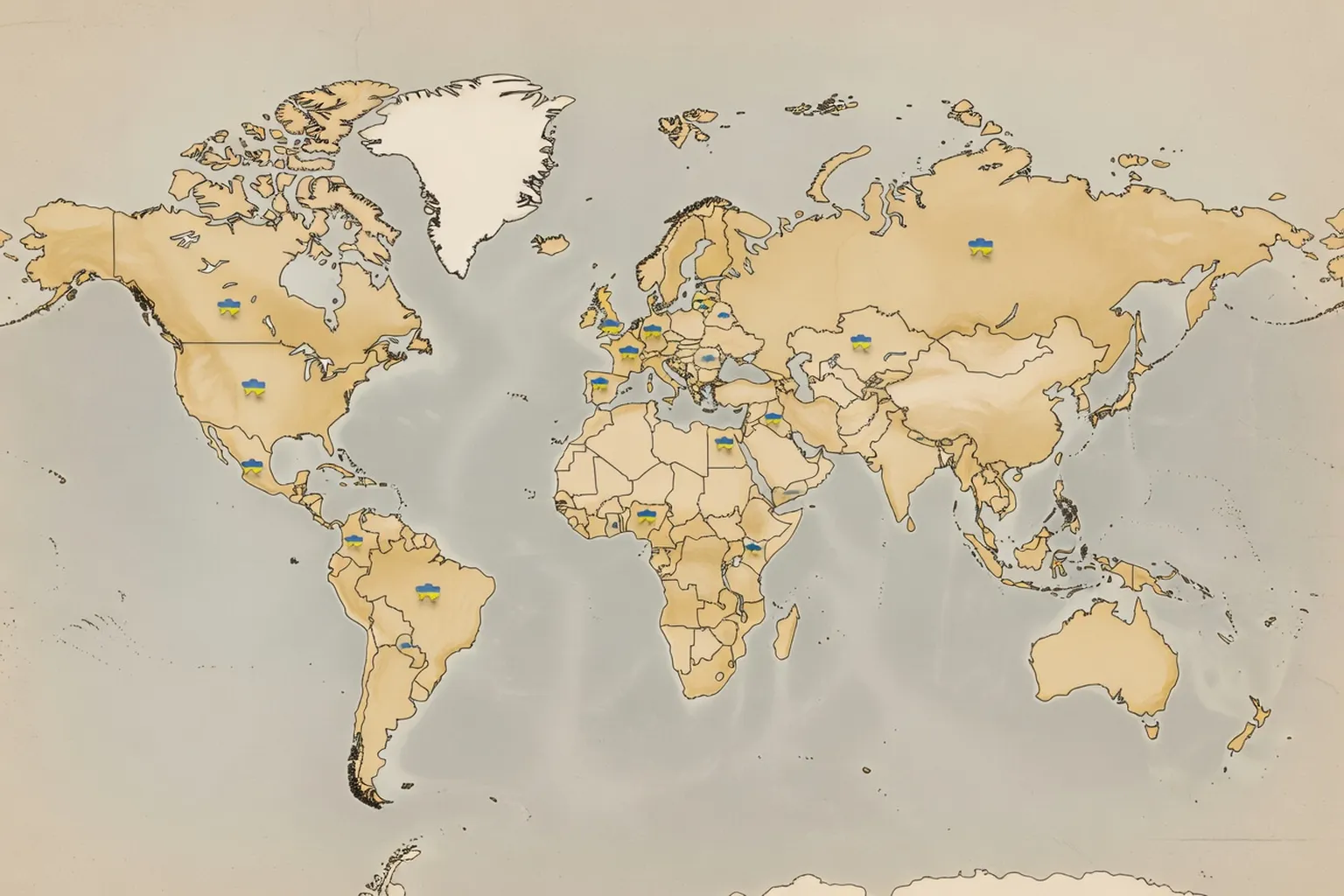
World map showing the major Ukrainian diaspora communities in 2026 across Canada, United States, Poland, Germany, Brazil and Argentina with population estimates.
Marko:The Brazilian Ukrainian community is a fascinating parallel case. Roughly 600,000 people of Ukrainian descent live in Brazil, with about 80 percent concentrated in Paraná state, particularly around Prudentópolis, Curitiba and Iraty. The community traces to the same first wave that built rural Canada, between 1891 and the 1910s, when families fled poverty and Habsburg conscription in Galicia and Bukovyna.
The agricultural roots look almost identical to the Prairie story: forested land cleared for farming, block settlements with their own churches and schools, Greek Catholic and Orthodox parishes side by side. The difference is what happened next. Canada urbanised through the second, third and fourth waves; Edmonton and Toronto absorbed Ukrainian migration after each world war and after independence. Brazil never received those subsequent urban waves.
The result is a community that is mostly third and fourth generation, rural, with high language retention in some areas and almost none in others. Prudentópolis is sometimes called the Brazilian Ukrainian heartland because Ukrainian is still spoken at markets and the local archeparchy maintains a Ukrainian-language seminary. But there is little of the institutional density Canada has built. It’s a community frozen in time in some ways — and that’s instructive. Without the post-1945 and post-1991 urban waves, Canada would probably look more like Paraná.
Will Rankings Shift Again by 2030?
Anna: Looking ahead, will the rankings shift again by 2030?
Marko:Yes, almost certainly. Three forces will reshape the map between now and 2030. The first is post-war return: when active hostilities end, Polish authorities and the EU expect a return rate of 30 to 60 percent of those on temporary protection. Germany may see similar returns. Canada will see fewer, because CUAET arrivals invested in long-term housing, schooling and employment further from Ukraine.
The second force is naturalisation. Many CUAET arrivals are converting to Canadian permanent residency through dedicated pathways, and a sizeable share will become Canadian citizens by the end of the decade. Once they hold Canadian citizenship and have Canadian-born children, they tend to stay — so Canada’s gains from 2022-2024 are largely “sticky.” The third force is continuing migration: even after the war ends, Ukraine will face years of reconstruction and ongoing economic outflow.
My base-case projection for 2030: Russia still nominally first by ethnic registration but increasingly disconnected, Canada solidly second by ancestry at 1.5 to 1.6 million, Poland shrinking from its 2024 peak but still well above pre-war, Germany consolidating its cohort into a million-plus permanent diaspora, the United States ticking upward, and Brazil stable. Canada’s position will be more secure rather than less. For ongoing trends see Ukrainian refugees in Canada stats.
Identity Versus Paperwork
Anna: Throughout this conversation we keep coming back to a tension between identity and paperwork. How do you weigh those?
Marko:That tension is the central methodological problem in diaspora studies. Paperwork is what governments and statisticians can count: passports, residence permits, census tickboxes, school enrolments. Identity is what people feel: how they describe themselves to a neighbour, what language they sing in, what icons hang in their kitchen. The two only partially overlap.
Take a fourth-generation Edmontonian whose great-grandparents arrived in 1903. She holds only a Canadian passport, may not speak Ukrainian, may not have visited Ukraine. By citizenship she is invisible; by language too; by a Canadian ancestry tickbox she is fully Ukrainian-Canadian. By her own self-identification, depending on the day, she may feel Ukrainian, Canadian, Ukrainian-Canadian, or simply Canadian with a hyphen. All those answers are real. Now take a Kyiv accountant who arrived in Toronto in 2023 on CUAET: by citizenship she is Ukrainian, by ancestry she may be invisible to Canadian counts because she hasn’t responded to a census, by self-identification she is Ukrainian first.
So the right answer to “how big is the diaspora” is to give multiple numbers and explain what each captures. Single rankings are journalism shorthand. The reality is a layered map of overlapping populations.
What’s Most Misunderstood
Anna: Last question. What’s most misunderstood about diaspora rankings?
Marko:Two things. First, that rankings are static. They are snapshots, and the picture changes constantly. The 2022 reshuffle proved that. When readers see a confident ranking written today, they should assume it will be partially outdated within five years.
Second, the ranking against other host countries matters less than the ranking against Ukraine itself. The Ukrainian state has roughly 28 to 35 million residents in 2026, depending on how you count occupied territories and the displaced. Even the largest single diaspora community is less than one tenth of the homeland. What matters is its relationship to Ukraine, not its position against another diaspora.
Readers in Canada sometimes get caught up in “are we second or third” debates that miss the point. The real question is whether the Ukrainian-Canadian community can sustain its institutions, transmit identity to the next generation, and contribute meaningfully to Ukraine’s future. By those measures Canada is doing well, and our exact rank is almost beside the point. For cultural context across the broader Slavic world, complementary perspectives such as a Slavic heritage perspective are worth consulting, but the lens that matters most for Canadian readers is local.

Side-by-side composition of a Canadian prairie Ukrainian church and a Paran a Brazilian Ukrainian church, both with onion domes, illustrating the parallel rural diaspora communities.
Quick Questions: Diaspora Myths and Realities
We closed the conversation with a rapid-fire round on common claims about the Ukrainian diaspora. Each statement was put to Dr. Petrenko in a sentence; here are his short verdicts.
Three Things to Remember
- There is no single ranking. Russia leads by Soviet-era ethnic registration, Poland leads by post-2022 wartime arrivals, Canada leads the free world by ancestry self-identification with 1.4 million people. Each ranking captures a different reality.
- Canada sits between second and fourth. Second by ancestry behind Russia, third or fourth by Ukraine-born current residents behind Poland, Germany and sometimes the United States. Both statements are accurate.
- Institutional weight outlasts raw counts. Canada’s 130-year continuity, dense network of churches, schools and political representation make it a permanent anchor of the global Ukrainian world regardless of whether the population ranking shifts by a place or two.