What Was the Cucuteni-Trypillia Culture?
Cucuteni-Trypillia was a Neolithic and Eneolithic farming civilisation that flourished in present-day Ukraine, Moldova, and northeastern Romania between roughly 5500 BC and 2750 BC. It is named for two type-sites: Cucuteni, a hilltop settlement in northeastern Romania first excavated in 1884, and Trypillia, a village near Kyiv where the Ukrainian archaeologist Vikentiy Khvoyka identified parallel material culture in 1893. Soviet-era scholarship for decades kept the two designations separate, but archaeologists since the 1960s have recognised them as belonging to a single continuous cultural tradition.
The defining material features of Cucuteni-Trypillia are unmistakable: highly geometric painted pottery in three colours (typically black, white, and red on a buff or orange background); ceramic female figurines often associated with hearths and domestic ritual; rectangular houses with daub-and-wattle walls and clay floors; and a settlement pattern that progressively scaled from villages of a few hundred people to enormous planned communities of more than ten thousand. The culture practised mixed agriculture — einkorn and emmer wheat, barley, peas, lentils — with substantial herding of cattle, pigs, and sheep. They had domesticated dogs but had not yet adopted the horse for either riding or traction.
What sets Cucuteni-Trypillia apart from other contemporary Neolithic cultures is the scale and sophistication of its later mega-settlements. While most European farming communities of the fifth millennium BC consisted of clusters of a dozen or so houses, the Cucuteni-Trypillia builders eventually achieved planned communities of more than 400 hectares laid out in radial geometric patterns. These were the largest organised human settlements anywhere in the world at the time, predating by centuries the Sumerian cities of Uruk and Ur and the Egyptian capital cities of the Old Kingdom.
The culture has only been known to global scholarship for about a century and a half. The 1884 Cucuteni excavation by Teodor Burada in Romania and the 1893 Trypillia excavation by Khvoyka in Ukraine sparked early interest, but it was twentieth-century radiocarbon dating and satellite-based magnetic surveys, beginning in the 1970s, that revealed the staggering scale of the mega-settlements. The deeper a comprehensive picture emerged of Ukraine's full history and how it has been shaped by every successive wave of settlement, the clearer it became that Cucuteni-Trypillia is not a curiosity of regional archaeology but a major chapter of European prehistory.
Where Were the Cucuteni-Trypillia Settlements? Map of Ukraine, Moldova, Romania
The geographical range of Cucuteni-Trypillia covers roughly 350,000 square kilometres of southeastern Europe. The territory extends from the eastern Carpathian foothills in northeastern Romania, through the Prut and Dniester river basins in Moldova, across the western Ukrainian forest-steppe of Vinnytsia and Cherkasy oblasts, and as far east as the Dnipro River near present-day Kyiv. The northern boundary lies roughly at the present Belarus-Ukraine border; the southern boundary along the lower Dniester and the northern coast of the Black Sea.
This territory corresponds almost exactly to the so-called black-earth belt — the chernozem zone — that runs across Ukraine. The chernozem, with its deep humus-rich topsoil produced by millennia of grassland decomposition, was and remains some of the most productive agricultural land in the world. The Cucuteni-Trypillia farmers settled exactly where the soil could sustain large concentrations of population for extended periods. This is not coincidence: it is the foundational fact of the culture's geography. Where the chernozem was thinner or absent (further north into the boreal forest, further east into the open steppe), Cucuteni-Trypillia settlements either did not develop or were short-lived.
Within this overall range, settlement density was uneven. Three core zones contained the highest concentration of communities. The first lies in the Buh and Sinyukha river basins of central Ukraine, in present-day Cherkasy oblast, where the largest mega-settlements were built. The second is along the Prut and Dniester rivers in Moldova and northwestern Ukraine, where the chronologically older settlements clustered. The third is the upper Siret valley in northeastern Romania, the original Cucuteni heartland. Within each zone, individual settlements were typically spaced 5 to 15 kilometres apart, suggesting an interconnected network rather than isolated communities.
The culture had no overall political centre. There is no Cucuteni-Trypillia equivalent of a Mesopotamian capital or an Egyptian royal residence. The mega-settlements appear to have been organised internally without obvious hierarchical structures — no royal palaces, no exceptional residences, no monumental temples in the Sumerian sense. This absence of social hierarchy in the archaeological record is one of the culture's most intriguing features and one that contemporary archaeology has not entirely explained.
Timeline: 5500 BC to 2750 BC — Three Phases
Cucuteni-Trypillia is conventionally divided into three chronological phases by archaeologists, each with its own pottery typology and settlement pattern.
The Early phase (approximately 5500-4750 BC, sometimes labelled Pre-Cucuteni and Trypillia A) is marked by small village settlements of 50 to 300 people, simple incised pottery with limited polychrome decoration, and a steady spread eastward from the Romanian Carpathian foothills into the Ukrainian forest-steppe. During this initial millennium, the Cucuteni-Trypillia material culture took on its distinctive form but the settlements remained modest in scale. The earliest figurines and the first evidence of organised house-floor ritual date from this phase.
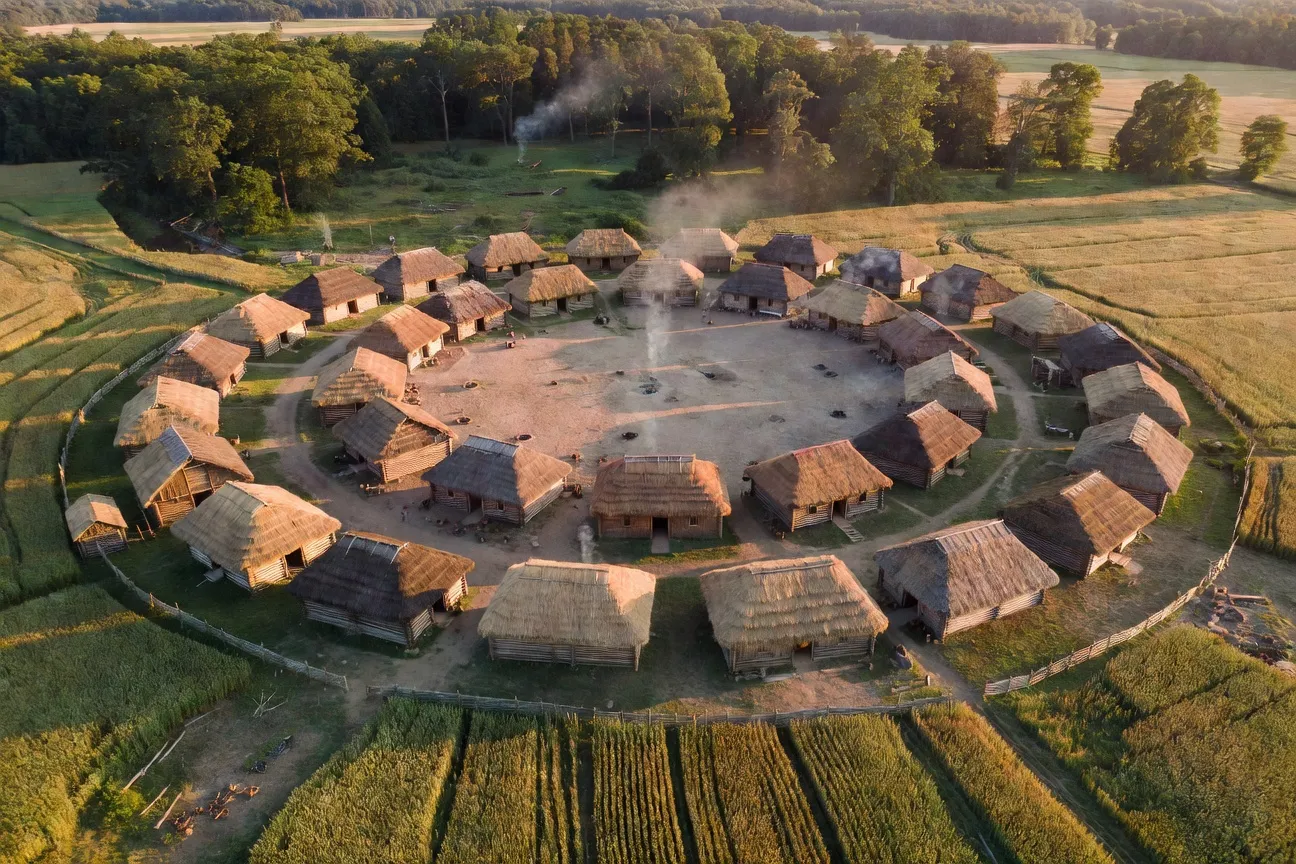
Reconstruction of a Cucuteni-Trypillia neolithic mega-settlement around 4000 BC, circular wooden houses arranged in concentric rings.
The Middle phase (approximately 4750-4000 BC, Cucuteni A through B and Trypillia B-I and B-II) saw rapid expansion of both territory and settlement size. By 4500 BC, the average settlement had grown to 50-100 houses; the polychrome painted pottery had reached its full developed form; the figurine tradition had elaborated into stylised forms with detailed incised patterns. The transition from late-Middle to Late phase is the moment when the mega-settlement experiment begins.
The Late phase (approximately 4000-2750 BC, Cucuteni B and Trypillia C-I and C-II) is the era of the mega-settlements and the most spectacular cultural production. The largest sites — Talianki, Maidanetske, Dobrovody, Nebelivka — all date from the centuries between 4000 and 3500 BC. Painted pottery reached technical heights difficult to match anywhere in contemporary Europe. The figurines acquired their famous stylisation. The settlements achieved their largest scale before, within the space of perhaps two centuries after 3500 BC, beginning a sustained collapse that ended in the abandonment of every major site by 2750 BC.
The total span of Cucuteni-Trypillia therefore covers about 2,750 years — longer than the span from the founding of Rome to the present day. To place this in perspective: the entire history of literate civilisation, from the first cuneiform tablets to the smartphone, has unfolded in a shorter time than the Cucuteni-Trypillia culture itself existed.
The Mega-Settlements: Talianki, Maidanetske and the World's First Cities
The discovery that fundamentally changed Cucuteni-Trypillia studies was the realisation, beginning in the 1970s, that several Late-phase sites in central Ukraine reached unprecedented size. The breakthrough came with magnetic gradiometer surveys conducted by Soviet and later Ukrainian-German teams across the Buh-Sinyukha interfluve. The surveys revealed beneath ploughed fields the outlines of entire planned settlements with hundreds, sometimes thousands of house foundations.
Talianki, surveyed in the 1980s and continuously studied since, is the largest. The site occupies approximately 450 hectares (4.5 square kilometres), with house foundations arranged in eleven or twelve concentric oval rings around a large central open space. Conservative estimates place the population at 14,000-15,000 people at its peak around 3700-3500 BC. The houses were rectangular, two-storeyed in some cases, with timber frames, daub walls, and clay floors. Streets ran radially between the rings; gates and approaches were positioned at cardinal directions; the central open space, presumably ceremonial or pastoral, was the largest planned public space anywhere in the world at the time.
Maidanetske, located 18 kilometres from Talianki, is only marginally smaller, occupying about 200 hectares with an estimated population of 12,000. Together with Dobrovody, Nebelivka, Glybochok, and several other Late-phase sites in the same region, these constitute what some archaeologists now call the Cucuteni-Trypillia mega-settlement landscape: a cluster of urban-scale communities within a small region, contemporary with each other, with intervening landscapes filled with smaller villages and isolated farmsteads.
The interpretation of these sites as urban communities is contested. Sceptics argue that the houses were rebuilt at intervals (every 60 to 80 years, by current estimates) and that the population at any one moment was lower than the cumulative head count would suggest. Some scholars propose that mega-settlements functioned as temporary aggregations — perhaps ritual gathering points used periodically by a region's population rather than permanently inhabited cities. Other scholars insist that the magnetic-survey evidence of continuous house occupation and the absence of seasonal abandonment indicators support the urban interpretation. The debate continues, but even on the most cautious reading, the mega-settlements housed thousands of people for sustained periods, a scale of complex social organisation that has few parallels in Neolithic Europe.
What is genuinely unprecedented about the mega-settlements is the absence of detectable social hierarchy. There are no royal residences, no monumental temple complexes, no warehouses indicating state-organised storage of grain or trade goods. House sizes vary moderately but there is no archaeology of palace versus hovel. Burials are rare in the Cucuteni-Trypillia record overall, which itself is curious, but where burials exist, they are not accompanied by extravagant grave goods that would indicate aristocratic burial. The mega-settlement appears to have been a relatively egalitarian large-scale community, sustained for centuries before collapsing.
Pottery, Spiral Symbolism and Female Figurines
The pottery of Cucuteni-Trypillia is among the most accomplished ceramic art of any prehistoric culture in Europe. The Late-phase wares, especially, exhibit a technical sophistication and decorative inventiveness that European pottery did not reach again for thousands of years. Vessels were made by coiling, with a long preparation of fine-grained clay tempered with finely ground sherd material; firing was achieved in carefully managed open hearths capable of reaching 950 to 1000 degrees Celsius; surfaces were polished, then painted in three or four colours with mineral pigments before a second firing fixed the design.
The decorative vocabulary is built almost entirely from variations on a few geometric primitives: the spiral, the meander, the lozenge, the zig-zag, and the schematic figure. The spiral motif — especially the so-called “running spiral” that wraps around the body of a vessel in connected loops — appears in countless variations, on pots ranging from small drinking cups to massive storage jars over a metre in height. The same motif appears in modern Ukrainian folk embroidery patterns and on the painted Easter eggs (pysanky) that the Ukrainian diaspora maintains as a living tradition; some scholars argue for a direct continuity, others insist on coincidence. Whatever the genealogical relationship, the visual rhyme is striking.
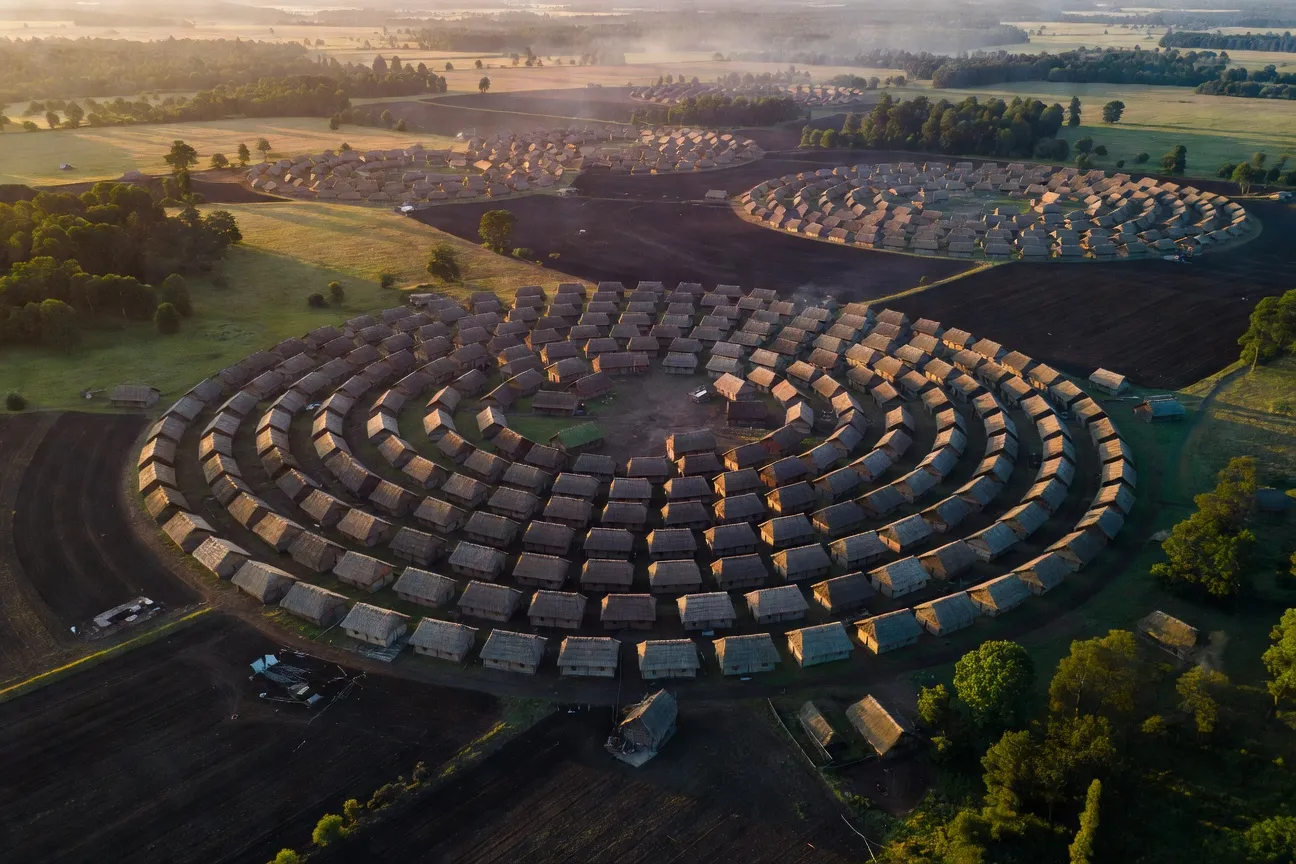
Aerial reconstruction of Talianki mega-settlement, central Ukraine, 4000 BC, 15000 inhabitants, circular layout, surrounded by black soil farmland.
The ceramic figurines are the other defining artefact category. They are predominantly female, modelled with stylised abstract bodies, broad hips and torsos, schematic heads, and incised patterns suggesting clothing or body decoration. They are typically small, between 10 and 30 centimetres tall; they are found within house contexts, often near hearths or domestic altars; they are sometimes deliberately broken, perhaps as part of household ritual. Interpretations have ranged widely: fertility goddesses, ancestor representations, ritual objects associated with the agricultural calendar, children's toys, instructional models. The truth probably lies in some combination — figurines that served multiple functions across the cycle of household life. The deep Ukrainian cultural traditions in Canada still preserve folk material that scholars trace back, with varying degrees of confidence, to the symbolic universe of which these figurines were once a part.
One striking feature of late Cucuteni-Trypillia pottery is the deliberate burning of houses with their contents inside. Excavated house sites frequently contain large quantities of intentionally vitrified clay, broken pottery, and partially preserved organic remains, all consistent with controlled burning rather than accidental fire. The custom appears to have been associated with the periodic rebuilding of settlements: houses reached an apparent ritual end of life every two to three generations, and were burnt with their household goods rather than abandoned. The practice is unusual in Neolithic Europe and remains poorly understood. The deeper Ukrainian heritage and folklore traditions in modern times contain few direct echoes of this specific practice, but the ritual treatment of the household hearth and home as objects with their own life cycle has parallels in many Slavic and pre-Slavic traditions.
Theories on the Disappearance: Climate, Migration, Steppe Pressure
The end of the Cucuteni-Trypillia culture is one of the most discussed problems in European prehistory. By 2750 BC the great mega-settlements were uninhabited; their characteristic painted pottery had ceased to be produced; the figurine tradition had ended; the cultural complex that had defined the region for nearly three millennia had simply stopped. The population did not vanish — the genetic and archaeological evidence makes clear that descendants continued to live in the region — but the distinctive cultural pattern was gone, replaced by Yamna and successor Bronze Age cultures with different material traditions.
Four main explanatory factors are debated in current scholarship, and most archaeologists believe the truth combines several of them.
Climate change is the first factor. Palaeoclimate data show a notable cooling and drying trend across southeastern Europe between 3200 and 2800 BC. The chernozem belt, which had sustained intensive farming through the Late phase, became less productive. Yields fell, sustained population concentrations became harder to maintain, and the smaller settlements that succeeded the mega-settlements may reflect this carrying-capacity adjustment. The climate evidence is robust; the question is whether it alone is sufficient.
Soil exhaustion is the second factor. Continuous cultivation of the same fields over centuries, without significant fertilisation, gradually depletes nutrient availability even on chernozem. The largest mega-settlements likely exhausted their immediate hinterlands before the climate began to deteriorate. Combined with cooling temperatures, soil exhaustion may have made the giant communities economically unsustainable.
Internal social transformation is the third factor. Some archaeologists argue that the very absence of detectable social hierarchy that characterised the mega-settlements was unsustainable. As communities grew, the conflict-resolution mechanisms that had functioned at the village scale broke down; without elite institutions to manage disputes and concentrate resources, the largest communities became ungovernable. The disappearance of the mega-settlement form, in this reading, was a return to a more sustainable village-scale organisation.
The fourth factor, and the most dramatic in current debate, is the eastward pressure of the Yamna culture. Beginning around 3500 BC, mobile pastoralist groups originating in the Pontic steppe (the open grasslands north of the Black Sea, in what is today southern Ukraine) began moving westward. These were the people who likely introduced Indo-European languages, the domesticated horse for traction and riding, and a different economic system based on cattle and sheep mobility rather than fixed agriculture. The genetic record shows that by 2500 BC, the population of central and eastern Europe contained a substantial Yamna ancestry component that was absent in earlier Cucuteni-Trypillia individuals. Whether the cultural transition was peaceful absorption or violent displacement is contested. The truth probably involved both, with the climate and economic stresses making the established farming culture more vulnerable to assimilation.
Why Does Cucuteni-Trypillia Matter for Modern Ukraine?
The Cucuteni-Trypillia culture has become, since Ukrainian independence in 1991, a central reference point in Ukrainian historical consciousness. The reasons are several and intersecting. First, the cultural heartland coincides geographically with central and western Ukraine, providing an unbroken human presence on the territory that long predates any of the rival historical narratives placing alternative peoples at the origin of the land's history. Second, the sophistication of the culture — the mega-settlements, the painted pottery, the figurines — supports a self-image of Ukraine as a land of deep civilisational achievement rather than a peripheral province of larger imperial systems. Third, the discovery and serious study of Cucuteni-Trypillia is itself overwhelmingly the work of Ukrainian archaeologists in Ukrainian institutions, giving the culture a status as both subject and product of Ukrainian scholarship.
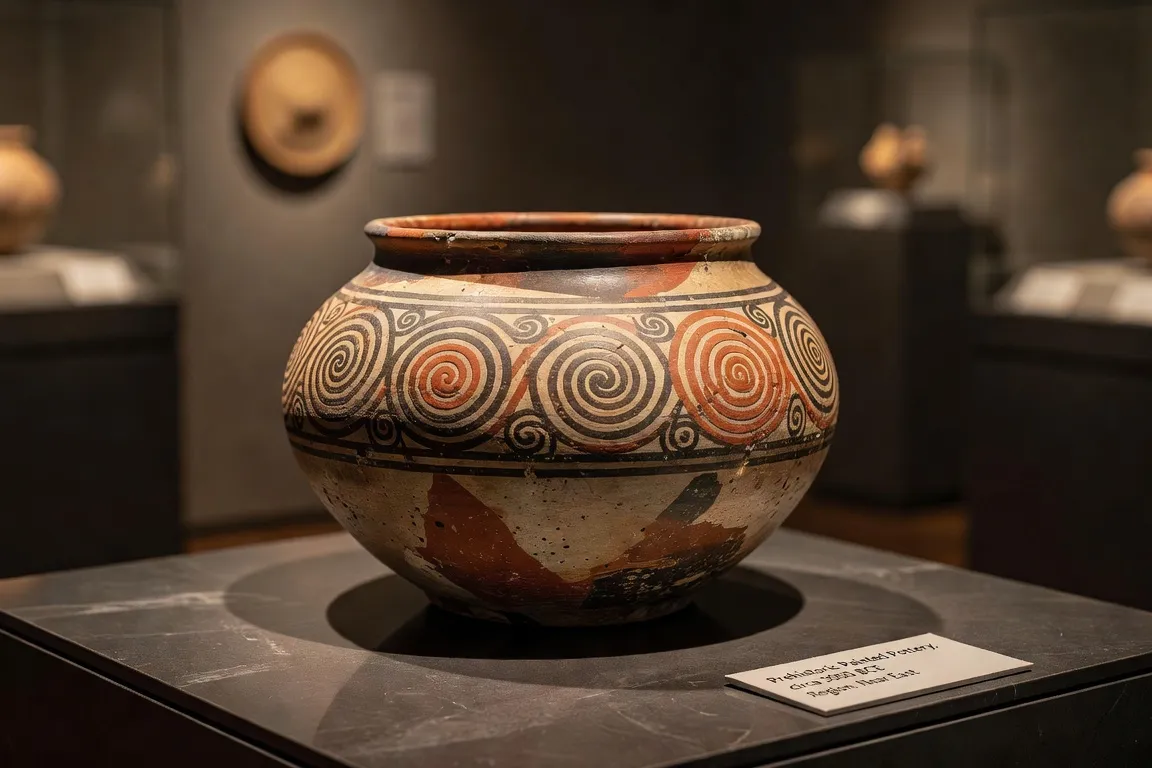
Close-up of authentic Cucuteni-Trypillia painted pottery with spiral motifs and a female ceramic figurine on a black museum background.
Public engagement has expanded considerably since 2000. The Trypillia Culture Museum at Lehedzyne in Cherkasy oblast was established in 2003 and significantly expanded after 2010; it now provides reconstruction houses, original artefacts, and interpretive programming for school groups and tourists. Several large painted reproduction vessels have been incorporated into Ukrainian state ceremonial settings as symbols of cultural depth. The cultural references have become common in popular history publications, documentary television, and educational curricula.
The post-2022 context has sharpened the reference. With Russian invasion narratives that frequently deny Ukrainian historical distinctness, the deep prehistoric record of Cucuteni-Trypillia has functioned in Ukrainian public discourse as evidence that civilisation on the territory of present-day Ukraine long predates anything that could be called Russian history. The depth of a deep dive into Ukrainian culture and folk traditions consistently brings the conversation back to material traditions whose roots demonstrably reach to the Late Neolithic.
For the Ukrainian diaspora in Canada, the cultural reference has been welcomed but had less immediate emotional resonance than more recent history. The first-wave Ukrainian arrivals in 1891 had no awareness of Cucuteni-Trypillia — the type-sites had only just been excavated. Today, however, Ukrainian-Canadian cultural programming includes Cucuteni-Trypillia references in school curricula, museum exhibitions, and adult education programs. The Edmonton Ukrainian Cultural Heritage Village has developed interpretive material on the deep prehistory of the territory from which its founding settlers originated. The connection between the prairie sod houses of 1891 and the painted pottery of 4000 BC is not direct in any genealogical sense, but it is a connection that contemporary Ukrainian-Canadians increasingly recognise as part of their longer story.
What Cucuteni-Trypillia offers any community is a sense of just how thinly stretched the line is between us and the deepest human past. The people who built Talianki in 4000 BC, who fired the painted pottery and modelled the female figurines and walked the streets of the largest organised community then existing anywhere in the world, were people in every recognisable sense. Their work survived the climate shift, the steppe migrations, the millennia of subsequent settlement and conflict, the indifferent ploughs that turned their houses into fields. It survived to be reassembled in museum cases and interpreted by archaeologists working in a country that did not yet exist as a state, on territory whose national identity is still actively being contested. That survival is a peculiar form of victory.