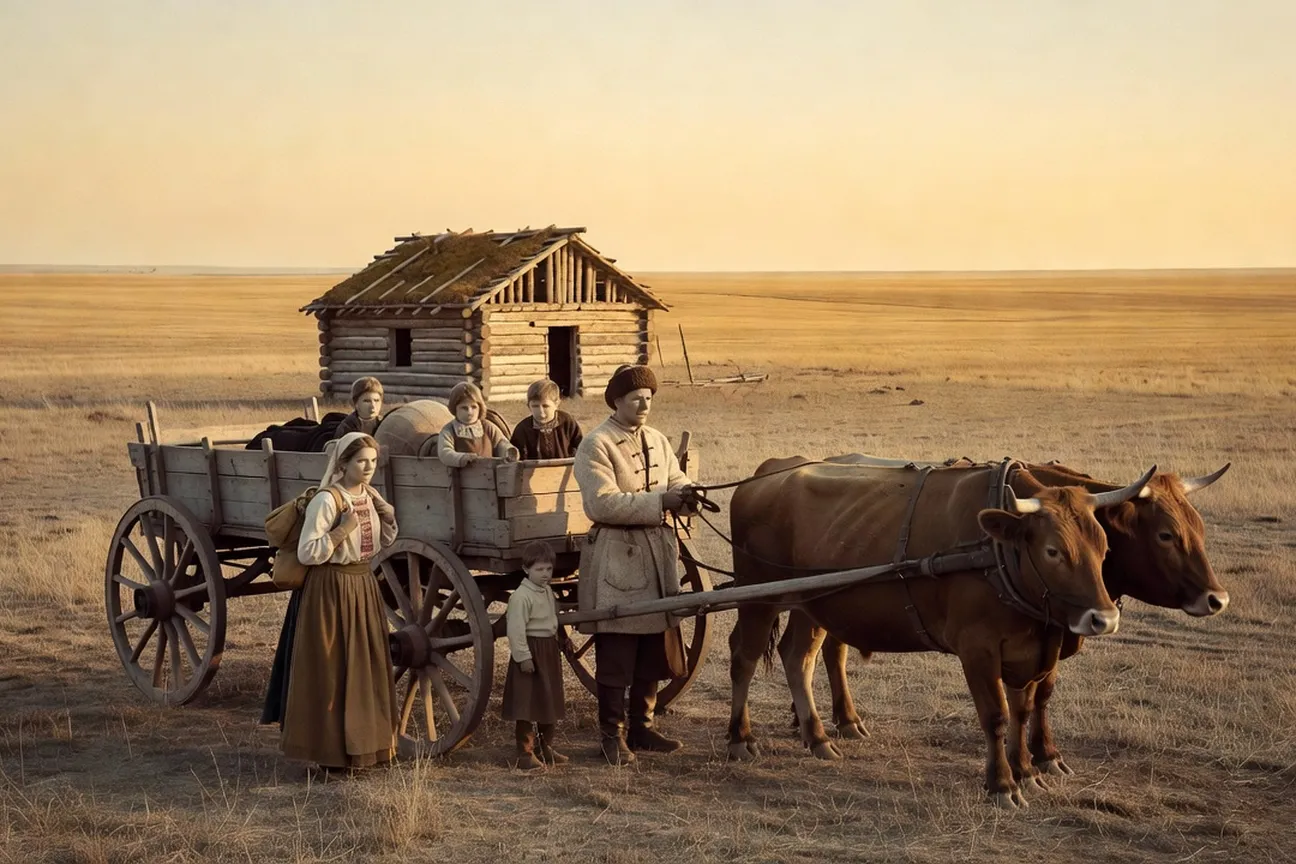
Ukrainian pioneer settlers arriving at Canadian prairie homestead circa 1905.
Table of Contents
- Clifford Sifton’s Immigration Policy (1896)
- Who Were the Ukrainian Prairie Settlers?
- The Journey to Canada
- Building Life on the Prairies
- Ukrainian Churches and Schools
- Cultural Life in the 1900s–1930s
- Economic Challenges: Drought and Depression
- The Ukrainian Belt Today
- How Prairie Communities Are Remembered in 2026
- The Prairie Legacy: A Living Heritage
- Frequently Asked Questions
Why the Prairies? Clifford Sifton's Immigration Policy (1896)
Clifford Sifton, appointed Minister of the Interior in Wilfrid Laurier's Liberal government in 1896, radically expanded Canadian immigration to populate the Prairie West. Sifton sought "stalwart peasants in sheepskin coats" capable of transforming unbroken grassland into productive farmland. His policy explicitly targeted Eastern Europeans, including Ukrainians from Galicia and Bukovyna, because British and American settlers showed little interest in the northern parkland belt. The Dominion Lands Act of 1872 remained the legal foundation, granting 160-acre homesteads for a ten-dollar fee after three years of residence and cultivation. Between 1896 and 1914 more than 170 000 Ukrainians entered Canada, the majority directed to the "reserved townships" east of Edmonton, the Interlake district of Manitoba, and the Humboldt–Rosthern corridor in Saskatchewan. Sifton's agents distributed pamphlets in German and Ukrainian at railway stations across Galicia; primary correspondence preserved in Library and Archives Canada shows monthly quotas set for each bloc settlement. The policy produced the largest single group of non-British settlers on the Prairies before the First World War.
Clifford Sifton’s immigration policy, implemented after his appointment as Minister of the Interior in 1896, relied on the established Manitoba prairie survey grid to allocate homesteads efficiently. Dominion surveyors had already subdivided much of the southern Prairies into 160-acre quarter-sections under the Dominion Lands Act, creating a uniform checkerboard that allowed rapid placement of new arrivals. Between 1897 and 1910, Ukrainian immigration to the region rose sharply: official records show roughly 2,300 arrivals in 1897, climbing to 7,400 by 1900 and peaking at over 14,000 in 1907, with cumulative Ukrainian entries exceeding 120,000 by 1910. Sifton’s agents, paid a per-head commission of approximately five dollars for each adult settler successfully placed on a homestead, aggressively recruited in Galicia and Bukovina, often working through steamship lines and local interpreters.
Parliamentary debates of the period reveal deep divisions over “foreign” settlement. Conservative critics, including MP George Foster, warned that large bloc settlements of Slavs threatened Anglo-Canadian cultural dominance and would create unassimilable enclaves. Sifton countered that only hardy agriculturalists from eastern Europe possessed the stamina required for the northern parkland, and he defended the bloc system as the most practical means of delivering mutual support during the critical first winters. These exchanges, recorded in Hansard, ultimately affirmed the government’s right to direct non-British immigration toward the Prairies while maintaining the survey framework that kept land administration orderly and titles secure.
Who Were the Ukrainian Prairie Settlers? Origins in Galicia and Volhynia
Most early arrivals came from the Austrian crownlands of Galicia and, to a lesser extent, Volhynia. Overpopulation, partible inheritance, and heavy taxation left many peasant families with holdings under two hectares. Villages such as Nebyliv, Ruski Banyliv, and Strutyn supplied the first cohorts. Ivan Pylypiv and Vasyl Eleniak, both from Nebyliv, reached the Edna-Star district of Alberta in 1891 and 1892 respectively; their letters home triggered chain migration. Austrian officials recorded 7 500 departures from Galicia to Canada in 1897 alone. Settlers spoke the Hutsul, Boyko, and Pokuttya dialects of Ukrainian; literacy rates averaged 25 percent. They arrived with minimal capital, relying on seasonal railway work and cordwood cutting to finance the purchase of oxen and breaking ploughs. Ukraine's regional geography and roots of prairie emigrants supplies detailed maps of these source counties.
Economic conditions in Galicia during the 1890s were marked by severe land hunger and repeated crop failures. The average peasant holding had shrunk to less than four hectares through partible inheritance, and the 1895 potato blight left many families without seed grain. The Greek Catholic Church played a direct role in sponsoring emigration; parish priests, often acting on instructions from the Lviv consistory, organised group departures and provided letters of introduction to Canadian immigration agents. These networks directed the majority of emigrants toward the Canadian West rather than the United States, where industrial labour predominated, or Brazil, where earlier Ukrainian colonies had suffered high mortality from tropical disease.
Among the settlers were distinct ethnographic groups such as the Hutsuls from the Carpathian highlands and the Lemkos from the western Beskids. Hutsul families tended to cluster in the Interlake district of Manitoba, bringing traditional woodworking skills that proved useful in constructing the first log churches. Class backgrounds ranged from landless agricultural labourers to modestly prosperous farmers who sold holdings to finance passage. The latter group often became informal leaders within the bloc settlements, using their literacy to negotiate with land agents and later to establish the first reading associations.
The Journey to Canada: Steamship Routes and Entry Points
The typical route began at Hamburg or Bremen aboard vessels of the Hamburg-America Line or North German Lloyd. After transfer at Liverpool or Antwerp, passengers sailed to Quebec City or Halifax. The ocean crossing averaged fourteen days in steerage. Upon landing, Ukrainian families boarded colonist cars of the Canadian Pacific Railway for the five-day journey to Winnipeg. There they registered at the Dominion Lands Office on Main Street, received homestead maps, and were assigned to bloc reserves. Between 1903 and 1914 the federal government operated a special Ukrainian interpreter service at the Winnipeg depot. Medical inspection records from 1905 show that 3 percent of arrivals were rejected for trachoma or favus; those accepted often wintered in the Immigration Hall before proceeding to raw prairie claims.
Building Life on the Prairies: Blockhouses and Pioneer Communities
Settlers established compact "block" communities to maintain social cohesion and mutual aid. The Edna-Star colony, centred on the townships around what is now Mundare, Alberta, grew to 1 200 families by 1905. Houses were constructed of poplar logs chinked with clay and moss; roofs were thatched with prairie wool until milled lumber arrived by rail. Breaking the heavy clay soil required four oxen and a sharpened breaking plough; a single 160-acre homestead demanded three to five seasons of labour. First winters were spent in "zemlyanky" (sod dugouts) where temperatures inside could reach −30 °C. Women hauled water from sloughs two kilometres distant and preserved cabbage and beets in root cellars. Contemporary diaries of the Basilian missionary Father Paul Olynyk describe repeated crop failures from early frost in 1898 and 1903.
Bloc settlements were organised around the principle of toloka, a traditional form of collective labour in which neighbours assembled to raise log houses, clear bush, or harvest crops within a single day. This system allowed isolated homesteads to be completed before winter and created dense social networks that persisted for generations. Women played central roles in establishing community institutions; they organised the first parish sisterhoods that collected funds for church bells and later staffed the cooperative stores that opened in places such as Dauphin and Vegreville after 1905. These stores operated on a Rochdale model, returning patronage dividends to members and shielding farmers from exploitative merchants in nearby railway towns.
Navigating Canadian land registry required settlers to learn the Dominion Lands Act procedures quickly. Many relied on bilingual interpreters hired by the Department of the Interior to file homestead entries and later to obtain patents after three years of residence and cultivation. Disputes over overlapping claims were common until the establishment of Ukrainian-language legal aid societies in Winnipeg, which helped families regularise titles and avoid forfeiture. By 1914, the combination of toloka labour, women’s organisational work, and formalised cooperatives had transformed raw prairie into stable agricultural communities with recognised property rights.
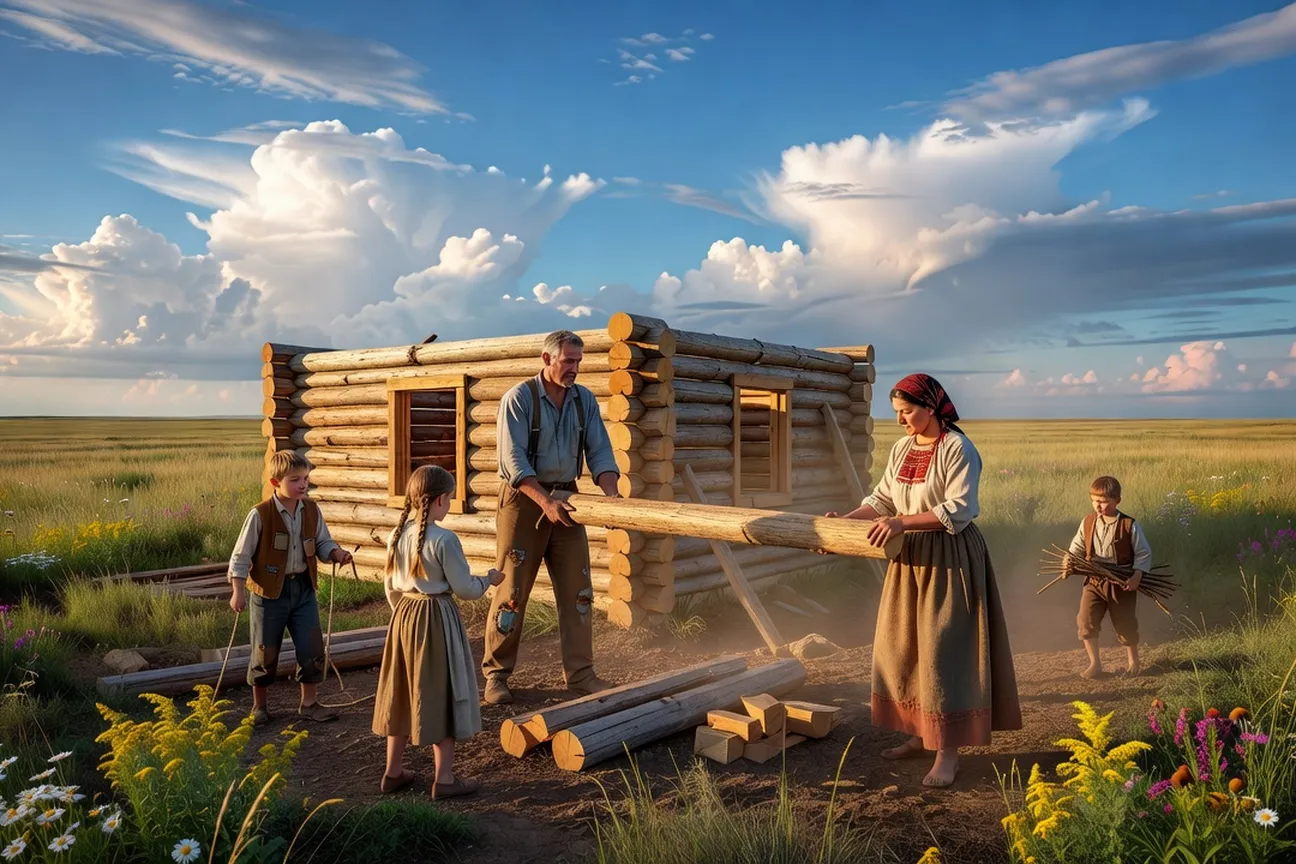
Ukrainian pioneer family building log house on Manitoba prairie.
Ukrainian Churches and Schools on the Prairie Frontier
Religious institutions anchored community life. The Ukrainian Catholic Church, under the jurisdiction of Bishop Nykyta Budka after 1912, erected frame churches in every bloc; the first was St. Nicholas at Edna-Star in 1897. Orthodox parishes appeared after 1918 when the Ukrainian Greek Orthodox Church of Canada was organised in Saskatoon. Both confessions operated "ridna shkola" (native schools) teaching reading, writing, and catechism in Ukrainian on Saturday mornings. Provincial authorities, however, enforced English-only instruction after 1916 in Manitoba and 1919 in Alberta. The resulting bilingual schools controversy, documented in the 1918 Royal Commission on Bilingualism, led to the dismissal of several Ukrainian teachers. Nevertheless, community halls continued covert Ukrainian-language classes until the 1930s.
Bishop Nykyta Budka, appointed apostolic exarch in 1912, became a focal point of wartime suspicion. Interned under the War Measures Act in 1918, he was accused of encouraging loyalty to Austria-Hungary among his parishioners. His arrest triggered protests from Ukrainian organisations across the Prairies and highlighted the precarious legal position of non-British clergy. Parallel to the Greek Catholic mainstream, Ukrainian Methodist mission schools operated in several bloc settlements after 1905. These schools offered English instruction but also provoked resistance when they attempted to replace traditional religious education with Protestant curricula.
Legislative battles over teacher certification erupted in Manitoba and Saskatchewan between 1913 and 1916. Several Ukrainian-trained teachers were dismissed for lacking provincial normal-school credentials, prompting petitions to the legislature and the formation of the Ukrainian Teachers’ Association. In response, communities established underground schools in private homes where Ukrainian language and history were taught after regular school hours. These clandestine classes preserved literacy in the Cyrillic script and maintained cultural continuity until bilingual provisions were partially restored in the 1920s.
Cultural Life in the 1900s–1930s: Preserving Language and Traditions
Women maintained foodways centred on pyrohy, holubtsi, and borscht. Pysanky egg decorating and embroidery of rushnyky were taught to daughters during long winters. Folk music ensembles performed at "vechernytsi" using violin, tsymbaly, and accordion. The first Ukrainian-language newspaper, "Svoboda," reached Prairie readers from New Jersey after 1896; local editions such as "Ukrainskyi Holos" (Winnipeg, 1910) and "Kanadiyskyi Farmer" (Winnipeg, 1903) provided vital information on homestead regulations and market prices. By 1931 more than thirty Ukrainian reading associations existed across the three Prairie provinces.
The Shevchenko Educational Society, founded in Winnipeg in 1907, coordinated a network of Prosvita reading rooms that spread across the parkland belt. Each reading room subscribed to Ukrainian-language newspapers published in both Canada and Europe, hosted lecture series, and maintained small lending libraries. Political debates within these spaces were intense: the monarchist Ukrainian Self-Reliance League (USRL) advocated loyalty to Canadian institutions and gradual integration, while the Ukrainian Labour-Farmer Temple Association (ULFTA) promoted socialist mutual-aid models and criticised private land ownership. Drama circles attached to both organisations staged plays by Kotliarevsky and Kvitka-Osnovianenko, providing entertainment and reinforcing linguistic skills across generations.
Ukrainian folk songs collected in Galicia were deliberately preserved and adapted to Prairie conditions. Harvest songs were reworked to reference wheat rather than rye, and winter carols incorporated references to Canadian blizzards. Annual festivals organised by the reading rooms featured these songs alongside traditional dance, ensuring that musical repertoire remained a living link to the homeland even as the second generation began to adopt English in daily life.
Economic Challenges: Drought, Depression, and Resilience
The 1930s Dust Bowl devastated Ukrainian districts already carrying heavy mortgage debt. In 1937 wheat yields in east-central Alberta fell to three bushels per acre. The Prairie Farm Rehabilitation Administration supplied feed and seed loans; Ukrainian farmers formed cooperative threshing rings to share scarce machinery. Credit unions, notably the Ukrainian National Credit Union in Winnipeg (1937) and the Vegreville Credit Union (1939), offered small loans when banks refused. Oral histories collected by the Ukrainian Canadian Research Foundation record families surviving on relief flour and garden produce for three consecutive winters.
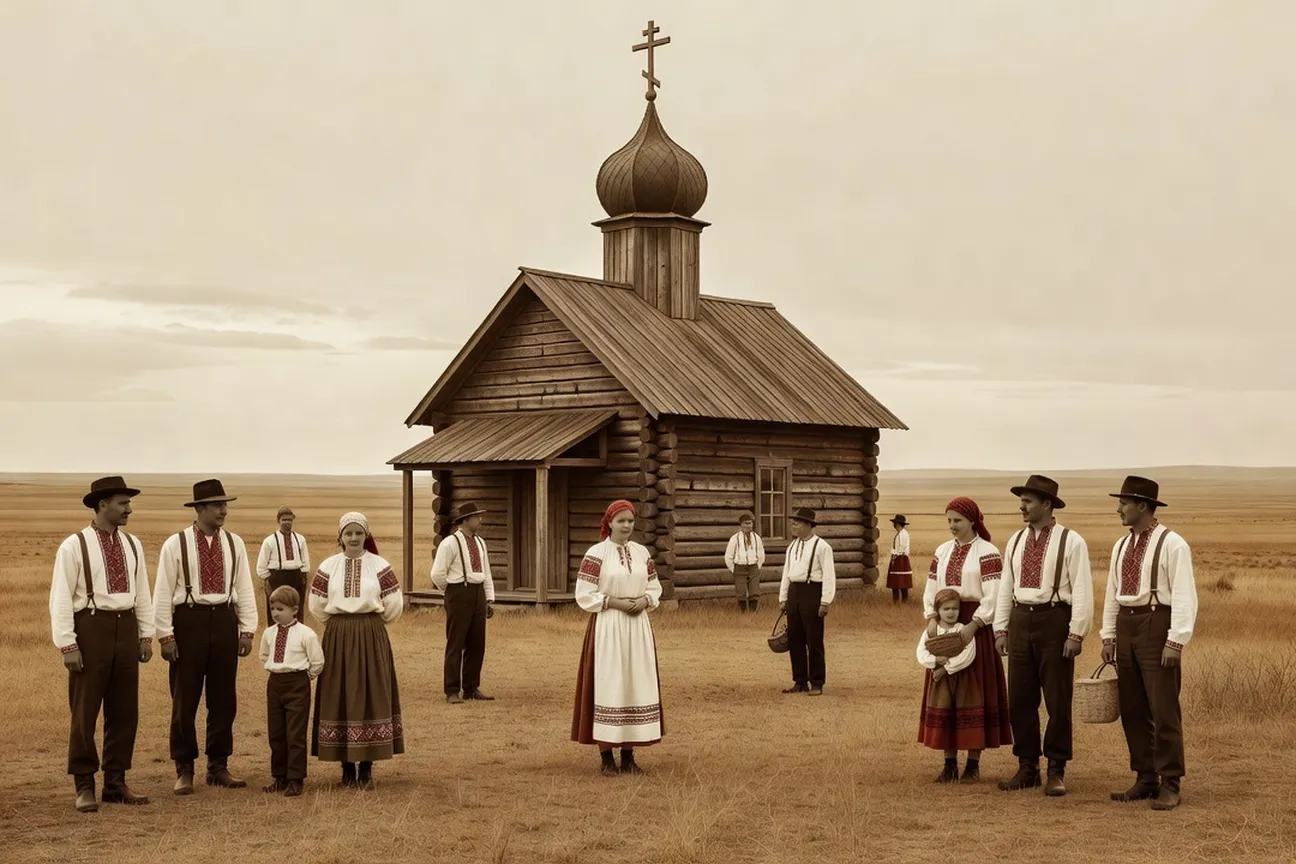
Ukrainian immigrant community outside small Ukrainian Orthodox church on Canadian prairie 1910s.
The Ukrainian Belt: Alberta, Manitoba and Saskatchewan Today
The historic settlement corridor remains visible on contemporary maps. Alberta's Ukrainian Cultural Heritage Village east of Edmonton reconstructs 1920s farmsteads with original log buildings. Vegreville's 8.5-metre pysanka, erected in 1975, marks the 100th anniversary of settlement. Manitoba's Dauphin hosts the National Ukrainian Festival each August, drawing 30 000 visitors. Saskatchewan preserves the 1914 Immaculate Conception Church at Cudworth and the Hafford Ukrainian Museum. first wave of Ukrainian immigration to Canada and Ukrainian community in Canada today provide further context on demographic continuity.
How Prairie Ukrainian Communities Are Remembered in 2026
Commemoration in 2026 centres on museums, plaques, and digital genealogy projects. The Ukrainian Canadian Archives and Museum of Alberta maintains 40 000 photographs and 2 000 oral histories. Provincial historic sites programmes have installed 120 interpretive plaques along Highway 16 and the Yellowhead Trail. The Ukrainian Genealogy Group of Canada, in partnership with genealogy resources for Ukrainian settlers, has digitised 1896–1914 homestead applications. Ukrainians in Canada and current statistics on Ukrainian Canadians document the living diaspora that continues to support these institutions through annual endowments.
Digital archives have transformed access to Prairie Ukrainian history. The genealogy.ca project, launched in partnership with Library and Archives Canada, has digitised more than 85,000 homestead files and passenger manifests from 1896 to 1914, allowing descendants to trace exact quarter-sections and family groupings. Post-2022 newcomers arriving after Russia’s full-scale invasion have used these records to locate distant relatives and to participate in heritage tourism on the former bloc settlements. Several families from Lviv and Ivano-Frankivsk oblasts have settled near Dauphin and Yorkton, attending local commemorative events and contributing new oral histories that link contemporary displacement with the 1890s exodus.
Planned 2026 commemorations mark the 130th anniversary of Sifton’s policy. Provincial governments in Manitoba, Saskatchewan, and Alberta are coordinating joint programming that includes restored one-room schoolhouses, travelling exhibits of Prosvita artefacts, and a national conference on the evolution of Ukrainian-Canadian identity. Organisers expect participation from both long-established Prairie families and recent arrivals, underscoring the continuing relevance of the original settlement corridors in contemporary Canadian multiculturalism.
The Prairie Legacy: A Living Heritage
The Ukrainian prairie settlement of 1896 to 1939 is not a closed chapter. It is a living inheritance that continues to shape Canadian society, politics, and culture. The descendants of those first stalwart homesteaders occupy positions at every level of Canadian public life — from provincial legislatures to federal cabinet, from university chairs to farming co-operatives. The very landscape of central Alberta, western Saskatchewan, and southern Manitoba still bears the imprint of bloc settlement: the onion-dome silhouette of Ukrainian Orthodox and Catholic churches rising above flat horizons, the community hall names in Ukrainian script, the grain elevators rebranded by prairie descendants of Galician immigrants.
For the 200,000 Ukrainians who arrived in Canada after 2022 under the CUAET programme, the prairie heritage offers both welcome and identity. Many are discovering, for the first time, that Canada has housed a significant Ukrainian community for 130 years — that they are joining a diaspora with century-deep roots rather than starting from nothing. Community organisations in Edmonton and Winnipeg have made conscious efforts to introduce new arrivals to the Ukrainian Cultural Heritage Village, to the national festivals at Dauphin, and to the genealogy archives where homestead applications from their regions of origin may still be found. In this sense, the prairie settlement is not history. It is an ongoing conversation between generations separated by an ocean and a century, finding, in the Canadian context, a shared identity.
Frequently Asked Questions
When did the first organised Ukrainian settlement occur in Alberta?
The Edna-Star colony, founded by Ivan Pylypiv and Vasyl Eleniak in 1891–1892, constitutes the earliest organised settlement; federal immigration policy under Clifford Sifton accelerated arrivals after 1896.
Which Prairie province received the largest number of Ukrainian homesteaders?
The institutions that followed settlement were largely built by Ukrainian-Canadian women’s organizations. Manitoba recorded the highest initial numbers because of proximity to the Winnipeg land office, yet Alberta ultimately hosted the densest bloc settlements by 1914.
What languages were used in early Prairie Ukrainian schools?
Ukrainian served as the language of instruction on Saturday mornings; English dominated weekday public-school curricula after provincial legislation of 1916–1919.
How did the Dust Bowl affect Ukrainian farmers specifically?
Yields collapsed to three bushels per acre in 1937; many families relied on credit-union loans and cooperative relief networks organised within the Ukrainian bloc communities. A new cohort of Ukrainian newcomers would arrive after the Second World War under very different circumstances, a history covered in our article on the second wave of Ukrainian immigration to Canada, 1947-1954.
Where can researchers access original homestead records today?
Library and Archives Canada holds the Dominion Lands registers; the Ukrainian Canadian Archives and Museum of Alberta provides indexed digital copies for Alberta townships.