Who Were the First Ukrainians to Arrive in Canada? Pylypiw and Eleniak (1891)
The recorded history of Ukrainian Canada begins on September 7, 1891, when two peasants from the village of Nebyliv in the Kalush district of Austrian-ruled eastern Galicia stepped off the SS Oregon at the port of Montreal. Their names were Ivan Pylypiw, 32 years old, and Wasyl Eleniak, 33. Neither could read or write in any language. Neither had ever travelled further than the regional market town of Stanyslaviv. Between them they had eight Canadian dollars and the addresses of cousins of cousins who had supposedly settled somewhere in the American Midwest. They had been encouraged to make the crossing by Mennonite agents who recruited Galician peasants for the empty Canadian prairies.
Pylypiw and Eleniak did not stay in Quebec. From Montreal they took the Canadian Pacific Railway west, alighting at Calgary and continuing to a homestead near present-day Lamont, Alberta. Pylypiw quickly recognised that the soil east of Edmonton resembled the chernozem black earth of his native village. He filed for a homestead, broke a few acres of sod by hand, and the following autumn returned to Galicia to recruit further settlers from his village. He carried with him samples of Canadian wheat and a fragment of prairie soil. When he showed these to his neighbours in Nebyliv, the village's collective consciousness made the leap that no immigration agent could have engineered alone. Within a year, several Pylypiw cousins had emigrated. Within five years, more than 200 families from a handful of Galician villages had relocated to a corridor running east from Edmonton.
The story of these two men matters not because they were exceptional but because they were typical. They came from the impoverished peasantry of eastern Galicia; they were Greek Catholic in religion; they spoke a dialect of Ukrainian still rooted in the village; they were entirely unprepared for the climate, the language, and the legal system of the country they had chosen. The fact that they survived and that thousands followed them sets the template for everything that happens in the first three decades of Ukrainian-Canadian history.
Pylypiw himself lived until 1936. He died at 77 on his original Alberta homestead, having seen his community grow from two men in a borrowed wagon to a continuous belt of Ukrainian settlements stretching from southeastern Manitoba to north-central Alberta. He is buried in the cemetery of the Ukrainian Catholic parish in Una, near the original homestead, where a monument marks the founding point of Ukrainian Canada. Eleniak lived even longer — until 1956 — and remains the founding ancestor figure for the broader community of Ukrainian Canadians whose roots in this country reach back to that 125 years of turbulent Ukrainian immigration history that began with the SS Oregon.
Why Did Ukrainians Leave Galicia and Bukovyna? Land, Poverty, Hapsburgs
To understand why hundreds of thousands of peasants left two specific provinces of the Habsburg Empire in a quarter-century, you have to look at the soil. Galicia, the eastern slice of the Austro-Hungarian Empire that contained today's Lviv, Ivano-Frankivsk, and Ternopil regions, was the empire's most densely populated agricultural province. By 1900, the average peasant landholding in eastern Galicia had shrunk to just 3.2 hectares (about 7.9 acres) — below the threshold required to feed a family. Population growth had outstripped both land redistribution and the capacity of Habsburg industry to absorb rural workers. The result, by the 1880s, was structural agrarian crisis.
The crisis was sharpened by the unequal land settlement that followed the 1848 abolition of serfdom. When the Austrian government liberated the peasants, it did so by giving each family title only to the land it already used. The forests, meadows, watering rights, and roadside grazing — resources the peasants had used collectively under feudalism — were transferred to the former landlords. Within a generation, peasants who needed to graze a cow or gather firewood had to pay the local Polish nobility for the privilege. Indebtedness and forced sales drove a steady stream of farms into the hands of larger holders. The phrase galician poverty entered the European vocabulary as shorthand for the rural distress.
Bukovyna, the smaller province to the southeast that today straddles the Ukrainian-Romanian border, faced parallel problems with an additional layer of multi-ethnic complication. Its Ukrainian peasants competed for land with Romanian, German, Polish, and Jewish neighbours; its administrative language was German; its dominant church was Orthodox rather than Greek Catholic. The grievances differed in texture but the underlying pressure on the land was identical.
Into this Galician-Bukovynian distress walked the agents of the Canadian government in 1896. The architect of Canadian immigration policy was Clifford Sifton, the Minister of the Interior in Wilfrid Laurier's Liberal cabinet. Sifton famously declared that he wanted “stalwart peasants in sheepskin coats, born on the soil, whose forefathers have been farmers for ten generations, with a stout wife and a half-dozen children.” The Galician Ukrainians fit the description exactly. Sifton dispatched immigration agents to the empire, distributed pamphlets in Ukrainian and Polish translating the 1872 Dominion Lands Act, and arranged steamship routes from Hamburg and Bremen to Montreal. The offer was simple: 160 acres of prairie land for a registration fee of ten dollars, with full title transferred to the homesteader after three years of residence and cultivation.
For a Galician peasant family struggling on three hectares of subdivided ancestral land, an unmortgaged 64-hectare farm in Canada was almost unimaginable. The arithmetic was so favourable that even the appalling cost of the Atlantic crossing — typically half a year's wages, paid by mortgaging the family's remaining land in Galicia — could be justified. The decision to emigrate was rarely individual; it was usually a family or village council that calculated which adult sons should make the journey first, which would follow, and how much capital could be raised by selling the home land.
Where Did They Settle? Manitoba, Saskatchewan, Alberta — The Prairie Block Settlements
The Canadian government's immigration officers, working with the Pylypiw network and similar early settlers, deliberately steered Ukrainian arrivals into block settlements — contiguous areas reserved for single ethnic groups. The policy was not announced in Ottawa as a multicultural strategy; Sifton simply recognised that peasants from the same village settled more successfully alongside their neighbours than dispersed among strangers. The resulting concentration of Ukrainian homesteads across the parkland belt of the Prairies created what was, by 1914, the densest concentration of Ukrainian-speakers anywhere outside Europe.
The three principal block settlements were Stuartburn in southeastern Manitoba, Dauphin in western Manitoba, and the long Edmonton-Vegreville-Mundare corridor in north-central Alberta. Stuartburn, the oldest, dates from 1896 and was settled mainly by Bukovynians, who tended toward Orthodoxy rather than the Greek Catholicism of the Galicians. Dauphin, west of Lake Manitoba, became home to a mixed Galician-Bukovynian population organised around the parishes of Dauphin and Sifton. The Edmonton corridor — running 150 kilometres east from the Alberta capital through Lamont, Mundare, Vegreville, Andrew, and Smoky Lake — emerged as the largest single Ukrainian colony in North America.
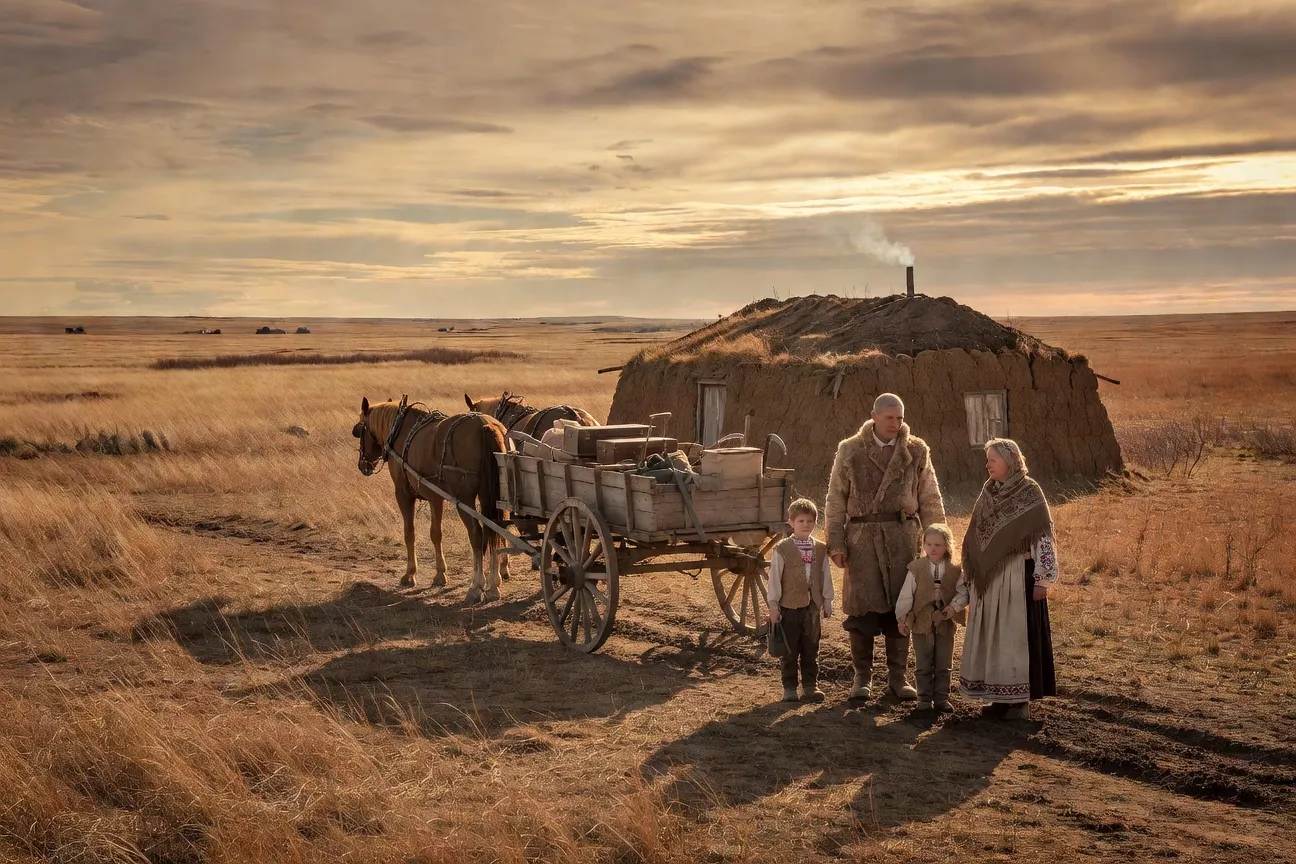
Late 19th century Ukrainian immigrant family arriving at a Manitoba sod house homestead, autumn prairie landscape.
Saskatchewan filled in between, with substantial Ukrainian populations around Yorkton, Canora, Rosthern, and the parkland of the Quill Lakes. Smaller secondary settlements grew in northern Manitoba, in the Athabasca district north of Edmonton, and along the railway corridors that opened the Peace River country after 1900. By 1914, the Ukrainian belt was a continuous demographic feature of the Canadian Prairies that twentieth-century Canadian historians would acknowledge as a defining characteristic of the West.
The intentional ethnic concentration had cultural consequences that long outlasted the era of immigration. Because villages in Galicia had often shipped their younger sons together, Canadian block settlements often replicated the social structure of specific home villages. The same parish names — Borshchiv, Buchach, Skala — appear as both Galician and Canadian place identifiers. Church architecture in central Alberta preserves Galician designs that have since been altered or destroyed in Ukraine itself. The dialect spoken by older speakers in Mundare today contains lexical features documented in Galician dialect surveys of the 1890s but absent from contemporary standard Ukrainian.
The concentration also enabled the rapid creation of institutional life. Within five years of the first arrivals, block settlements had their own Greek Catholic and Orthodox parishes, Ukrainian-language schools, mutual aid societies, and reading rooms. The pattern of Ukrainian Canadian identity formation that distinguishes this community from many other immigrant populations — the early development of dense communal institutions — was a direct consequence of the block-settlement policy.
Life on the Prairies: Sod Houses, Homesteading, Hardships
The 160-acre homestead on the Canadian prairie was not a working farm when the first Ukrainian family arrived. It was a quarter section of bald grassland or aspen parkland, marked by survey stakes, often two days' wagon ride from the nearest railway station. Before any crop could be grown, the homesteader had to break the prairie sod, locate a water source, build a shelter, and find a way to survive the first Canadian winter with no income.
The first dwelling of nearly every Ukrainian homesteader was a burdei — a half-dugout shelter built into a hillside, with logs and sod for walls and a thatched roof of prairie grass. The burdei was a Galician adaptation of a building technique that worked equally well on the Canadian prairie because both regions had the same combination of treeless landscape, severe winters, and abundant tall grass. A family of six could live in a burdei measuring perhaps three by four metres. It was warm because it was partially underground; it was dark because the only opening was a small window or sometimes just a hole covered in oiled paper. By spring, when the snow melted, the burdei was soggy and uninhabitable. By autumn, after a season's work, the family had usually moved into a proper sod house above ground.
The sod house — khata in Ukrainian — was an entire architectural type that the first-wave Ukrainians adapted from prairie materials. The walls were made of cut sod blocks stacked like bricks; the interior walls were plastered with a mixture of clay, straw, and manure; the roof was usually thatched with prairie grass over poplar rafters. The traditional Galician design featured a clay-floored main room with a tile stove (pich) in one corner, a small bedroom for the parents, and a loft for the children. A typical first-wave sod house in central Alberta survives today at the Ukrainian Cultural Heritage Village east of Edmonton, an open-air museum that preserves more than 40 restored buildings from the era.
The work of breaking the prairie was punishing. The first sod-breaking, done with a horse-drawn plough or sometimes by hand with a heavy spade, could produce only a few acres per year. The grass roots were dense and woody; the prairie soil, once broken, had to be turned a second time the following year before grain could be sown. A homestead family commonly took three to five years to bring its full quarter section into production. During those years, adult sons hired themselves out to railway construction gangs, to lumber camps in the boreal forest, or to wealthier settlers further west. A typical pattern was for the father and oldest son to work for cash wages while the mother and younger children maintained the homestead and broke ground each summer.
Winters were the test. The first Galician arrivals had not encountered minus-thirty Celsius cold and had not seen blizzards that lasted three days. Children died of pneumonia in the first months; women died in childbirth without medical access; men froze on the trails between homesteads. The Ukrainian-Canadian historian Vladimir Kaye documented a settlement near Stuartburn that lost twelve children in a single winter of 1897. The collective memory of the first decade preserved these losses through hymns, folk songs, and oral histories that survived in rural Manitoba until the 1980s.
The Numbers: How Many Ukrainians Came to Canada 1891-1914?
The numerical reconstruction of the first wave is complicated by the fact that Canadian immigration statistics before the 1920s classified arrivals primarily by country of origin (Austria-Hungary, Russia) rather than by ethnicity. Ukrainians from Galicia were recorded as Austrian; Ukrainians from Bukovyna as Austrian or Romanian; Ukrainians from the Russian Empire (a much smaller stream) as Russian. The historian Orest Subtelny and the Library and Archives Canada immigration database have nevertheless produced reliable estimates.
Between 1891 and 1914, approximately 170,000 Ukrainians arrived in Canada. The flow accelerated dramatically after 1896 when Sifton's recruitment policy began producing organised migration. The annual peak years were 1907 through 1913, when between 12,000 and 22,000 Ukrainians arrived each year. The cumulative impact on the Prairies is best appreciated through the 1911 Canadian census, which recorded 75,432 residents of Ukrainian ethnic origin in the three Prairie provinces. By 1916, after another five years of arrivals, that figure had effectively doubled.
The first wave ended on August 4, 1914, when Britain declared war on Germany and Canada automatically followed. Austria-Hungary became an enemy power; Galician and Bukovynian ports closed to emigrant traffic; and the men who had been on the verge of leaving for Canada found themselves conscripted into the Austrian army instead. Ukrainian immigration to Canada would not resume on any significant scale until the interwar second wave of the 1920s, when a different demographic of Ukrainian arrivals — somewhat better educated, more politically conscious, drawn partly from refugees of the Ukrainian-Polish War of 1918-1920 — began to arrive.
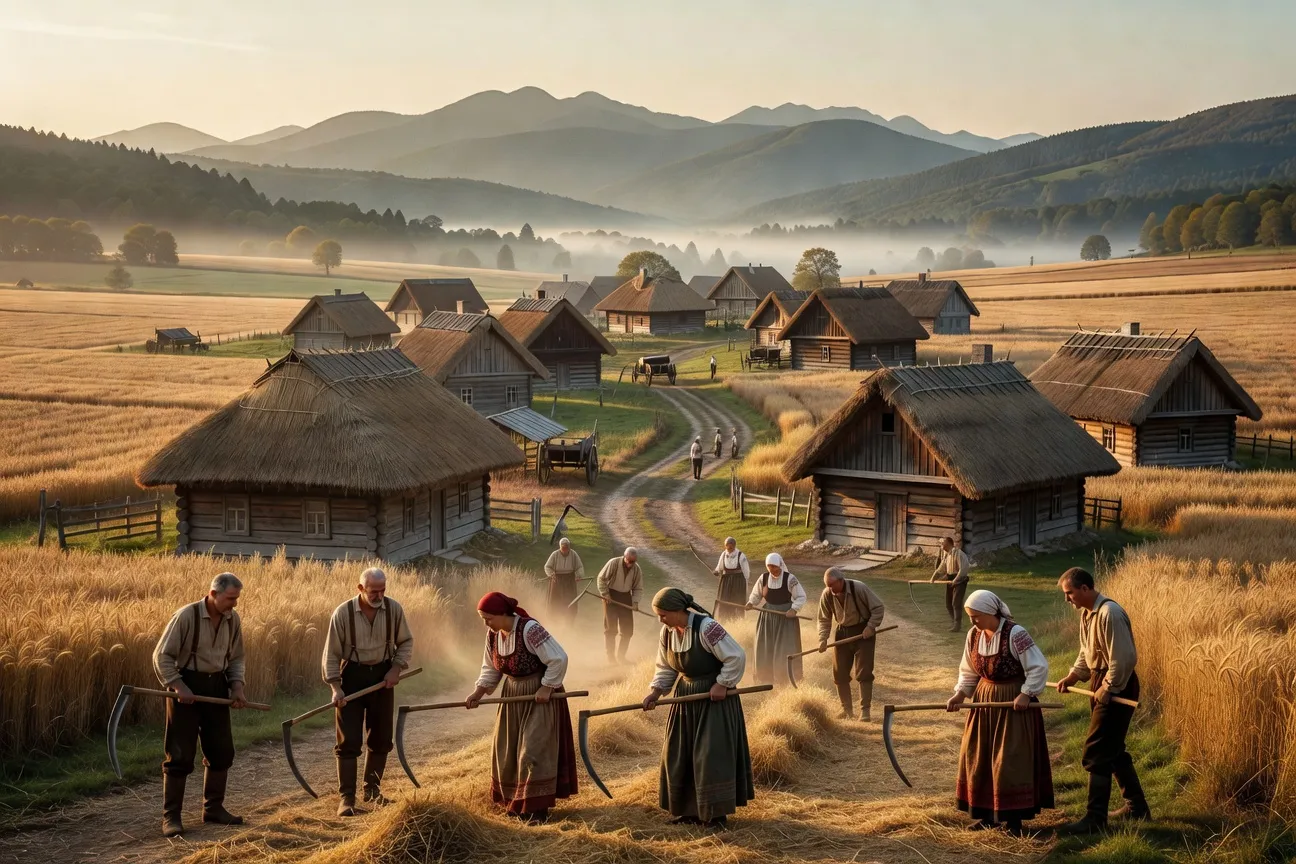
Galician village in Western Ukraine circa 1890, traditional wooden houses with thatched roofs, peasants in fields, Carpathian mountains in distance.
The first-wave numerical legacy is dramatic. Of the approximately 1.4 million Canadians who identify as Ukrainian today, a substantial majority — possibly as much as 70 percent — are descended at least in part from the 1891-1914 arrivals. The first wave is, in this sense, the demographic foundation of everything that followed.
Religion and Community: Greek Catholic and Orthodox Roots
The religion of the first-wave Ukrainian settlers was not a single tradition but two related ones. Galician Ukrainians belonged overwhelmingly to the Ukrainian Greek Catholic Church — an Eastern-rite church in full communion with Rome, using Ukrainian liturgy and married priests, but accepting the papal authority. Bukovynian Ukrainians, by contrast, were predominantly Eastern Orthodox, with no Roman connection. The two churches shared liturgical language, calendar, and many cultural practices, but they were institutionally distinct, and the distinction shaped Ukrainian-Canadian religious life from the first decade.
The challenge of supplying clergy to the rapidly growing communities was enormous. Galician dioceses could not send Greek Catholic priests to remote Canadian homesteads; the new arrivals had to make do with itinerant clergy who sometimes covered thousands of kilometres on horseback to perform baptisms, weddings, and funerals. The most famous of these pioneer priests, Father Nestor Dmytriw, walked between settlements in Manitoba and Saskatchewan in the late 1890s and early 1900s, organising parishes and writing back to Galicia with frank reports about Canadian conditions.
By 1912 the Ukrainian Greek Catholic Church in Canada had achieved sufficient organisation to receive its first resident bishop, Nykyta Budka, who arrived from Lviv to take up the new See of Winnipeg. Budka's appointment marked the formal institutionalisation of Greek Catholicism in Canada. Parallel developments on the Orthodox side led to the formation of the Ukrainian Orthodox Church of Canada in 1918, a body that would later become the largest non-Greek Catholic Ukrainian denomination in the country. The thousands of Ukrainian churches across Canada today — their distinctive onion domes a feature of the rural Prairie skyline — trace their lineage directly to the parishes organised in the first-wave era.
Beyond formal religion, the first-wave communities maintained a rich layer of folk practice that came directly from the home villages. Christmas Eve sviata vechera with its twelve meatless dishes, Velykden Easter with blessed paska bread and pysanky, Yordan blessing of water at Epiphany, malanka village New Year masking traditions — all of these survived the Atlantic crossing and adapted to prairie conditions. The folk calendar woven into the church calendar produced a year of rituals that anchored community life in places where there was almost nothing else to anchor it.
The First Ukrainian Newspapers, Schools, and Cultural Institutions
The institutional creativity of the first-wave Ukrainian-Canadian community is one of the most remarkable features of the era. Within a decade of the first arrivals, the community had produced its own newspapers, founded its own bilingual school programs, organised mutual aid societies, and launched reading rooms in dozens of prairie villages. The institutional density was higher than that of most contemporary North American immigrant groups, and it reflected the explicit determination of community leaders to ensure that the second generation would not be lost to assimilation.
The first Ukrainian-Canadian newspaper, Kanadiisky Farmer, began publication in Winnipeg in 1903. Within five years, several competing weeklies were appearing: Ukrayinskyi Holos (Ukrainian Voice), Kanadiiskyi Rusyn, and the Catholic press. By 1914 the Ukrainian-language press in Canada had a combined circulation that suggested almost every literate Ukrainian household received at least one paper. The newspapers covered Galician politics, Canadian elections, religious controversies, agricultural advice, and the practical questions of homesteading. They are the indispensable primary source for understanding what first-wave Ukrainian Canadians thought about themselves and their world.
Schools were a more complicated story. Provincial governments in Manitoba, Saskatchewan, and Alberta initially permitted bilingual instruction, with Ukrainian as one of the languages of teaching in heavily Ukrainian districts. Manitoba's 1897 Laurier-Greenway compromise specifically allowed instruction in any language where ten students spoke it. The result was that hundreds of rural prairie schools in the first-wave era operated partly in Ukrainian. Provincial backlash beginning around 1916 progressively restricted these arrangements; by 1918 Manitoba had banned bilingual public education, and the other Prairie provinces followed soon after. The loss of bilingual schools is a recurring grievance in Ukrainian-Canadian historiography of the era. To trace your own family roots through this period, Ukrainian genealogy resources for Canadian descendants can help connect contemporary families to specific homestead records and parish registers.
Mutual aid societies provided practical support and political voice. The Tovarystvo Ukrayinskykh Robitnykiv and similar workers' organisations enrolled men who worked seasonally on railway gangs and in lumber camps. Reading rooms (chytalni) in nearly every Ukrainian village provided books, newspapers, and meeting space. The Ukrainian Self-Reliance League (Soyuz Ukrayintsiv Samostiynykiv), founded in Saskatoon in 1927, would later coordinate much of the community's institutional life, but its roots reach back to first-wave organisations of the 1900s.
Cultural institutions included community choirs, drama clubs, and dance ensembles. The first Ukrainian-Canadian choir was organised in Winnipeg in 1904; within twenty years, choirs in dozens of prairie communities were performing concerts of Ukrainian sacred and folk music. The choirs were a particularly important institution for women, who otherwise had few opportunities for public cultural participation. The deeper context of history of Ukraine and its diaspora ties this Canadian institutional flowering to broader patterns of Ukrainian cultural mobilisation that were taking place simultaneously in Galicia, in eastern Ukraine under Russian rule, and in the smaller Ukrainian communities forming in the United States.
WWI and the Enemy Alien Internment (1914-1920)
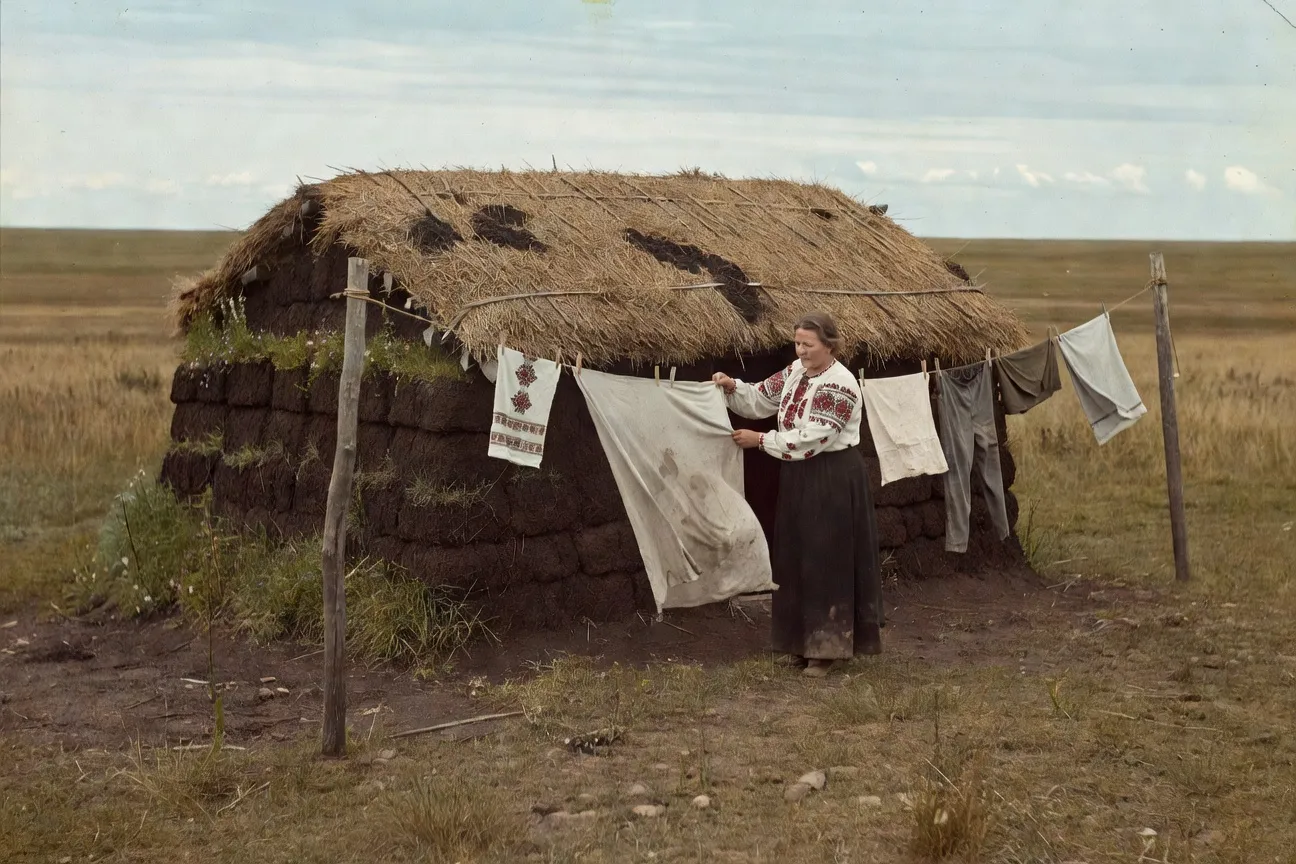
Authentic Ukrainian-Canadian sod house on the Manitoba prairie circa 1900, woman in traditional embroidered blouse hanging laundry, vast empty horizon.
The first-wave era ended not with a successful transition to second-generation integration but with a catastrophic political reversal. When Canada declared war on Austria-Hungary in August 1914, every Ukrainian Canadian who had emigrated from Galicia or Bukovyna without yet naturalising became, by Canadian law, an enemy alien. Under the 1914 War Measures Act and the Internment Operations of 1914-1920, approximately 8,579 people were interned in 24 camps across Canada, and a much larger number — perhaps 80,000 — were required to register, report to police, and surrender any firearms.
Of the internees, approximately 5,441 were Ukrainians. The largest camps were at Castle Mountain in Banff National Park, Kapuskasing in northern Ontario, Spirit Lake in Quebec, and Brandon in Manitoba. The internees performed forced labour: building roads in Banff and Jasper, clearing forest, constructing railway sidings, working in iron mines. They received nominal pay, much of which was deducted for board and clothing. Their property at home was sometimes seized; their families often lost their homesteads. They had no right to legal representation or to know the basis for their internment.
The internment was not formally rescinded until June 20, 1920, and even after release the survivors lived under social stigma that lasted decades. Ukrainian Canadians who had been interned often hid the fact from their own children. The episode was effectively erased from public Canadian memory until the 1980s, when community advocacy began to surface the documentary record. The federal Internment of Persons of Ukrainian Origin Recognition Act, passed in 2005, formally acknowledged the injustice and established the Canadian First World War Internment Recognition Fund.
The legacy of the internment is complex. On one hand, the experience deepened a sense of distinctiveness among Ukrainian Canadians that the assimilationist pressures of the war years could not erase. On the other, it produced a generation of Ukrainian-Canadian leaders who were determined to demonstrate loyalty in the next conflict. When World War Two came, more than 35,000 Ukrainian Canadians served in Canadian uniform, an exceptionally high proportion of the community's young men. The arc from internment to wartime service is one of the most striking patterns of twentieth-century Ukrainian-Canadian history, and you can trace it further in our companion piece on the Ukrainian Canadian veterans of WWI and WWII.
The first wave that began with two Galician peasants stepping off a Montreal pier in September 1891 produced, in its first quarter-century, a permanent demographic and cultural feature of the Canadian West. Its institutions, its parishes, its sod houses, and its sacrifices laid the foundation on which the entire subsequent history of Ukrainian Canada was built. Every Canadian Ukrainian alive in 2026 stands, in some measure, on the shoulders of Ivan Pylypiw, Wasyl Eleniak, and the 170,000 who followed them. A very different cohort of newcomers would arrive a half-century later, fleeing displaced persons camps in postwar Europe; that story is told in our companion article on the second wave of Ukrainian immigration to Canada, 1947-1954.