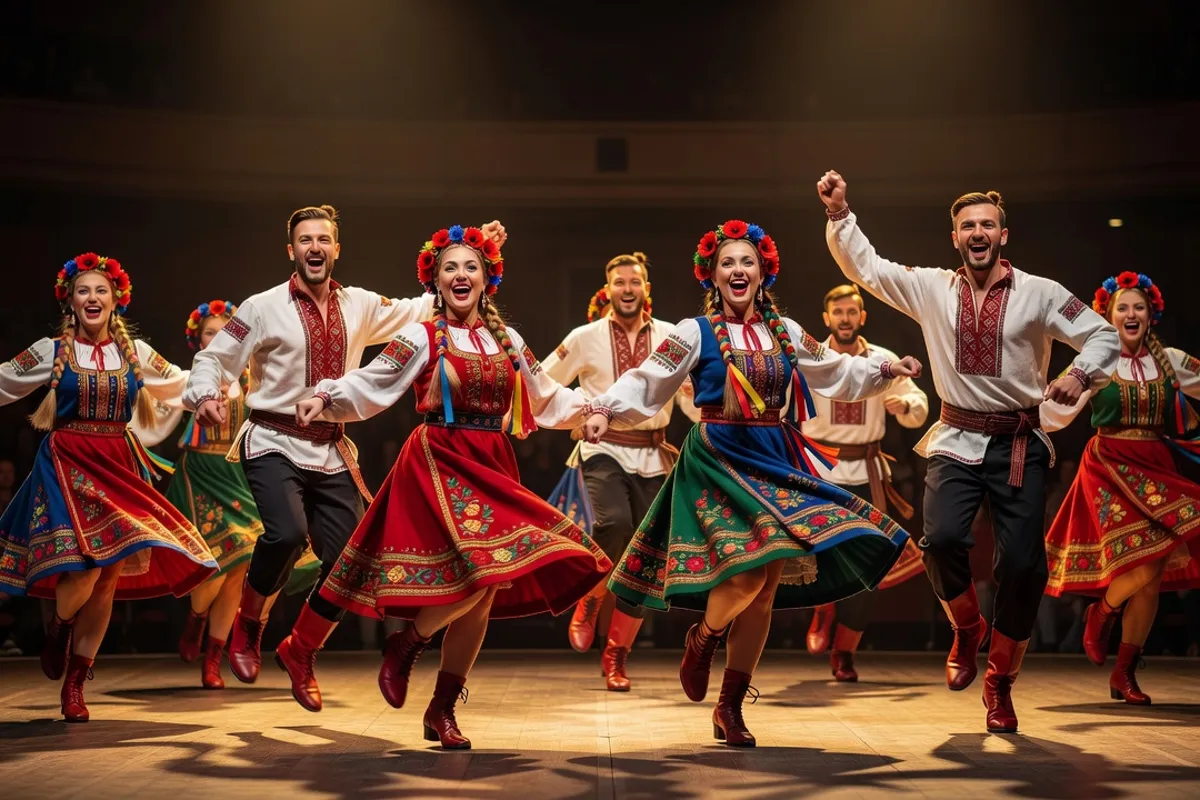
Before the stage: dancing in the first settlements
Ukrainian dance in Canada is older than any company, school or festival that carries its name today. The Canadian Encyclopedia notes that dances were performed inside Ukrainian communities from the very beginning of the first wave of immigration in 1891, as recreation: at weddings, harvest gatherings and evenings in a rented hall, where the point was to take part, not to be watched.
That distinction matters, because the history of Ukrainian dance in Canada is really the story of a shift from participation to presentation. The Encyclopedia of Ukraine describes the early repertoire as spontaneous improvisation maintained by the descendants of the first settlers. Nobody was codifying steps. Nobody was choosing costumes. A dance was whatever the people in the room remembered, adjusted to the size of the floor and the skill of the fiddler.
The settlers of the prairie bloc communities, whose arrival is traced in our account of the first wave of Ukrainian immigration from Galicia, had little reason to polish any of this. They were clearing land and building churches. Dance was a pleasure and a link with home, not yet a symbol.
The symbol came later, and it came largely because of one man.
Vasyl Avramenko and the 1927 tour
Vasyl Avramenko was born on 22 March 1895 in the village of Stebliv in the Kyiv region and died in New York on 6 May 1981. According to the Internet Encyclopedia of Ukraine he began organizing folk dance schools in 1921 in an internment camp for soldiers of the Ukrainian People's Republic army at Kalisz, in Poland, then continued in Western Ukraine, Czechoslovakia and Germany. In 1926 he emigrated to Canada, and later moved on to the United States.
His Canadian importance rests on a single claim that two independent entries in the Encyclopedia of Ukraine repeat: his 1927 tour gave rise to folk dance schools in the larger centres and to staged, choreographed performances. The Winnipeg entry adds that Ukrainian folk dancing became a popular recreational and stage activity after he visited that city in 1926-27 and again in 1937-38, training a cadre of instructors.
What did he actually change? Reading the encyclopedias side by side, three things stand out.
- A set repertoire. The spontaneous improvisations of the early immigrants were succeeded by dance repertoires shaped by Avramenko around a few set pieces. A dance now had a fixed form that could be taught, rehearsed and repeated identically in Winnipeg and Toronto.
- Teachers, not just performers. He trained instructors, and those instructors trained others. The Encyclopedia of Ukraine says the majority of the dance groups formed in the 1930s and 1940s, mostly attached to youth organizations, were led by his disciples.
- A public image. Dance was no longer only something a community did for itself. It became something a community could show to outsiders as evidence that it had a culture worth noticing.
He was also a showman of an unusual kind. The same entry records appearances with a Ukrainian dance ensemble and the Oleksander Koshyts chorus at the Metropolitan Opera in New York in 1931, at the Century of Progress Exposition in Chicago in 1933 and at the White House in 1935, and a sound-film studio in 1936-37 that produced three Ukrainian-language opera films, including Natalka Poltavka. Those events happened in the United States, not Canada, but they show the ambition behind the Canadian schools: dance as a national calling card.
A note on dates. Accounts of Avramenko's first Canadian months vary; some local histories place his arrival in Toronto in late 1925 and mention appearances at the Canadian National Exhibition. This article keeps to what the Encyclopedia of Ukraine states directly (emigration in 1926, tour in 1927, Winnipeg visits in 1926-27 and 1937-38) and treats finer details as unconfirmed.
Halls, schools and disciples in the 1930s and 1940s
A teacher needs a room, and for Ukrainian Canadians that room was usually the community hall. Organizations such as the Ukrainian National Federation ran halls where language classes, drama circles, choirs and dance rehearsals shared the same stage. The Winnipeg entry of the Encyclopedia of Ukraine mentions the UNF hall as the home of a later and very important ensemble, Rusalka.
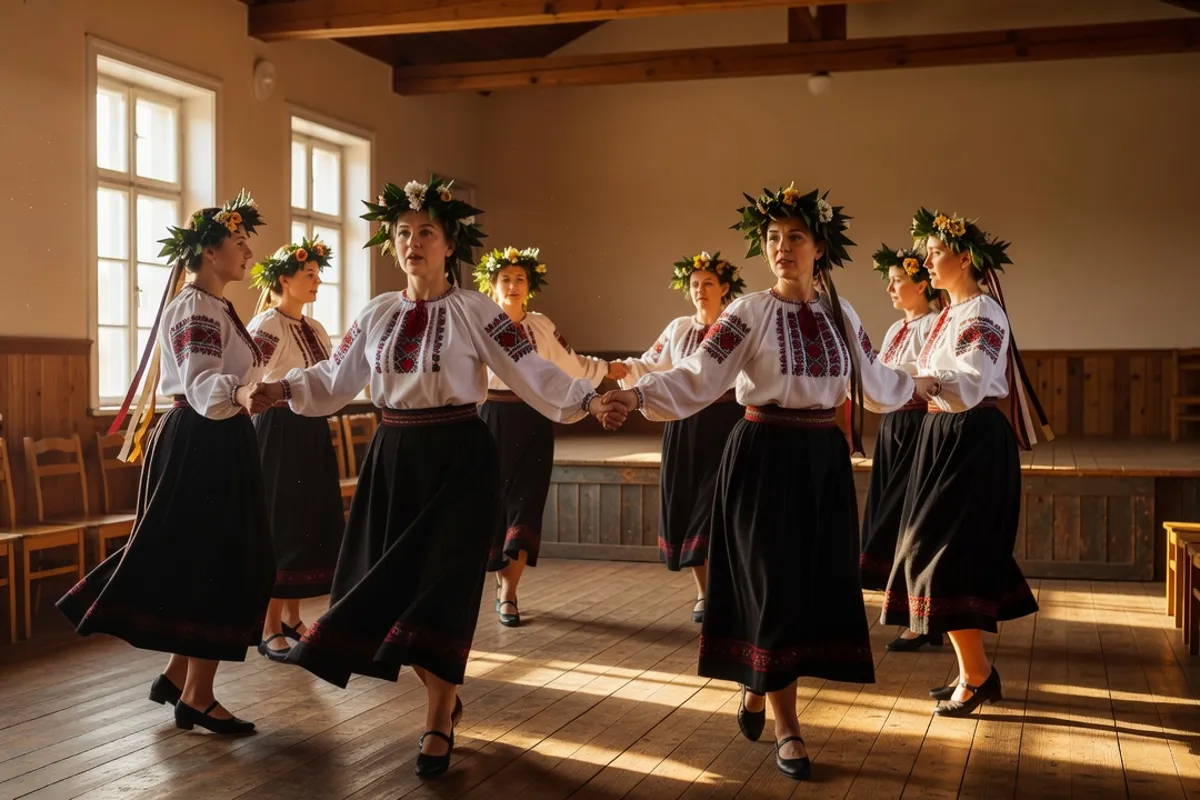
Rusalka is a good example of how the Avramenko lineage worked in practice. The encyclopedia states that Peter Hladun, one of the instructors trained after Avramenko's Winnipeg visits, established Rusalka at the UNF hall in 1962, and calls it the city's premier folk dance ensemble. Between the teacher's visits in the 1920s and 1930s and the company's founding lie a generation or more. Dance traditions in Canada were passed on slowly, from instructor to student to the student's own students.
The Second World War interrupted the pattern less than one might expect. The interwar groups kept meeting; the postwar years supplied them with new people. As the next section shows, the real break came in the 1950s.
Readers interested in how this network of halls and Saturday classes still functions today will find a practical overview in our guide to Ukrainian Saturday schools in Toronto and Edmonton, where dance often sits alongside language and history lessons.
The postwar companies: from amateur circles to large ensembles
The Encyclopedia of Ukraine summarizes the postwar change in one sentence: Ukrainian professional dancers who arrived in the 1950s established dance schools and ensembles in addition to performing themselves. People who had trained formally, often in Europe, were now running studios in Canadian cities. Technique improved, repertoires widened, and choreography became more ambitious.
Numerous groups emerged in the 1960s and 1970s, often with organizational ties but increasingly as independent societies. The same entry names, among the large companies with junior and intermediate sections, the Rusalka Dance Ensemble in Winnipeg, Chaika in Hamilton, the Ukrainian Festival Dance Company and Kalyna in Toronto, and the Shumka Dancers in Edmonton. It also lists individuals active in instruction and direction after the war: Peter Marunczak, Jaroslav Klun, Peter Hladun, Chester Kuc, Tom Luchenko, and Nadia and Lucia Pavlychenko.
Two further developments deserve attention because they are less comfortable than the usual story of heritage preserved.
- Soviet-style staging. According to the encyclopedia, in the 1960s some dance groups began to adopt the colourful, large-scale, and conformist style of touring troupes from Soviet Ukraine, and in 1975 the influence became more direct with dance seminars taught by Soviet Ukrainian choreographers. Canadian groups were borrowing a stage language that had been shaped under state sponsorship.
- Training and variety. At the same time, more attention began to be paid to formal dance training, to more varied repertoires and to innovative choreography. The community was not merely copying; it was also professionalizing its own craft.
The numbers grew quickly. In the 1970s there were approximately 100 amateur troupes representing different age groups and skill levels, and by the 1980s the Encyclopedia of Ukraine counts more than 200 Ukrainian dance troupes in Canada. Growth in the 1960s and 1970s was helped by national media exposure and by government grants that subsidized tours by the larger companies, as well as workshops and seminars.
Shumka: dance as a Canadian stage spectacle
If one company stands for the third stage of this history, it is the Ukrainian Shumka Dancers of Edmonton. The Canadian Encyclopedia, in an entry by dance scholar Andriy Nahachewsky, calls them perhaps the best known of Canada's 230 Ukrainian dance groups and schools. The group was founded in 1959, with Chester Kuc as artistic director until 1969, followed by Orest Semchuk (1969-82) and John Pichlyk (1982-97). The entry records that over 300 individuals had danced with the company by the time it was last revised in 2015.
The same entry offers a useful framework. Ukrainian dance in Canada, it says, has three focuses of activity:
- Recreational dance, performed within communities since 1891 and still going on, though now in the background;
- Dance with a national focus, performed on stage as an explicit symbol of Ukrainian identity and most prominent from 1927 to 1960, which is precisely the Avramenko era;
- Dance as stage spectacle and performing art, where the emphasis moves to aesthetics and to giving the audience a moving theatrical experience.
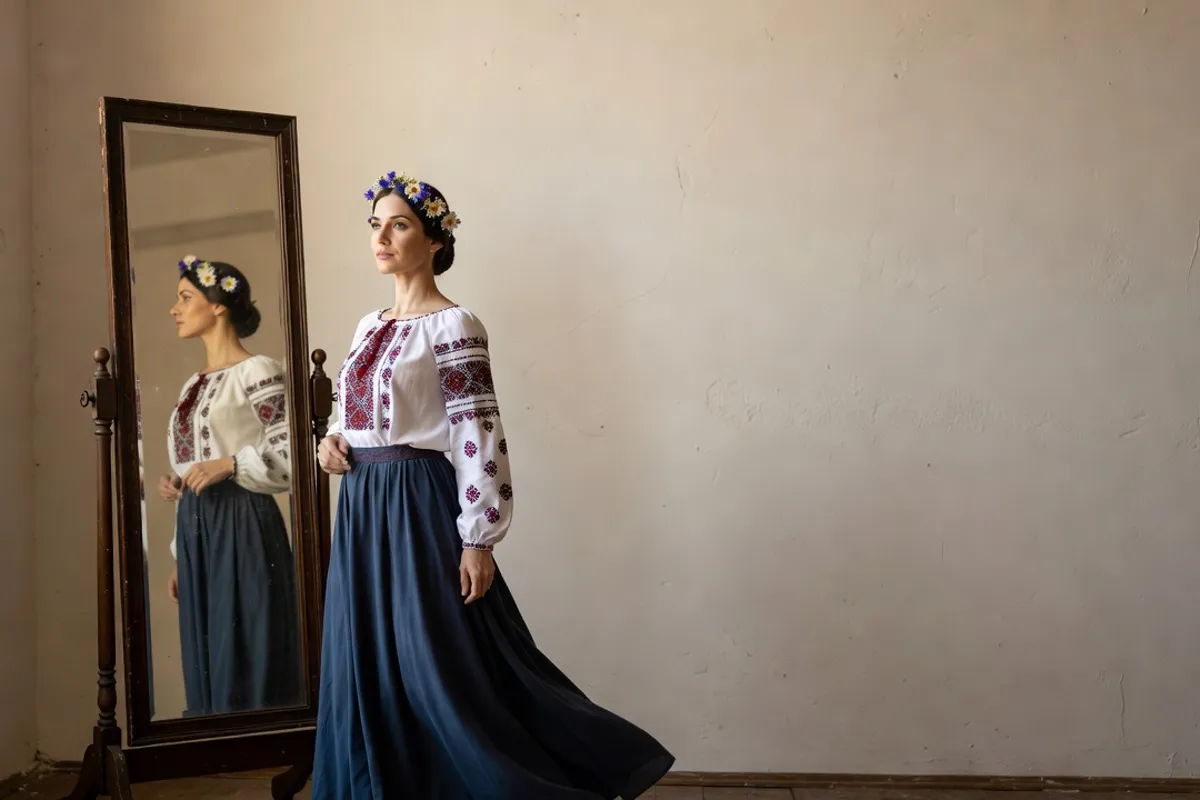
Shumka, the entry argues, clearly demonstrates the shift toward the third. Its defining characteristic is a fusion of Canadian and Ukrainian elements. The steps, melodies and costume pieces come from Ukrainian peasant culture, but the organizing devices are Canadian: a commitment to a story line in each production, themes chosen for their appeal to Canadian audiences, expressive mime, extremely fast tempos and dense choreographic texture. Costumes, lighting, set design, promotion and management are described as clearly Canadian as well.
The touring record is concrete. Since 1969 the company has performed in Tunisia, Japan, Korea, Hong Kong, the United States, Ukraine and Russia. Nine Canadian tours have been mounted since 1977; the 1995-96 tour of the program Absolutely Shumka was seen by some 50,000 people, and Shumka's Cinderella (2000) toured 20 cities across Canada. In December 1997 Shumka began touring internationally with the National Opera and Ballet of Ukraine in the production Nutcracker: A Ballet Fantasy.
One detail from the encyclopedia is worth quoting for its honesty: performing members of the company were unpaid, and dancers averaged about 12 years of Ukrainian dance training before joining. The Ukrainian Shumka Dancers also run a large children's school and an active alumni organization, and graduates have moved into careers in dance, costume design, production, arts promotion and music. The pipeline from child student to senior performer to arts professional is as much a part of the story as any single show.
A timeline at a glance
| Period | What happened | Source entry |
|---|---|---|
| From 1891 | Recreational dancing accompanies the first wave of settlement | Canadian Encyclopedia (Shumka) |
| 1926-1927 | Avramenko emigrates to Canada; his 1927 tour gives rise to folk dance schools and staged performance; first Winnipeg visit | Encyclopedia of Ukraine (Avramenko, Canada, Winnipeg) |
| 1930s-1940s | Youth organizations form dance groups led largely by Avramenko's disciples; second Winnipeg visit in 1937-38 | Encyclopedia of Ukraine (Canada, Winnipeg) |
| 1950s | Ukrainian professional dancers arrive and open schools and ensembles | Encyclopedia of Ukraine (Canada) |
| 1959 | Shumka Dancers founded in Edmonton | Canadian Encyclopedia (Shumka) |
| 1962 | Peter Hladun establishes Rusalka at the UNF hall in Winnipeg | Encyclopedia of Ukraine (Winnipeg) |
| 1960s-1970s | Large companies multiply; Soviet-style staging influences some groups; seminars from 1975; about 100 amateur troupes | Encyclopedia of Ukraine (Canada) |
| 1980s | More than 200 troupes in Canada | Encyclopedia of Ukraine (Canada) |
| After 1991 | Senior ensembles often hire dancers from Ukraine as instructors | Encyclopedia of Ukraine (Canada) |
Where Ukrainian dance is seen and taught today
The Encyclopedia of Ukraine lists four regional festivals where Ukrainian dancers perform regularly: Canada's National Ukrainian Festival in Dauphin, Manitoba, the Pysanka Festival in Vegreville, Alberta, the Vesna Festival in Saskatoon, and the Bloor West Village Ukrainian Festival in Toronto. Our own overview of Ukrainian festivals in Toronto and Edmonton explains how to plan a visit. Always confirm dates with the organizers; festival schedules change from year to year.
The post-independence period brought a quiet change inside the studios. The encyclopedia observes that senior Ukrainian dance ensembles in Canada commonly began to employ dancers from Ukraine as instructors. The flow that began with Avramenko, Europe-trained teachers travelling to Canada, thus continues in another form.
Since 2022 many newcomers arrive in Canada with their own dance training and with children who want to continue. The practical route is the same one earlier generations used: ask at a parish, a community hall, a Saturday school or a settlement agency, and visit a rehearsal before committing. Some groups welcome adult beginners, others recruit only children, and programs differ from city to city, so there is no single national rule. The broader picture of how these institutions fit together is laid out in our overview of the main Ukrainian Canadian organizations.
What the history teaches
Three lessons run through the sources. First, tradition in Canada was never frozen; it was made, by named teachers and named organizations, and it changed with each generation. Second, the same dance can serve different purposes at different times: a wedding pleasure in 1900, a national statement in 1930, a theatrical production in 2000. Third, the institutions matter as much as the choreography. Without halls, schools, youth organizations and grants there would be no companies, and without a steady supply of children in beginner classes there would be no senior ensembles.
This is also why scholars treat Ukrainian dance as part of a wider identity story. The question of what it means to be Ukrainian and Canadian at once, explored in our essay on Ukrainian Canadian identity, is answered partly on stage, in costumes that nobody wears on the street.
Frequently asked questions
Who brought organized Ukrainian dance to Canada?
The Encyclopedia of Ukraine credits Vasyl Avramenko, who emigrated to Canada in 1926. Its Canada entry states that his 1927 tour gave rise to folk dance schools in larger centres and to staged, choreographed performances, and that most instructors of the dance groups formed in the 1930s and 1940s were his disciples.
When was the Shumka Dancers company founded?
The Canadian Encyclopedia gives 1959 as the founding year, in Edmonton, with Chester Kuc as the first artistic director, serving until 1969.
How many Ukrainian dance groups are there in Canada?
The numbers depend on the year and on what counts as a group. The Encyclopedia of Ukraine reports about 100 amateur troupes in the 1970s and more than 200 by the 1980s, and the Canadian Encyclopedia speaks of 230 Ukrainian dance groups and schools. Treat these as historical estimates, not as a current directory.
What is the difference between recreational and stage Ukrainian dance?
Recreational dance is performed by community members for their own enjoyment and has existed since the first settlements. Stage dance with a national focus is performed by trained dancers in costume as a symbol of Ukrainian identity, and stage dance as performing art puts theatrical effect first. The Canadian Encyclopedia describes these as three overlapping focuses, not as successive replacements.
Where can newcomers find a Ukrainian dance class?
Ask at a Ukrainian parish, a community hall, a Saturday school or a settlement agency in your city, and visit a rehearsal first. Availability, age limits and fees vary by group, so check directly with each organizer.