Saturday Schools in Canada: A Diaspora Tradition Since 1905
The first Ukrainian Saturday school in Canada was organised in Winnipeg in 1905, just fourteen years after the first wave of Ukrainian settlers arrived from Galicia. It met in the basement of a Greek Catholic parish hall on a Saturday morning, taught Ukrainian reading and writing, and was paid for by passing the hat among the families of the dozen children enrolled. That foundational model — Saturday morning, parish basement, language-and-culture, community-funded — has scaled across more than a century into the network of seventy Ukrainian schools that operate across Canada today. Most of them still meet on Saturday mornings. Most are still organised around parishes. Most still teach reading, writing, and culture. And most are still paid for, in part, by passing the hat.
The post-2022 context has transformed the network in ways that the founders of 1905 could not have imagined. Roughly 200,000 Ukrainians arrived in Canada under the CUAET emergency authorization program between 2022 and 2024. A high proportion of them are families with children of school age. Their arrival has reshaped Ukrainian-language education in Canada more profoundly than any single event since the post-World War Two displaced-persons wave of the late 1940s. Schools that had been steadily losing enrolment for decades are now full. New schools have been founded in suburbs that had no Ukrainian institutional presence. Heritage Canadian Ukrainian families are sending their children to school alongside families whose mother tongue is contemporary Kyiv Ukrainian rather than the older diaspora dialect.
To understand what is happening on the ground, we spent an afternoon at the St. Vladimir Institute in Toronto talking with Olha Boyko, who has run the institute's Saturday school since 2007. The institute, located near Bathurst and Queen, has been one of the central institutions of Ukrainian Toronto since the 1940s. Its Saturday school is the largest in the Greater Toronto Area and one of the largest in Canada. What follows is our conversation, edited only for length and clarity.
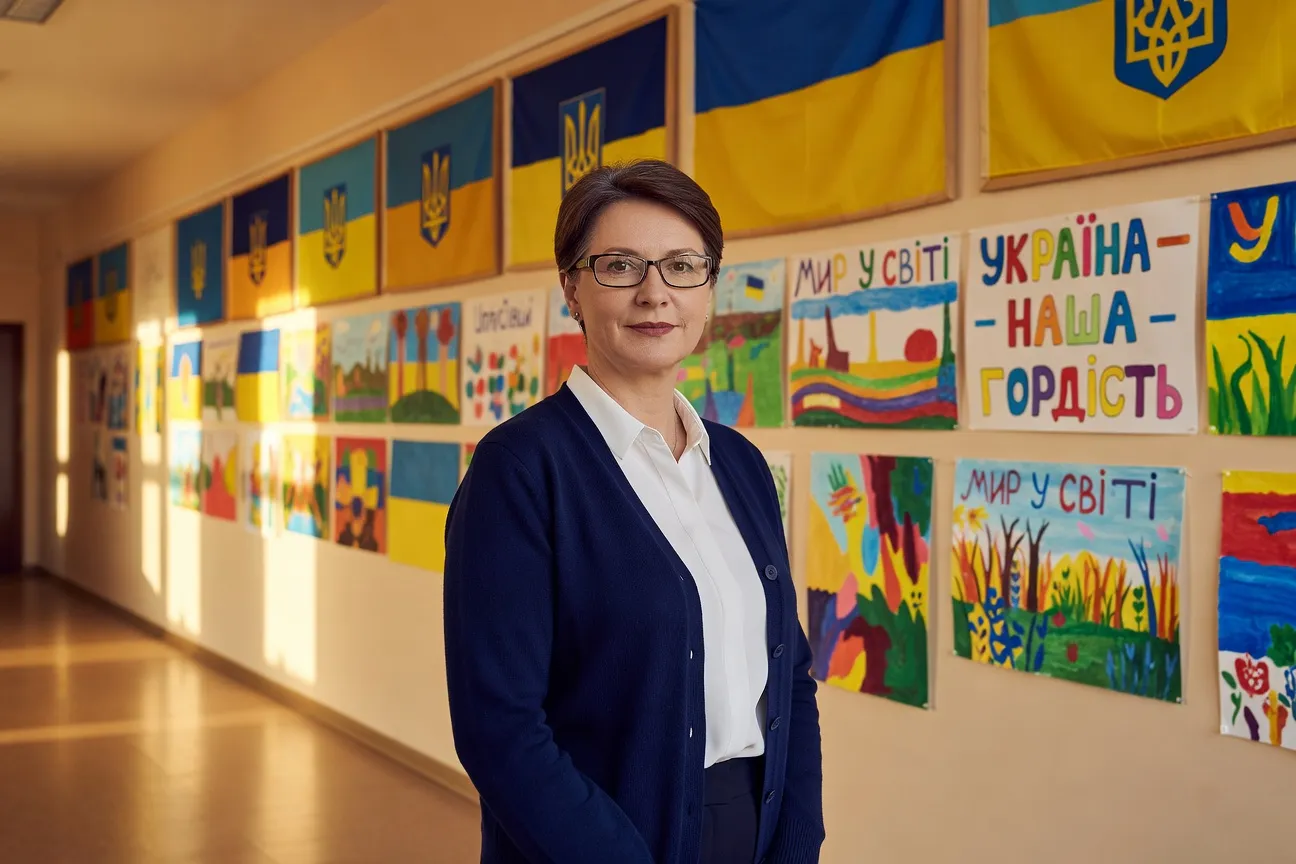
Olha Boyko, director of the Ukrainian Saturday School at St. Vladimir Institute Toronto.
Olha Boyko
Director of the Ukrainian Saturday School at St. Vladimir Institute, Toronto. Eighteen years in the role. Education credentials from Lviv Polytechnic and the University of Toronto OISE. Specialises in K-12 Ukrainian-language and cultural education for both heritage diaspora children and recent arrivals.
Q1: How many Ukrainian Saturday schools operate in Canada in 2026?
Sarah KlymenkoOlha, let's start with the basic landscape. Most readers will have a vague idea that Ukrainian Saturday schools exist somewhere, but they don't know how many or where. Give us the picture.
Olha BoykoLook, before 2022 the official Ukrainian Canadian Congress count was about fifty schools nationwide. That number had been declining gently for years. Some prairie communities had folded their schools because there weren't enough children. Some Toronto schools had merged.
In 2026, the count is closer to seventy. (For the broader picture of [how much Ukrainian is still spoken at home in Canada](/ukrainian/ukrainian-language-retention-canada-generations/), the census data is sobering.) Honestly, I think it's a little higher than that — some of the very small CUAET-founded schools haven't registered yet, and some are operating informally in church basements without being on anyone's official list. So the real number is probably between seventy and eighty.
Where are they? The biggest concentrations are in Greater Toronto (about fifteen schools), Edmonton (eight), Winnipeg (six), and the Lower Mainland of British Columbia (five). The Maritimes have two. The North has none. Quebec has two, both in Montreal. Saskatchewan and rural Manitoba have lost most of their old prairie schools but a few have come back.
Total enrolment across the country is approximately twelve thousand children. That is an extraordinary number for a heritage-language school network in 2026. It is, in fact, the largest single Ukrainian-language education system anywhere outside Ukraine.
Q2: What is the typical curriculum — language only, or culture too?
Sarah KlymenkoIf a Canadian parent enrolls a seven-year-old in your Saturday school this fall, what will they actually learn over the year?
Olha BoykoHonestly, the curriculum varies by school, but most of us teach a balanced program. Roughly half is language — reading, writing, vocabulary, grammar at the developmentally appropriate level. The other half splits between Ukrainian history and geography, folk arts and crafts (pysanky in spring, embroidery samples, paper-cutting), music and choir, and Ukrainian dance. Religious schools add half an hour of catechism or scripture.
Our school runs nine months, mirroring the Canadian public school year. We start in September and end in early June. We meet Saturday mornings from nine to one, with a fifteen-minute snack break. Total instruction is about thirty hours per nine-week term.
I'll give you a concrete example. A seven-year-old in our Grade Two class this year is doing the Ukrainian alphabet workbook, reading short stories about a family of badgers in Ukrainian (with English glossaries), learning the names and locations of seven Ukrainian cities, practising a Christmas carol for the December performance, learning the first basic steps of Hopak (the Ukrainian dance), and decorating two pysanky in March. That is the standard load.
What parents don't realise is that the cultural content matters as much as the language content. A child who only studies the language will treat Ukrainian as homework. A child who also dances and sings and decorates pysanky and learns the geography — that child knows Ukrainian as a living tradition. The retention rate into adulthood is much higher for kids in the integrated programs.
Q3: Have enrollments changed since 2022?
Sarah KlymenkoLet's talk about the elephant in the room. How has 2022 changed enrolments?
Olha BoykoI'll be precise. In the 2021-2022 academic year our school had 240 students enrolled. In 2024-2025 we had 421. In the current year, 2025-2026, we have just over 440 and a waiting list of about sixty children we cannot place because we don't have enough classroom space. That is roughly an eighty percent increase in four years.
The increase is not just CUAET families. Heritage Canadian Ukrainian families are also enrolling in larger numbers. The war seems to have triggered a re-engagement among third- and fourth-generation Ukrainian Canadians who had let their children's Ukrainian education lapse. Some of these are grandparents bringing their grandchildren in. Some are millennial parents who themselves attended Saturday school in the 1990s and stopped after they had their own children. They are coming back.
The class mix in any given room is now roughly half CUAET-arrival kids and half heritage kids. The dynamic is interesting. The CUAET kids speak fluent contemporary Ukrainian; the heritage kids speak schoolbook Ukrainian or no Ukrainian at all. Within a couple of months the heritage kids' fluency catches up significantly because of constant peer exposure. The CUAET kids learn the Canadianised forms and the older diaspora vocabulary their grandmothers used. The cultural exchange is incredible and unexpected. Both groups end up speaking a richer Ukrainian than either would alone.
Q4: How much does it cost and is there government support?
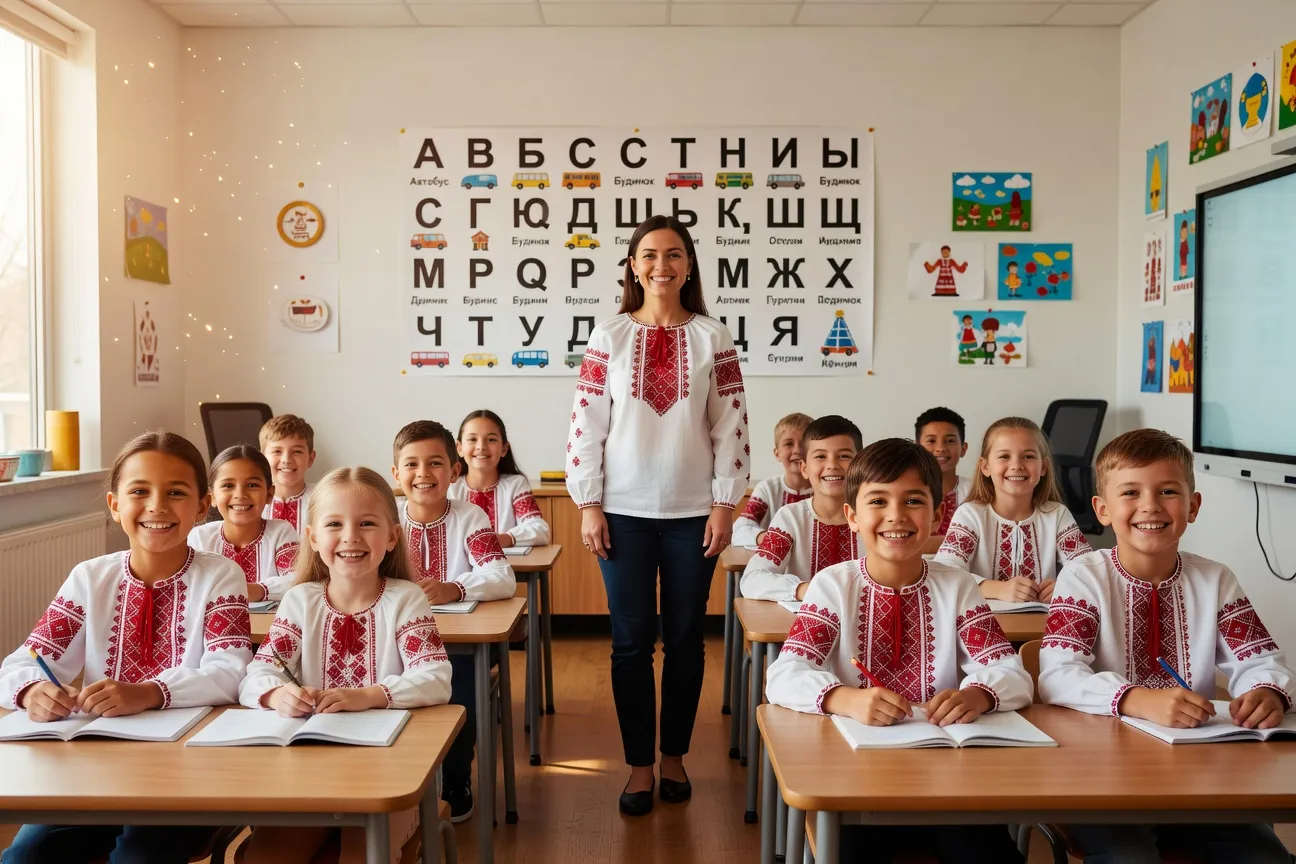
Modern Ukrainian Saturday school classroom in Toronto 2026, children aged 7-10 in vyshyvanka embroidered blouses, teacher with Ukrainian alphabet poster.
Sarah KlymenkoMoney. What does it cost a family to send a child to Ukrainian Saturday school in 2026, and who pays?
Olha BoykoOur tuition this year is 750 dollars for the first child and 575 for the second. So a family with two kids pays about 1,325 a year. Other Toronto schools charge between 400 and 950 depending on facilities and programming. Edmonton and Winnipeg are similar. Vancouver is a little higher because of facility costs.
Where does the money come from? Most of our budget — about 70 percent — comes from tuition. About 20 percent comes from St. Vladimir Institute, which subsidises our space and shares some staff costs. The remaining 10 percent comes from community donations, fundraisers (the spring concert raises about ten thousand dollars), and the occasional grant from organisations like the Ukrainian Canadian Foundation of Taras Shevchenko.
Government funding? Honestly, very little, and that is a sore point. Manitoba and Alberta have provincial heritage language program grants that contribute a few hundred dollars per student. Ontario's heritage language program is much more limited. Saskatchewan was good in the past but the program has been cut back. Federal funding is project-based, not ongoing.
For CUAET families specifically, we offer a sliding scale and have had a tuition-free first-year option since 2023, funded by donations earmarked for that purpose. Several schools across the country offer similar programs. No CUAET family has been turned away from our school for inability to pay. We have made that a hard rule.
Q5: What are the biggest schools in Toronto, Edmonton and Winnipeg?
Sarah KlymenkoWalk me through the biggest schools in each major city for a parent who is doing comparison shopping.
Olha BoykoIn Toronto, the biggest is ours at St. Vladimir with 440-plus. Next are St. Demetrius (about 300) in Etobicoke, Plast Toronto on Christie Street (about 280, more youth-organisation flavoured), and the new MovaPaTaTa programme that started after 2022 has grown to around 220 across a couple of locations. Smaller heritage schools at individual parishes — St. Nicholas, Holy Eucharist, St. Andrew's — range from 50 to 150 students each.
In Edmonton, the giant is Plast Edmonton with over 350 students. The Ukrainian Bilingual Education Program in the public schools is technically not a Saturday school but it serves a similar function for thousands of additional kids during the regular school week. Edmonton also has the Vegreville Saturday school an hour east, which serves the historic Ukrainian Block.
In Winnipeg, the biggest is Sadochok Plast at Holy Family parish, with around 280. The Ridna Shkola program at the Ukrainian Canadian Congress building has 200. There are several smaller parish-based schools, each with 50-100. Winnipeg's Ukrainian community is the densest in the country relative to total population, which sustains a strong network of smaller programs. For a national overview of the organizations driving this network, see our guide to the top 15 Ukrainian Canadian organizations and associations.
Quick mentions: Vancouver Ridna Shkola has 200, Ottawa Ukrainian School has 220, Calgary has two schools with 150 each. Hamilton has a new school with 80 (almost entirely CUAET). Mississauga has a brand-new school with 95.
Q6: Should CUAET families enroll their kids or use the Canadian school system only?
Sarah KlymenkoThis is the question that I get asked most by my friends from Kyiv who arrived in 2023. Their kids are exhausted from English. They wonder if they should add Saturdays of Ukrainian on top of weekday English-language school.
Olha BoykoTo be clear, I am biased. I have spent my career on Ukrainian-language education. But let me tell you what I have observed over four years working with CUAET families.
The kids who came after 2022 and are not enrolled in any Ukrainian-language programming are at risk of losing the language within two to three years. I am seeing this in real time. A nine-year-old who arrived in 2022 fluent in Ukrainian is now, at age thirteen, speaking English with her parents at home, refusing to speak Ukrainian at family events, and reading Ukrainian only with significant effort. Once the child has English friends at school, the home language loses competitive ground rapidly.
The kids who attend Saturday school maintain the language. Not because the four hours on Saturday teach them anything fundamentally new — they already know how to speak Ukrainian, after all — but because they have a peer group who also speaks it, and they have a context in which Ukrainian is the social language. That peer-group effect is what we are really providing. The language instruction is almost a pretext.
For families who arrived as Ukrainian refugees and are still finding their footing in Canada, I always say: enrolling your child in Saturday school is one of the easiest culture-preservation decisions you will ever make. It is also one of the cheapest. The alternative is much more expensive in regret.
That said: I do not push every family to enroll. A child who is dealing with severe trauma from the war, or whose family has other Saturday commitments, or who is already overloaded with weekday academic stress, may not benefit. We do triage carefully when families ask.
Q7: What about online options for families outside the major cities?
Sarah KlymenkoNot every Ukrainian family in Canada lives within driving distance of a Saturday school. What options exist?
Olha BoykoOnline Ukrainian education has exploded since 2022. Three categories exist.
First, formal remote programmes run by established Saturday schools. The Edmonton Saturday school has a robust online stream that serves Alberta families outside the city. Our school at St. Vladimir runs a Zoom-based programme for families in Northern Ontario who have no local school. The MovaPaTaTa programme operates primarily online and serves Ontario and Quebec families. Tuition is usually somewhat lower than for in-person programmes.
Second, private Ukrainian tutoring services. A number of Ukrainian teachers (some living in Ukraine, some in Canada) offer one-on-one or small-group tutoring via video call. Hourly rates range from twenty to fifty Canadian dollars. The quality is mixed but several established services have built strong reputations.
Third, free or low-cost group conversation circles organised by CUAET-arrival parents in smaller communities. These are not really schools; they are weekly play-dates with Ukrainian conversation as the explicit goal. They cost nothing, they are easy to organise, and they help maintain the language for the youngest children.
If I had to recommend one thing for a remote family, I would say: combine a formal online programme (for structure and rigour) with a local in-person play-date or family gathering (for the social dimension of language use). Either alone is less effective than both together. For families learning the Ukrainian language as an adult or in mixed-language households, the same principle applies: structured study plus social conversational practice. Either alone falls short.
Quick Questions (5 rapid-fire)
YES True or false: Saturday schools really still teach kids to read and write Cyrillic by hand. — Yes, absolutely. Mechanical pencil and notebook. We refuse to skip this step. The motor learning matters.
NUANCE Is the Ukrainian taught in Canadian schools the same as Ukrainian in Ukraine today? — Mostly. We use modern Ukrainian textbooks but we acknowledge the older diaspora vocabulary that many heritage children hear at home. We do not treat the older forms as wrong.
NO Do Saturday schools accept non-Ukrainian-background children? — Most are happy to accept them but the integration requires effort. We have had several non-Ukrainian children attend over the years, usually because a parent is dating or has married into a Ukrainian family.
YES Should I send my five-year-old or wait until grade one? — Send them. Five is ideal. The kindergarten classes are play-and-song based and the kids love it.
NUANCE Do the schools coordinate with the Canadian public school curriculum? — Some, not all. The bilingual programs in Manitoba and Alberta do. Saturday schools are mostly independent. Most of us focus on what Canadian schools do not cover.
How to Enroll: Step-by-Step
If you are considering enrolling a child, here is the practical sequence based on Olha's advice and the typical workflow at most Canadian Ukrainian schools:
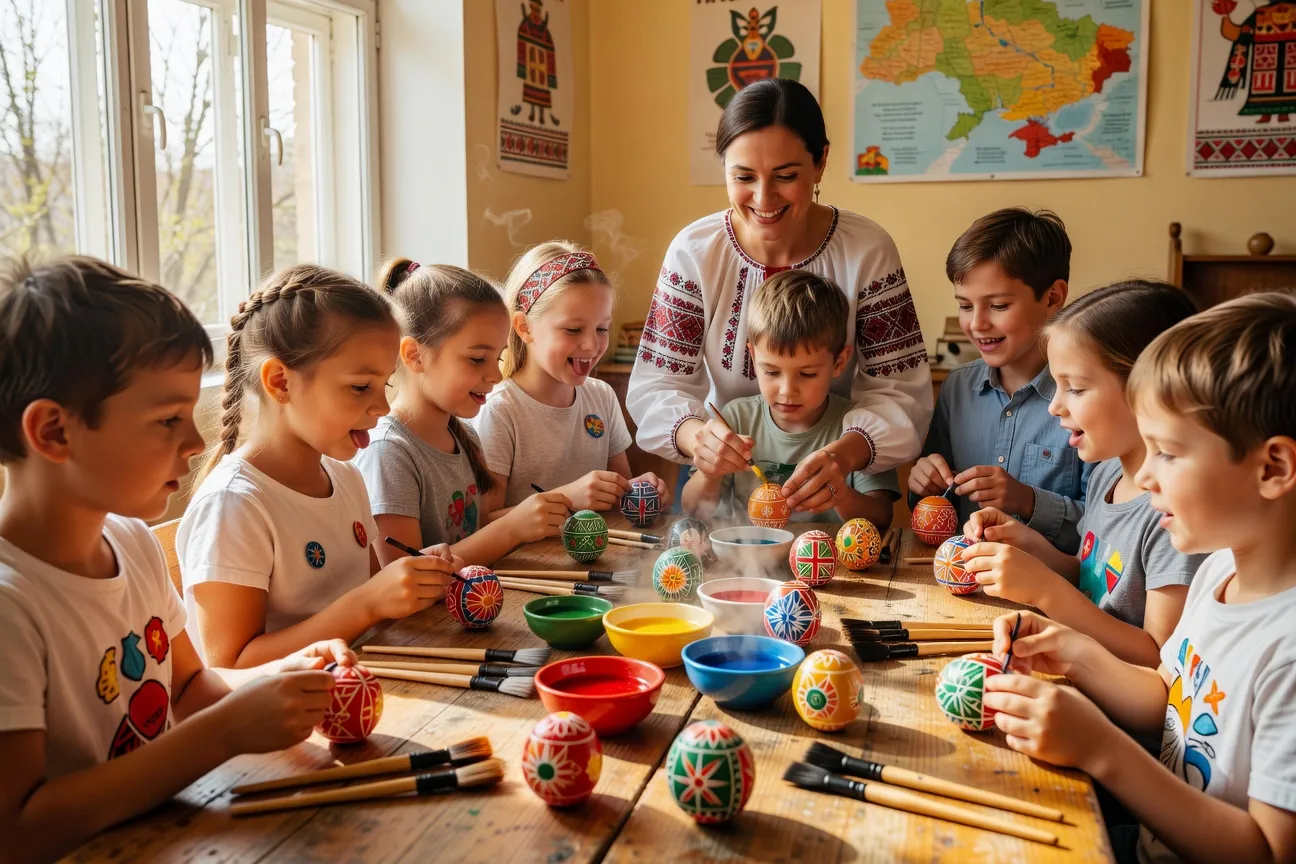
Children at a Ukrainian Saturday school decorating pysanky Easter eggs at a long wooden table.
Step 1: Identify schools near you. The Ukrainian Canadian Congress maintains a directory at ucc.ca. For Toronto, the institute websites (St. Vladimir, St. Demetrius, Plast Toronto) all have current enrolment information. In Edmonton, Plast Edmonton's site is the central source. In Winnipeg, the Ukrainian Canadian Congress Manitoba branch maintains the local list.
Step 2: Contact 2-3 schools in March or April. Enrolment for the September academic year typically opens in April or May. The biggest schools fill quickly. CUAET families should mention this explicitly when contacting schools; most will move CUAET applications to priority status.
Step 3: Attend an open house. Most schools host open houses in May or June. Bring your child. See the space. Meet the teachers. The fit between child temperament and school style matters and is best assessed in person.
Step 4: Submit registration and pay deposit. Most schools require a deposit of 100-200 dollars to hold a spot, with the balance payable in September. If you are on a sliding scale or scholarship, this is the moment to discuss it.
Step 5: Show up in September. Bring patience for the first few weeks. Children take time to settle into a Saturday rhythm. Heritage families sometimes report that the first month feels like a struggle; almost all report that by November the child looks forward to Saturday morning. Families weighing full bilingual immersion rather than a once-a-week program may also want to read our interview on Ukrainian bilingual education programs in Canada.
For broader context on Ukrainian Canadian identity formation and how cultural anchors like Saturday school fit into the diaspora's long history, the conversation continues across the Ukrainian community of Toronto and the GTA, where the largest concentration of Ukrainian-language educational institutions in Canada is now located. The broader frame of Ukrainian cultural events and resources for diaspora communities provides additional context for families navigating language preservation in 2026.