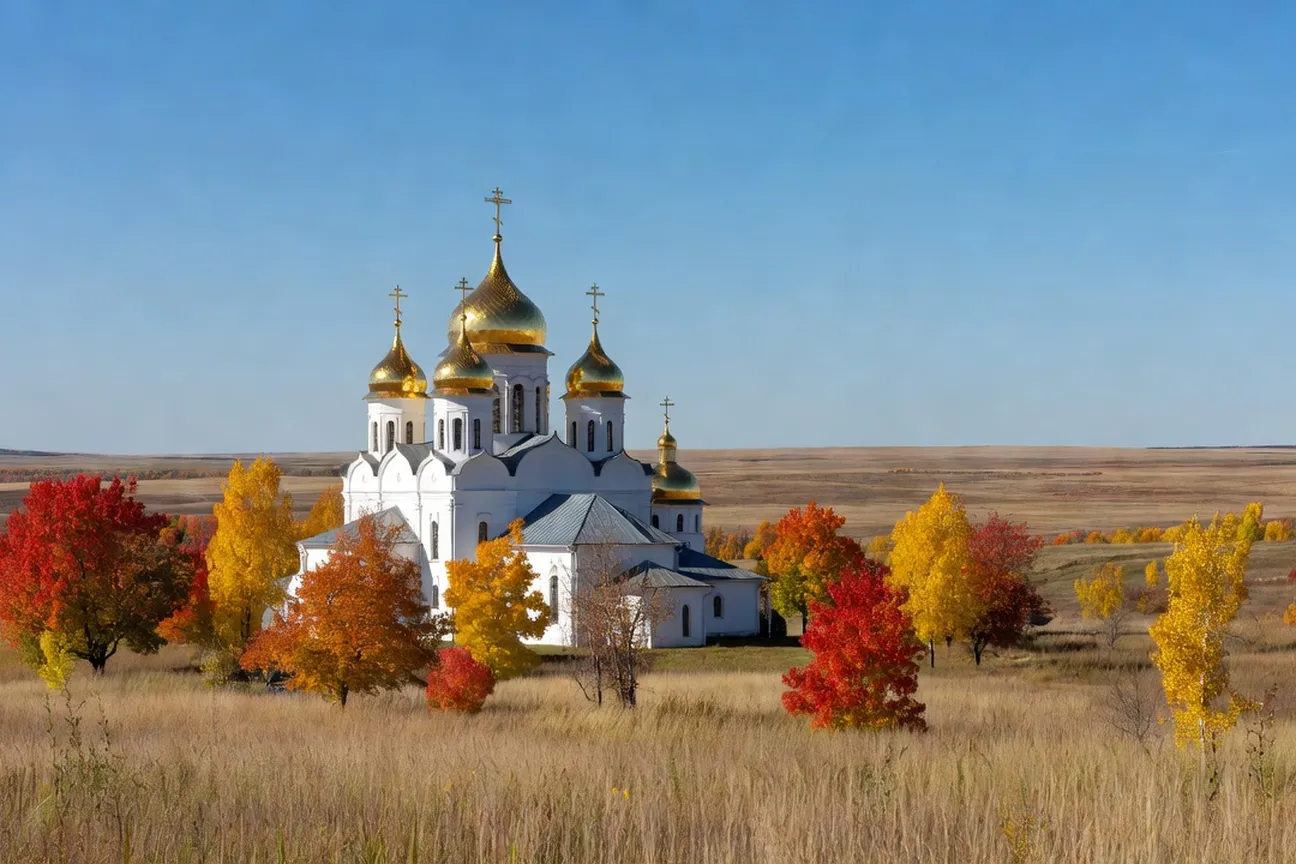
Ukrainian church with onion domes on the Canadian Prairies.
Father Ihor Kutash, priest and church historian, Ukrainian Orthodox Church of Canada, Winnipeg.
Father Ihor Kutash
Parish priest and Church historian, Ukrainian Orthodox Church of Canada (Consistory of Winnipeg). Author of parish histories on the 1918 founding congress and the Prairie mission era. Serves a Winnipeg congregation and lectures on Ukrainian ecclesiastical history at diocesan seminars across the Prairies.
Winnipeg, Manitoba, Canada
Drive through almost any small town on the Canadian Prairies that received Ukrainian settlers between 1891 and 1914, and you will likely find not one but two Ukrainian churches within a few kilometres of each other — one under the authority of Rome, the other independent and Orthodox. The split between the Ukrainian Greek Catholic Church and the Ukrainian Orthodox Church of Canada is one of the most consequential and least understood chapters of Ukrainian-Canadian history, born out of wartime suspicion, a bishop's internment, and a grassroots nationalist movement that reshaped religious life for tens of thousands of settlers.
Father Ihor Kutash has spent much of his priesthood researching and teaching this history from his parish base in Winnipeg, home to the Consistory of the Ukrainian Orthodox Church of Canada. We spoke with him about the founding congress in Saskatoon in 1918, the role of Bishop Nykyta Budka, the architecture and social function of the prairie parish, and how these century-old institutions are adapting to serve a new wave of Ukrainian arrivals since 2022.
Table of Contents
- Introduction: Two Churches, One Community
- The Galician Roots of Ukrainian Catholicism in Canada
- Bishop Nykyta Budka and His 1914 Pastoral Letter
- Internment and the Crisis of Legitimacy
- The 1918 Saskatoon Congress
- Ivan Bodrug, Vasyl Kudryk, and the New National Church
- Rivalry and Coexistence in Prairie Communities
- The Parish as Social and Cultural Centre
- Onion Domes and Prairie Church Architecture
- Decline in Practice and the Post-2022 Refugee Role
- Parish Life Today in Toronto, Winnipeg, and Edmonton
- Quick Answers: Common Misconceptions
- Three Key Takeaways
- Frequently Asked Questions
Q: For readers who don't know this history at all, how did Ukrainian Canadians end up with two separate church traditions?
A: It comes down to where the earliest settlers came from and what happened to their church leadership once they arrived. The first wave of Ukrainian immigrants, roughly 1891 to 1914, came overwhelmingly from Galicia, then part of Austria-Hungary, where the dominant Ukrainian church was the Greek Catholic Church — Eastern in liturgy and language, but in communion with Rome since the Union of Brest in 1596. These settlers built Greek Catholic parishes across the Prairies. But by 1918, a breakaway movement created a second institution, the Ukrainian Orthodox Church of Canada, which rejected Roman authority entirely and organized itself as an independent, self-governing Orthodox church. Both traditions use nearly identical Byzantine-rite liturgy, both sing the same hymns, but one recognizes the Pope and one does not. That single distinction, and the history behind it, still shapes parish life in this country over a century later.
Q: Let's start with the Galician roots. What did Ukrainian Catholic religious life look like for the first settlers on the Prairies?
A: For the first fifteen or so years, it was extraordinarily difficult. Settlers arrived with a strong attachment to their Greek Catholic faith, but there were almost no Ukrainian-speaking priests in Canada, and the existing Roman Catholic hierarchy in the West — largely French and Irish in background — did not always know what to do with a married, Eastern-rite clergy that looked and worshipped so differently from Latin-rite Catholicism. Some Roman Catholic bishops were openly suspicious of Greek Catholic priests, questioning their legitimacy or trying to Latinize their practices. Settlers built their own log churches, often before they had a resident priest, and would wait months or years for a itinerant Basilian father to arrive and bless a marriage or baptize a child. This vacuum of leadership is really the seed of everything that followed.
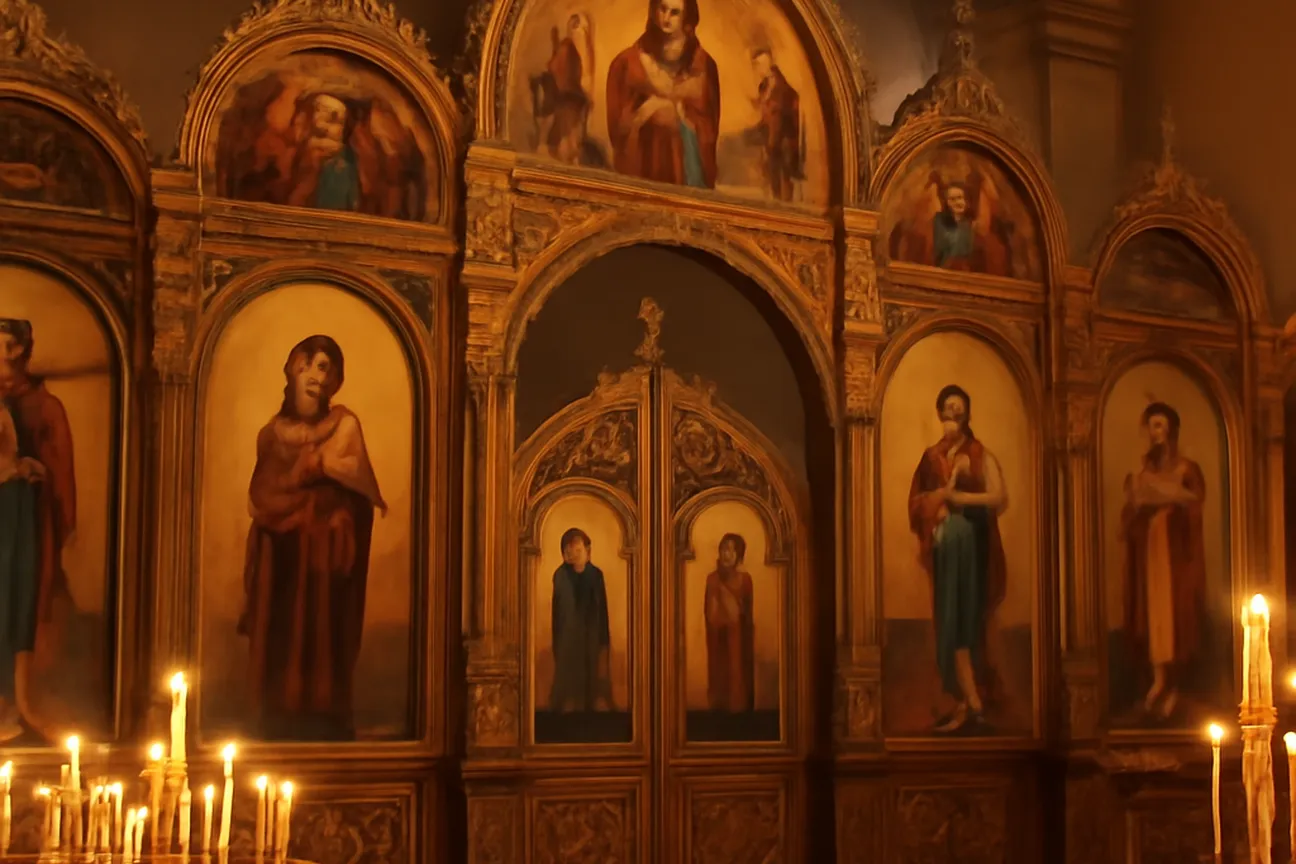
Interior of a Ukrainian Greek Catholic parish church on the Prairies.
Q: That leadership vacuum was eventually filled by Bishop Nykyta Budka in 1912. Tell us about his role and the controversy of his 1914 pastoral letter.
A: Bishop Budka arrived in Canada in December 1912 as the first Ukrainian Greek Catholic bishop for the country, based in Winnipeg. He inherited an enormous, scattered diocese with too few priests and a settler population desperate for structure. Then came August 1914. When war broke out, Budka issued a pastoral letter urging Ukrainian men who were still Austro-Hungarian reservists to return to Europe and fulfil their military obligations to Austria-Hungary. Within days, with Canada now at war with Austria-Hungary, this letter looked catastrophic. Budka retracted it almost immediately and urged loyalty to Canada instead, but the damage was done. He was branded disloyal in the English-Canadian press, and the letter became a pretext for suspicion against the entire Ukrainian community, feeding directly into the internment operations that followed.
Q: How did the internment crisis of 1914 to 1918 affect Budka personally and the Church's standing among Ukrainian settlers?
A: Under the War Measures Act, roughly 5,000 to 8,000 Ukrainians and other "enemy aliens" from Austro-Hungarian territories were interned in camps across Canada, including at Castle Mountain and Spirit Lake. Budka himself came under RCMP surveillance and was investigated repeatedly, though never formally interned in a camp himself; his authority and moral standing were nonetheless deeply damaged by the association with disloyalty. For a portion of the settler community, this crisis exposed exactly the kind of dependency on European ecclesiastical authority — Austro-Hungarian in origin, ultimately answerable to Rome — that nationalist-minded Ukrainians wanted to escape. If a foreign-appointed bishop's missteps could bring suspicion on an entire community, the argument went, then Ukrainians in Canada needed a church of their own making, accountable to no outside power.
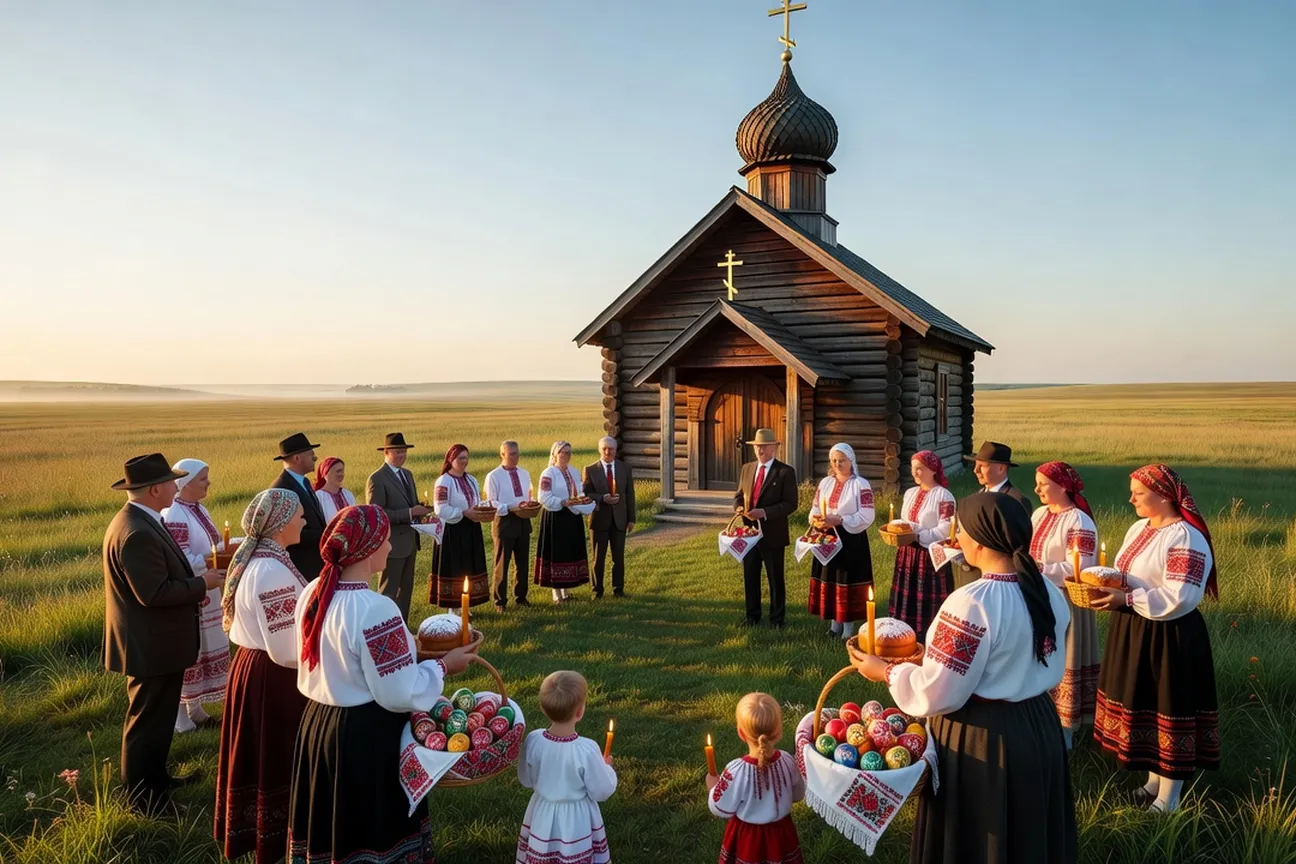
Onion-domed Ukrainian Orthodox church on the Canadian Prairies.
Q: That brings us to July 1918 and the founding congress in Saskatoon. What actually happened there?
A: In July 1918, lay delegates from Ukrainian settlements across the Prairies gathered in Saskatoon, Saskatchewan, for a congress that formally established the Ukrainian Orthodox Church of Canada — often called, in its early years, the Ukrainian Greek Orthodox Church of Canada. This was overwhelmingly a lay-driven movement, not a top-down decision by bishops. Ordinary farmers, teachers, and community leaders who had grown frustrated with what they saw as Roman and Austro-Hungarian domination of their religious life voted to break away and build an independent, self-governing Orthodox church rooted in Ukrainian national identity rather than allegiance to Rome or any foreign patriarch. It was as much a political and cultural declaration as a theological one — a statement that Ukrainian Canadians could govern their own spiritual affairs.
Q: Two names come up constantly in the history of that congress: Ivan Bodrug and Vasyl Kudryk. Who were they and what did they contribute?
A: Ivan Bodrug and Vasyl Kudryk were among the most important lay organizers of the new church, and neither began as an Orthodox priest in the traditional sense — both came out of a Presbyterian mission background among Ukrainian settlers, which is itself a fascinating detour in this story. Bodrug had trained as a Presbyterian minister working with Ukrainian communities in Manitoba, and brought organizational experience and a network of contacts built through years of mission work. Kudryk became one of the intellectual architects of the new church, editing periodicals, drafting founding documents, and articulating the theological and national case for an independent Ukrainian Orthodoxy. Together with dozens of local delegates, they helped translate a wave of grassroots frustration into a functioning ecclesiastical institution with a constitution, a governing consistory, and a plan to recruit or train Orthodox clergy for Prairie parishes that, in many cases, simply defected wholesale from the Greek Catholic parish next door.
Q: Did entire communities switch allegiance overnight, or was it more contested at the local level?
A: It was often bitterly contested, sometimes within a single family. You have to picture a small settlement that had built one wooden church with enormous communal sacrifice, and now the congregation splits over whether to remain Greek Catholic or join the new Orthodox church. In some towns, one faction kept the original building and the other built a second church, sometimes visible from the first. There are well-documented cases of legal disputes over who owned the parish property, the bell, even the vestments, because both factions claimed continuity with the original settler congregation. It took decades, in some communities, for that rivalry to soften into the more or less peaceful coexistence you see today, where a town might have a Catholic parish and an Orthodox parish that cooperate on community events, share a cemetery, and attend each other's major feast days, even while remaining formally separate.
Q: Beyond the theological dispute, what role did these parishes play in the everyday life of settler communities?
A: The parish was never just a place for Sunday liturgy. In an isolated prairie settlement with few other institutions, the church hall was the school, the meeting hall, the wedding venue, the site of the harvest festival, and often the only building large enough to gather the whole community. Ukrainian-language schooling frequently happened in a room attached to the church before public school infrastructure caught up. Reading clubs, choirs, drama societies, and mutual aid associations organized themselves around the parish. Even political organizing — discussions about land rights, labour conditions, or wartime internment — often happened in the church basement because there was simply nowhere else for people to congregate. That social and cultural function, arguably, mattered as much to settlers as the specific theological allegiance of the building they were meeting in.
Q: The onion domes are probably the most recognizable feature of these churches from the highway. What is the architectural story there?
A: The onion dome comes from a much older Byzantine and Kyivan Rus architectural tradition, symbolizing, in one common interpretation, a candle flame reaching toward heaven. When settlers arrived on the Prairies with almost no capital and few skilled stonemasons, they adapted that inherited form to local materials — wood-frame construction, sometimes tin or galvanized metal sheathing for the dome itself, built by farmer-carpenters who had perhaps only seen a church like this in memory or in a photograph brought from the old country. Both Greek Catholic and Orthodox parishes use the same basic vocabulary of domes, iconostasis screens, and Byzantine-rite layout, which is part of why the two traditions can feel so similar to an outside visitor despite the ecclesiastical divide. Driving across Saskatchewan or Alberta today, that skyline of silver and blue onion domes against wheat fields is arguably one of the most distinctive pieces of built heritage that Ukrainian settlers left on this country.
Q: How has church attendance and religious practice changed over the past few generations?
A: Like most Christian denominations in Canada, both the Ukrainian Greek Catholic and Ukrainian Orthodox churches have seen substantial declines in regular attendance since the mid-twentieth century, as third- and fourth-generation Ukrainian Canadians assimilated, moved to cities, and in many cases became less observant. Some rural prairie parishes that once served a thriving farming community now hold liturgy only occasionally, sometimes just on major feast days, because the surrounding population has shrunk so much. At the same time, urban parishes in Toronto, Winnipeg, and Edmonton have often held up better, partly because of successive waves of new Ukrainian immigration — the post-war displaced persons of the late 1940s, later Soviet-era arrivals, and now the large wave of newcomers since Russia's full-scale invasion in 2022.
Q: You mentioned the post-2022 wave. What role have parishes played for newly arrived Ukrainian refugees and CUAET arrivals?
A: It has been one of the most meaningful developments I have witnessed in my own ministry. Since 2022, parishes of both traditions have essentially become informal settlement agencies, often working alongside more than they compete with each other. A newly arrived family might attend an Orthodox liturgy on Sunday simply because that is the nearest Ukrainian-speaking congregation, regardless of whether they identify as Orthodox or Catholic back in Ukraine, and no one at the door is checking denominational credentials. Parish halls have hosted clothing drives, temporary housing referrals, translation help with school enrolment and health cards, and community meals that double as informal support groups for people who arrived with almost nothing. For many newcomers, the parish is the first Canadian institution that greets them in their own language, and that matters enormously in the first months of resettlement.
Q: What does parish life actually look like today in a city like Winnipeg, Toronto, or Edmonton, compared to a century ago?
A: The core liturgical life is remarkably continuous — the same Divine Liturgy, largely the same hymns, many of the same feast-day customs around Christmas Eve supper and Easter basket blessings. But the surrounding social infrastructure has modernized considerably. Toronto's Ukrainian Catholic and Orthodox parishes often run active youth groups, Ukrainian dance ensembles, and cooperate closely with organizations like the Ukrainian Canadian Congress on cultural programming. Winnipeg, as the historic seat of both the Ukrainian Catholic eparchy and the Orthodox consistory, still functions as something like the administrative heart of Ukrainian religious life in Canada. Edmonton parishes maintain close ties to the nearby Ukrainian Cultural Heritage Village and the broader Alberta settlement story. What has not changed is the basic fact that these two churches, born out of one historic rupture, continue to serve, separately but in parallel, the spiritual and communal needs of the same diaspora.
The rupture of 1918 was never really about doctrine in the narrow sense; it was about who had the authority to define Ukrainian religious life in a new country, and whether that authority could remain answerable to Rome and, indirectly, to an empire that had just gone to war with Canada. More than a century later, the Ukrainian Greek Catholic Church and the Ukrainian Orthodox Church of Canada remain formally separate, yet the parishes they built continue to anchor the same communities described in our guide to Ukrainian Prairie settlement in Alberta and Saskatchewan. For readers researching family history connected to a specific parish, the Ukrainian Genealogy Group PEI maintains searchable parish and immigration records that can help trace which congregation an ancestor belonged to. And for a broader look at how these traditions fit into Ukrainian-Canadian identity today, see our overview of Ukrainian culture and traditions in Canada.
Both church traditions also intersect directly with the community institutions covered in our reporting on Ukrainian Saturday schools in Toronto and Edmonton, many of which operate out of parish halls, and with the commemorative work described in our feature on Holodomor memorials across Canada, several of which stand on Orthodox or Greek Catholic parish grounds. Readers wanting a deeper dive into Ukrainian heritage and travel connections between Canada and Ukraine can also consult Ukraine Trips for cultural and pilgrimage travel resources tied to Ukraine's historic churches and monasteries.
Quick Answers: Common Misconceptions
- Myth: The two churches are theologically very different. Reality: Both use nearly identical Byzantine-rite liturgy; the core distinction is recognition of Roman authority versus Orthodox self-governance.
- Myth: Bishop Budka was formally interned in a camp. Reality: He was investigated and surveilled but not confined in an internment camp; his authority was nonetheless badly damaged by the 1914 pastoral letter controversy.
- Myth: The 1918 split was ordered by bishops. Reality: It was a lay-driven movement, organized by settlers and organizers like Ivan Bodrug and Vasyl Kudryk at the Saskatoon congress.
- Myth: Rival parishes in the same town are still hostile today. Reality: Most communities settled into peaceful coexistence decades ago, sharing cemeteries and cooperating on cultural events.
- Myth: Only Orthodox or only Catholic newcomers attend Ukrainian churches since 2022. Reality: Recent refugees often attend whichever Ukrainian-speaking parish is nearest, regardless of denominational background.
Three Key Takeaways
1. The 1918 split was political as much as theological. Wartime suspicion, Bishop Budka's damaged authority, and a grassroots desire for a self-governing national church drove the founding of the Ukrainian Orthodox Church of Canada in Saskatoon, independent of Rome.
2. Parishes were community infrastructure, not just churches. Much of that parish work was organised and sustained by the women’s branches of Ukrainian-Canadian associations. For isolated prairie settlers, the parish hall doubled as school, meeting hall, and cultural centre — a role echoed today in newcomer support services.
3. Two traditions, one diaspora. Despite formal separation, Greek Catholic and Orthodox Ukrainian parishes share architecture, liturgy, and, increasingly, a common mission of welcoming new Ukrainian arrivals since 2022.
Frequently Asked Questions
Why did the Ukrainian Orthodox Church of Canada split from the Greek Catholic Church?
The split in 1918 stemmed from dissatisfaction with the Vatican's slow response to Ukrainian Catholic needs, the damaged authority of Bishop Nykyta Budka after his 1914 pastoral letter, and a nationalist movement seeking a self-governing Ukrainian church free of Roman control.
Who founded the Ukrainian Orthodox Church of Canada?
It was founded at a congress in Saskatoon in July 1918, led by lay organizers Ivan Bodrug and Vasyl Kudryk alongside Prairie settler delegates who wanted an independent Ukrainian national church.
What is the difference between Ukrainian Greek Catholic and Ukrainian Orthodox churches?
Both share the same Byzantine liturgical rite, but the Greek Catholic Church is in communion with Rome, while the Ukrainian Orthodox Church of Canada is autocephalous and part of wider Eastern Orthodoxy.
Why do Ukrainian churches have onion-shaped domes?
The onion dome descends from Byzantine and Kyivan Rus architectural tradition, often interpreted as a flame reaching toward heaven, adapted by Prairie settlers using wood and tin. For related cultural context, see Heritage Russe on Eastern Slavic church architecture.
How have Ukrainian parishes responded to the 2022 refugee wave?
Parishes in Toronto, Winnipeg, and Edmonton became informal settlement hubs, offering housing referrals, translation help, and community meals for CUAET arrivals, regardless of their specific denominational background.
For more on the communities and institutions shaped by these two churches, visit our pages on Ukrainian Prairie settlement history and Ukrainian culture and traditions in Canada.