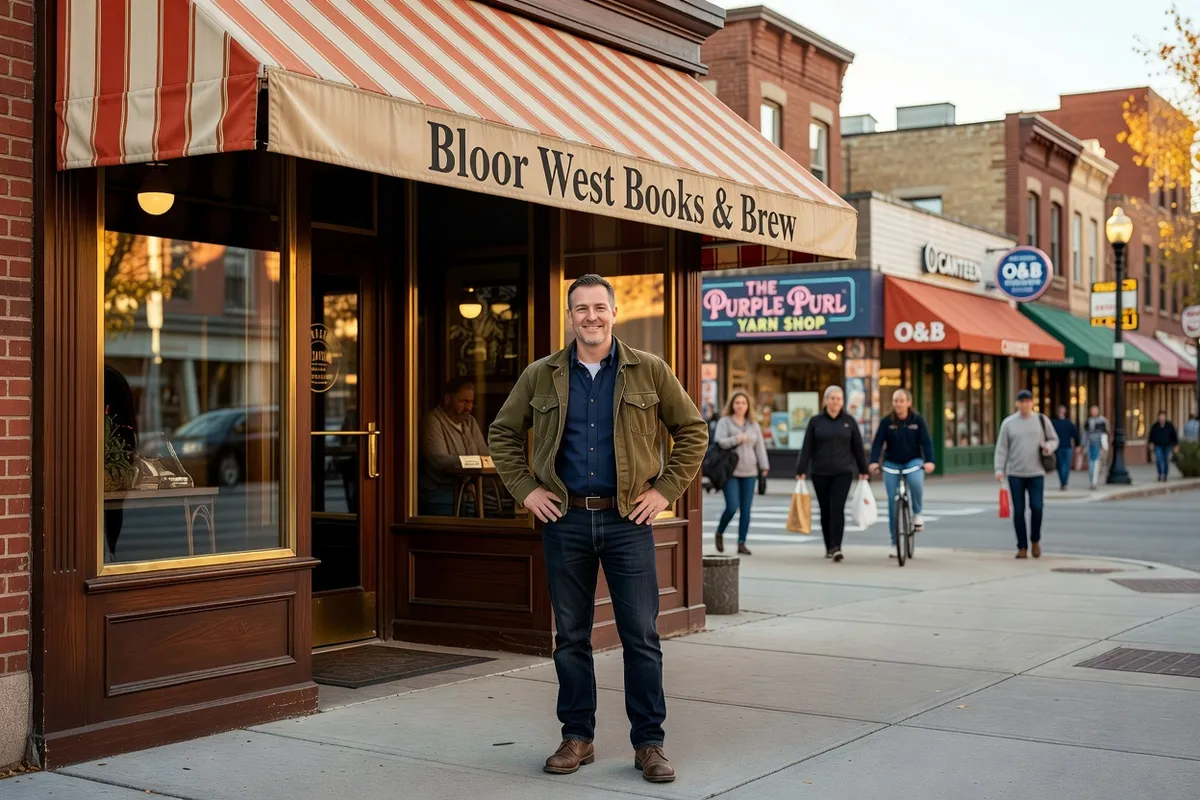
Ukrainian Canadian small business owner standing in front of a storefront in Bloor West Village Toronto.
Table of Contents
- A Century of Ukrainian Canadian Enterprise
- The Cooperative Roots: Prairie Grain and Farm Economies
- Credit Unions as the Financial Backbone
- Bloor West Village and the Rise of Urban Commercial Ukraine
- Sectors Where Ukrainian Canadian Businesses Concentrate
- Family Business and Multigenerational Succession
- Post-2022 Newcomer Entrepreneurship
- Comparing Financing Paths for New Ukrainian Canadian Founders
- Support Programs and Resources for New Founders
- Challenges Facing Ukrainian Canadian Business Owners Today
- Measuring Community Economic Impact
- An Unbroken Entrepreneurial Thread
- Frequently Asked Questions
A Century of Ukrainian Canadian Enterprise
Business ownership runs through the entire history of Ukrainian settlement in Canada, though its shape has changed dramatically with each successive wave of arrivals. The earliest Prairie homesteaders built cooperative farm economies out of necessity, pooling resources to survive a landscape and climate that offered no shortage of both opportunity and hardship. Their descendants, alongside the postwar Displaced Persons who settled overwhelmingly in cities, built the commercial storefronts, professional practices, and service businesses that gave neighbourhoods such as Bloor West Village their distinct character. Today, a newer generation of entrepreneurs, many of them recent arrivals since Russia's full-scale invasion of Ukraine in 2022, are adding a fresh chapter to this history, launching everything from consulting practices to specialty food businesses to technology startups. Not every skilled newcomer can pursue self-employment right away: professionals such as physicians and nurses face a distinct regulatory barrier explored in our article on Ukrainian-Canadian healthcare workers and the credential-recognition challenge.
This entrepreneurial continuity is not simply a matter of individual ambition, though ambition certainly plays a role. It reflects a set of institutions, most notably cooperative credit unions and mutual aid societies, that Ukrainian Canadians built specifically to support economic self-sufficiency when mainstream Canadian financial and social institutions were slow to extend the same support to a community still establishing itself.
The Cooperative Roots: Prairie Grain and Farm Economies
The first substantial wave of Ukrainian Canadian entrepreneurship was agricultural and cooperative in character, born out of the practical demands of homesteading the Prairie bloc settlements of Alberta, Saskatchewan, and Manitoba. Grain-growing cooperatives, farm equipment sharing arrangements, and community granaries allowed settlers with limited individual capital to compete effectively within a market dominated by larger, better-capitalized operations. These early cooperative structures also gave rise to mutual aid and burial societies, which functioned as an informal insurance system in the absence of readily available commercial alternatives.
Beyond farming itself, the earliest generation of Ukrainian Canadian business owners included general store proprietors serving bloc settlement communities, blacksmiths, and small-scale millers, businesses that grew directly out of local demand within a settlement pattern too dispersed and too new to attract established Canadian commercial chains. These modest enterprises formed the first layer of a Ukrainian Canadian business tradition that would, over the following decades, migrate from rural service provision toward urban commercial development as the community itself urbanized.
Row of Ukrainian-owned storefronts and delicatessens on a Toronto commercial street.
Credit Unions as the Financial Backbone
No institution did more to enable Ukrainian Canadian business formation than the community's own credit union movement. Mainstream Canadian banks in the early and mid-20th century were frequently reluctant to extend credit to newly arrived immigrant families with limited collateral, no established Canadian credit history, and, in some periods, outright discriminatory lending attitudes toward Eastern European newcomers. Ukrainian Canadian credit unions, built on cooperative principles that pooled community deposits and extended loans back to community members, filled this gap directly.
These institutions financed a significant share of the earliest Ukrainian Canadian small businesses, from the first delicatessens and bakeries in Winnipeg's North End to professional offices opened by Displaced Persons who had been credentialed professionals in Europe but arrived in Canada with no financial track record whatsoever. The full story of these institutions, their founding, their expansion, and their role in the community today, is covered in detail in our guide to Ukrainian Canadian credit unions and community financial institutions; the short version for our purposes here is that without this cooperative lending infrastructure, a great deal of Ukrainian Canadian business history simply would not have happened on the same timeline, or at the same scale.
Bloor West Village and the Rise of Urban Commercial Ukraine
Toronto's Bloor West Village stands as the clearest physical expression of Ukrainian Canadian commercial development. Its transformation into a recognizably Ukrainian commercial strip began in earnest with the arrival of the second wave of Ukrainian Displaced Persons who arrived in Canada between 1947 and 1954, whose disproportionately urban, educated, and professionally credentialed profile produced a wave of business formation that a purely rural settlement pattern could never have generated. Delicatessens selling Ukrainian sausage and baked goods, travel agencies organizing trips and remittances to relatives still in Soviet-controlled Ukraine, bookstores stocking Ukrainian-language literature, and professional offices for engineers, accountants, and lawyers barred from immediately practising their European credentials all clustered along the strip through the 1950s and 1960s.
This commercial concentration proved self-reinforcing. As more Ukrainian-owned businesses opened, the neighbourhood attracted more Ukrainian Canadian residents and shoppers from across the Greater Toronto Area, which in turn supported further business formation. The pattern is documented further in our overview of Ukrainian neighbourhoods in Toronto, but the essential business history point is this: Bloor West Village is not simply a residential neighbourhood with some Ukrainian shops, it is a deliberately built commercial ecosystem whose founders were, in a very direct sense, entrepreneurs solving the practical problem of an underserved market of newly arrived compatriots.
Sectors Where Ukrainian Canadian Businesses Concentrate
Across more than a century, Ukrainian Canadian business ownership has clustered in a recognizable, if evolving, set of sectors. The table below summarizes the broad pattern, moving from the historically dominant sectors toward those growing fastest among the newest generation of business owners.
| Sector | Historical Period of Concentration | Current Status |
|---|---|---|
| Agriculture and farm cooperatives | 1890s–1950s | Reduced but still present in Prairie communities |
| Food retail, delicatessens, bakeries | 1940s–present | Stable, especially in established neighbourhoods like Bloor West Village |
| Professional services (legal, accounting, engineering) | 1950s–present | Steady growth, particularly among second- and third-generation professionals |
| Construction and skilled trades | 1950s–present | Strong and consistent across generations |
| Travel and remittance services | 1950s–2000s | Declining as digital alternatives have replaced traditional travel agency models |
| Technology, consulting, and creative services | 2010s–present | Fastest-growing category, especially among post-2022 newcomer founders |
The rise of the technology and consulting sector is particularly notable and connects directly to the broader trend covered in our discussion of Ukrainian Canadian tech professional associations and networking communities, where many newcomer tech workers eventually transition from salaried roles into independent consulting or founding their own small firms once they have built sufficient Canadian professional experience and a local client network.
Family Business and Multigenerational Succession
A recurring pattern within Ukrainian Canadian entrepreneurship is multigenerational family ownership, particularly within the food retail and professional services sectors concentrated in established neighbourhoods. It is not unusual to find a Bloor West Village business now in its second or third generation of family ownership, with children or grandchildren of the original Displaced Persons founder having taken over daily operations while maintaining the original business name and community reputation built over decades.
Succession within these family businesses carries genuine challenges familiar to small business owners generally, but with an added cultural dimension: younger generations sometimes weigh continuing a legacy business against pursuing careers outside the family trade entirely, a tension that community elders and business associations have increasingly begun addressing through informal mentorship, aimed at helping younger family members either successfully take over an existing enterprise or launch a new one that still honours the family's entrepreneurial tradition.

Newcomer entrepreneur working at a small business counter with handmade Ukrainian craft products displayed.
Post-2022 Newcomer Entrepreneurship
The arrival of large numbers of Ukrainians under the Canada-Ukraine Authorization for Emergency Travel programme since 2022 has introduced a genuinely new cohort of entrepreneurs to the Canadian landscape, distinct in character from earlier waves. Many CUAET arrivals bring professional or entrepreneurial experience from a considerably more digitized, internationally connected Ukrainian economy than earlier immigrant generations encountered, and a meaningful share have chosen self-employment or small business formation relatively quickly after arrival, whether by necessity, given the practical challenges of credential recognition in regulated professions, or by genuine entrepreneurial ambition.
Where Newcomer Businesses Are Concentrating
1. Digital and remote-friendly services. Consulting, design, translation, and other services that do not require immediate Canadian credential recognition are a common early entry point.
2. Specialty food and retail. New Ukrainian bakeries, cafes, and specialty grocers have opened in cities beyond the traditionally established Ukrainian neighbourhoods, reflecting the broader geographic distribution of post-2022 arrivals covered in our overview of Ukrainian refugees and newcomers in Canada.
3. Technology and startups. A smaller but visible cohort has launched technology startups, drawing on Ukraine's strong pre-war IT sector reputation and connections built through professional networking communities.
Comparing Financing Paths for New Ukrainian Canadian Founders
Newcomer founders typically weigh several financing paths in the earliest stage of launching a business, each with distinct advantages and requirements.
| Financing Path | Typical Requirement | Best Suited For |
|---|---|---|
| Credit union small-business loan | Community ties, modest credit history | Founders with limited Canadian credit history |
| Mainstream bank business loan | Established Canadian credit history | Founders with prior Canadian financial track record |
| Personal savings / self-financing | Available capital, no external approval | Small-scale service or consulting launches |
| Family or community lending | Personal relationships, informal terms | Very early-stage or trial ventures |
| Government newcomer business grants | Eligibility criteria, application process | Founders meeting specific newcomer/immigrant program criteria |
Support Programs and Resources for New Founders
Support for Ukrainian newcomer entrepreneurs in Canada tends to come from two overlapping sources rather than a single dedicated national program. General newcomer and immigrant small-business support programs, typically operated by municipal economic development offices or settlement service agencies, provide baseline guidance on business registration, licensing, and basic financial literacy applicable to any newcomer founder regardless of country of origin. Layered on top of this general infrastructure, informal mentorship and referral networks within the established Ukrainian Canadian business community, often connected through the same organizations documented in our overview of the community's broader institutional life in Canada today, provide more targeted advice specific to the Ukrainian Canadian market and customer base.
- Municipal small business enterprise centres offering free consultations and licensing guidance
- Settlement agency employment and entrepreneurship counselling for newcomers
- Informal mentorship from established Ukrainian Canadian business owners, often arranged through community and professional networks
- Credit union small-business lending products, where an applicant's community ties can sometimes substitute in part for a limited Canadian credit history
Challenges Facing Ukrainian Canadian Business Owners Today
Despite this supportive infrastructure, real challenges persist for both established and newcomer Ukrainian Canadian business owners. Rising commercial rents in established neighbourhoods such as Bloor West Village put pressure on legacy family businesses operating on thin margins. Newcomer founders continue to face the familiar barrier of building a Canadian credit history and business track record from scratch. And across the board, the same succession challenge noted earlier, whether the next generation wants to continue a family enterprise, remains an open question for a meaningful share of legacy Ukrainian Canadian businesses.
Common Missteps for New Ukrainian Canadian Founders
- Underestimating licensing timelines. Provincial and municipal licensing, particularly for food service businesses, can take considerably longer than founders coming from Ukraine's business environment might expect.
- Overlooking cooperative financing options. Newcomers unfamiliar with the Canadian credit union model sometimes default to higher-cost commercial lending without exploring community-based alternatives first.
- Underinvesting in local networking. A strong product or service alone rarely substitutes for the relationship-building that drives early customer acquisition within a new market.
Measuring Community Economic Impact
Quantifying the precise economic footprint of Ukrainian Canadian-owned businesses nationally is genuinely difficult, since Statistics Canada does not consistently track business ownership by specific ethnic origin the way it tracks some other demographic variables, and self-identification in business registration data is inconsistent at best. What can be said with confidence, drawing on the qualitative and sector-level patterns documented above, is that Ukrainian Canadian entrepreneurship has produced durable, multigenerational commercial institutions concentrated in a handful of Canadian cities, and that this concentration has, in turn, reinforced those cities' broader reputations as centres of Ukrainian Canadian community life. Bloor West Village's commercial vibrancy, for instance, functions as both an economic and a cultural anchor simultaneously, drawing visitors and customers well beyond the immediate Ukrainian Canadian community and contributing to the neighbourhood's broader property values and civic profile within Toronto.
For researchers and journalists seeking harder data, the most reliable available proxies tend to be business directory counts maintained by community organizations, membership rolls of Ukrainian Canadian chambers of commerce or trade bodies where they exist, and targeted surveys occasionally conducted by academic researchers studying immigrant entrepreneurship in Canada more broadly, rather than a single authoritative national dataset specific to this community.
An Unbroken Entrepreneurial Thread
From the cooperative grain economies of the earliest Prairie settlers to the storefronts of Bloor West Village to the newest technology startups founded by post-2022 arrivals, Ukrainian Canadian entrepreneurship has consistently reinvented itself while relying on a remarkably stable set of underlying institutions: cooperative financing, community mentorship, and dense local networks that lower the barriers facing each new generation of founders. For today's newcomer entrepreneurs, that century of accumulated institutional knowledge, and the community willing to share it, remains one of the most practical assets available as they build their own businesses in Canada.
What stands out most across this history is how consistently the community has responded to gaps in mainstream institutional support by building its own parallel infrastructure, cooperative credit, mutual aid, mentorship networks, rather than waiting for external systems to adapt. That pattern, repeated across more than a century and multiple distinct waves of arrival, offers a genuinely instructive model for any newcomer community navigating the practical challenges of building an economic foothold in a new country.
Frequently Asked Questions
What sectors have Ukrainian Canadian businesses traditionally concentrated in?
Historically, agriculture and agricultural cooperatives on the Prairies, followed by food retail and delicatessens, travel agencies, professional services, and construction trades in urban centres such as Toronto and Winnipeg. Since 2022, newcomer-founded businesses span a wider range, including tech services, consulting, and creative industries.
What role did credit unions play in Ukrainian Canadian business development?
Ukrainian Canadian credit unions provided crucial early-stage lending to community members who faced barriers accessing mainstream Canadian banks, particularly in the early and mid-20th century, functioning as a cooperative financial backbone for small business formation.
How did Bloor West Village become a Ukrainian commercial hub?
Bloor West Village's Ukrainian commercial character developed primarily from the late 1940s onward, as second-wave Displaced Persons and their descendants opened delicatessens, bakeries, travel agencies, and professional offices along the strip, a concentration that intensified over subsequent decades.
Are there support programs specifically for Ukrainian newcomer entrepreneurs in Canada?
Support tends to come through a combination of general newcomer small-business programs offered by settlement agencies and economic development organizations, alongside informal mentorship and referral networks within the established Ukrainian Canadian business community.
What challenges do Ukrainian newcomer entrepreneurs face in Canada?
Common challenges include accessing startup capital without an established Canadian credit history, navigating provincial and municipal licensing requirements, and building a customer base without pre-existing local business relationships, though community networks can meaningfully offset some of these barriers.