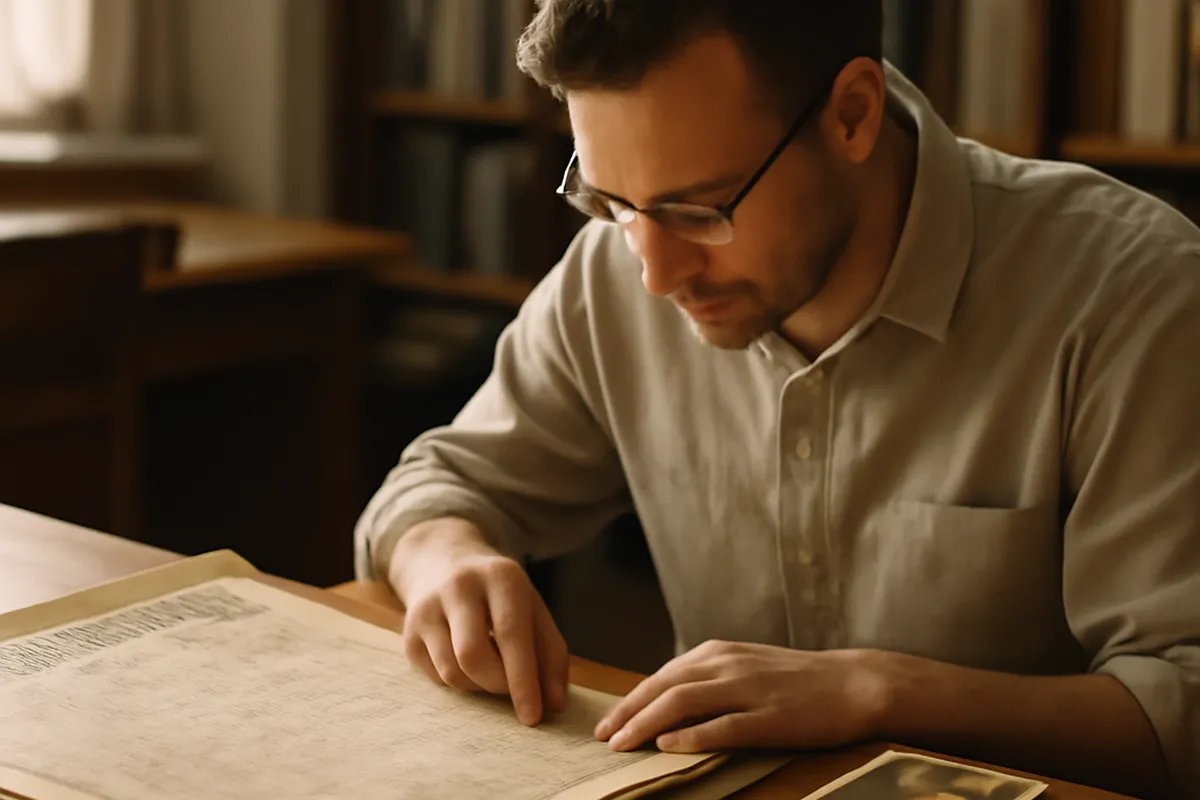
Researcher examining old immigration ship manifests and family photographs at an archive table.

Dr. Sofiya Melnychuk, genealogical researcher and archivist specializing in Ukrainian-Canadian immigration records.
Dr. Sofiya Melnychuk
Genealogical Researcher and Archivist specializing in Ukrainian-Canadian immigration records. PhD in Archival Studies. Fifteen years helping families trace ancestry through Pier 21 manifests, homestead records, and parish registers from Galicia and Bukovyna. Frequent speaker at Ukrainian Canadian heritage societies.
Winnipeg, Manitoba, Canada
Table of Contents
- Q1: Where should someone start tracing Ukrainian Canadian ancestry?
- Q2: What are Pier 21 records and how do you access them?
- Q3: How do homestead records work for Prairie settler families?
- Q4: What if a family's village no longer exists or changed names?
- Q5: How reliable are ship manifests and passenger lists?
- Q6: What role do parish and church records play?
- Q7: What's different about researching second-wave DP families?
- Q8: What's the most common mistake beginner researchers make?
- Q9: What advice would you give someone just starting out today?
- Research Checklist: Six Steps to Start This Week
- Frequently Asked Questions
Q1: Where should someone start tracing Ukrainian Canadian ancestry?
Q: A lot of people want to research their Ukrainian Canadian family history but don't know where to even begin. What's the first move?
A: Start at home, not in an archive. Before anyone opens a single database, I ask them to sit down with whatever living relatives they have — parents, grandparents, elderly aunts and uncles — and simply ask: what village did our family come from, what year did they arrive, what was the original spelling of the surname before it was anglicized. That last one matters enormously, because Ukrainian surnames were routinely altered at the port of entry or by schoolteachers who couldn't pronounce them. I've had clients spend months searching for "Wowk" who eventually discovered the original was "Vovk." Once you have even a rough village name, an approximate arrival decade, and the original surname spelling, the archival research becomes dramatically more efficient. Skipping this step and going straight to a database search is the single biggest waste of time I see.
Q2: What are Pier 21 records and how do you access them?
Q: Everyone mentions Pier 21. What exactly is in those records, and how does someone actually access them?
A: Pier 21 in Halifax was Canada's principal Atlantic port of entry from 1928 through 1971, and it processed an enormous share of arrivals, including a large portion of the second-wave Ukrainian Displaced Persons who arrived between 1947 and 1954. The Canadian Museum of Immigration at Pier 21, working alongside Library and Archives Canada, maintains searchable passenger arrival records. What you'll typically find is the ship name, the date of arrival, the port of departure in Europe, and sometimes the sponsoring individual or organization in Canada. For DP-era arrivals specifically, records may also reference the labour contract category under the postwar Order-in-Council programme.
Access is largely free through the Library and Archives Canada online catalogue, though some original documents require an in-person or mail request. I always tell people to be patient with search variations, because names were transcribed by hand from often difficult handwriting, so a search for the "correct" spelling can miss a record filed under a phonetic misspelling.
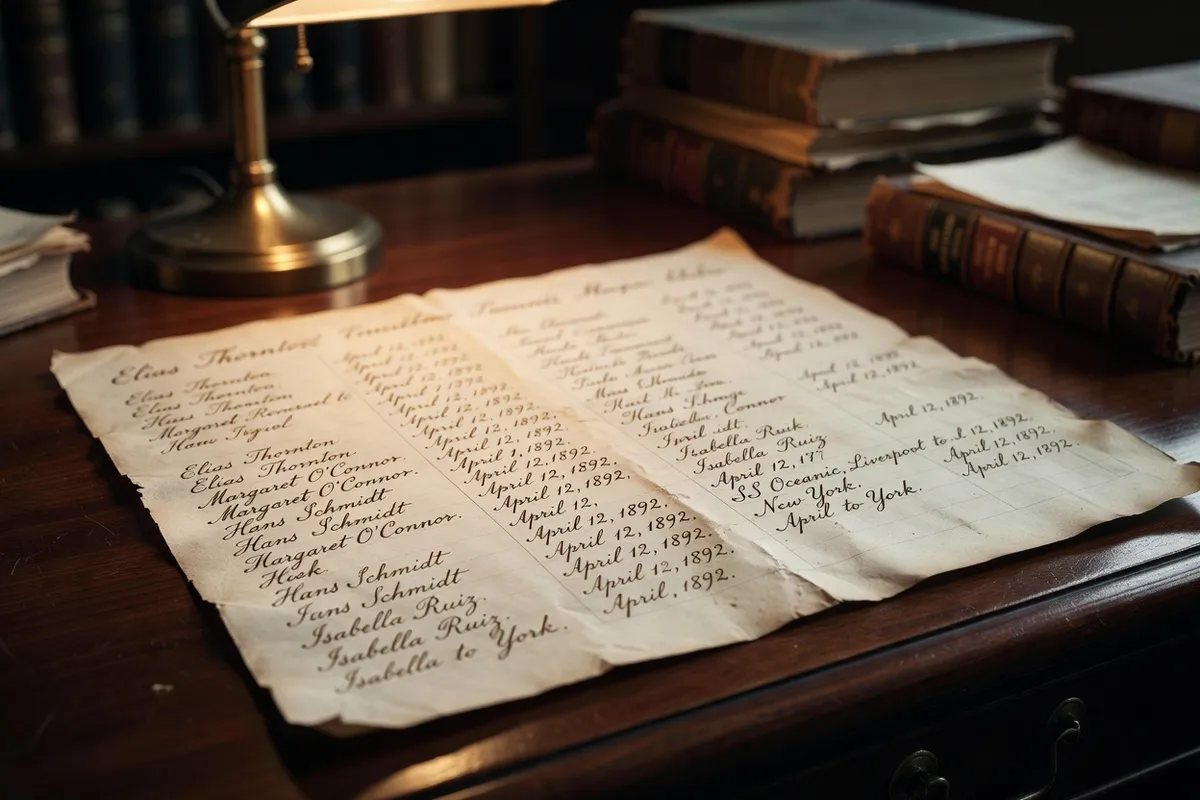
Close-up of a historical ship passenger manifest document with handwritten Ukrainian surnames.
Q3: How do homestead records work for Prairie settler families?
Q: For families descended from the earlier Prairie settlers, is there a paper trail for the actual land they farmed?
A: Almost always, yes, and this is one of the richest record types for first-wave families tied to Ukrainian Prairie settlement in Alberta and Saskatchewan. Under the Dominion Lands Act, a settler filed a homestead application at a local land office, and that file typically survives in provincial archives today. It usually includes the applicant's name, country and district of origin, the legal land description — township, range, and section — and sometimes correspondence about proving up the claim, meaning demonstrating the required years of cultivation and residence before the title was granted.
Alberta, Saskatchewan, and Manitoba each maintain these homestead files through their provincial archival services, and increasingly they are digitized and searchable by surname. Finding your ancestor's original quarter-section is, for a lot of clients, the single most emotionally powerful moment of the whole research process. Some families have gone on to visit the actual land, which in many cases is still farmed today, sometimes by a Ukrainian Canadian family unrelated to the original homesteader but aware of that history.
Q4: What if a family's village no longer exists or changed names?
Q: This seems like it would be a huge obstacle. What do you do when the village name from a hundred years ago doesn't match anything on a modern map?
A: It's extremely common, and it's not actually an obstacle once you know the trick. Villages in Galicia and Bukovyna, the two regions that sent the overwhelming majority of first-wave immigrants, sat under Austro-Hungarian administration before 1918, then Polish or Romanian administration in the interwar period, then Soviet Ukrainian administration after 1939 or 1945, and are now, of course, in independent Ukraine. Each administrative change could bring a name change, a spelling change, or a border redraw. A village recorded on a Canadian immigration document as "Zolota Slobidka" under one transliteration might appear on a modern map under a slightly different spelling, or might have been absorbed into a neighbouring village.
The tool I rely on most is a set of historical gazetteers cross-referenced against pre-1939 Austro-Hungarian administrative maps, which let you triangulate an old name to its modern equivalent through the surrounding district and nearest larger town, which tends to be more stable than small village names. It takes patience, but I have never had a case where the village simply could not be located with enough cross-referencing.
Q5: How reliable are ship manifests and passenger lists?
Q: Can people actually trust what's written on these old manifests?
A: Reasonably reliable for the big facts — name, approximate age, ship, and date — but treat every other detail with healthy skepticism. Ages were frequently rounded or simply guessed by an overworked immigration clerk. Occupations were sometimes recorded generically as "labourer" regardless of the person's actual trade, because that's what fit the immigration category being processed. And, as I mentioned, surname spelling is often phonetic rather than accurate. I tell clients to treat the manifest as a strong anchor point — proof that this person was on this ship on this date — rather than as a fully trustworthy biographical record. Corroborate the details against other sources: census records, church records, and family memory.
Q6: What role do parish and church records play?
Q: Where do church records fit into all this?
A: Parish records are often the deepest and most personal layer of the research, both in the country of origin and in Canada. Ukrainian Catholic and Ukrainian Orthodox parishes on both sides of the Atlantic kept detailed baptism, marriage, and burial registers, frequently going back generations further than any government record. In Canada, many parish archives are held by the respective eparchies rather than by the individual church, so tracking down the right diocesan archive is a necessary step. In the old country, parish registers from Galicia and Bukovyna survive to varying degrees, some destroyed by war, some preserved in regional Ukrainian or Polish state archives, and increasingly some digitized by volunteer genealogical projects.
These records are usually written in Ukrainian, Polish, Latin, or German depending on the empire, period, and denomination, so translation help is genuinely worth the investment for anyone serious about pushing the research back before the immigration generation.
Q7: What's different about researching second-wave DP families?
Q: Does the research process change for families who arrived later, as postwar Displaced Persons rather than early homesteaders?
A: Yes, meaningfully. Second-wave families have an additional, very rich record layer that first-wave families don't: the Displaced Persons camp records themselves, administered first by UNRRA and then the International Refugee Organization between 1945 and the early 1950s. These camp registration files can include prewar residence, family composition, and sometimes wartime displacement details that are extraordinarily valuable and often more complete than what survives for earlier arrivals. The trade-off is that many DP-era descendants are researching more recent, sometimes more painful history — forced labour, wartime displacement, family separation — and the emotional weight of that research is different from tracing a homesteading great-great-grandparent. I always encourage people to go into DP-era research prepared for that, and to lean on the broader Ukrainian Canadian community for support if difficult material surfaces.
Q8: What's the most common mistake beginner researchers make?
Q: If you could stop people from making one mistake, what would it be?
A: Trusting a single online family tree without verifying it against a primary source. Genealogy platforms have made research far more accessible, which is genuinely wonderful, but they've also made it very easy to copy an unverified detail from someone else's tree and treat it as established fact. I've traced errors that propagated across dozens of family trees online, all citing each other rather than an original document. My rule is simple: every fact should trace back to something you can actually point to — a manifest, a homestead file, a parish register — not just another person's tree.
A closely related mistake is giving up too quickly when a name doesn't match on the first search attempt. I've had clients declare a research dead end after one unsuccessful database search, when in reality the record exists under a slightly different transliteration, a clerical error, or an entirely different archive than the one first tried. Genealogical research, especially for a community with as much administrative border-crossing as Ukrainian Canadians, rewards persistence and creative searching, trying alternate spellings, searching by approximate age range instead of an exact birth year, checking neighbouring villages, over a single precise query that assumes the record was transcribed perfectly the first time.
Q9: What advice would you give someone just starting out today?
Q: If someone reading this wants to begin tonight, what's the realistic first evening of work?
A: Realistically, spend the first evening simply writing down everything you already know, even fragments, even things you're not sure are accurate. Names, approximate years, a village that might be misremembered, a family story about why someone left. Don't worry about verifying any of it yet; just get it out of your head and onto paper or into a document. Then call the oldest living relative you have access to and ask them the same questions, recording the conversation if they're comfortable with that. That single evening of work, done properly, will save you weeks of unfocused archive searching later, because you'll know exactly what to look for instead of starting from nothing.
Research Checklist: Six Steps to Start This Week
| Step | Action |
|---|---|
| 1 | Interview living relatives for names, approximate dates, and original surname spelling |
| 2 | Search Library and Archives Canada's immigration and Pier 21 passenger records |
| 3 | Check provincial land title archives for homestead files (Alberta, Saskatchewan, Manitoba) |
| 4 | Locate the correct eparchy or diocesan archive for parish baptism/marriage records |
| 5 | Cross-reference old village names against historical gazetteers and pre-1939 maps |
| 6 | Verify every detail against a primary source before adding it to a family tree |
Three Key Takeaways
1. Start with living memory, not databases. A rough village name, arrival decade, and original surname spelling from a living relative makes every subsequent archival search dramatically more efficient.
2. Different waves leave different paper trails. First-wave homesteaders left rich provincial land records; second-wave Displaced Persons left rich camp registration files. Know which applies to your family.
3. Verify against primary sources. Manifests, homestead files, and parish registers are the anchor points; treat details copied from other people's family trees with healthy skepticism until confirmed.
Frequently Asked Questions
Where do I start researching Ukrainian Canadian ancestry?
Start at home: collect names, approximate birth years, and any village names from living relatives before turning to archives. Then move to Library and Archives Canada's immigration and passenger records, which cover most Ukrainian arrivals from the 1890s onward.
What are Pier 21 records and how do I access them?
Pier 21 in Halifax processed hundreds of thousands of immigrants, including many second-wave Ukrainian Displaced Persons after 1947. The Canadian Museum of Immigration at Pier 21 and Library and Archives Canada jointly maintain searchable passenger arrival records that can confirm ship name, arrival date, and port of departure.
Can I find my ancestor's original Prairie homestead?
Yes, in most cases. Provincial land title archives in Alberta, Saskatchewan, and Manitoba retain homestead application files, which typically include the applicant's name, place of origin, and legal land description, and are searchable through each province's archival services.
What if my family's village no longer exists or changed names?
This is common, especially for villages in Galicia and Bukovyna that changed names or borders after Soviet annexation and later Ukrainian independence. Historical gazetteers and pre-1939 Austro-Hungarian administrative maps can help cross-reference an old village name to its modern equivalent.
Do I need to speak Ukrainian or Polish to do this research?
It helps but is not strictly necessary for the Canadian side of the research, since most immigration and homestead records are in English. Parish records from the country of origin are often in Ukrainian, Polish, Latin, or German depending on the empire and period, and translation help is worth seeking for that stage.