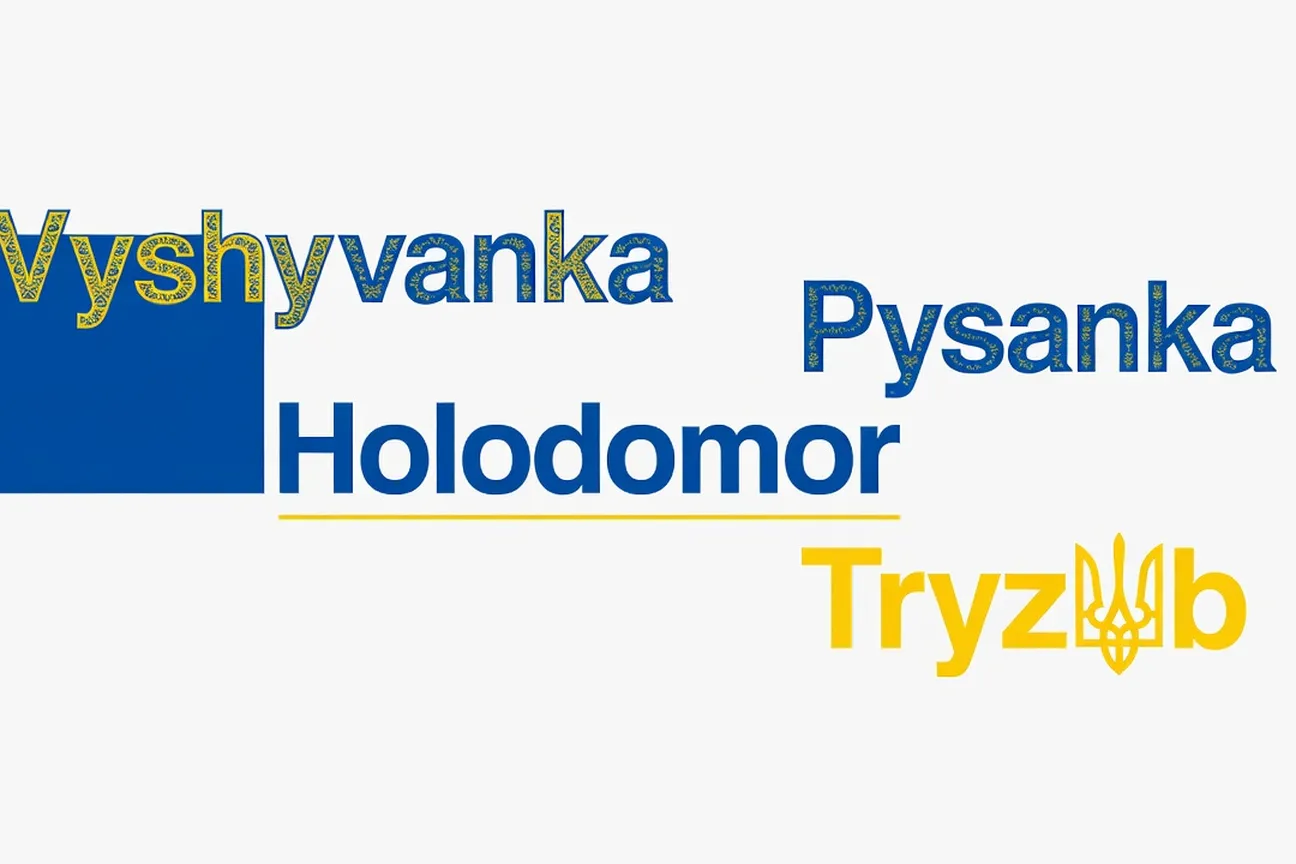
Typographic design featuring Ukrainian diaspora key terms — Vyshyvanka, Holodomor, Pysanka, Tryzub.
Table of Contents
Introduction
The vocabulary of Ukrainian-Canadian community life draws on several overlapping lexicons: Ukrainian language words that have been adopted into diaspora English usage; historical terms referring to specific events, policies, and periods; institutional abbreviations for organisations; and cultural terms referring to objects, customs, and traditions. Understanding this vocabulary is essential for anyone wishing to engage meaningfully with Ukrainian-Canadian identity and community life, whether as a new participant, an ally, or a researcher. The history of Ukraine provides indispensable context for many of the terms below.
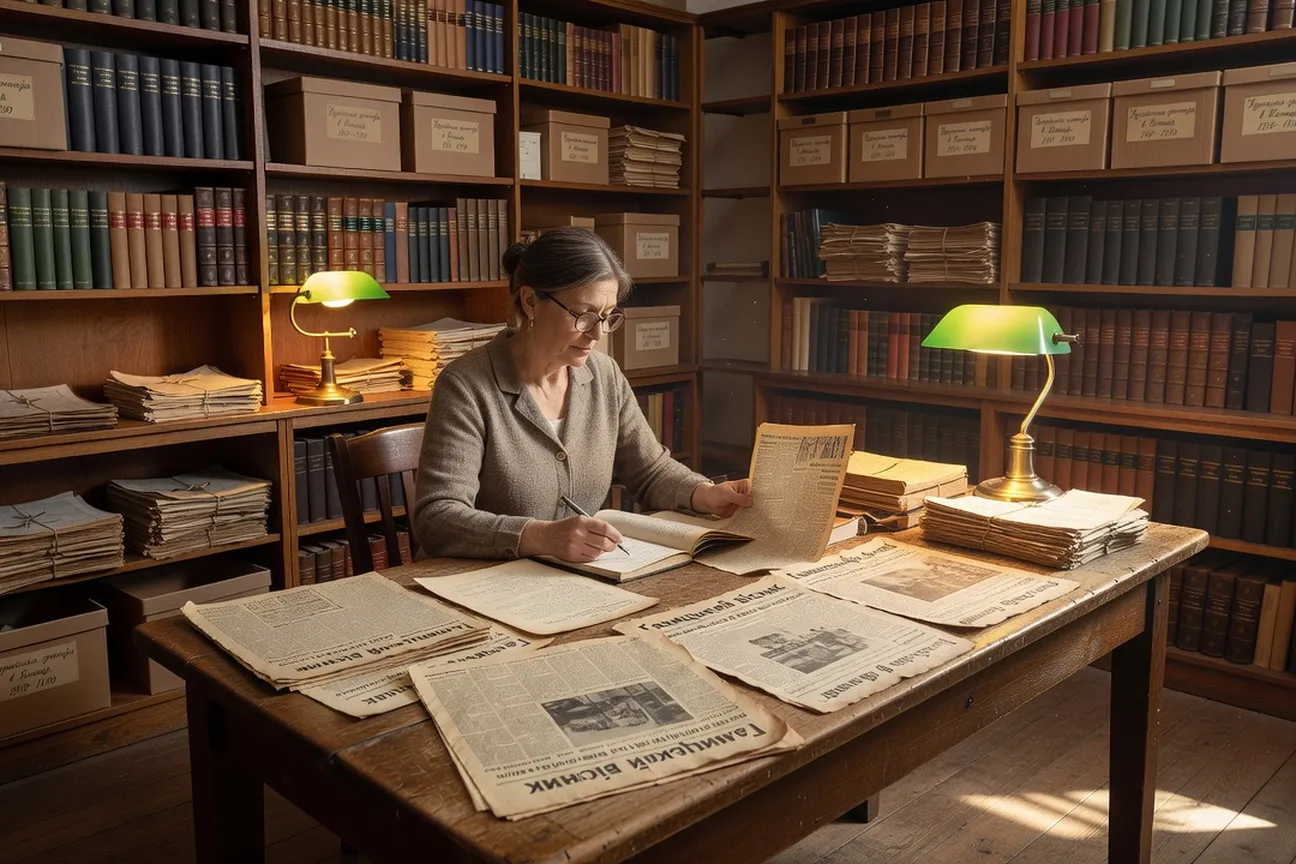
Ukrainian-Canadian historical archive room with researcher examining old Ukrainian-language newspapers.
A to E
Bandura (bahn-DOO-rah) — A Ukrainian national plucked-string instrument with 55–65 strings, combining features of the lute and psaltery. Historically associated with the kobzar tradition of wandering blind minstrels who performed epic ballads (dumy). In the Ukrainian-Canadian community, bandura ensembles and solo performers are a fixture of cultural concerts and community events. Bandura instruction is offered at several Ukrainian Saturday schools in Toronto, Edmonton, and Winnipeg.
Bloor West Village — The section of Bloor Street West between Runnymede Road and Jane Street in Toronto, historically known as "the Ukrainian Village." Ukrainian Catholic and Orthodox churches, cultural organisations, delis, and bakeries have been concentrated here since the 1950s, when post-WWII displaced persons settled in the adjacent Roncesvalles and Swansea neighbourhoods. Still a major cultural hub, though the community has partially dispersed to North York and suburban areas.
Bukovyna (boo-koh-VEE-nah) — Historical region of eastern Europe, partly in today's western Ukraine (Chernivtsi Oblast) and partly in Romania. Along with Galicia, it was a primary source of Ukrainian immigration to Canada during the first wave (1891–1914). Ukrainian immigrants from Bukovyna spoke a distinct dialect and had slightly different cultural practices from Galician immigrants, though both groups shared Greek Catholic (Uniate) religious affiliation.
CUAET — Canada-Ukraine Authorization for Emergency Travel. A special visa programme launched by the Canadian government in March 2022 following Russia's full-scale invasion of Ukraine. It allows Ukrainian nationals and their immediate family members to obtain temporary residency in Canada under expedited procedures, with authorization to work and study. Over 200,000 Ukrainians arrived in Canada under CUAET by early 2026, representing the largest single influx of Ukrainian immigrants in Canadian history.
Diaspora — From the Greek for "dispersion." In the Ukrainian-Canadian context, refers to the community of Ukrainians and their descendants living outside Ukraine, particularly those who maintain cultural, linguistic, religious, or political connections to the homeland. Canada's Ukrainian diaspora numbers approximately 1.36 million people (2021 census), making it the world's second-largest Ukrainian community outside Ukraine and Russia.
Displaced Persons (DPs) — Term applied to the approximately 85,000–100,000 Ukrainians who arrived in Canada between 1947 and 1955 as refugees from Soviet-occupied western Ukraine following WWII. DPs were typically more educated and more politically nationalist than the earlier prairie settlers, and they revitalised Ukrainian-Canadian cultural institutions, establishing Ukrainian studies programmes, literary societies, and professional organisations.
Dumy (DOO-mih) — Plural of "duma." Traditional Ukrainian epic ballads historically performed by wandering blind kobzar musicians accompanying themselves on the bandura or kobza. Dumy address themes of Cossack heroism, captivity by Ottoman forces, and Ukrainian national identity. The duma tradition was nearly destroyed under Soviet rule; it has been partly revived in Canada through cultural preservation efforts.
Enemy Alien Act — Popular shorthand for the War Measures Act (1914) provisions that classified Ukrainian Canadians from Austro-Hungarian territories as "enemy aliens" during World War I. Under these provisions, approximately 8,579 Ukrainians were interned in 24 camps across Canada between 1914 and 1920, and thousands more were forced to report regularly to police. The Canadian government issued a formal apology and redress in 2005.
F to L
Galicia (gah-LEE-tsee-yah) — Historical region of central Europe, today comprising south-eastern Poland and western Ukraine (particularly Lviv, Ternopil, and Ivano-Frankivsk oblasts). Galicia was the primary source of Ukrainian immigration to Canada during the first wave (1891–1914). The name "Galician" was widely used (often pejoratively) to describe early Ukrainian settlers on the Canadian Prairies.
Greek Catholic Church (also Ukrainian Catholic Church) — A Christian church in communion with Rome but following the Byzantine Rite of liturgy in Church Slavonic and Ukrainian. Established by the Union of Brest (1596), it was the dominant church of Galician and Bukovynian Ukrainians and thus of the first-wave Canadian immigrants. Today known as the Ukrainian Catholic Church in Canada, it remains one of the two major Ukrainian religious denominations alongside the Ukrainian Orthodox Church.
Holodomor (hoh-loh-doh-MOR) — From Ukrainian: "death by hunger." The Soviet-engineered famine of 1932–33 in Soviet Ukraine, caused by Stalin's forced collectivisation policies and deliberate grain confiscation. Estimated to have killed 5–7 million Ukrainians. Canada officially recognised the Holodomor as genocide in 2008 following decades of advocacy by Ukrainian-Canadian organisations. The fourth Saturday of November is observed as Holodomor Remembrance Day across Canada.
Hopak (HO-pahk) — The most famous Ukrainian folk dance, originating in the Zaporozhian Cossack tradition. Characterised by acrobatic leaps, squatting kicks, and energetic footwork by male dancers, complemented by graceful turning movements by female performers. The hopak is a centrepiece of Ukrainian cultural festivals in Canada and is taught at Ukrainian dance schools across the country.
Hutsul (HOOT-sool) — A Ukrainian ethnographic subgroup from the Carpathian highlands (Hutsulshchyna), known for distinctive folk art, woodcarving, embroidery, and music. Hutsul immigrants were among the first-wave settlers in Canada, particularly in Manitoba's Interlake district. Hutsul cultural elements — including the trembita (wooden alpine horn) and distinctive geometric embroidery patterns — are preserved in Ukrainian-Canadian folk art collections.
Internment Operations — The systematic detention of Ukrainian Canadians as "enemy aliens" during World War I (1914–1920). Some 8,579 Ukrainians were held in 24 internment camps across Canada, including Spirit Lake (Quebec), Banff (Alberta), and Kapuskasing (Ontario). Internees were used as forced labour to build infrastructure, including roads in Banff National Park. The 2005 Canadian Redress recognised this as a violation of civil rights.
Kobzar (KOB-zar) — A Ukrainian wandering minstrel who traditionally performed epic ballads (dumy) and historical songs while accompanying himself on the kobza or bandura. Kobzari were often blind men who occupied a special social role in Ukrainian society. The kobzar tradition was systematically destroyed during the Soviet period. The name is also associated with Taras Shevchenko's famous poetry collection Kobzar (1840), the foundational text of modern Ukrainian literature.
Kolomeika (koh-loh-MAY-kah) — A lively Ukrainian folk dance from the Hutsul region, performed in a circle or line with improvised steps. The kolomeika is one of the oldest Ukrainian folk dances and is frequently performed at Ukrainian cultural events in Canada alongside the hopak.
M to R
Maidan — Ukrainian word for "public square." Associated primarily with the Euromaidan revolution of 2013–14 (named after Maidan Nezalezhnosti, or Independence Square, in Kyiv), during which mass protests led to the ousting of President Viktor Yanukovych. The Euromaidan was a watershed event for Ukrainian-Canadian political activism, triggering increased engagement with events in Ukraine and accelerating immigration. The term has entered Ukrainian-Canadian political vocabulary as a symbol of democratic aspiration.
Multiculturalism Act (1988) — Canada's federal Multiculturalism Act, which enshrined cultural diversity and heritage preservation as policy principles of the Canadian state. Ukrainian-Canadian advocates were instrumental in shaping the policy framework during the Royal Commission on Bilingualism and Biculturalism (1963–69). The act has provided the legal basis for government funding of Ukrainian cultural organisations, heritage language programmes, and Ukrainian studies academic chairs.
Prosvita (proh-SVEE-tah) — Ukrainian word for "enlightenment." Refers to a network of Ukrainian reading associations and educational societies that spread across the Canadian Prairies from the early 1900s. Prosvita reading rooms served as cultural, educational, and political centres in Ukrainian bloc settlements, offering libraries, lectures, drama performances, and debate. Several Prosvita halls survive in Prairie communities and remain active as cultural centres.
Pysanka (PEE-sahn-kah) — A traditional Ukrainian decorated egg, created using a wax-resist batik technique similar to batik textile dyeing. Intricate geometric, floral, and symbolic patterns are applied with a stylus dipped in beeswax; the egg is then dyed in successive colour baths. Pysanky have deep roots in Ukrainian folk religion and symbolism. Pysanka-making is widely taught in Ukrainian Saturday schools and workshops across Canada, and the world's largest pysanka — 9.4 metres high — stands in Vegreville, Alberta.
Ridna Shkola (REED-nah SHKO-lah) — Ukrainian for "native school." Refers to the Ukrainian Saturday school system that has operated in Canada since the early 1900s, providing instruction in Ukrainian language, history, literature, and culture to children attending English-language public schools during the week. Approximately 60–70 ridna shkola programmes operate across Canada in 2026.
Rushnyky (singular: Rushnyk, roosh-NIK) — Traditional Ukrainian embroidered ritual cloths used in ceremonies including weddings, funerals, house blessings, and religious festivals. Rushnyky feature highly symbolic geometric and floral patterns that vary by region, and are among the most prized artefacts in Ukrainian-Canadian museum collections. The Ukrainian Museum of Canada holds one of the largest public collections of historical rushnyky outside Ukraine.
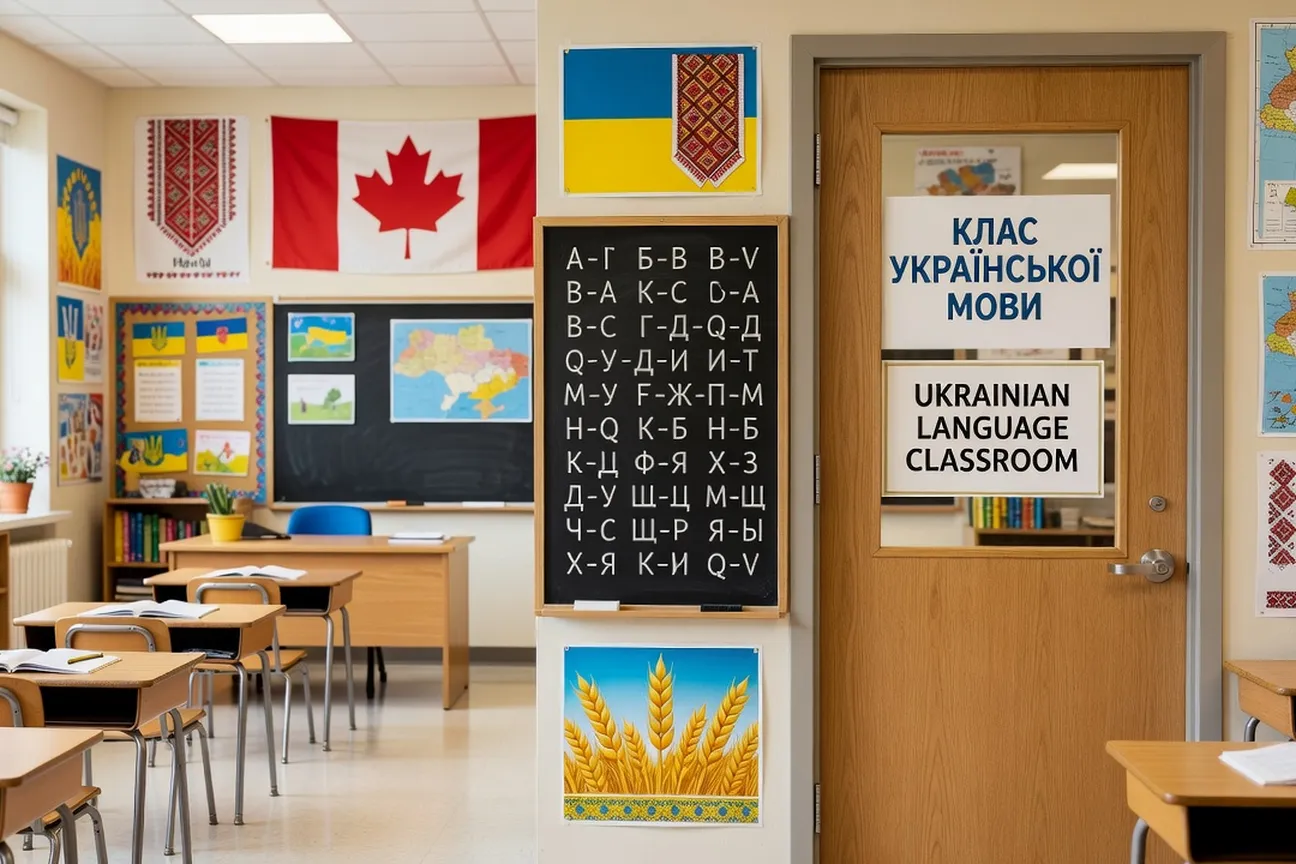
Ukrainian language classroom sign with Cyrillic alphabet, Canadian school setting.
S to Z
Sifton Policy — The immigration policy implemented by Clifford Sifton, Canadian Minister of the Interior (1896–1905), which actively recruited Ukrainian peasants from Galicia and Bukovyna to homestead on the Canadian Prairies. Sifton famously described his preferred immigrants as "stalwart peasants in sheepskin coats." The policy brought over 170,000 Ukrainians to Canada by 1914 and is the foundational event of Ukrainian-Canadian history.
Toloka (toh-LOH-kah) — Traditional Ukrainian form of collective voluntary labour in which community members assembled to help a neighbour complete a large task — building a house, harvesting a field, or raising a barn — typically in a single day. Toloka was central to the social organisation of pioneer Ukrainian settlements on the Prairies and created dense networks of mutual obligation that persisted for generations.
Trembita (trem-BEE-tah) — A traditional Ukrainian wooden alpine horn used in the Carpathian highlands, especially among Hutsul communities. Up to four metres in length, it produces a distinctive resonant sound used to signal across mountain valleys. Trembita performances are occasionally featured at Ukrainian cultural events in Canada, particularly those celebrating Hutsul heritage.
Tryzub / Trident (TREE-zoob) — The trident symbol that serves as Ukraine's national emblem and appears on the Ukrainian coat of arms and state seal. It derives from the dynastic symbol of Kievan Rus princes, particularly Prince Volodymyr the Great (980–1015). In the Ukrainian-Canadian community, the tryzub is a ubiquitous symbol on church steeples, organisational logos, and cultural materials, and has become globally recognised as a symbol of Ukrainian identity since 2022.
UCC — Abbreviation for the Ukrainian Canadian Congress, the national umbrella organisation of Ukrainian-Canadian civil society, founded in 1940.
UCCA — Ukrainian Canadian Civil Liberties Association. Advocacy organisation focused on civil rights issues affecting Ukrainian Canadians, particularly the WWI internment redress.
UCU — Ukrainian Credit Union. The primary Ukrainian-Canadian financial institution in Ontario, headquartered in Toronto, providing community-oriented banking services since 1944.
Vegreville Easter Egg — A 9.4-metre-tall pysanka sculpture located in Vegreville, Alberta, erected in 1975 to commemorate the centennial of Ukrainian settlement in the region and the 100th anniversary of the Royal Canadian Mounted Police. It is one of Canada's most recognisable roadside attractions and a symbol of Alberta's Ukrainian heritage.
Vyshyvanka (vee-shee-VAHN-kah) — A traditional Ukrainian embroidered shirt or blouse, featuring decorative needlework in patterns that vary by region, gender, and occasion. Vyshyvanky are worn at Ukrainian cultural events, festivals, and church services in Canada. Since 2022, wearing a vyshyvanka has become a widely recognised act of solidarity with Ukraine, extending well beyond the Ukrainian-Canadian community.
Volhynia (vol-HEE-nyah) — Historical region in north-western Ukraine (today's Volyn and Rivne oblasts), another major source of Ukrainian first-wave immigration to Canada alongside Galicia. Volhynian settlers were predominantly Greek Orthodox rather than Greek Catholic, contributing to the religious diversity of early Prairie Ukrainian communities.
War Measures Act — Canadian federal legislation (first enacted 1914) that granted the government sweeping powers during times of "war, invasion, or insurrection." Used to intern Ukrainian Canadians as "enemy aliens" during WWI (1914–1920). The act was invoked twice more in Canadian history: during WWII (1939) and the 1970 October Crisis. It was replaced by the Emergencies Act in 1988.
Welland Canal Corridor — Region in Ontario's Niagara Peninsula with a significant Ukrainian-Canadian population, linked to early 20th-century labour migration for canal construction and steel industry work. Less well-known than the Prairie heritage communities, the Welland corridor represents the urban-industrial dimension of early Ukrainian-Canadian settlement.
Zemlyanky (zem-LYAHN-kee) — Semi-subterranean sod dugout houses built by Ukrainian settlers on the Canadian Prairies during their first winters. Built by excavating a shallow pit and covering it with sod and wood, zemlyanky provided minimal but effective insulation against prairie winters while permanent log houses were constructed. References to zemlyanky appear frequently in oral histories and memoirs of pioneer Ukrainian-Canadian life.
Using This Glossary
The 40 terms above represent an entry point into the rich and layered vocabulary of Ukrainian-Canadian community life. Many terms not included here — particularly those relating to specific organisations, geographic regions, or artistic traditions — can be explored through the resources of the Ukrainian Museum of Canada, the Canadian Institute of Ukrainian Studies (CIUS) at the University of Alberta, and the Oseredok Cultural Centre in Winnipeg. For those new to Canada from Ukraine, this glossary provides context for understanding how diaspora communities have translated Ukrainian traditions into a Canadian setting over 130 years. For Canadian-born members of the heritage community, it offers a structured entry point into terminology that may be familiar as oral culture but unfamiliar in written form. And for all Canadians interested in the culture that 1.36 million fellow citizens call their heritage — welcome to this fascinating corner of Canadian multicultural life.
Frequently Asked Questions
What does 'diaspora' mean in the context of Ukrainian Canadians?
In the Ukrainian-Canadian context, 'diaspora' refers to the community of Ukrainians and their descendants living outside Ukraine, particularly those who maintain cultural, linguistic, religious, or political connections to their homeland. Canada's Ukrainian diaspora numbers 1.36 million people (2021 census), making it the world's second-largest Ukrainian community outside Ukraine and Russia.
What is the Holodomor?
The Holodomor ('death by hunger' in Ukrainian) was the Soviet-engineered famine of 1932–33 that killed an estimated 5–7 million Ukrainians. Canada officially recognised the Holodomor as genocide in 2008. The fourth Saturday of November is observed as Holodomor Remembrance Day across Canada.
What is CUAET?
The Canada-Ukraine Authorization for Emergency Travel (CUAET) is a special visa programme launched in March 2022 following Russia's full-scale invasion of Ukraine. It allows Ukrainian nationals and their immediate family members to obtain temporary residency in Canada under expedited procedures. Over 200,000 Ukrainians arrived in Canada under CUAET by early 2026.
What is a Tryzub (Trident)?
The Tryzub (Ukrainian trident) is the national symbol of Ukraine, appearing on its coat of arms. It derives from the dynastic symbol of Kievan Rus princes. In the Ukrainian-Canadian community, the tryzub is widely used on church steeples, logos, and cultural materials, and has become a globally recognised symbol of Ukrainian solidarity since 2022.
What is a Vyshyvanka?
A Vyshyvanka is a traditional Ukrainian embroidered shirt or blouse featuring intricate geometric or floral patterns. In the Ukrainian-Canadian diaspora, the vyshyvanka is worn at cultural events and festivals. Since 2022, wearing a vyshyvanka has become a widely recognised gesture of solidarity with Ukraine among Canadians of all backgrounds.