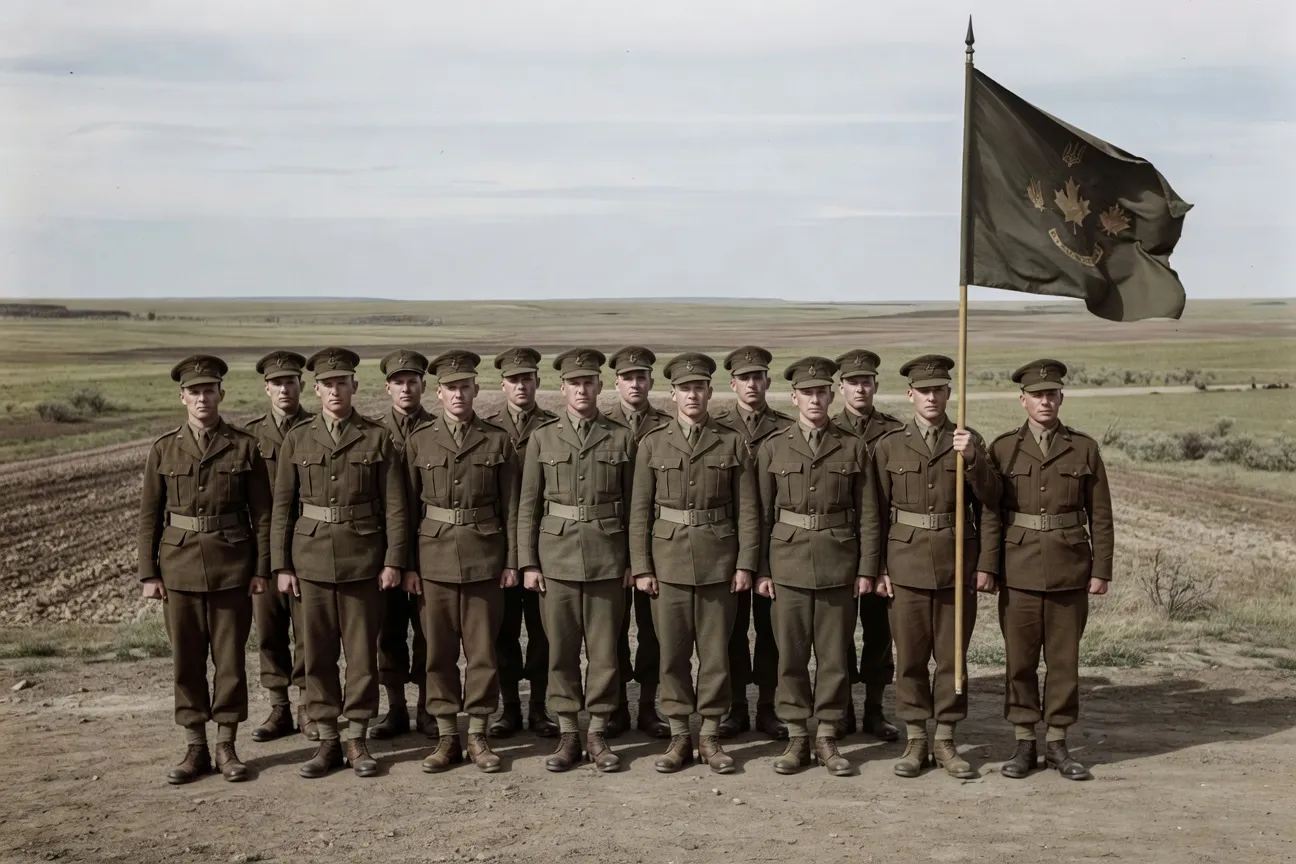
Ukrainian Canadian soldiers in WWII Canadian Army uniforms standing in formation, archival 1944 photo aesthetic, regimental flag visible.
The Paradox: Interned in WWI, Decorated in WWII
The military history of Ukrainian Canada is structured by a paradox so extreme that it would seem implausible if the documents did not exist. In 1914, the Canadian state declared the Galician and Bukovynian Ukrainian immigrants who had homesteaded the prairies under the Sifton policy to be enemy aliens of a hostile Austro-Hungarian Empire. Some 5,441 Ukrainian-born men, women, and children were interned in 24 camps under the War Measures Act. They performed forced labour. Their property was confiscated. Their citizenship rights were suspended. Their newspapers were closed; their cultural organisations dissolved; their schools investigated. The internment did not formally end until June 20, 1920, nearly two years after the war.
Twenty-five years later, in September 1939, the same Canadian state called on the same Ukrainian-Canadian families to send their adult children to fight in the Canadian armed forces. The response was overwhelming. By the time the war ended in 1945, approximately 35,000 to 40,000 Ukrainian Canadians had served in army, navy, and air force units — one of the highest per-capita enlistment rates of any Canadian ethnic community. Their motivations, the historical record makes clear, were complex: assimilation pressure, demonstration of loyalty after the WWI humiliation, conviction that Hitler had to be stopped, employment opportunity in the Depression-emptied countryside, simple patriotism. But the historical fact is that the children and nephews and grandchildren of the WWI internees built one of the most distinguished records of any community in the Canadian war effort.
This arc — from internment to decoration, from enemy alien to Victoria Cross recipient — is one of the most striking patterns in twentieth-century Canadian social history. It is also a story that until recently the broader Canadian public has not known. Ukrainian-Canadian veterans' history was carried within the community through the Canadian Ukrainian Servicemen's Association and successor veterans' organisations but rarely entered the national narrative. The post-2005 federal acknowledgment of the WWI internment created an opening for the parallel WWII service story to receive its due recognition. The arc from injustice to extraordinary contribution is one that the community has long understood and that the country is finally beginning to. A similar pattern of Canadian representation predating Ukraine's own independent institutions runs through sport, as documented in our history of Ukrainian-Canadian athletes and Olympic history.
The First World War: 5,441 Interned as Enemy Aliens (1914-1920)
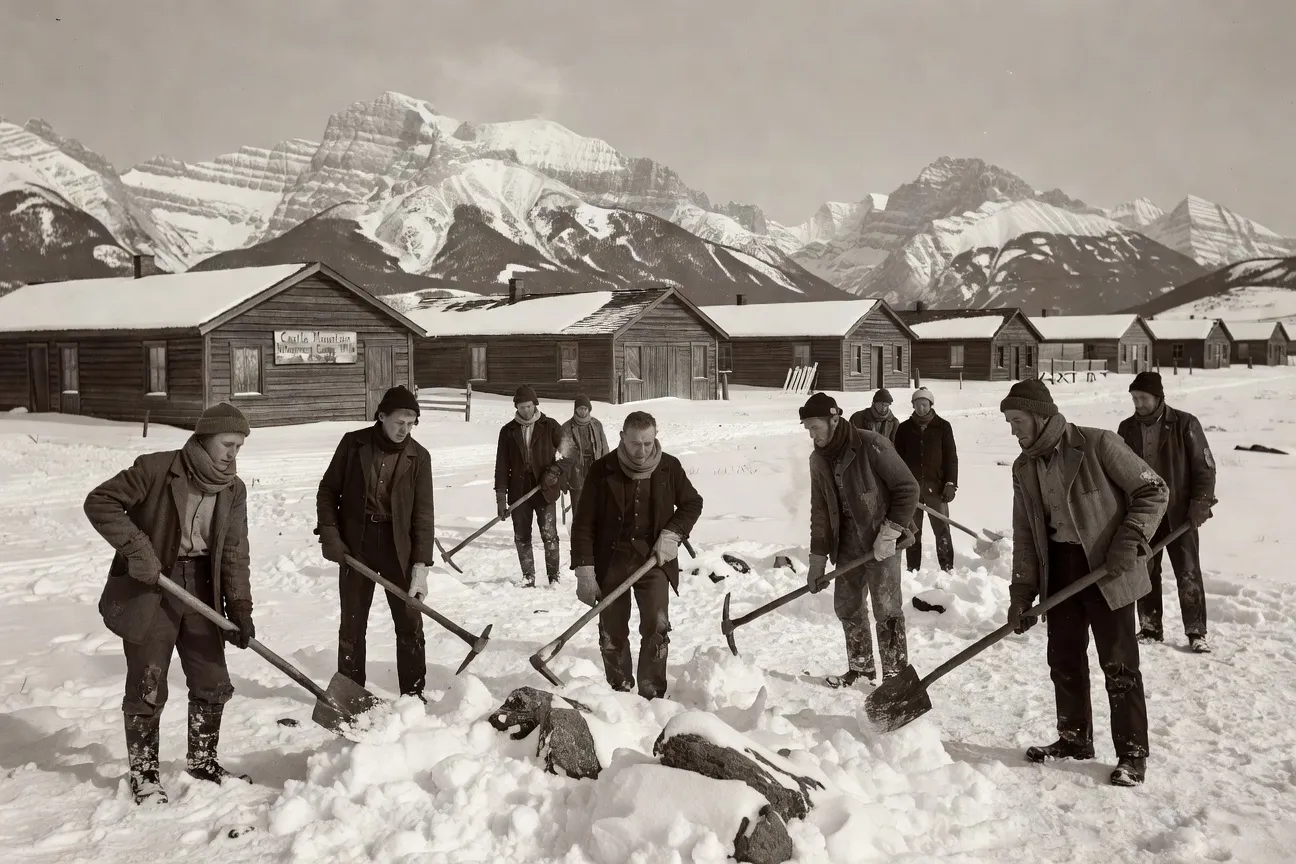
Authentic 1916 Canadian internment camp at Castle Mountain Alberta, wooden barracks, Ukrainian internees doing forced labour with shovels, mountain landscape.
When Britain declared war on Germany on August 4, 1914, Canada was automatically at war. When Britain declared war on Austria-Hungary on August 12, the Ukrainian Canadians who had emigrated from Galicia and Bukovyna in the previous twenty-three years became, by Canadian law, citizens of an enemy power. The War Measures Act, passed on August 22, gave the federal government extraordinary powers to detain, intern, and restrict the movement of anyone of enemy alien status. Between 1914 and 1920, approximately 8,579 people were interned in twenty-four camps across Canada under the War Measures Act. Of these, approximately 5,441 were Ukrainians.
The internment camps were spread across western and central Canada. The largest were at Castle Mountain in Banff National Park and Otter (later renamed Petawawa) in Ontario. Internees performed forced labour: building roads through Banff and Jasper National Parks, clearing forest, constructing railway sidings, working in iron mines in northern Ontario. The construction of the road from Banff to Lake Louise — today the most visited tourist route in Banff National Park — was largely Ukrainian internee labour. The Trans-Canada Highway corridor through the Rockies follows roads that internees built without their consent.
The Ukrainian-Canadian community has long-recorded the personal toll: families separated; homesteads abandoned and lost to subsequent settlers; civil rights revoked; the indignity of being branded enemy aliens by a country to which they had pledged allegiance. The total losses were never fully documented because the federal government destroyed many internment-era records in 1954. The community itself has reconstructed the picture through surviving family records, parish documents, and oral histories collected from internee descendants. The deeper context of the first wave of Ukrainian immigration to Canada that brought these families here in the first place is essential to understanding what the internment took from them.
Yet even during the internment, Ukrainian Canadians were serving in the Canadian Expeditionary Force. Approximately 10,000 Ukrainian Canadians enlisted in the CEF between 1914 and 1918. Those who had naturalised before 1914 enlisted under their own names; many who had not naturalised enlisted under Canadianised versions of their names to avoid the enemy-alien restriction. Their service records survive in the CEF attestation papers held at Library and Archives Canada, and Ukrainian-Canadian historians have been combing through these records for decades to reconstruct the full roster of Ukrainian CEF service personnel.
The most prominent Ukrainian-Canadian veteran of WWI is Filip Konowal, who received the Victoria Cross for his actions at Hill 70 in August 1917. Konowal was a Polish-Galician immigrant who had arrived in 1913, enlisted in 1915, and over three days of fighting near Lens, France, attacked German machine-gun positions repeatedly, killing sixteen enemy soldiers and capturing several positions. He was the only Ukrainian Canadian and the only Eastern European immigrant to Canada to receive the Victoria Cross in WWI. His story was buried for decades; only in recent years has it received recognition through plaques at the Canadian War Museum in Ottawa and at the Royal Canadian Legion branches that he later helped found.
The federal Internment of Persons of Ukrainian Origin Recognition Act, passed in 2005 after decades of community advocacy, formally acknowledged the WWI internment as an injustice and established the Canadian First World War Internment Recognition Fund. The Fund supports research, commemoration, and educational programs about the internment. The arc from a community organising to fight forced labour in 1914 to a country acknowledging the wrong nine decades later is one of the more remarkable accountability stories in Canadian history.
The Second World War: 35,000+ Ukrainian Canadians in Uniform
When Canada declared war on Germany in September 1939, the Ukrainian-Canadian community responded with a mass enlistment that exceeded its proportional share of the Canadian population by a wide margin. The total number of Ukrainian Canadians who served in the Canadian armed forces during WWII is estimated at between 35,000 and 40,000. Given the Ukrainian-Canadian population of roughly 305,000 at the time, this means that one in seven or eight Ukrainian Canadians (and a much higher fraction of adult men) served. Per-capita enlistment was approximately double the rate for the Canadian population as a whole.
The motivations of the enlistment were multiple and overlapping. The post-WWI experience of the community had created an acute consciousness of the need to demonstrate loyalty. The Depression of the 1930s had left rural Ukrainian-Canadian communities in poverty, and military service offered cash income that few alternative employment opportunities matched. The threat of Nazi Germany was felt with particular intensity in the Ukrainian-Canadian community because of its connections to Eastern Europe. Soviet collaboration with Nazi Germany under the 1939 pact made the position more complicated — Ukrainian Canadians could not unambiguously cheer the Soviet ally — but Hitler was unambiguously the enemy.
The Ukrainian Canadian Committee (UCC), founded in November 1940 as the umbrella organisation of Ukrainian community life in Canada, organised the community's wartime contribution. The UCC channelled volunteers, raised money for the Canadian Red Cross and victory bonds, supported families of serving personnel, and coordinated efforts to publicise the Ukrainian-Canadian war effort in mainstream Canadian newspapers. The UCC's wartime presence was one of the most successful community-organisation campaigns by any ethnic group in WWII Canada and shaped the post-war institutional development of the Ukrainian-Canadian community.
Ukrainian Canadians served in every branch and many regiments. The largest concentrations were in army infantry units recruited from the prairies: the Princess Patricia's Canadian Light Infantry, the Royal Winnipeg Rifles, the Lake Superior Regiment, the Westminster Regiment, the Cape Breton Highlanders. Significant numbers served in the Royal Canadian Air Force, where Ukrainian-Canadian pilots distinguished themselves in fighter and bomber squadrons. Royal Canadian Navy service was more limited but still substantial. Over 600 Ukrainian Canadians were killed in action during the war; many more were wounded.
The community kept detailed records of its enlistment through CUSA newsletters distributed to families on the home front and to serving personnel overseas. Each issue listed the names of newly commissioned officers, awards received, casualties, and prisoners of war. The CUSA archive, now held in the Ukrainian Canadian Archives and Museum, is the principal primary source for Ukrainian-Canadian WWII service. The formation of Ukrainian Canadian identity as a distinct cultural-political category in postwar Canada is impossible to understand without the WWII service that consolidated the community's place in the national story.
Notable Ukrainian Canadian Veterans of WWII
Among the thousands of Ukrainian-Canadian servicemen and women of WWII, certain individual stories stand out and are now part of the community's collective memory.
Squadron Leader Mike Dembowski, RCAF, flew Mosquito night fighters with No. 410 Squadron RCAF over occupied Europe in 1944-1945. His record of seven confirmed enemy aircraft destroyed earned him the Distinguished Flying Cross and Bar (a second award). He was one of the highest-scoring Ukrainian-Canadian aces of the war and after the war became a community leader in Toronto.
Captain Stephen Worobetz, who later became Lieutenant Governor of Saskatchewan from 1970 to 1976, was awarded the Military Cross for actions in Italy in 1944 while serving with the Saskatoon Light Infantry. Born in Saskatchewan to a Ukrainian-Canadian family, his combat record exemplifies the trajectory from prairie homestead to wartime decoration that the WWII generation made possible.
Lieutenant-Colonel Peter Bashuk served with the Canadian Army Special Operations during the war and later played a role in the postwar War Crimes Commission investigations in occupied Germany. Bashuk's bilingual fluency in Ukrainian and English allowed him to interview Eastern European displaced persons and document Nazi atrocities for the Allied courts. He became a key figure in the postwar Ukrainian-Canadian displaced persons advocacy.
Sergeant Anne Wojcik, RCAF Women's Division, served as one of the small but significant number of Ukrainian-Canadian women who enlisted in the wartime auxiliary services. She worked at RCAF Station Trenton in radio operations through 1942-1945. Her story is preserved in the Ukrainian Canadian Women's Council archives.
Wing Commander John (Jack) Kostelnyk, RCAF, flew Lancaster bombers with No. 419 Squadron during the campaign over Germany. His twenty-eight combat missions earned the Distinguished Flying Cross. He was shot down over the North Sea in March 1945 but survived as a prisoner of war until liberation in May. Postwar, he became a founder member of the Ukrainian Canadian Veterans' Association.
These individual stories are surface examples of a much larger pattern. The Ukrainian-Canadian Veterans History Project at the University of Manitoba has documented over 6,000 individual service records and continues to add new entries. The complete picture of Ukrainian-Canadian WWII service includes not just decorated officers but thousands of ordinary servicemen and women whose contribution is recorded in attestation papers, regimental rolls, and family memory. To trace a specific veteran's record, Ukrainian genealogy and family history resources for Canadian descendants can help locate the regimental records, casualty lists, and unit war diaries that preserve individual service detail.
Korea, Peacekeeping, Afghanistan: Service Through the Generations
Ukrainian-Canadian military service did not end with VE Day in May 1945. The subsequent decades brought further chapters that extended the wartime service tradition into the second and third generations of the community.
Approximately 1,200 Ukrainian Canadians served in the Korean War of 1950-1953, including significant numbers in the Princess Patricia's Canadian Light Infantry at the Battle of Kapyong and the Royal Canadian Regiment in subsequent actions. The Korean War service is less well documented in the community's institutional memory because by the early 1950s the Ukrainian-Canadian community was absorbing the large displaced-persons immigration of 1947-1953 and its institutional attention was elsewhere. But the Korean veterans' records exist and the community is increasingly recognising their service through commemorative plaques and survivor histories.
Ukrainian Canadians have served in every major Canadian peacekeeping deployment from the United Nations Emergency Force in 1956 onwards. The Cyprus deployment of 1964-1993, the Egyptian Sinai mission, the Cambodia operations, the former Yugoslavia campaign of the 1990s, the Rwanda mission — in each, Ukrainian-Canadian personnel served alongside other Canadians. The post-Cold War shift of Canadian military emphasis toward peacekeeping and humanitarian operations meant that the community's military tradition adapted to a different kind of service.
The Afghanistan campaign of 2001-2014 brought renewed combat service. Approximately 1,500 Ukrainian Canadians served in Afghanistan over the campaign. Casualties included several Ukrainian-Canadian killed in action, most notably Master Corporal Anthony Klumpenhouwer (a third-generation Ukrainian Canadian from Winnipeg) and Trooper Brett Aaron Loehr. Their funerals at Ukrainian Catholic and Orthodox parishes drew thousands of community members. The Ukrainian Canadian Servicemen's Association of the post-Afghanistan era now serves a generation of veterans whose combat experience is recent rather than historical.
The Canadian Ukrainian Servicemen's Association (CUSA)
The Canadian Ukrainian Servicemen's Association, founded in 1944, was the principal wartime organisation connecting Ukrainian-Canadian military personnel. CUSA's monthly newsletter The Beachhead was distributed to serving Ukrainian Canadians overseas and to families on the home front. The newsletter carried news of community life in Canada, lists of recent awards, condolences for the families of those killed in action, and inspirational pieces about the connection between Ukrainian-Canadian heritage and the war against fascism.
CUSA's significance extended beyond the war years. The organisation transformed at the end of the war into the post-war Ukrainian Canadian Veterans' Association, which became one of the most influential community institutions of the late 1940s and early 1950s. The UCVA's advocacy work was central to the campaign to bring tens of thousands of Ukrainian displaced persons to Canada under the postwar refugee admissions. Ukrainian-Canadian veterans, having proven their loyalty in uniform, had political credibility that previous community organisations had lacked, and they used that credibility to secure parliamentary support for the displaced-persons immigration that brought a third major wave of Ukrainian arrivals to Canada.
The UCVA also played a central role in founding the Ukrainian Canadian Congress in its postwar form. Veterans took leadership positions in the umbrella organisation and shaped its political direction for decades. The legacy is visible today: most Ukrainian-Canadian community institutions of the late twentieth century trace their leadership lineage back to the WWII veterans' cohort. The post-2022 generation of community leadership is just now succeeding the last of the WWII veterans, many of whom remained active in community work into their nineties.
Honoring Their Memory: Monuments and Cemeteries Across Canada
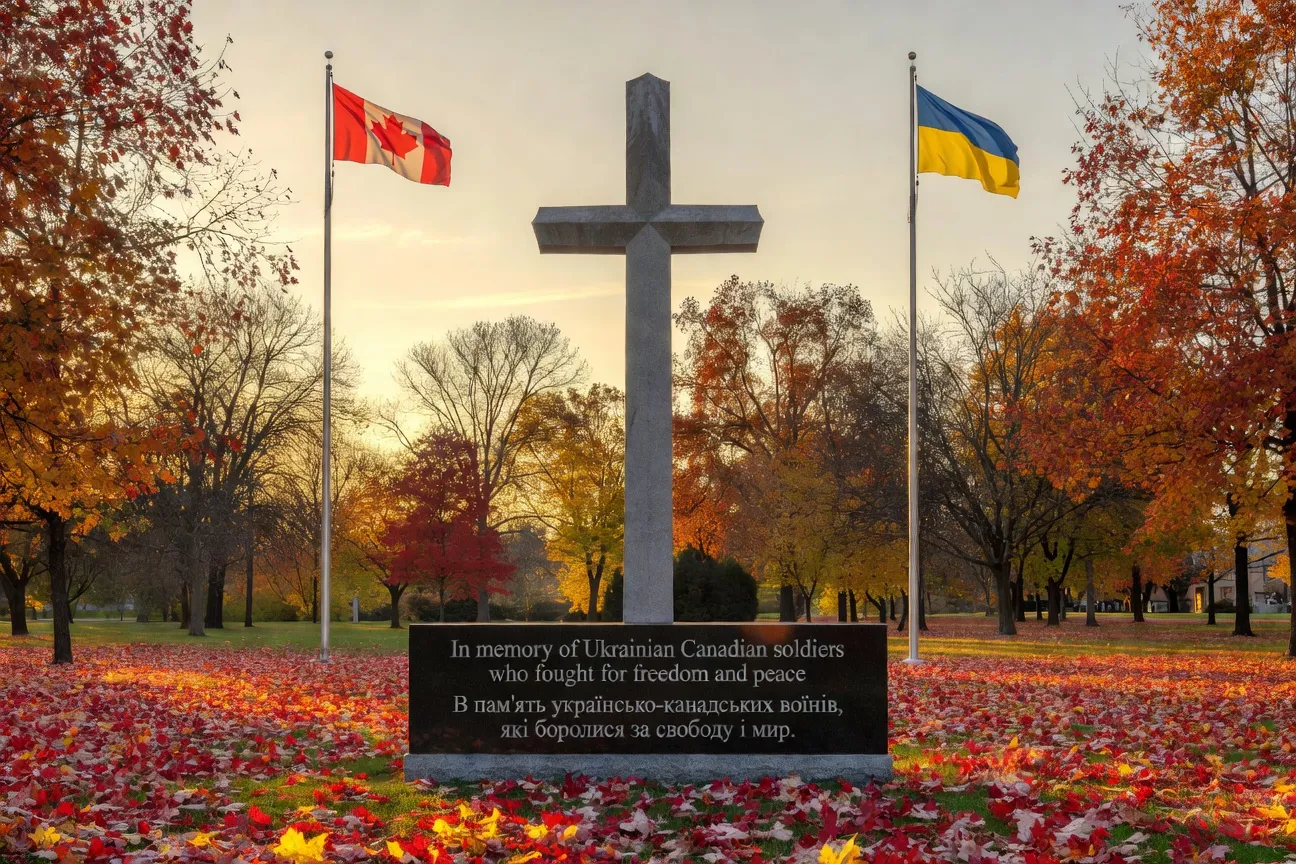
Ukrainian Canadian war memorial cross with bilingual English-Ukrainian inscription, autumn light, maple trees, Canadian and Ukrainian flags.
The principal Ukrainian-Canadian war memorial sites are concentrated in the major Ukrainian-Canadian centres but extend across the country.
In Edmonton, the Ukrainian Canadian War Museum maintains a comprehensive memorial wall listing every Ukrainian Canadian known to have died in Canadian military service from WWI through Afghanistan. The museum also houses the largest archive of personal effects, photographs, and oral histories of Ukrainian-Canadian service members. The museum was renovated in 2018 with federal and provincial funding.
In Winnipeg, the Ukrainian National Federation hall on Pritchard Avenue houses a memorial to Manitoba Ukrainian-Canadian war dead. The Manitoba Legislature lawn includes a separate Ukrainian-Canadian veterans' plaque, installed in 1994 on the fiftieth anniversary of CUSA. The Holy Family Ukrainian Catholic Church holds an annual Remembrance Day service that draws hundreds of veterans and family members.
In Toronto, the Bloor West Village neighbourhood — historically the heart of Ukrainian Toronto — hosts a community war memorial at the corner of Bloor and Runnymede. The St. Demetrius Ukrainian Catholic Cathedral in Etobicoke maintains a memorial wall in the parish hall listing parishioners who served. Several smaller memorials exist at Ukrainian Catholic and Orthodox parishes across the Greater Toronto Area.
Smaller memorials are at the Saskatoon Ukrainian Museum of Canada, the Vancouver Ukrainian Catholic Cathedral, the Hamilton Ukrainian Catholic Diocese, and dozens of rural prairie parishes. The community-level commemoration network is dense, decentralised, and continuously maintained by the next generation.
The graves of Ukrainian-Canadian war dead are scattered across Canada and across the war cemeteries of Europe. Veterans Affairs Canada maintains the official war grave registry. Many Ukrainian-Canadian families have requested bilingual English-Ukrainian inscriptions on the headstones of soldiers buried in Italy, Northwest Europe, and Hong Kong. The result is a quiet network of Ukrainian-language commemoration scattered across the Allied war cemetery system — small evidence of the cultural identity that the WWII generation carried into its service.
The Russian Invasion of 2022: A New Generation of Ukrainian Canadian Volunteers
The Russian full-scale invasion of Ukraine in February 2022 has produced a new generation of Ukrainian-Canadian military service of a kind that has no exact precedent in the community's history.
Several hundred Ukrainian Canadians have travelled to Ukraine since February 2022 to serve with the Ukrainian Armed Forces or with the International Legion of Territorial Defence. The Canadian government's position on this volunteer service has been complex: not actively encouraging it, but not prohibiting it. Canadian Armed Forces veterans with combat experience from Afghanistan and the Balkans have been among the most prominent volunteers, applying their training to a war that the diaspora community sees as connected to its own historical experience.
At the same time, the Canadian Armed Forces has been running Operation UNIFIER — a training mission that has provided thousands of Ukrainian soldiers with Canadian-led tactical training in Britain, Poland, and Latvia since 2015. Ukrainian-Canadian personnel within the CAF have served on Operation UNIFIER teams with particular distinction, providing both military expertise and language and cultural bridge-building.
Canada has also become a destination for Ukrainian veterans of the current war. The Ukrainian refugees who arrived in Canada through the CUAET programme since 2022 include a significant number of recent veterans of the Ukrainian Armed Forces, many of them wounded in combat. Canadian Ukrainian-community veterans' organisations have organised support for these arrivals, providing mentorship, employment assistance, and access to mental-health services. The relationship between Canadian Ukrainian veterans of older conflicts and the current generation of Ukrainian veterans arriving in Canada has become one of the most significant new dynamics in the community.
The arc from Filip Konowal in 1917, to the WWII enlistees, to the Afghanistan veterans, to the post-2022 Ukrainian-Canadian volunteers and the Ukrainian veterans arriving as refugees is a single continuous story. It is a story that the broader Canadian public, after a century of partial inattention, is beginning to take in. The deeper context of Ukrainian military and historical traditions connects what Ukrainian Canadians have done in the Canadian uniform to what Ukrainians more broadly have done in their own military history. The two streams converge in the present moment. That same generation of veterans and their children went on to shape federal and provincial politics, a legacy traced in our profile of Ukrainian-Canadian politicians and MPs.