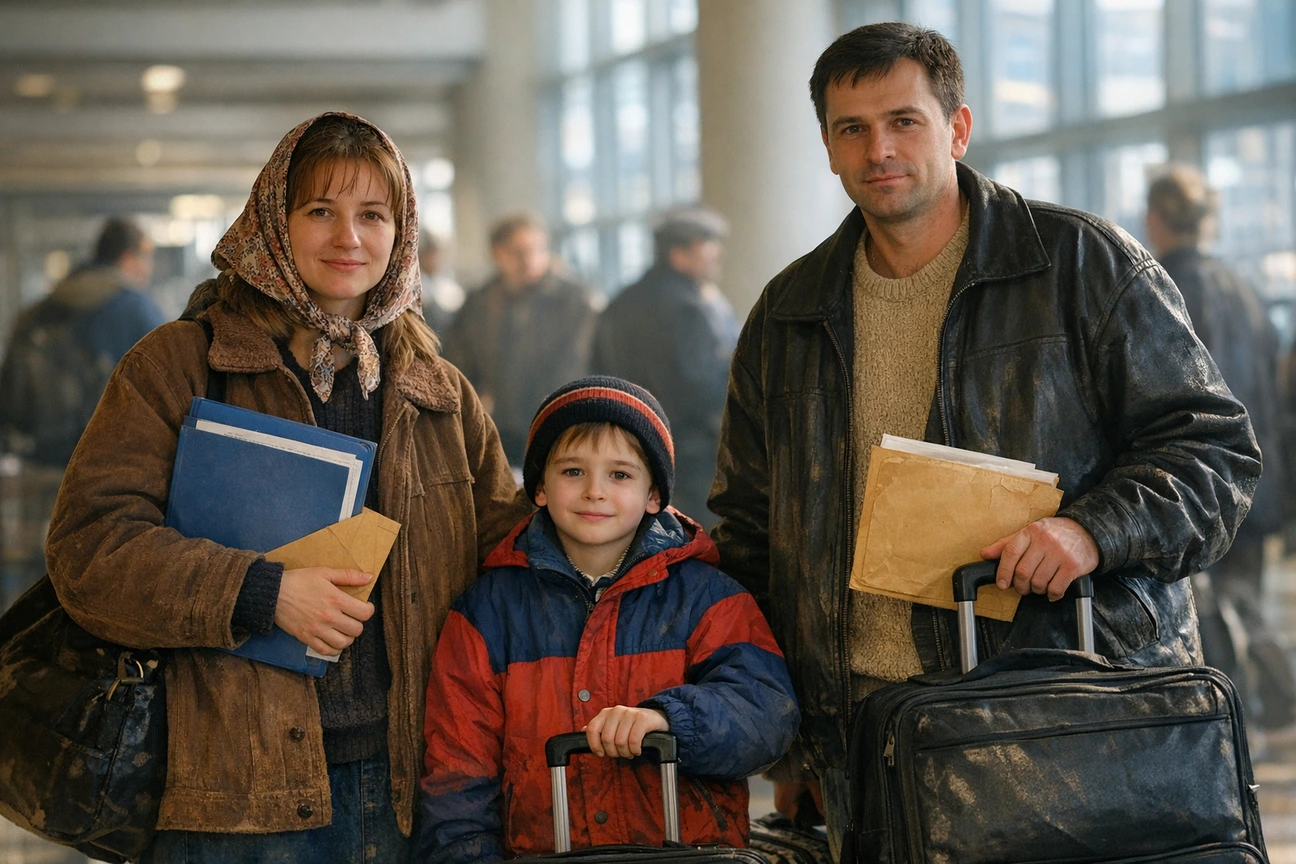
A Ukrainian family arriving at a Canadian airport in the early 1990s, part of the post-independence immigration wave.
Table of Contents
- Third Wave or Fourth? A Question of Numbering
- Why They Left: Post-Soviet Push Factors
- How They Came: Immigration Streams and Programs
- The Numbers: What the Census Actually Shows
- Where They Settled: Toronto and Beyond
- Who They Were: Profile of the Post-1991 Immigrant
- Connection to Earlier Waves and the Road to 2022
- A Community Renewed by Choice
- Frequently Asked Questions
Third Wave or Fourth? A Question of Numbering
Ukrainian migration to Canada did not end with the Displaced Persons of the late 1940s. When Ukraine declared independence on 24 August 1991, and when the Soviet Union formally dissolved that December, a new era of movement began. Over the three decades that followed, well over 100,000 people born in Ukraine obtained permanent residence in Canada, in a sustained, largely economic migration that historians generally call the third wave of Ukrainian immigration to Canada.
The numbering deserves a word of explanation, because sources disagree. The Internet Encyclopedia of Ukraine describes the mass movement as occurring in distinct periods: approximately 170,000 arrivals between 1891 and 1914, about 68,000 in the interwar years, and roughly 34,000 in the immediate postwar period from 1947 to 1954. On this accounting, the post-1991 migration is sometimes called the fourth wave, counting the interwar movement separately. This site follows the community convention used for its companion article on the first wave of 1891–1914, treating the interwar years as a continuation of the first wave's chain migration. By that convention, the post-independence movement is the third wave. Either way, the substance is identical: a new, distinct migration shaped by free choice rather than by war-era displacement or closed imperial borders.
Why They Left: Post-Soviet Push Factors
The third wave was, above all, an economic migration. The collapse of the Soviet planned economy produced a decade of hardship in Ukraine that remains difficult to overstate. Industrial production collapsed across the heavily industrialized east; wages went unpaid for months at a time; pensions and savings were rendered nearly worthless by the hyperinflation of the early 1990s; and the social safety net that had anchored Soviet urban life disintegrated. For engineers, doctors, teachers and factory workers alike, the calculus of staying changed dramatically between 1991 and 1995.
Several distinct pressures combined to push emigrants toward the exit:
- Economic collapse and deindustrialization — falling output, mass layoffs and the disappearance of lifetime employment in the state sector;
- Hyperinflation and savings erosion — the wiping out of household savings and fixed incomes in the early 1990s;
- Corruption and weak institutions — unpredictable rule of law and the rise of oligarchic control over the economy;
- Political upheaval — the contested Orange Revolution of 2004 and the Euromaidan upheaval of 2013–2014 deepened perceptions of instability;
- War after 2014 — the annexation of Crimea and the conflict in the Donbas added security concerns to the economic motives, even though most 2014–2021 arrivals still entered Canada through ordinary economic and family categories rather than as refugees.
Unlike the first wave's peasants fleeing land hunger in Galicia and Bukovyna, or the second wave's Displaced Persons who could not safely return to Soviet Ukraine, third-wave emigrants were choosing to leave an independent, formally democratic state. Scholarship on the period, including the work of sociologist Vic Satzewich on Ukrainian migration and transnationalism, emphasizes that these were mobility decisions made by people with genuine alternatives — which is precisely why Canada's points-based system, with its rewards for education and skilled experience, proved such a good fit for them.
How They Came: Immigration Streams and Programs
Canada's immigration system in the 1990s and 2000s offered Ukrainian applicants three principal doors, and the third wave used all of them. The largest was economic immigration. The Federal Skilled Worker program, introduced in 2002, selected principal applicants on the basis of education, occupational experience, official-language ability, age and adaptability — criteria that favoured the unusually well-educated Ukrainian applicant pool. Provincial Nominee Programs, which began with the 1996 Manitoba agreement and expanded across the country through the 2000s, gradually became a second major economic channel, allowing provinces to nominate candidates who met local labour-market needs.
The second door was family reunification. With more than a million Canadians of Ukrainian origin already in the country — 1,359,655 reported Ukrainian ethnic or cultural origin in the 2016 Census — sponsorship of spouses, parents and dependent children by established relatives produced steady chain migration throughout the period. The third door, refugee and humanitarian admission, remained comparatively small before 2022, though it opened briefly for specific groups, including Ukrainians from Poland and the former Yugoslavia in the 1980s and religious-minority evacuees in the early 1990s.
A structural feature of the period is what Canadian policy literature calls two-step immigration: an increasing share of newcomers first arrived on temporary work or study permits and only later obtained permanent residence. According to Statistics Canada's 2021 Census analysis, more than one-third of all immigrants admitted between 2016 and 2021 had pre-admission experience in Canada, and this pattern was well established among Ukrainian students and temporary workers years earlier — a marked contrast with the bonded-labour regime under which the second wave of Displaced Persons had entered the country.
The Numbers: What the Census Actually Shows
Because different statistical measures answer different questions, the size of the third wave is best stated carefully. Statistics Canada's 2021 Census, which integrated Immigration, Refugees and Citizenship Canada administrative records for year of immigration and admission category, counted about 112,000 Ukraine-born immigrants whose period of immigration began between 1991 and 2016, plus roughly 14,000 more from 2017 to May 2021 — approximately 126,000 Ukraine-born people who had arrived since independence and were living in Canada at census time. This is a stock measure: it excludes those who arrived and later left Canada or died, and it is not identical to IRCC's annual admission counts.
| Measure | Figure | Source |
|---|---|---|
| Immigrants from Ukraine, 1991–2001 | 23,435 | Internet Encyclopedia of Ukraine |
| Ukraine-born immigrants arriving 1991–2016, present in 2021 | ≈112,000 | Statistics Canada, 2021 Census |
| Ukraine-born arrivals 2017–May 2021, present in 2021 | ≈14,000 | Statistics Canada, 2021 Census |
| People born in Ukraine, Canada, 2021 Census | 99,170 | Statistics Canada, Census Profile |
| People born in Ukraine, Toronto CMA, 2021 Census | 31,450 | Statistics Canada, Census Profile |
| Ukrainian ethnic or cultural origin, 2021 (total responses) | 1,258,635 | Statistics Canada, 2021 Census |
| Ukrainian ethnic or cultural origin, 2016 (comparison) | 1,359,655 | Statistics Canada, 2016 Census |
Two comparisons give the third wave its proper scale. The first-wave era brought roughly 170,000 Ukrainians to Canada over 23 years; the third wave brought approximately 126,000 Ukraine-born permanent immigrants over 30 years — smaller in absolute terms than the homesteading flood, but remarkable for occurring through a selective points system rather than through mass agricultural recruitment. Second, the 2021 Census count of people born in Ukraine (99,170) understates the community's presence, because the Ukrainian-origin population of 1,258,635 includes the descendants of earlier waves.
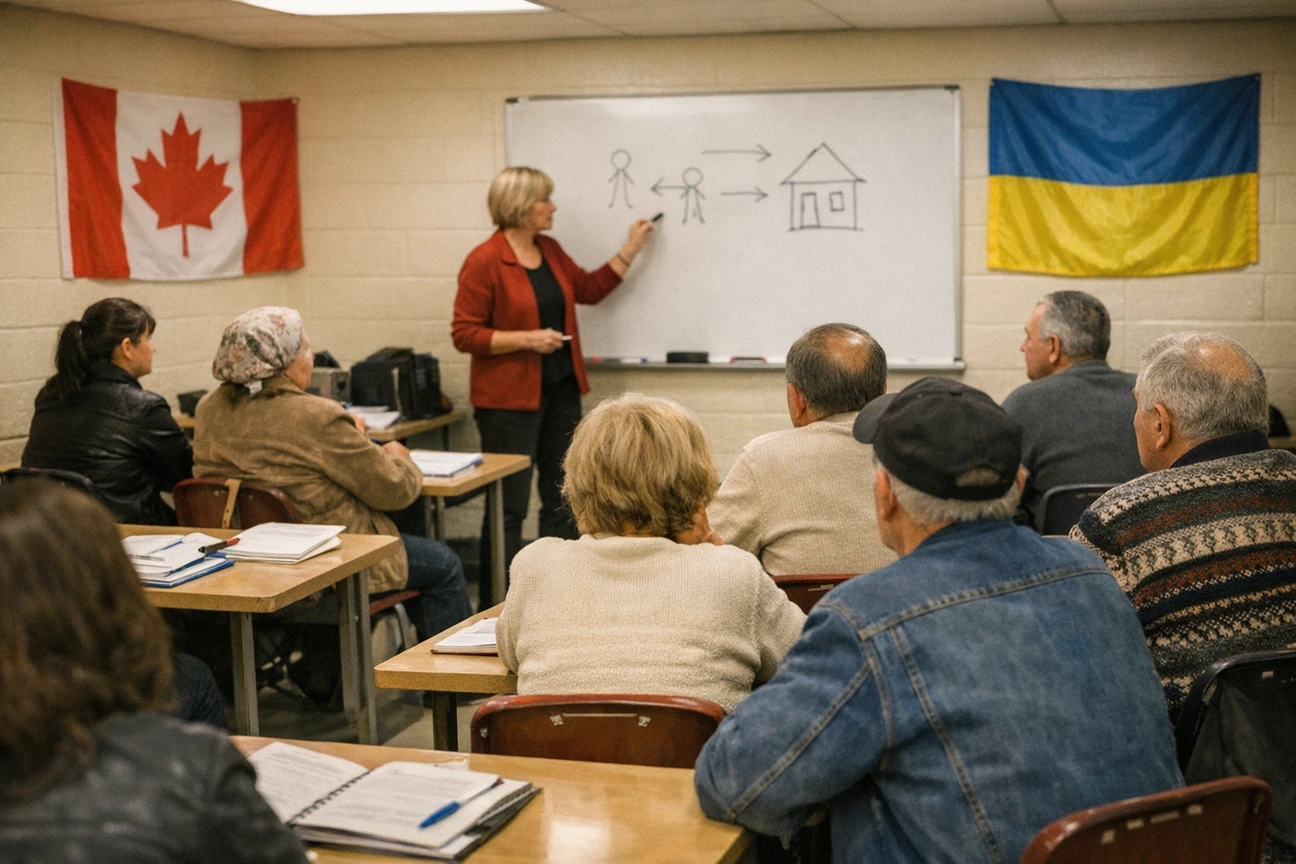
English-language classes at Toronto community centres were a first stop for many post-1991 Ukrainian immigrants.
Where They Settled: Toronto and Beyond
If the first wave made the Prairie provinces the demographic heart of Ukrainian Canada, the third wave confirmed Toronto as its economic centre. The Internet Encyclopedia of Ukraine notes that the majority of the post-1991 wave settled in Ontario, particularly Toronto, and the census numbers bear this out: the Toronto census metropolitan area was home to 31,450 Ukraine-born residents in 2021 — by far the largest urban concentration in the country. Toronto's pull factors were practical as much as emotional: the largest and most diversified labour market in Canada, direct air connections to Kyiv established in the 1990s, and an existing Ukrainian institutional infrastructure spanning churches, credit unions, Saturday schools and media.
Settlement was not exclusively Torontonian. Winnipeg retained its symbolic importance as the historic cradle of Ukrainian Canadian life, Edmonton and Calgary attracted growing shares through Alberta's booming economy and provincial nominee programming, and Vancouver drew a smaller west-coast contingent. Statistics Canada's 2021 Census analysis found that 29.5% of all recent immigrants to Canada settled in the Toronto CMA — a proportion that holds roughly for the Ukrainian third wave as well, given the metropolitan concentration of Ukraine-born residents. In the Toronto CMA, immigrants made up 46.6% of the total population in 2021, the highest share of any Canadian metropolitan area, which meant third-wave newcomers landed in one of the world's most immigrant-experienced cities. The detailed census picture of both ethnic-origin and birthplace measures is covered in our complete statistics on Ukrainians in Canada.
Within Toronto, the newcomers of the 1990s and 2000s found a community visibly shaped by the second wave. Bloor West Village's Ukrainian strip, St. Vladimir's Institute near the University of Toronto, the churches along Bathurst Street, and organizations descended from the Displaced Persons era all provided immediate points of entry — even as the new arrivals' accents, Soviet-era experiences and post-independence outlook distinguished them from the established community.
Who They Were: Profile of the Post-1991 Immigrant
The third wave's demographic profile differed from both earlier waves. Where the first wave was rural and the second wave combined camp-hardened nationalists with forced labourers, the third wave was predominantly urban, educated and professionally experienced. Its members came from Kyiv, Kharkiv, Lviv, Odesa, Dnipro and the industrial cities of the east and south, often with university degrees and Soviet-era professional careers that did not always transfer cleanly into the Canadian labour market. The familiar immigrant story of the period was the engineer driving a taxi or the physician retraining through Canadian certification.
Politically and culturally, the wave was heterogeneous. Some arrivals were Russian-speaking easterners for whom Ukrainian identity became more salient only in Canada; others were western Ukrainians from Galicia and Volhynia whose families had maintained distinct national traditions through the Soviet decades; still others were Jews from Ukraine, ethnic Russians married to Ukrainians, and members of mixed families, all of whom appear in the census's Ukraine-born count without appearing in the Ukrainian-origin count. This internal diversity made the third wave both a reinforcement and a quiet challenge to established diaspora institutions, a dynamic explored in the history of Ukrainian emigration and diaspora communities documented by Ukraine Zoom for the parallel French case, where post-1991 arrivals similarly renegotiated the relationship between homeland politics and diaspora identity.
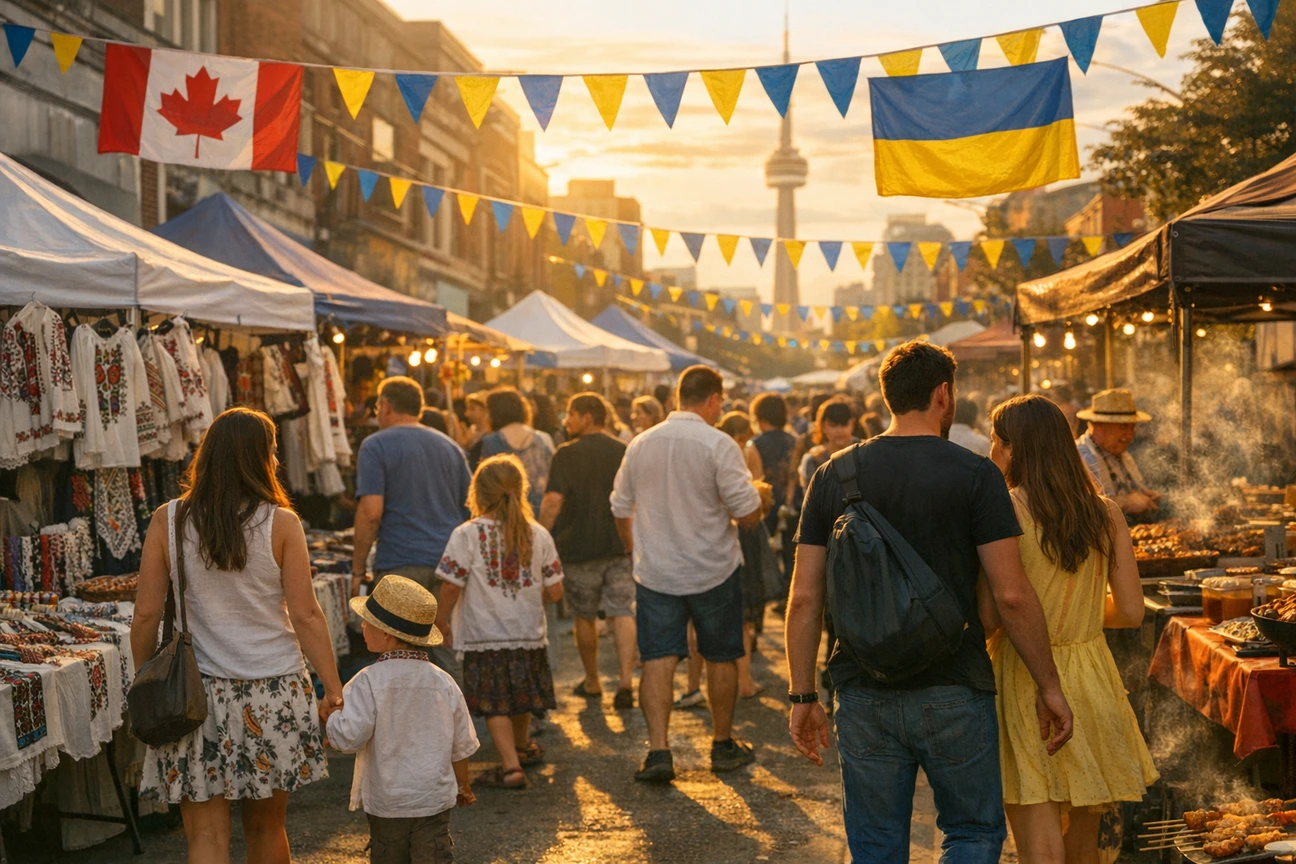
Toronto's Ukrainian street festivals blend post-1991 newcomers with descendants of earlier waves.
Connection to Earlier Waves and the Road to 2022
Relations between the third wave and the established community followed a pattern familiar from the second wave's arrival. The long-established institutions — the Ukrainian Canadian Congress and its member organizations, the churches, the credit-union network — offered settlement assistance and social connection, while the newcomers brought energy, professional skills and, after 2014, first-hand experience of war and revolution. Intermarriage between third-wave arrivals and descendants of earlier waves, joint participation in cultural events, and shared advocacy on Ukrainian sovereignty gradually blended the groups, even as language and outlook differences persisted at the margins.
The third wave also supplied the human infrastructure that made Canada's response to Russia's full-scale invasion possible in 2022. Bilingual volunteers, community organizations with decades of post-1991 settlement experience, and an established pattern of two-step immigration all shaped the reception of the new arrivals under the Canada-Ukraine Authorization for Emergency Travel. The contrast between the two movements is sharp: the third wave arrived as permanent residents through a selective system over three decades, while the post-2022 arrivals came as temporary residents fleeing an active war — a new chapter detailed in our guide to the Canada-Ukraine Authorization for Emergency Travel.
A Community Renewed by Choice
The third wave of Ukrainian immigration to Canada was, in its essence, a migration of choice made under economic duress. It lacked the epic scale of the Prairie homesteading migration and the dramatic urgency of the Displaced Persons, but it quietly achieved something neither earlier wave could: it linked Ukrainian Canada permanently to an independent Ukrainian state. Remittances flowed to families in Ukraine; Canadian-Ukrainian professionals built careers that spanned both countries; and when Ukraine's existence was threatened after 2014 and again in 2022, the community that responded was one whose ties to the homeland were direct, personal and recent.
For researchers and descendants, the third wave is also the best-documented migration in Ukrainian Canadian history — IRCC administrative records, census microdata and community archives allow family histories to be traced with a precision impossible for the homesteaders of 1891. In Toronto in 2026, its legacy is everywhere: in the bilingual signage of Bloor West Village, in the classrooms of Ukrainian Saturday schools filled with children of post-1991 families, and in a community whose centre of gravity has completed its long shift from the Prairie sod house to the country's largest city.
Frequently Asked Questions
How many Ukrainians immigrated to Canada between 1991 and 2021?
Statistics Canada's 2021 Census counted roughly 126,000 Ukraine-born immigrants whose period of immigration began between 1991 and May 2021: about 112,000 who arrived from 1991 to 2016 and another 14,000 from 2017 to May 2021. The Internet Encyclopedia of Ukraine records 23,435 immigrants from Ukraine between 1991 and 2001 alone, followed by a continuing flow of roughly 2,500 per year.
Why is post-1991 immigration called the third wave?
On the numbering used by this site and by many community historians, the first wave was the 1891–1914 homesteading migration and the second wave the 1947–1954 Displaced Persons. Sources that count the smaller interwar movement of the 1920s and 1930s as a separate wave call the post-1991 movement the fourth wave. Both labels describe the same post-independence migration.
What immigration programs did Ukrainians use after 1991?
Economic immigration was the largest stream, especially the Federal Skilled Worker program after its 2002 introduction, with Provincial Nominee Programs growing steadily after the first agreement was signed with Manitoba in 1996. Family sponsorship was the second major stream, while refugee and humanitarian admissions remained a smaller share until the 2022 CUAET emergency measures.
Where did post-1991 Ukrainian immigrants settle in Canada?
Ontario, and the Toronto metropolitan area in particular, absorbed the largest share of the post-1991 wave. The 2021 Census counted 31,450 people born in Ukraine in the Toronto CMA, and the Internet Encyclopedia of Ukraine notes that the majority of the post-1991 wave settled in Ontario, especially Toronto, with Winnipeg, Edmonton, Calgary and Vancouver as secondary centres.
How does the third wave differ from the CUAET arrivals since 2022?
The third wave was a permanent-resident migration selected mainly through economic and family immigration categories, while the post-2022 arrivals came primarily under the Canada-Ukraine Authorization for Emergency Travel as temporary residents fleeing the full-scale Russian invasion. Third-wave immigrants had years to plan their moves; CUAET beneficiaries fled an active war, often with only days of preparation.