Ask a Canadian art historian to name a Ukrainian-Canadian painter and most will land on one name: William Kurelek. That instinct is correct but incomplete. Kurelek was the artist who crossed over into the national art establishment, but he emerged from — and was shaped by — a much larger, largely self-organised community of Ukrainian-Canadian visual artists that has been building exhibitions, art schools and collections since the 1950s, largely outside the commercial gallery circuit that defines "Canadian art" in most textbooks.
In brief: William Kurelek (1927-1977), raised on an Alberta grain farm to Ukrainian immigrant parents, became one of Canada's most collected painters, with work now held by the National Gallery of Canada, the Art Gallery of Ontario and MoMA. He worked alongside a formal artists' association, USOM, founded in 1955-1956, and a later generation including Natalka Husar carried Ukrainian-Canadian art into wider recognition. Since Russia's 2022 invasion, Toronto galleries have hosted a new wave of exhibitions by displaced Ukrainian artists working through war and dislocation in real time.

Ukrainian-Canadian painter working on a canvas in a studio, referencing prairie and immigrant themes.
William Kurelek: The Painter Who Broke Through
William Kurelek was born in 1927 on a grain farm near Willingdon, Alberta, to Ukrainian immigrant parents, and grew up between the Prairies and rural Manitoba. His paintings return obsessively to that childhood — threshing crews, one-room schoolhouses, isolated farmhouses under enormous skies — filtered through a psychology shaped by mental illness he confronted directly in his art, and later through a devout Catholic faith that gave his late work an explicitly religious register.
His breakthrough series, The Maze, was a self-portrait he described as a look "inside my skull." He considered his 160-painting Passion of Christ cycle his most important body of work. Kurelek was also a working illustrator: his books A Prairie Boy's Winter and A Prairie Boy's Summer won the Amelia Frances Howard-Gibbon Illustrator's Award in 1974 and 1976. The University of Manitoba gave him its Distinguished Alumni Award in 1975, and in 1976 he was appointed a Member of the Order of Canada. According to the Encyclopedia of Ukraine, his work is now held in fifteen museums and galleries across North America, including the National Gallery of Canada, the Art Gallery of Ontario, the Winnipeg Art Gallery, the Edmonton Art Gallery and the Museum of Modern Art in New York. He died in 1977, but his commercial and critical success remains the reference point every later Ukrainian-Canadian artist is measured against — a comparison several of them have pushed back against, since Kurelek's subject matter (Prairie farm memory) was never meant to define the whole tradition.
USOM: Building an Institution Nobody Else Would Build
Kurelek did not emerge from nowhere. In 1955-1956, painters Mykhailo Dmytrenko, Bohdan Stebelsky and Ivan Keywan founded the Ukrainian Association of Visual Artists of Canada (USOM), a formal organisation created because Canadian commercial galleries of the period showed almost no interest in immigrant-community art. USOM gave its members — including Myron Levytsky and Mykola Bidniak — a functioning exhibition circuit, a professional identity, and a mechanism for passing techniques and contacts to younger artists. This is the part of the story that rarely makes it into general Canadian art histories: Ukrainian-Canadian visual art did not simply "exist" alongside the mainstream, it had to build its own institutional scaffolding first, decades before multiculturalism became official federal policy in 1971.
Dmytrenko, Stebelsky and Keywan were not amateurs organising a hobby club. All three were trained painters with their own exhibition histories, and USOM's founding reflected a pragmatic recognition that community institutions — churches, cultural centres, immigrant aid societies — were, in the 1950s, more reliable patrons of Ukrainian-Canadian art than the commercial market. That pattern, of Ukrainian-Canadian visual art growing up around community infrastructure rather than through it, echoes across the diaspora's other institutions; see our overview of Ukrainian-Canadian organisations and associations for how this self-organising pattern shows up outside the arts too.
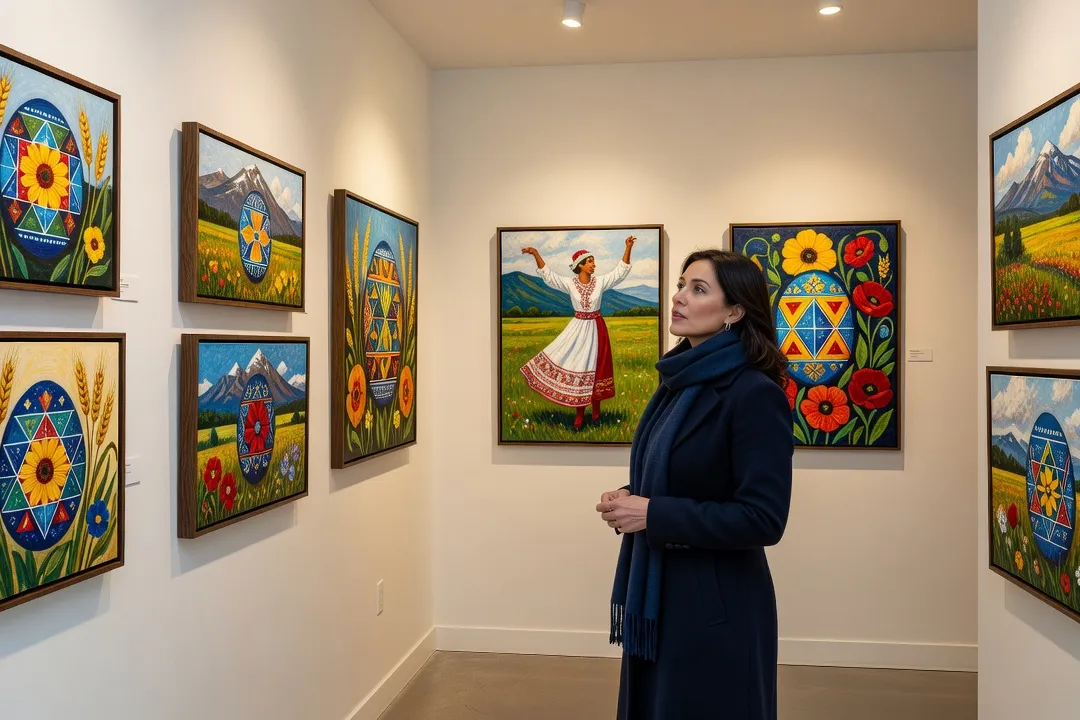
Vintage-style Ukrainian-Canadian art exhibition with paintings on gallery walls in Toronto.
The Postwar Generation Beyond Kurelek
USOM's founding generation and their contemporaries covered a wider range of practice than Kurelek's Prairie realism suggests. Halyna Novakiwsky, Irena Nosyk and Lydia Palij worked across painting, printmaking and design in the postwar decades, developing distinct visual languages that drew on Ukrainian folk motifs — embroidery patterns, icon painting conventions, rushnyk symbolism — without simply reproducing them as craft. This distinction matters: Ukrainian-Canadian fine art has always been in dialogue with folk tradition, but it is not folk tradition. A painter referencing a pysanka motif in an abstract composition is doing something categorically different from a grandmother decorating an egg for Easter, even when the visual vocabulary overlaps.
Much of this generation's work, and the institutional record of it, lives today at the Ukrainian Museum of Canada, Ontario Branch, which holds more than 8,000 artifacts spanning textiles, pysanky, ceramics, wood carving and sacred objects alongside fine-art holdings, and at the Taras Shevchenko Museum in Toronto, which describes itself as the only Shevchenko museum in the Americas. In Winnipeg, the Oseredok Ukrainian Cultural and Educational Centre plays a comparable role, holding public collections connected to Ukrainian-Canadian artists working across the Prairies.
Natalka Husar and the Move Into the Mainstream
If Kurelek was the artist who broke into the national art establishment from within a rural, community-rooted practice, Natalka Husar represents a later, urban route into wider recognition. Scholarly work on Ukrainian-Canadian visual art identifies her, alongside figures like the internationally known photographer Edward Burtynsky, as part of a generation whose work moved decisively past the community-exhibition circuit into national and international galleries, while still engaging directly with Ukrainian-Canadian identity, memory and, in Husar's case, the post-Soviet experience of Ukraine itself.
Taras Polataiko, born in Chernivtsi in 1966 and based in Canada, extends this trajectory further into performance art and conceptual practice — a reminder that "Ukrainian-Canadian art" is not a fixed style but an ethnicity-linked thread running through very different movements, from Kurelek's narrative realism to Polataiko's performance work decades later.
Where to See Ukrainian-Canadian Art Today
For anyone wanting to see this tradition rather than just read about it, Toronto has the densest concentration of dedicated venues in the country. The KUMF Gallery, operated by the Ukrainian Canadian Art Foundation, runs a continuous programme of exhibitions specifically dedicated to Ukrainian-Canadian and Ukrainian art. Art at St. Volodymyr Institute mounts smaller shows aimed explicitly at promoting Ukrainian art within Canada, and Ukrainian Arts T.O. operates as a community-facing platform connecting artists and audiences through events rather than a fixed gallery space. This concentration of institutions overlaps closely with Toronto's broader Ukrainian cultural infrastructure; readers exploring the neighbourhood context can also see our guide to Ukrainian culture, galleries and events in Toronto.
Edmonton and Winnipeg have a longer institutional history with Ukrainian-Canadian settlement generally, but a thinner footprint of dedicated art venues specifically — public collections in city halls and cultural centres hold individual works, but neither city currently has a gallery devoted solely to Ukrainian-Canadian visual art on the scale of Toronto's KUMF Gallery. That gap is worth noting for anyone assuming Alberta and Manitoba, as the historical demographic centres of the diaspora, automatically lead on cultural infrastructure across every category — they do not, at least not in the visual arts specifically.
The Post-2022 Wave: Art Made From War
Russia's full-scale invasion in February 2022 produced a distinct, fast-moving wave of exhibitions in Toronto that differs from the postwar USOM generation in one crucial respect: much of this work was made by artists processing displacement and war in real time, not decades of retrospective memory. Ruslan Kurt, a Ukrainian artist based in Toronto, built a touring installation titled Doors: Through the Horror of War from eight actual doors removed from buildings in Ukraine; it has toured Canada since October 2022. Mykola Zhuravel and Daria Tishchenko-Zhuravel presented Invasion Redux at Withrow Common Gallery in spring 2022, the same venue that later hosted the group exhibition Awakening, bringing together artists from Ukraine, the United States and Canada.
The Shevchenko Museum has played a particularly active role since 2022, hosting Lana Matskiv's solo exhibition Defiance from December 2022 to February 2023, and Memories of the Future, a group show of thirteen Ukrainian newcomer artists, in August and September 2023. Between 2022 and 2024, the museum also hosted contemporary work by Pavlo Lopata, Oleksandr Gutyrya and Matskiv. What distinguishes this wave from earlier generations is professional background: many of these exhibiting artists arrived in Canada as displaced professionals under emergency travel programmes rather than as immigrants seeking a market for their work, a pattern that mirrors the broader post-2022 arrival profile documented in our overview of Ukrainian refugee statistics in Canada.
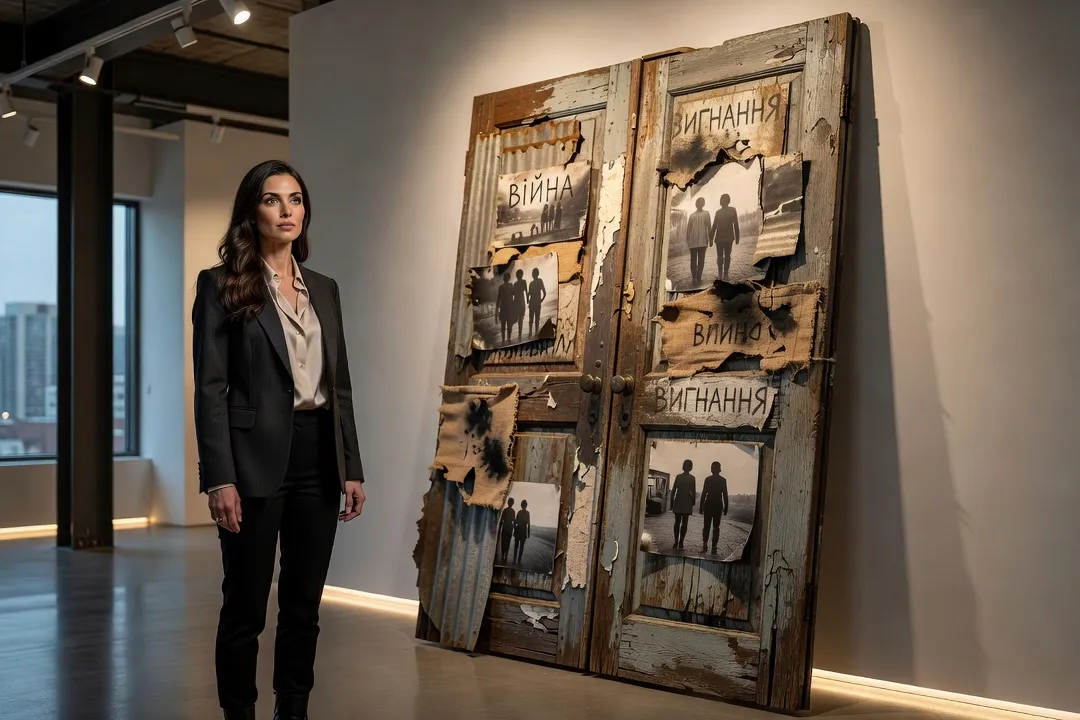
Contemporary Ukrainian-Canadian artist creating war-themed installation art in a Toronto gallery.
Folk Tradition Versus Fine Art: A Necessary Distinction
One confusion worth clearing up directly: Ukrainian folk art and Ukrainian-Canadian fine art are related but not interchangeable categories, and conflating them flattens the story told above into something closer to craft preservation than art history. Folk forms — pysanky, embroidery, rushnyky — are largely intergenerational craft traditions, taught within families and preserved with relatively little formal innovation. Fine art, the subject of this article, is the work of trained painters, sculptors and printmakers who frequently draw on that same folk vocabulary but operate within contemporary art movements, exhibit in galleries and museums, and are evaluated by the same critical standards applied to any other working Canadian artist. Kurelek's Passion of Christ cycle and a hand-embroidered rushnyk are both meaningfully "Ukrainian-Canadian," but they belong to different traditions with different training pathways, audiences and institutions behind them.
Key Institutions at a Glance
| Institution | City | Focus | Founded / Notable Detail |
|---|---|---|---|
| Ukrainian Association of Visual Artists of Canada (USOM) | National (est. Toronto) | Professional artists' association | Founded 1955-1956 by Dmytrenko, Stebelsky and Keywan |
| Ukrainian Museum of Canada, Ontario Branch | Toronto | Folk art, textiles, fine art collection | 8,000+ artifacts |
| Taras Shevchenko Museum | Toronto | Culture and history, contemporary exhibitions | Only Shevchenko museum in the Americas |
| KUMF Gallery / Ukrainian Canadian Art Foundation | Toronto | Contemporary Ukrainian-Canadian art | Rotating exhibition programme |
| Oseredok Ukrainian Cultural and Educational Centre | Winnipeg | Cultural collections, public art | Prairie-region institutional anchor |
| Withrow Common Gallery | Toronto | Contemporary and post-2022 exhibitions | Hosted Invasion Redux, Awakening |
How to Support Ukrainian-Canadian Artists
For readers who want to engage beyond reading, a few concrete starting points recur across the institutions above:
- Visit KUMF Gallery or the Shevchenko Museum during a rotating exhibition rather than only during major festivals, since smaller shows often feature emerging or newly arrived artists who get less press coverage.
- Check the exhibition calendars of Withrow Common Gallery and the St. Volodymyr Institute, both of which have hosted post-2022 shows on short notice as artists arrived in Canada.
- Buy directly from artist-run platforms such as Ukrainian Arts T.O. rather than exclusively from secondary markets, which channels support to working artists rather than resellers.
- Support the Ukrainian Museum of Canada and Oseredok as collecting institutions — both rely partly on donations to expand their fine-art holdings beyond folk-art artifacts.
None of this requires specialist art knowledge. Most of these venues run free or low-cost public programming specifically designed for newcomers and general audiences, not just collectors.
Frequently Asked Questions
Who is the most famous Ukrainian-Canadian painter?
William Kurelek (1927-1977) is the best-known Ukrainian-Canadian painter. Born to Ukrainian immigrant parents near Willingdon, Alberta, he became one of the most commercially successful artists in Canadian history, was appointed a Member of the Order of Canada in 1976, and his work hangs in the National Gallery of Canada, the Art Gallery of Ontario and the Museum of Modern Art in New York.
What is USOM and why does it matter to Canadian art history?
USOM (Ukrainian Association of Visual Artists of Canada) was founded in 1955-1956 by painters Mykhailo Dmytrenko, Bohdan Stebelsky and Ivan Keywan. It gave Ukrainian-Canadian artists a formal exhibition network at a time when few Canadian galleries showed their work, and it remains the organisational backbone that connects postwar and contemporary generations of Ukrainian-Canadian visual artists.
Where can you see Ukrainian-Canadian art in Toronto?
The Ukrainian Museum of Canada, Ontario Branch and the Taras Shevchenko Museum both hold permanent collections in Toronto. The KUMF Gallery, run by the Ukrainian Canadian Art Foundation, mounts rotating exhibitions of contemporary work, and Withrow Common Gallery has hosted several post-2022 exhibitions by Ukrainian and Ukrainian-Canadian artists.
How has the 2022 invasion changed Ukrainian-Canadian art?
Since February 2022, Toronto galleries have hosted a wave of exhibitions responding directly to the war, including Ruslan Kurt's touring installation Doors: Through the Horror of War, built from eight doors removed from bombed Ukrainian buildings, and group shows such as Awakening and Memories of the Future at Withrow Common Gallery and the Shevchenko Museum. Many exhibiting artists arrived in Canada as displaced professionals rather than as art-school graduates seeking a foreign market.
Did Ukrainian-Canadian artists face discrimination in Canada's art world?
For much of the twentieth century, Ukrainian-Canadian artists worked largely outside the mainstream Canadian gallery system, exhibiting through community institutions such as USOM rather than commercial galleries. Scholars researching the field note that recognition beyond the community, achieved by figures like Kurelek and later Natalka Husar, took decades and required deliberate institution-building rather than happening automatically.
Is Ukrainian folk art the same as Ukrainian-Canadian fine art?
No. Folk art forms such as pysanky (decorated eggs), embroidery and rushnyky are craft traditions passed down through families and preserved largely unchanged. Ukrainian-Canadian fine art, by contrast, is the work of trained painters, sculptors and printmakers who often draw on folk motifs and immigrant memory but work within contemporary Canadian and international art movements.