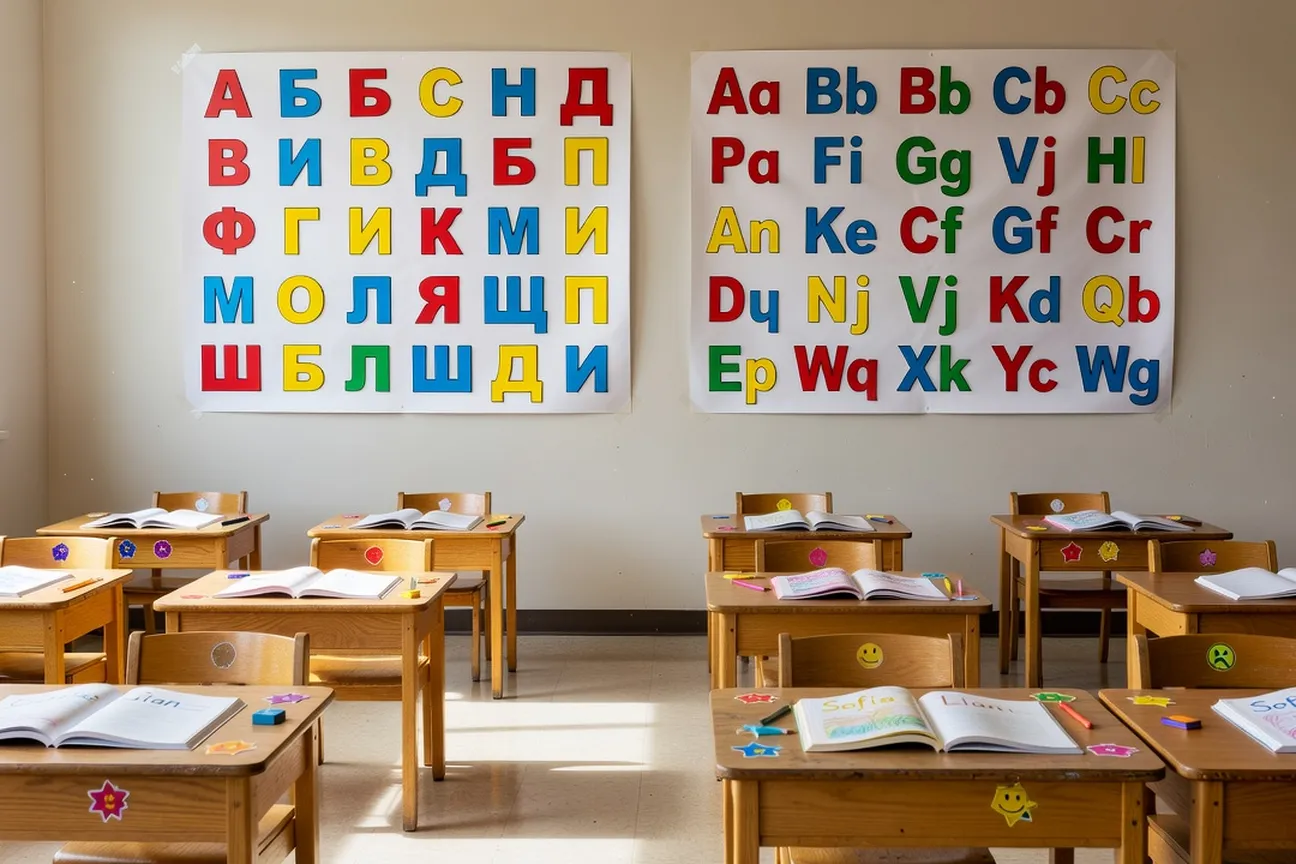
Ukrainian bilingual classroom in a Canadian public school.
Dr. Halyna Kravets, bilingual programs coordinator, Edmonton Public Schools.
Dr. Halyna Kravets
Coordinator of Bilingual and Multilingual Programs at Edmonton Public Schools. Doctorate in bilingual education policy from the University of Alberta. Twenty years working with Ukrainian bilingual schools in Edmonton, including curriculum development and teacher recruitment. Active member of the Ukrainian Bilingual Education Association.
Edmonton, Alberta, Canada
Every weekday morning in Edmonton, children file into classrooms where the alphabet on the wall is Cyrillic on one side and Latin on the other, and where a teacher may greet the class in Ukrainian before switching to English for the afternoon’s math lesson. This is Ukrainian-English bilingual education, a public school option that has existed in Alberta since 1971 and has since spread to Manitoba and Saskatchewan. Far from a private or supplementary offering, it is fully funded, publicly accessible schooling — a rare example of a heritage language achieving parity with English inside the regular curriculum.
Dr. Halyna Kravets has spent two decades coordinating these programs for Edmonton Public Schools, the district with the largest concentration of Ukrainian bilingual seats in the country. We spoke with her about how the legislation came to be, what distinguishes a true bilingual program from a heritage language class, the wave of new interest since Russia’s full-scale invasion of Ukraine in 2022, and the very real staffing and funding pressures these schools face today.
Table of Contents
- Introduction to Ukrainian Bilingual Education
- The 1971 Alberta School Act Amendment
- Bilingual Programs vs. Heritage Language Classes
- Flagship Schools in Edmonton and Beyond
- Expansion to Manitoba and Saskatchewan
- Enrolment Decline and the Post-2022 Rebound
- Diaspora Ukrainian vs. Contemporary Ukrainian
- Teacher Shortages and Funding Pressures
- The Role of Parent and Community Associations
- Quick Answers: Common Misconceptions
- Three Key Takeaways
- Frequently Asked Questions
Q: Let's start at the beginning. How did Ukrainian bilingual education become part of the public school system in Canada?
A: It goes back to 1971, when Alberta amended its School Act to permit instruction in a language other than English for up to fifty percent of the school day. Before that amendment, schools in Alberta were legally required to teach almost entirely in English, with only very limited exceptions for French. The 1971 change was a direct response to lobbying from Ukrainian-Canadian parents and community organizations, many of them descendants of the settlers who had come to the Prairies decades earlier and who wanted their grandchildren to have the chance to learn Ukrainian formally, inside the public system, rather than only through Saturday schools or church programs. Edmonton Public Schools opened its first Ukrainian bilingual classrooms that same year, and it remains, to this day, one of the only public school districts in North America offering Ukrainian instruction at this scale.
Q: Many people use "bilingual education" and "heritage language classes" interchangeably. What is the actual difference?
A: This distinction matters a great deal, and it's one of the most common points of confusion for new parents. A bilingual program means that roughly half of the instructional day, across core subjects like mathematics, science, social studies, and language arts, is delivered in Ukrainian rather than English, from kindergarten all the way through to grade twelve in some divisions. It is a full academic stream, with its own curriculum documents approved by the provincial ministry of education. Heritage language classes, by contrast, are much shorter add-on periods, often thirty to forty minutes a few times a week, focused specifically on language instruction and cultural content rather than full subject teaching. A child in a heritage language class is still receiving nearly all of their education in English; a child in a bilingual program is receiving a genuinely dual-language education. Both have value, but they serve very different purposes and require very different levels of institutional commitment.
Students studying in a Ukrainian bilingual classroom in Alberta.
Q: Which schools would you point to as the flagship Ukrainian bilingual programs in Canada today?
A: Edmonton Public Schools operates several sites, including St. Basil's Ukrainian Bilingual School and King Edward Ukrainian Bilingual School, both of which have been offering the program for decades and have built a strong reputation within the community for academic quality alongside language retention. Calgary has smaller but well-established programs as well. These schools function exactly like any other Edmonton public school in terms of provincial testing, extracurriculars, and facilities — the only structural difference is the language of instruction for half the timetable. Families sometimes assume these are private or parochial schools because of the Ukrainian name, but they are fully public, tuition-free, and open to any family that wants to enrol, regardless of heritage or existing language ability.
Q: How did the model spread beyond Alberta to Manitoba and Saskatchewan?
A: Manitoba and Saskatchewan followed Alberta's lead during the 1980s, each passing its own enabling legislation that allowed bilingual instruction in languages beyond French and English. Manitoba in particular built out a substantial network, with Ukrainian bilingual schools operating within the Winnipeg School Division and the Seven Oaks School Division, both of which serve neighbourhoods with historically strong Ukrainian-Canadian populations. Saskatchewan's programs in Saskatoon and Regina developed on a smaller scale, often tied closely to specific parishes and cultural centres, but they persist to this day. What is notable is that all three provinces arrived at broadly the same fifty percent instructional threshold, even though they legislated it independently, which speaks to a shared understanding within Ukrainian-Canadian communities of what a credible bilingual program required.
Q: Enrolment in these programs wasn't always growing. What happened during the 1990s and 2000s?
A: We saw a real and sustained decline through those decades. Part of it reflects broader demographic assimilation — third- and fourth-generation Ukrainian-Canadian families were increasingly English-dominant at home, and the perceived practical value of Ukrainian fluency was less obvious to parents weighing it against other priorities like French immersion, which had strong federal government backing and bilingualism-in-Canada messaging behind it. Some smaller bilingual sites in rural Alberta and Saskatchewan actually closed during this period due to declining enrolment, consolidating students into fewer, larger urban programs. It was a genuinely difficult stretch for the field, and there was serious concern among educators and community leaders that the model might not survive another generation.
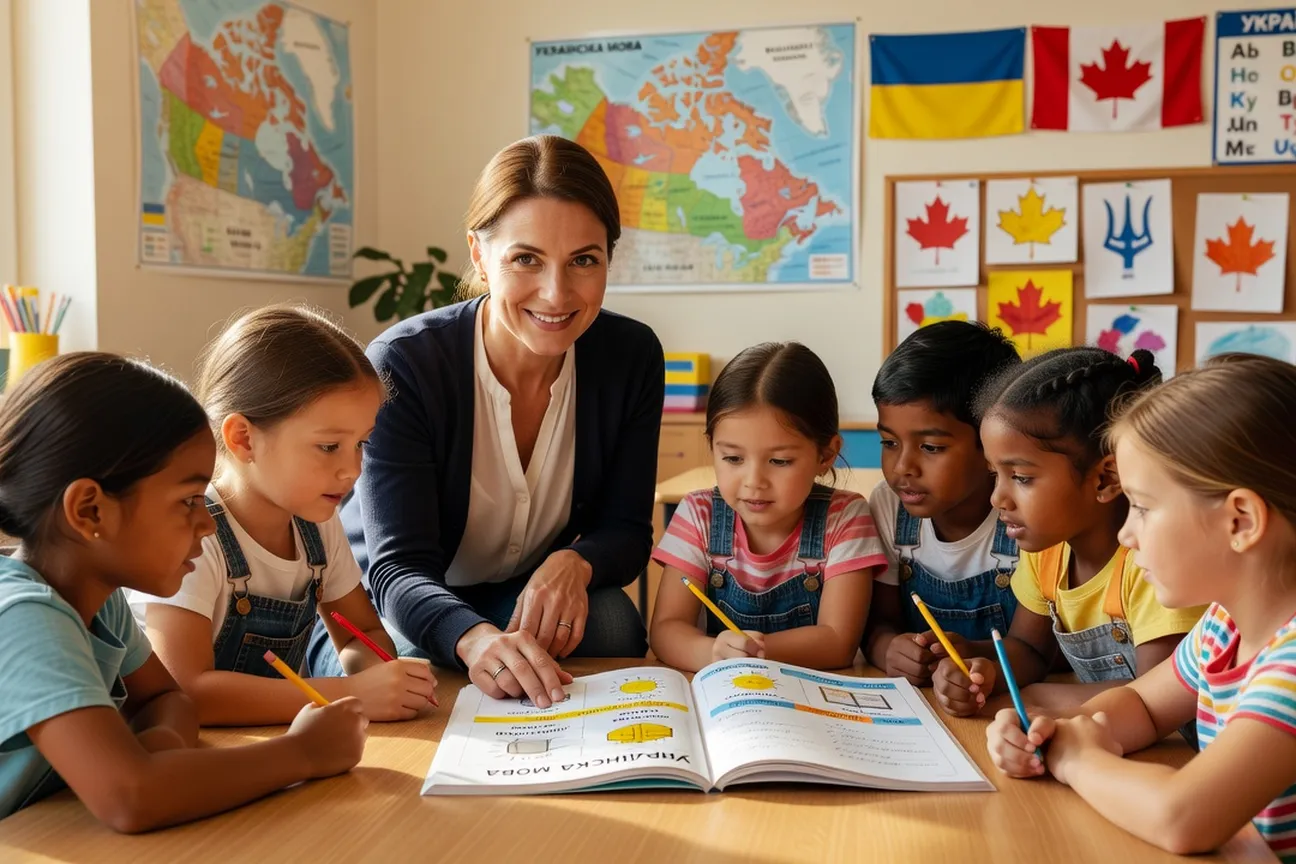
Ukrainian newcomer family enrolling children in a Canadian bilingual school.
Q: And then 2022 changed things. What did you observe on the ground?
A: The change was immediate and, frankly, larger than anything we had planned for. Following the full-scale Russian invasion of Ukraine in February 2022, tens of thousands of Ukrainian families arrived in Canada under the federal government's emergency travel authorization, and a significant number settled in Alberta and Manitoba specifically because of the existing Ukrainian-Canadian community infrastructure, including our bilingual schools. Suddenly we had waitlists at programs that had been stable or shrinking for years. These weren't diaspora families reconnecting with a heritage language their grandparents spoke — these were parents who spoke Ukrainian as their first and dominant language, wanting their children to keep that fluency while also gaining English. It required us to rethink placement testing, classroom composition, and even some curriculum sequencing almost overnight.
Q: You mentioned a distinction between the Ukrainian spoken by longtime diaspora families and by recent arrivals. Can you say more about that?
A: This is one of the more delicate aspects of the work. The Ukrainian preserved by Prairie diaspora communities over the past hundred-plus years has its own regional character, shaped by western Ukrainian dialects from the late 19th and early 20th century immigration waves, along with decades of relative isolation from linguistic developments in Ukraine itself. Contemporary Ukrainian, as spoken by recent newcomers, reflects modern usage, more Kyiv-standard pronunciation and vocabulary, and, especially since 2014 and again since 2022, a conscious linguistic distancing from Russian influence that has accelerated inside Ukraine. In the classroom, this means a teacher might have students who grew up hearing their great-grandmother's century-old dialect sitting beside a child who arrived last year speaking current, standard Ukrainian. It's a rich resource if handled well, but it does require teachers who are linguistically flexible and aware of these differences rather than treating "Ukrainian" as a single uniform target language.
We have actually built some of this into professional development now. Teachers new to our bilingual sites spend time specifically studying the vocabulary gaps between diaspora Ukrainian and contemporary standard Ukrainian, things as simple as which words for everyday technology or food items differ, so that they don't inadvertently correct a student's family dialect as though it were simply wrong. For readers interested in how these two linguistic strands intersect more broadly across the diaspora, organizations documenting Slavic language history, including resources like Langue Russe, offer useful comparative context on how Slavic languages evolve differently depending on political and geographic isolation.
Q: What is the single biggest obstacle to expanding these programs to meet current demand?
A: Without question, it is the shortage of qualified teachers. We need educators who hold a valid Canadian teaching certification and who are also fluent enough in Ukrainian to teach full academic subjects, not just conversational language. That is a narrow pool, and it has only gotten narrower as older, Canadian-trained bilingual teachers retire faster than new ones are certified. We have explored recruiting newly arrived Ukrainian teachers, some of whom taught in Ukraine before the war, but Canadian certification requirements, provincial teacher education equivalency processes, and English language proficiency requirements can take a year or more to navigate, even for highly experienced educators. On top of that, provincial funding formulas were largely designed around standard English-language enrolment and don't always account for the added costs of bilingual curriculum materials, specialized recruitment, or smaller class sizes that some bilingual streams require in their early grades.
Q: What role do parent associations and organizations like the Ukrainian Bilingual Education Association play in sustaining these programs?
A: They are essential, honestly more essential than most people outside the community realize. The Ukrainian Bilingual Education Association and local parent councils advocate directly with school boards and provincial ministries when program funding or staffing is at risk, they organize cultural events that reinforce what students learn in the classroom, and they often fundraise for supplementary materials that provincial budgets don't cover. Parent associations were instrumental in the original 1971 legislative push, and they remain the community's institutional memory today. When a new wave of Ukrainian families arrived after 2022, it was often these same parent networks, alongside groups like the Ukrainian Saturday school community, that helped newcomers navigate enrolment, understand how the bilingual stream worked, and connect with established families for support.
Ukrainian bilingual education in Canada occupies an unusual position: a fully public, provincially funded school stream that has survived demographic decline, weathered decades of shifting immigration policy, and is now expanding again to meet demand from families who never expected to need it under these circumstances. From the 1971 Alberta School Act amendment to today's waitlists in Edmonton and Winnipeg, the story reflects both the resilience of Ukrainian cultural traditions in Canada and the practical challenges of sustaining a heritage language program at scale. It is also, in Dr. Kravets's words, a model that other communities have studied closely: school divisions considering new bilingual streams in other heritage languages have visited Edmonton Public Schools specifically to understand how a fifty-year-old program adapted its staffing, curriculum sequencing, and community partnerships to remain viable through both lean decades and sudden surges in demand. For families weighing their options, understanding the difference between a bilingual program and heritage language classes, and knowing which school divisions offer each, is the first step. Readers curious about the broader diaspora experience can also explore our glossary of Ukrainian diaspora terms and the history of Ukrainian Prairie settlement that first brought these communities to Alberta and Saskatchewan. For readers researching family history connected to these communities, the Ukrainian Genealogy Group PEI maintains useful archival resources on early settler records.
Quick Answers: Common Misconceptions
- Myth: Ukrainian bilingual schools are private or religious institutions. Reality: They are fully public, tuition-free schools within regular school divisions.
- Myth: Only children of Ukrainian heritage can enrol. Reality: Enrolment is open to any family in the district, regardless of background.
- Myth: Bilingual programs and heritage language classes are the same thing. Reality: Bilingual programs deliver roughly half the curriculum in Ukrainian; heritage language classes are short, supplementary periods.
- Myth: These programs only exist in Alberta. Reality: Manitoba and Saskatchewan also operate established Ukrainian bilingual schools.
- Myth: Demand for these programs has been steadily declining for decades. Reality: After a long decline, several divisions have reported growing waitlists since 2022.
Three Key Takeaways
1. A fifty-year public school model. Since Alberta's 1971 School Act amendment, Ukrainian-English bilingual education has operated as a fully funded public school stream, later adopted by Manitoba and Saskatchewan, distinct from private or supplementary heritage language instruction.
2. Post-2022 demand reversed decades of decline. After enrolment fell through the 1990s and 2000s, the arrival of Ukrainian families fleeing the full-scale invasion since 2022 has produced waitlists at flagship schools in Edmonton and Winnipeg.
3. Teacher supply is the binding constraint. This constraint is inseparable from the wider question of who still speaks Ukrainian in Canada. The scarcity of Canadian-certified, Ukrainian-fluent teachers, combined with funding formulas not designed for bilingual staffing costs, remains the central challenge to expanding these programs further.
Frequently Asked Questions
What is the difference between a bilingual program and heritage language classes?
A bilingual program delivers roughly 50 percent of instruction across the curriculum in Ukrainian, from kindergarten through the grades, while heritage language classes are shorter, optional periods, often 30 to 40 minutes a few times a week, focused only on language and culture rather than full subject instruction.
When did Ukrainian bilingual education become legal in Canada?
Alberta amended its School Act in 1971 to permit instruction in a language other than English for up to 50 percent of the school day, making it the first province to legalize Ukrainian-English bilingual programs. Manitoba and Saskatchewan followed with their own enabling legislation during the 1980s.
Which Canadian cities have Ukrainian bilingual public schools?
Edmonton has the largest concentration, including St. Basil's, King Edward, and other Edmonton Public Schools sites, with additional programs in Calgary. Winnipeg operates several Ukrainian bilingual schools within the Winnipeg School Division and Seven Oaks School Division, and Saskatoon and Regina maintain smaller programs.
Has enrolment in Ukrainian bilingual programs changed since 2022?
Yes. After a long decline through the 1990s and 2000s, several school divisions reported waitlists and new enrolment growth starting in 2022, driven largely by families who arrived in Canada under emergency travel measures following the full-scale invasion of Ukraine. Community resources such as Ukraine-Zoom have also helped newcomer families connect with schools and settlement services.
What is the biggest challenge facing these programs today?
The most persistent challenge is a shortage of qualified bilingual teachers who are both certified to teach in a Canadian public school system and fluent in Ukrainian, compounded by provincial funding formulas that do not always account for the added cost of recruiting and supporting bilingual staff.
For more on Ukrainian community life in Canada, visit our pages on Ukrainian Saturday schools and Ukrainian cultural traditions heritage.